Chaque semaine, notre équipe de production reçoit des appels d'acheteurs frustrés qui ont acheté des drones avec des résidus de pesticide cachés 1 problèmes. Ces problèmes de contamination entraînent des refus de récoltes, des amendes réglementaires et des pannes d'équipement. Le problème est réel et coûte des milliers de dollars aux agriculteurs.
Lors de l'achat de drones agricoles, évaluez le nettoyage de la cuve en vérifiant la conception de la cuve pour un drainage complet, en vérifiant la compatibilité des matériaux avec les produits chimiques, en inspectant la plomberie interne pour les zones mortes et en confirmant que le fournisseur propose des protocoles de nettoyage et un support technique. Demandez des certificats de nettoyage et envisagez des tests en laboratoire indépendants pour l'équipement d'occasion.
Ce guide vous explique tout ce que vous devez savoir sur l'évaluation du nettoyage des réservoirs polyéthylène haute densité (PEHD) 2. Nous aborderons les caractéristiques de conception, la sélection des matériaux, les systèmes de plomberie et le support des fournisseurs.
Comment puis-je évaluer si la conception du réservoir du drone permet un retrait complet des résidus ?
Notre équipe d'ingénieurs passe des mois à perfectionner la géométrie du réservoir 3 avant que tout drone ne quitte l'usine. Une mauvaise conception du réservoir piège les résidus de pesticides dans les coins et les crevasses. Ces résidus piégés contaminent votre prochaine application et endommagent les cultures analyse LC-MS/MS 4.
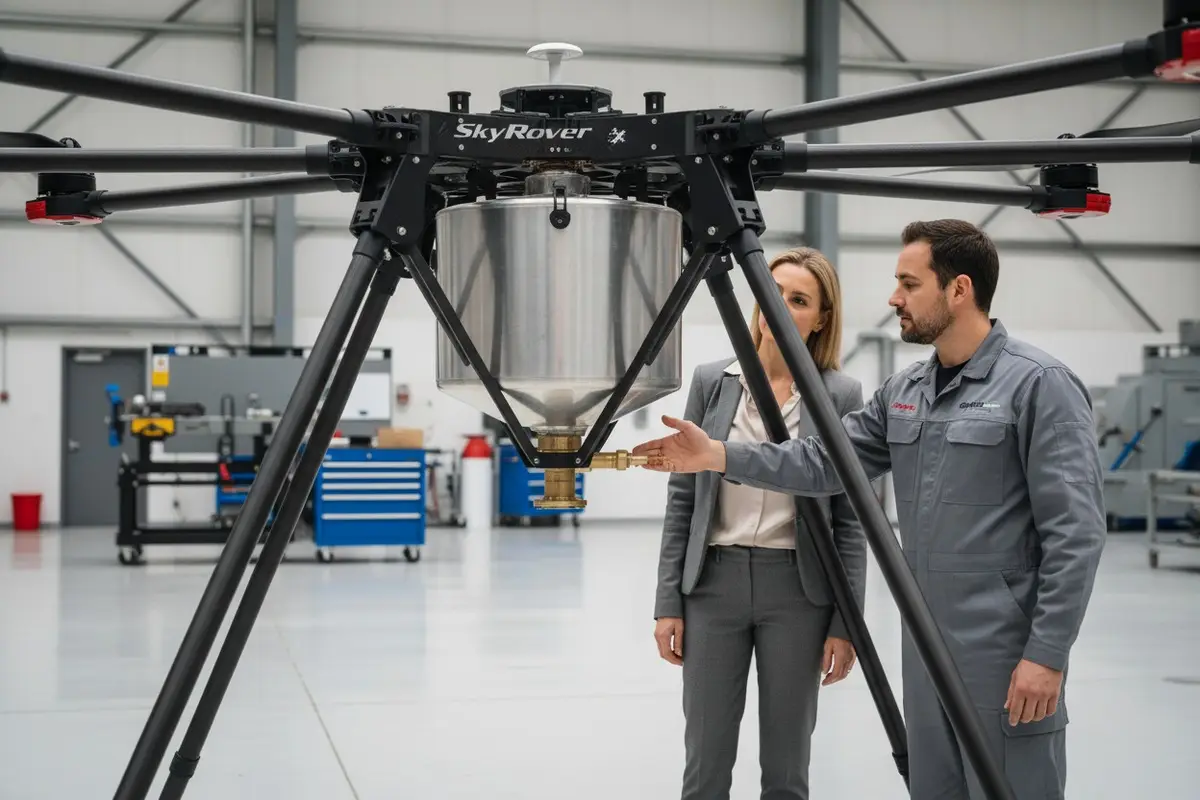
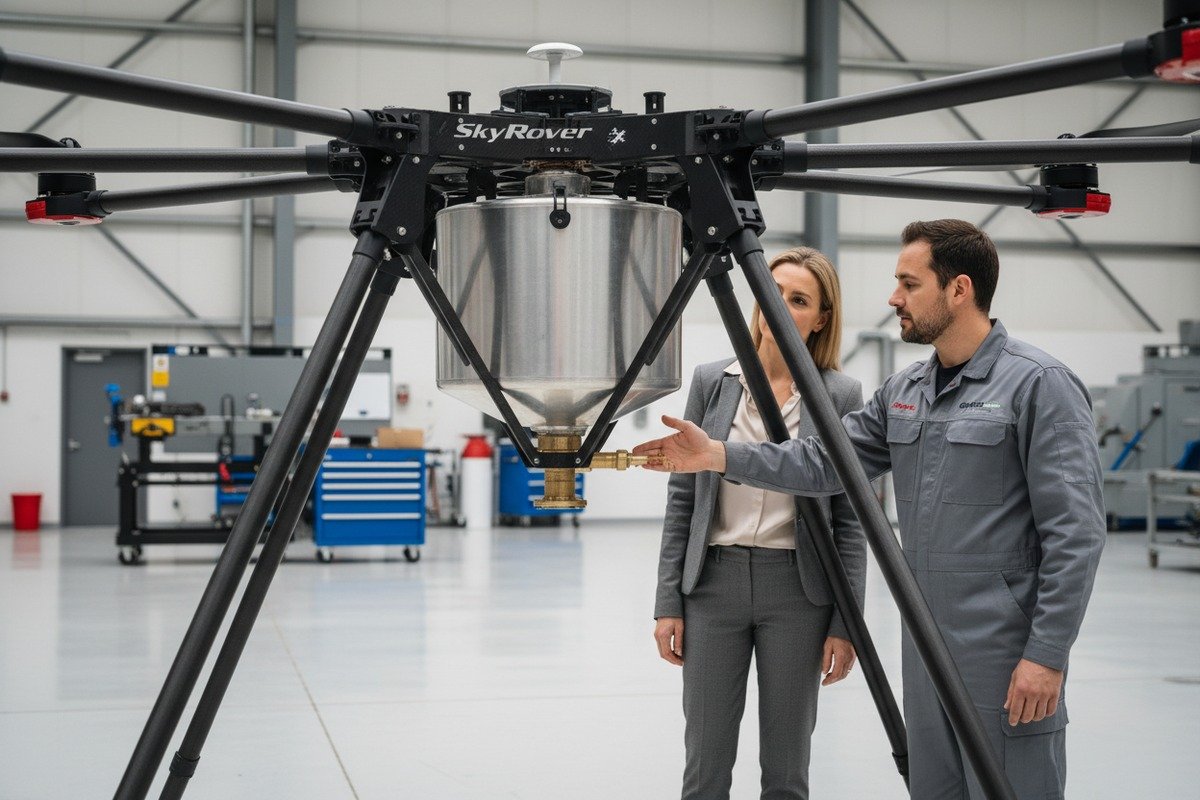
Un réservoir de drone bien conçu présente des surfaces internes lisses, des fonds inclinés pour un drainage complet, des orifices d'inspection accessibles et aucun coin pointu où les résidus s'accumulent. Recherchez des réservoirs avec des vannes de vidange au point le plus bas et de larges ouvertures permettant un accès pour le nettoyage manuel.

Comprendre la géométrie du réservoir
La forme du réservoir est plus importante que la plupart des acheteurs ne le réalisent. Lorsque nous testons de nouvelles conceptions de réservoirs, nous utilisons un colorant pour suivre les schémas de résidus. Les réservoirs à fond plat retiennent jusqu'à 15% de liquide en plus que les conceptions correctement inclinées.
Le réservoir idéal a un fond conique ou en forme de V. Cette forme dirige tout le liquide vers un point de drainage central. Nos modèles hexacoptères utilisent cette géométrie pour atteindre une efficacité de drainage de 99%.
Caractéristiques de conception critiques à vérifier
Avant d'acheter, examinez ces caractéristiques spécifiques :
| Fonctionnalité | Bonne conception | Mauvaise conception |
|---|---|---|
| Forme du fond | Incliné ou conique | Plat |
| Coins internes | Arrondis | Angles vifs à 90 degrés |
| Emplacement du drain | Point le plus bas | Latéral ou surélevé |
| Ouvertures d'accès | Larges, multiples | Petites, uniques |
| Finition de surface | Lisse, poli | Rugueux, texturé |
Accessibilité du port d'inspection
Vous ne pouvez pas nettoyer ce que vous ne pouvez pas atteindre. De nombreux drones bon marché ont de petites ouvertures de remplissage qui empêchent une inspection adéquate. Nous recommandons des réservoirs avec des ouvertures d'au moins 10 centimètres de diamètre.
Demandez au vendeur de démontrer l'accès au réservoir. Pouvez-vous voir toutes les surfaces internes ? Pouvez-vous atteindre tous les coins avec une brosse ou une lance de rinçage ? Sinon, des résidus s'accumuleront dans les zones cachées.
Le problème des zones mortes
Zones mortes 5 sont des zones où le liquide stagne pendant le rinçage. Elles se forment dans les coins, derrière les déflecteurs et dans les zones en retrait. Au cours de notre processus de contrôle qualité, nous identifions et éliminons les zones mortes par des tests de débit.
Demandez les données de test de débit à votre fournisseur. Les fabricants réputés documentent les schémas de drainage et la validation du nettoyage. Si le vendeur ne peut pas fournir ces informations, considérez cela comme un signal d'alarme.
Practical Testing Methods
Lors de l'évaluation d'un drone en personne, effectuez ces tests simples :
- Remplissez le réservoir d'eau propre
- Videz complètement et mesurez le liquide restant
- Vérifiez les zones humides indiquant un mauvais drainage
- Sentez les odeurs chimiques d'une utilisation antérieure
- Inspectez la décoloration ou les taches
Un réservoir bien conçu se vide presque complètement en 30 secondes. Les flaques restantes indiquent des défauts de conception qui causeront des problèmes de contamination.
Quels matériaux de réservoir dois-je rechercher pour éviter l'absorption de produits chimiques dans mes drones agricoles ?
Lorsque nous sélectionnons les matériaux pour nos réservoirs, la compatibilité chimique 6 est la première considération. Le mauvais matériau absorbe les pesticides comme une éponge. Cette contamination se libère lentement au fil du temps, empoisonnant les cultures des mois après l'application initiale.
Choisissez des réservoirs fabriqués en polyéthylène haute densité (PEHD), en acier inoxydable ou en polymères spécialisés résistants aux produits chimiques. Évitez les plastiques standard, l'aluminium et les composites en fibre de carbone pour les surfaces en contact avec les fluides. Le PEHD offre le meilleur équilibre entre résistance chimique, durabilité et coût pour la plupart des applications agricoles.

Bases de la compatibilité des matériaux
Différents pesticides attaquent différents matériaux. Les solvants dissolvent certains plastiques. Les acides corrodent les métaux. Les solutions alcalines endommagent les composites. Votre réservoir doit résister à toute la gamme de produits chimiques que vous prévoyez de pulvériser.
Nous testons les matériaux de nos réservoirs contre plus de 200 produits chimiques agricoles courants. Ces tests révèlent quels matériaux donnent les meilleurs résultats pour des applications spécifiques.
Guide de comparaison des matériaux
| Matériau | Résistance chimique | Poids | Coût | Meilleur pour |
|---|---|---|---|---|
| PEHD | Excellent | Léger | Faible | Usage général |
| Acier inoxydable 316 | Excellent | Lourd | Haut | Produits chimiques corrosifs |
| Polypropylène | Bon | Léger | Faible | Produits chimiques doux |
| Doublé PTFE | Supérieur | Moyen | Très élevé | Solvants agressifs |
| Aluminium | Pauvre | Léger | Moyen | À éviter pour les pesticides |
| Plastique standard | Pauvre | Léger | Très faible | À éviter entièrement |
Le problème de l'absorption
Certains matériaux absorbent les produits chimiques au niveau moléculaire. Cette absorption est invisible mais dangereuse. Le produit chimique est lentement libéré lors d'applications futures, contaminant des cultures sans rapport.
Nous avons testé la cuve en plastique d'un concurrent après six mois d'utilisation d'herbicide. Même après un nettoyage approfondi, la cuve a libéré des résidus d'herbicide détectables dans de l'eau propre. L'agriculteur a perdu sa certification de culture biologique pour une récolte entière.
Vérification des spécifications des matériaux
Demandez les fiches techniques des matériaux à votre fournisseur. Ces documents listent :
- Indice de résistance chimique
- Limites de température
- Stabilité aux UV
- Durée de vie prévue
- Caractéristiques d'absorption
Si le vendeur ne peut pas fournir les spécifications des matériaux, supposez le pire. Les fabricants de qualité documentent tout.
Joints, garnitures et raccords
La cuve elle-même n'est qu'une partie de l'équation. Chaque joint, garniture et raccord entre en contact avec des pesticides. Ces composants utilisent souvent des matériaux différents de ceux de la cuve principale.
Nos conceptions utilisent des joints en Viton ou EPDM 7 partout. Ces élastomères résistent à la plupart des produits chimiques agricoles. Les drones bon marché utilisent du caoutchouc standard qui se dégrade rapidement et absorbe les produits chimiques.
Dégradation des matériaux à long terme
Même les matériaux résistants se dégradent avec le temps. L'exposition aux UV, les cycles de température et le contact chimique répété affaiblissent tous les matériaux. Nous recommandons le remplacement du réservoir tous les 5 à 7 ans pour une utilisation commerciale intensive.
Inspectez soigneusement les drones usagés pour détecter les signes de dégradation des matériaux :
- Craquelures ou fissures en surface
- Changements de couleur ou taches
- Zones molles ou fragilité
- Aspect trouble dans les matériaux transparents
Comment puis-je vérifier que le système de plomberie interne n'entraînera pas de contamination croisée par des pesticides ?
Nos techniciens de service découvrent souvent des sources de contamination dans la plomberie, pas dans les réservoirs. Les pompes, les tuyaux, les filtres et les buses piègent tous les résidus. Un seul filtre bouché peut contaminer des centaines d'hectares avant d'être détecté.
Vérifiez la propreté de la plomberie en inspectant les grilles de filtre, en vérifiant la décoloration de l'intérieur des tuyaux, en faisant couler de l'eau propre dans le système et en testant le débit, et en examinant les motifs de pulvérisation des buses pour détecter toute irrégularité. Demandez la documentation du protocole de rinçage et renseignez-vous sur l'accessibilité des composants pour un nettoyage manuel.

Cartographie du trajet du fluide
Comprendre où les produits chimiques voyagent vous aide à identifier les risques de contamination. Un drone agricole typique a ce chemin de fluide 8:
- Réservoir
- Filtre d'admission
- Pompe primaire
- Régulateur de pression
- Collecteur de distribution
- Filtres secondaires
- Buse ou atomiseur
Chaque composant peut piéger des résidus. Chaque point de connexion peut fuir ou accumuler des dépôts.
Composants critiques à inspecter
| Composant | Risque de contamination | Méthode d'inspection | Difficulté de nettoyage |
|---|---|---|---|
| Filtres en ligne 9 | Très élevé | Visuel, retirer et vérifier | Facile si accessible |
| Pompes | Haut | Faire couler de l'eau de test, vérifier la sortie | Modéré |
| Tuyaux | Moyen | Couper la section, inspecter l'intérieur | Facile à remplacer |
| Collecteurs | Haut | Rincer et tester | Difficile |
| Buses | Très élevé | Test de motif, vérification visuelle | Facile |
| Régulateurs de pression | Moyen | Test de cohérence de la pression | Difficile |
Le problème des filtres
Les filtres protègent les buses des obstructions mais piègent les résidus de pesticides. Nous concevons nos systèmes avec des filtres facilement accessibles qui peuvent être retirés sans outils. De nombreux concurrents cachent les filtres à l'intérieur de boîtiers scellés.
Demandez à voir le processus de retrait du filtre. S'il nécessite des outils spéciaux ou un démontage important, le nettoyage sera négligé en pratique. Les filtres négligés deviennent des réservoirs de contamination.
Matériau et acheminement des tuyaux
Le matériau du tuyau est aussi important que le matériau du réservoir. Nos systèmes utilisent des tubes chimiquement résistants, classés pour les produits chimiques agricoles. Nous minimisons également la longueur des tuyaux et évitons les points bas où le liquide s'accumule.
Vérifier l'acheminement des tuyaux pour :
- Les points bas qui piègent le liquide
- Les coudes serrés qui restreignent le débit
- Les connexions qui ne peuvent pas être démontées
- Sections endommagées ou vieillies
Techniques d'inspection des buses
Les buses sont le dernier point de contrôle de la contamination. Les atomiseurs à disque rotatif, courants sur les drones agricoles modernes, nécessitent un nettoyage approfondi entre les types de pesticides.
Testez les schémas de pulvérisation en faisant passer de l'eau propre dans le système. Des schémas irréguliers, des crachotements ou une réduction du débit indiquent une accumulation de résidus. Comparez le schéma aux spécifications du fabricant.
Vérification du protocole de rinçage
Chaque drone doit avoir un protocole de rinçage documenté. Ce protocole spécifie :
- Volume d'eau requis
- Durée du rinçage
- Recommandations d'agents de nettoyage
- Procédures spécifiques aux composants
- Méthodes de vérification
Nous fournissons des protocoles de rinçage détaillés avec chaque drone. Les vendeurs qui ne peuvent pas fournir cette documentation n'ont probablement pas testé leurs procédures de nettoyage.
Systèmes de nettoyage automatisés
Les drones avancés comprennent des cycles de rinçage automatisés. Ces systèmes font circuler la solution de nettoyage dans tous les composants de plomberie par simple pression d'un bouton. Bien qu'ils ne remplacent pas le nettoyage manuel, l'automatisation améliore la cohérence.
Renseignez-vous sur les fonctions de nettoyage automatisé. Nos modèles haut de gamme comprennent des cycles de rinçage programmables qui peuvent être personnalisés pour différents types de produits chimiques.
Quel support technique dois-je attendre de mon fournisseur pour assurer une hygiène des réservoirs à long terme ?
Notre équipe de support client traite plus de questions de nettoyage que de questions de vol. Une bonne hygiène du réservoir nécessite des conseils continus, pas seulement un manuel d'utilisation. Le bon fournisseur devient un partenaire à long terme dans la gestion des résidus.
Attendez-vous à ce que les fournisseurs fournissent des protocoles de nettoyage détaillés pour chaque classe de pesticides, des tableaux de compatibilité des matériaux, la disponibilité des pièces de rechange, une assistance technique à distance pour les problèmes de nettoyage et des ressources de formation. Les fournisseurs de qualité proposent également des services de vérification du nettoyage, des calendriers d'inspection et une documentation de conformité réglementaire.

Ensemble de documentation essentiel
Avant l'achat, vérifiez que le fournisseur fournit :
| Type de document | Objectif | Pourquoi c'est important |
|---|---|---|
| Manuel du protocole de nettoyage | Procédures de nettoyage étape par étape | Assure une technique appropriée |
| Tableau de compatibilité des matériaux | Interactions chimiques/matérielles | Empêche les dommages |
| Calendrier de maintenance | Intervalles d'inspection recommandés | Détecte les problèmes à un stade précoce |
| Catalogue de pièces | Spécifications des composants de remplacement | Permet les réparations |
| Guide de conformité réglementaire | Exigences régionales | Évite les problèmes juridiques |
| Conditions de garantie | Couverture des dommages liés au nettoyage | Protège l'investissement |
Support de formation et d'éducation
L'équipement sans formation est inutile. Nous fournissons une formation complète qui couvre :
- Procédures de nettoyage quotidiennes
- Tâches de maintenance hebdomadaires
- Nettoyage en profondeur saisonnier
- Réponse d'urgence en cas de contamination
- Exigences de tenue de registres
Demandez aux fournisseurs potentiels quels sont leurs programmes de formation. Les tutoriels vidéo, les webinaires en direct et la formation sur site apportent tous une valeur ajoutée. Les fournisseurs qui vendent et disparaissent vous laissent résoudre les problèmes seuls.
Support technique à distance
Les problèmes de contamination nécessitent un diagnostic expert. Notre équipe de support technique peut examiner des photos et des vidéos pour identifier les sources de résidus. Nous guidons les clients à travers les procédures de test lors d'appels vidéo.
Évaluez la réactivité du support avant l'achat. Envoyez une question technique à l'équipe de vente. Des réponses rapides et éclairées indiquent un bon support après l'achat. Des réponses lentes ou vagues prédisent des frustrations futures.
Disponibilité des pièces et délais de livraison
L'usure liée au nettoyage est normale. Les joints se dégradent. Les filtres nécessitent un remplacement. Les tuyaux vieillissent. Votre fournisseur doit fournir rapidement des pièces de rechange.
Nous maintenons un inventaire de toutes les pièces d'usure avec une expédition garantie sous 48 heures. Certains concurrents exigent des délais de 4 à 6 semaines pour les composants de base. Ce délai vous oblige à faire fonctionner un équipement contaminé ou à immobiliser entièrement votre drone.
Support de test par des tiers
Parfois, des tests professionnels sont nécessaires. Les fournisseurs de qualité entretiennent des relations avec des laboratoires d'essai et peuvent faciliter la soumission d'échantillons.
Les options de tests en laboratoire comprennent :
- analyse LC-MS/MS: Très précis, détecte les résidus traces, prend 3 à 5 jours
- Tests par écouvillonnage: Résultats rapides, sensibilité modérée, bon pour les vérifications ponctuelles
- Analyse de l'eau de rinçage: Teste le système entier, coût modéré
- Imagerie hyperspectrale: Non destructif, rapide, technologie émergente
Nous nous sommes associés aux laboratoires SGS pour offrir des tests à prix réduit à nos clients. Ce partenariat démontre notre engagement envers l'efficacité du nettoyage.
Support de conformité réglementaire
Les réglementations de l'EPA et de la PMRA exigent des procédures de nettoyage documentées pour certaines applications de pesticides. Votre fournisseur doit vous aider à répondre à ces exigences.
Nous fournissons des dossiers de conformité qui comprennent :
- Modèles de journaux de nettoyage
- Listes de contrôle d'inspection
- Enregistrements de calibration
- Stockage des résultats des tests de résidus
- Guides de préparation d'audit
Valeur du partenariat à long terme
Les meilleurs fournisseurs considèrent chaque vente comme le début d'une relation. Nous suivons l'historique de nettoyage des clients et recommandons proactivement la maintenance. Nos ingénieurs améliorent continuellement les protocoles de nettoyage en fonction des retours du terrain.
Demandez aux fournisseurs potentiels leur taux de rétention de clientèle. Un taux de rétention élevé indique des clients satisfaits qui reçoivent une valeur continue. Un faible taux de rétention suggère une approche de vente et d'oubli qui vous rend vulnérable.
Conclusion
L'évaluation de la capacité de nettoyage du réservoir protège votre investissement et vos cultures. Vérifiez la conception du réservoir, validez la compatibilité des matériaux, inspectez les systèmes de plomberie et confirmez le support du fournisseur avant l'achat. Ces étapes évitent les problèmes de contamination coûteux et garantissent des performances fiables pendant des années.
Notes de bas de page
1. L'OMS fournit des informations faisant autorité sur les résidus de pesticides dans les aliments et leurs implications pour la santé. ︎
2. Shell Polymers, un leader de l'industrie, détaille les propriétés de résistance chimique et les applications du PEHD. ︎
3. L'ASME offre une perspective d'ingénierie sur la façon dont la géométrie du réservoir affecte la dynamique des fluides et le roulis. ︎
4. Anacon Laboratories détaille l'utilisation de la technologie LC-MS/MS pour une détection efficace des résidus de pesticides. ︎
5. Cet article académique définit les zones mortes dans l'écoulement des fluides et discute de leur impact sur la qualité de l'eau. ︎
6. Greene Tweed explique l'importance d'évaluer la résistance chimique et la compatibilité des fluides pour les matériaux. ︎
7. Cette source de l'industrie fournit une comparaison directe de la compatibilité chimique entre les joints Viton et EPDM. ︎
8. Elementary Engineering explique le concept de trajet d'écoulement en mécanique des fluides et sa représentation. ︎
9. PoreFiltration offre un aperçu complet des filtres en ligne et de leur utilisation dans les industries de transformation. ︎

 English
  Español de México
  Deutsch
  Français
  Русский
  العربية
Comments
No comments yet. Be the first to share your thoughts!
Leave a Comment