

Les feux de forêt se déplacent plus rapidement que les équipes au sol ne peuvent réagir, créant un environnement chaotique où la visibilité est nulle. Chez SkyRover, nous construisons nos drones pour combler cette lacune, en veillant à ce que votre équipe reste en sécurité tout en obtenant des renseignements aériens essentiels.
Les incendies de forêt se déplacent plus rapidement 1
Pour lutter efficacement contre les incendies de forêt, privilégiez les drones dotés d'une imagerie thermique à haute résolution pour la pénétration de la fumée, d'une grande autonomie de vol pour une surveillance continue et de systèmes de transmission robustes à longue portée. En outre, il faut s'assurer que la cellule présente une résistance élevée à la chaleur et une grande capacité de charge utile pour soutenir les efforts de suppression active dans les environnements volatils.
Examinons les caractéristiques spécifiques qui transforment un drone standard en un outil de sauvetage pour votre département.
Quelle est l'importance de la transmission à longue distance pour couvrir de vastes zones forestières ?
Perdre le signal en cours de mission est le cauchemar de tout pilote, surtout lorsque des vies sont en jeu. Lorsque nous testons nos drones dans des forêts denses, nous savons qu'une connexion fiable fait la différence entre une mission réussie et une perte d'équipement.
La transmission à longue portée est absolument essentielle, car les incendies de forêt s'étendent souvent sur des milliers d'hectares en terrain éloigné, avec des obstructions naturelles du signal. Un système robuste garantit des opérations au-delà de la ligne de visée visuelle (BVLOS), ce qui permet aux opérateurs de cartographier les périmètres en toute sécurité sans risquer de perdre le signal ou de mettre en danger les équipes au sol.
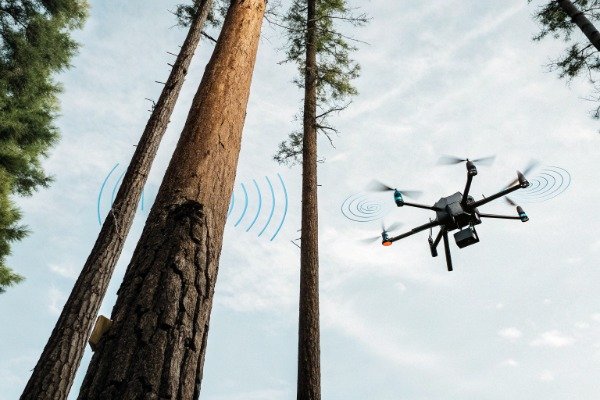
Lors de l'évaluation d'un drone pour des scénarios de feux de forêt, le système de transmission est l'épine dorsale de votre opération. Notre expérience de la fabrication d'unités destinées à l'exportation vers les États-Unis et l'Europe nous a permis de constater que les protocoles de transmission standard des consommateurs échouent souvent dans la topographie accidentée d'un feu de forêt. Les arbres contiennent de l'eau, qui absorbe les radiofréquences, et le terrain montagneux bloque les signaux en visibilité directe. Il ne faut donc pas compter sur les systèmes de transmission de base basés sur le Wi-Fi.
absorbe les radiofréquences 2
Comprendre la pénétration du signal et la fréquence
La fréquence utilisée par votre drone détermine sa capacité à communiquer à travers un couvert végétal dense. Les fréquences plus élevées, comme le 5,8 GHz, transportent plus de données (meilleure qualité vidéo) mais ont une faible capacité de pénétration. Elles rebondissent sur les feuilles et les rochers. Les fréquences plus basses, telles que 900 MHz ou 2,4 GHz, sont beaucoup plus efficaces pour franchir les obstacles et maintenir une liaison sur de longues distances.
Chez SkyRover, nous recommandons souvent des systèmes à double liaison qui peuvent automatiquement changer de fréquence en fonction des niveaux d'interférence. Ainsi, si le flux vidéo se dégrade, la liaison de contrôle reste stable, ce qui permet au pilote de ramener l'avion à la maison.
La nécessité des capacités BVLOS
Les incendies de forêt se produisent rarement à proximité de routes praticables. Vos opérateurs peuvent être postés à des kilomètres de la ligne de feu active pour assurer leur sécurité. Le drone doit donc opérer au-delà de la ligne de visée visuelle (BVLOS).
Au-delà de la ligne de mire visuelle 3
Une portée de transmission standard de 3 à 5 miles est souvent insuffisante dans les conditions réelles, car cette "portée maximale" suppose un désert plat et ouvert. Dans une forêt avec des interférences de fumée et des changements d'altitude, la portée effective peut chuter de 60%. Nous concevons nos systèmes industriels pour qu'ils prennent en charge des portées de 10 à 15 km afin de compenser cette dégradation de l'environnement.
Réseau maillé et capacités d'essaimage
Une technologie plus récente que nous intégrons est le réseau maillé. Elle permet à plusieurs drones de communiquer entre eux. Si un drone vole derrière une crête montagneuse et perd la connexion avec la station au sol, il peut relayer son signal par l'intermédiaire d'un autre drone qui est toujours en vue. Cette "mise en réseau" des signaux est essentielle pour couvrir les incendies de forêt de grande ampleur, où un seul point de défaillance est inacceptable.
réseau maillé 4
Comparaison des technologies de transmission
Pour vous aider à comprendre ce qu'il faut rechercher, voici une ventilation des types de transmission les plus courants dans l'industrie :
| Type de transmission | Plage typique (ouverte) | Pénétration des forêts | Temps de latence | Meilleur cas d'utilisation |
|---|---|---|---|---|
| Wi-Fi standard (2,4/5,8 GHz) | < 3 km | Pauvre | Haut | Entraînement ou petits feux d'herbe ouverts. |
| OcuSync / Lightbridge | 8 - 15 km | Modéré | Faible | Surveillance générale et éclaireurs. |
| Radio cryptée (900 MHz) | > 20 km | Excellent | Très faible | Opérations en forêt profonde et BVLOS. |
| 4G / 5G LTE | Illimité (en fonction de la cellule) | Variable | Modéré | Incendies d'interface urbaine avec la couverture des tours de téléphonie mobile. |
| Liaison par satellite | Mondial | Parfait | Haut | Une nature sauvage et isolée, sans infrastructure. |
Quelle est l'autonomie de vol réaliste pour la surveillance continue des forêts ?
Les remplacements fréquents de batterie tuent l'élan au cours d'un incendie et laissent les équipes aveugles. Notre équipe d'ingénieurs s'attache à maximiser le temps d'antenne, car nous savons que chaque minute d'immobilisation est une minute d'angles morts pour le commandant de l'incident.
Pour une surveillance efficace des forêts, une autonomie de vol réaliste est de 45 à 60 minutes pour les multirotors électriques, tandis que les modèles hybrides ou à voilure fixe devraient atteindre 2 à 4 heures. Cette durée permet une cartographie complète et un balayage thermique de vastes secteurs sans interruptions constantes pour recharger l'appareil.
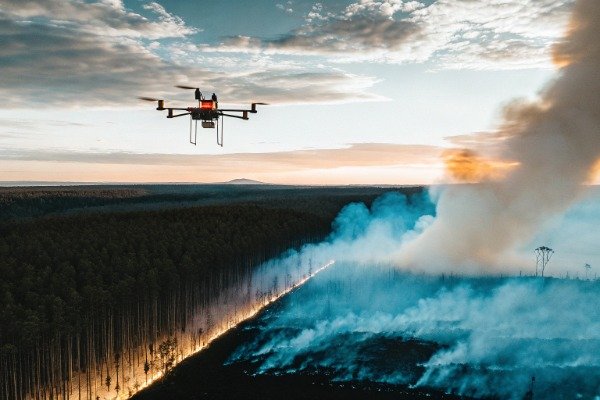
L'endurance du vol est souvent le plus grand goulot d'étranglement dans les opérations des drones. Dans le cas d'un incendie de forêt, le drone ne se contente pas de rester en vol stationnaire ; il doit lutter contre les forts courants ascendants provoqués par la chaleur de l'incendie, affronter les rafales de vent et transporter de lourdes charges utiles telles que des caméras thermiques ou des télémètres laser. Tous ces facteurs épuisent les batteries plus rapidement que ne le laissent supposer les spécifications indiquées sur la boîte.
Endurance de vol 5
La réalité du "temps de vol maximal"
Lorsque vous voyez une fiche technique indiquant "55 minutes de temps de vol", rappelez-vous que cette durée est généralement testée au niveau de la mer, sans vent et sans charge utile. Dans un scénario d'incendie réel, vous devez vous attendre à obtenir environ 70% de cette durée nominale. Si vous achetez un drone avec seulement 20 minutes d'autonomie de vol, vous n'aurez peut-être que 12 minutes d'autonomie utilisable au-dessus de l'incendie avant d'atteindre le seuil de la batterie "retour à la maison". C'est pourquoi nous conseillons à nos clients d'opter pour des plateformes dotées d'une mémoire tampon importante.
Batteries et systèmes hybrides
Pour la reconnaissance tactique à courte portée, les multirotors électriques sont excellents. Ils sont silencieux, faciles à déployer et nécessitent peu d'entretien. Cependant, pour la surveillance d'un incendie qui s'étend sur des milliers d'hectares, les batteries électriques sont limitées.
C'est là que les drones hybrides gaz-électricité entrent en jeu. Ces appareils utilisent un petit générateur à essence pour alimenter les moteurs électriques, ce qui permet d'allonger les durées de vol à 3 ou 4 heures. Nous avons constaté une forte augmentation de l'utilisation de ces modèles par les services forestiers, car ils peuvent décoller, cartographier une chaîne de montagnes entière et revenir sans avoir besoin de s'arrêter.
drones hybrides gaz-électricité 6
Drones captifs pour la surveillance persistante
Parfois, il n'est pas nécessaire de voler loin ; il suffit de rester en l'air pendant longtemps. Si votre objectif est de surveiller un foyer d'incendie spécifique ou de protéger un bien essentiel comme une tour de communication ou un quartier résidentiel, un drone captif est la solution.
Ces drones sont reliés à une centrale électrique au sol par un câble fin. Tant que le générateur au sol a du carburant, le drone peut rester en vol pendant 24 heures ou plus. Nous fournissons souvent ces drones aux centres de commandement qui ont besoin d'un "œil dans le ciel" permanent pour surveiller les éruptions ou les changements de vent qui pourraient mettre en danger les pompiers.
Efficacité opérationnelle et tarification
Si vous optez pour des drones électriques standard, vous devez prendre en compte la logistique de la recharge. Sur le terrain, vous n'aurez probablement pas accès à des prises murales. Vous aurez besoin de générateurs de terrain de grande capacité et de stations de recharge rapide.
Nous recommandons un ratio minimum de 4 jeux de batteries par drone. Cela permet à un jeu d'être en vol, à un jeu de refroidir (les batteries ne peuvent pas être chargées immédiatement après un vol à chaud), et à deux jeux d'être en charge. Ce cycle assure un fonctionnement continu.
Impact de la charge utile sur l'endurance
Il est essentiel de comprendre le compromis entre ce que vous transportez et la durée de votre vol.
| Configuration du drone | Exemple de charge utile | Temps de vol estimé | Profil de la mission |
|---|---|---|---|
| Reconnaissance de la lumière | Caméra RVB unique | 45 - 55 minutes | Repérage rapide des incendies ponctuels. |
| Capteur lourd | Thermique + Zoom + LiDAR | 30 - 40 minutes | Cartographie détaillée et identification des points chauds. |
| Cargo / Suppression | Boules d'extinction d'incendie | 15 - 25 minutes | Gouttes d'eau actives pour l'extinction des incendies. |
| VTOL hybride | Balancier multi-capteurs | 2 - 4 heures | Cartographie à grande échelle du périmètre forestier. |
La caméra thermique peut-elle détecter efficacement les points chauds à travers une fumée épaisse ?
La fumée aveugle les pilotes humains, mais elle ne doit pas aveugler vos données. Nous intégrons des capteurs radiométriques spécifiques dans nos charges utiles SkyRover afin que nos clients puissent voir la source de chaleur, et pas seulement la brume grise.
Oui, les caméras thermiques radiométriques de haute qualité peuvent détecter efficacement les points chauds à travers une épaisse fumée en capturant le rayonnement infrarouge plutôt que la lumière visible. Ces capteurs visualisent les différences de température, ce qui permet aux pompiers de localiser avec précision le cœur de l'incendie, d'identifier les foyers ponctuels et de suivre les schémas de propagation, même lorsque la visibilité est quasi nulle.
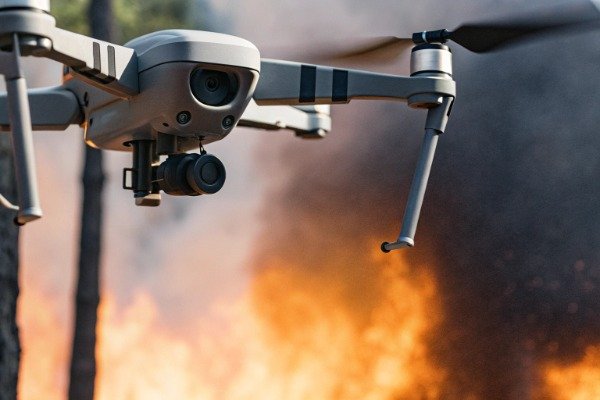
La capacité de voir à travers la fumée est peut-être la caractéristique la plus précieuse d'un drone de lutte contre les incendies. Cependant, toutes les caméras thermiques ne se valent pas. Nous rencontrons fréquemment des clients qui ont acheté des drones thermiques grand public moins chers et qui se sont aperçus qu'ils ne pouvaient pas faire la différence entre un rocher chaud et une souche fumante.
Radiométrique et non radiométrique
Pour la lutte contre les incendies, vous avez absolument besoin d'un radiométrique caméra thermique. Une caméra non radiométrique vous montre simplement une image de zones chaudes et froides (pixels plus clairs et plus foncés). Une caméra radiométrique mesure la température spécifique de chaque pixel de l'image.
Pourquoi cela est-il important ? Lors d'un incendie de forêt, il faut savoir si un point chaud est à 50°C (chaleur résiduelle du soleil) ou à 400°C (combustion active). Les données radiométriques permettent de définir des alarmes de température. Par exemple, vous pouvez demander au drone d'afficher en rouge vif tout pixel dont la température est supérieure à 200 °C. Cela attire instantanément l'attention du pilote. Cela permet d'attirer instantanément l'attention du pilote sur des incendies invisibles à l'œil nu ou cachés sous un couvert végétal dense.
Résolution et options d'objectif
La résolution est essentielle en fonction de l'altitude. Si vous volez à 400 pieds pour passer la limite des arbres, une caméra thermique à faible résolution (160×120 pixels par exemple) affichera un feu sous la forme d'une tache floue. Vous ne pourrez pas savoir exactement quel arbre est en train de brûler.
Nous recommandons une résolution minimale de 640×512 pixels. Cela permet d'obtenir suffisamment de détails pour identifier de petits incendies ponctuels à partir d'une altitude sûre. En outre, la capacité de zoom thermique change la donne. Elle permet à l'opérateur d'étudier une signature thermique sans avoir à faire voler le drone dangereusement près des flammes.
Palettes de couleurs et isothermes
Les caméras thermiques professionnelles offrent différentes palettes de couleurs. Dans la lutte contre les incendies, les couleurs "Ironbow" ou "White Hot" sont courantes, mais les "isothermes" sont les plus utiles. Une isotherme permet d'isoler une plage de température spécifique.
Imaginez que vous regardiez une colline généralement chauffée par le soleil. Avec un isotherme réglé sur le "mode feu", l'écran peut rester en niveaux de gris pour tout ce qui est inférieur à 150°C, mais devenir orange vif pour tout ce qui est supérieur à cette température. Cette vue très contrastée élimine le bruit visuel et permet une prise de décision rapide.
IA et détection automatisée
Les logiciels de vol modernes, que nous contribuons à développer pour nos clients, peuvent désormais traiter ces données thermiques en temps réel. Les algorithmes d'intelligence artificielle peuvent analyser le flux vidéo et encadrer ou étiqueter automatiquement les incendies présumés. Cela réduit la charge cognitive du pilote. Au lieu de regarder un écran en essayant d'interpréter des taches grises, le pilote reçoit une alerte : "Point chaud détecté aux coordonnées GPS X, Y." Ces données peuvent ensuite être transmises instantanément aux équipes au sol.
Intégration des capteurs
Les meilleurs résultats sont obtenus en superposant les données thermiques aux données visuelles.
| Fonctionnalité | Bénéfices pour la lutte contre les incendies |
|---|---|
| MSX (imagerie dynamique multispectrale) | Superpose les détails des bords de la caméra visuelle à l'image thermique, ce qui facilite la reconnaissance des points de repère tels que les routes ou les bâtiments. |
| Vue de l'écran partagé | Permet au pilote de voir la fumée (visuelle) et la source de l'incendie (thermique) côte à côte. |
| Télémètre laser | Lorsqu'un point chaud est détecté, le laser calcule ses coordonnées GPS exactes pour les équipes au sol. |
La cellule est-elle suffisamment durable pour résister à la chaleur et aux cendres ?
Le plastique standard fond à proximité d'un incendie, c'est pourquoi nous refusons de l'utiliser pour les composants critiques. Nous sélectionnons des composites de qualité aérospatiale pour nos cadres SkyRover, car nous savons que votre équipement doit survivre à la chaleur intense et aux cendres corrosives des incendies de forêt.
La durabilité n'est pas négociable ; les drones grand public standard tombent souvent en panne sous l'effet de la chaleur. Les drones industriels de lutte contre les incendies utilisent des composites en fibre de carbone et des résines haute température pour résister à la chaleur rayonnante, tandis que les moteurs scellés et les indices de protection IP protègent l'électronique interne des cendres conductrices et des projections d'eau pendant les opérations de lutte contre les incendies.
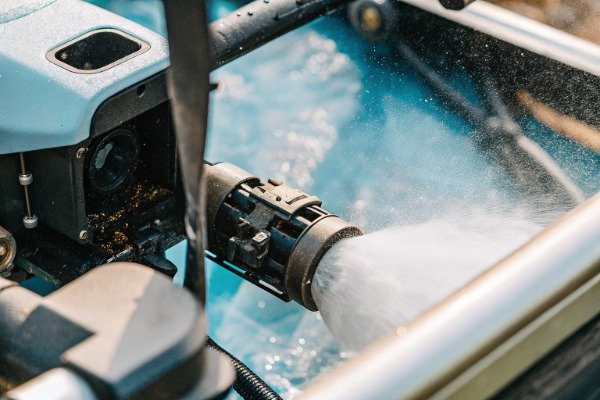
Un feu de forêt est l'un des environnements les plus hostiles pour un aéronef. L'air y est turbulent, chaud et chargé de particules. Lorsque nous concevons des drones pour ce secteur, nous devons penser à autre chose qu'à "bien voler". Nous devons penser à la survie.
Résistance à la chaleur et choix des matériaux
La menace la plus évidente est la chaleur. Bien que le drone ne doive pas être piloté directement dans les flammes, la chaleur rayonnante d'un feu de cime peut être intense, même à distance. Les cadres en plastique, courants sur les drones de loisir, peuvent se déformer ou se ramollir, entraînant une défaillance structurelle catastrophique.
Nous utilisons fibre de carbone et aluminium aviation pour la cellule. La fibre de carbone est incroyablement solide et résistante à la chaleur. Cependant, la résine qui maintient la fibre de carbone doit également être résistante aux hautes températures. Nous accordons également une grande attention au boîtier de la batterie. Les batteries se dégradent rapidement et peuvent même exploser si elles deviennent trop chaudes. Nos conceptions industrielles comportent souvent des matériaux de refroidissement actif ou de protection contre la chaleur autour du compartiment de la batterie afin de maintenir des températures de fonctionnement sûres.
Protection contre les cendres et les débris
La cendre est un tueur silencieux de l'électronique. Elle est fine, abrasive et souvent conductrice. Si la cendre pénètre dans le corps du drone et se dépose sur le contrôleur de vol ou les ESC (Electronic Speed Controllers), elle peut provoquer des courts-circuits.
Pour y remédier, nous respectons des normes strictes en matière de protection contre les infiltrations (IP). Un drone de lutte contre les incendies doit avoir un indice d'au moins IP54, mais IP65 est préférable.
- IP5X : Protégé de la poussière.
- IPX4 : Résistant aux éclaboussures (pluie ou pulvérisation d'eau).
- IPX5 : Résistant au jet d'eau.
Ce scellement garantit que ni les cendres ni l'eau/mousse utilisée par les pompiers ne pénètrent dans le cœur électronique.
Durabilité du moteur
Les moteurs sont les seules pièces mobiles exposées aux éléments. En cas d'incendie, l'air est rempli de suie. Nous utilisons des moteurs entièrement fermés à refroidissement centrifuge. Contrairement aux moteurs à évent ouvert qui aspirent l'air (et les cendres) à travers les enroulements pour les refroidir, les moteurs fermés empêchent les débris d'entrer, ce qui prolonge considérablement la durée de vie du système de propulsion.
Indices de protection contre les agressions (IP) 7
Entretien et réparabilité
Même le drone le plus robuste peut être mis à rude épreuve. Les hélices seront ébréchées par les débris volants et le train d'atterrissage souffrira des atterrissages brutaux sur un terrain rocailleux.
Isothermes 8
L'un des problèmes que nous signalent nos clients est le manque de pièces de rechange. Un drone durable est aussi un drone réparable. Nous concevons nos systèmes avec des bras et des trains d'atterrissage modulaires. Si un moteur tombe en panne ou si un bras se casse, il peut être remplacé sur le terrain avec des outils de base. Vous ne devriez pas avoir à renvoyer l'ensemble de l'appareil à l'usine en Chine pour une simple réparation.
caméra thermique radiométrique 9
Liste de contrôle de la durabilité
Lors de l'évaluation d'un fournisseur, posez des questions sur ces caractéristiques de durabilité spécifiques :
- Protection contre les infiltrations : Le drone est-il conforme à la norme IP54 ou à une norme supérieure ?
- Température de fonctionnement : Peut-il voler à des températures ambiantes allant jusqu'à 50°C (122°F) ?
- Résistance au vent : Peut-il supporter des rafales de 12 à 15 m/s (vents de niveau 6-7) ?
- Résistance à la corrosion : Les connecteurs sont-ils plaqués or ou scellés contre les produits chimiques corrosifs ignifuges ?
Conclusion
Pour sauver des vies et des forêts, il faut donner la priorité à la précision radiométrique thermique, à la pénétration des signaux à longue portée et à la robustesse. Chez SkyRover, nous sommes prêts à équiper votre équipe avec les outils fiables nécessaires pour maîtriser le feu.
drone captif 10
Notes de bas de page
- Valide la vitesse et le comportement chaotique des incendies de forêt. ︎
- Explication scientifique de la façon dont l'eau contenue dans la végétation atténue les signaux radio. ︎
- Contexte réglementaire et opérationnel du vol au-delà de la ligne de visée visuelle. ︎
- Vue d'ensemble de la technologie des réseaux maillés sans fil et de ses avantages. ︎
- Examine les facteurs qui influencent les calculs de temps de vol et d'endurance des drones. ︎
- Détails sur les systèmes de propulsion hybrides permettant d'allonger les temps de vol des drones. ︎
- Normes officielles définissant les niveaux de protection contre les infiltrations pour les boîtiers électriques. ︎
- Décrit comment les isothermes aident les pompiers à visualiser les plages de température. ︎
- Définit la technologie radiométrique et son importance pour la mesure de la température. ︎
- Explique les capacités et les cas d'utilisation des systèmes de drones captifs. ︎
 English
  Español de México
  Deutsch
  Français
  Русский
  العربية
Comments
No comments yet. Be the first to share your thoughts!
Leave a Comment