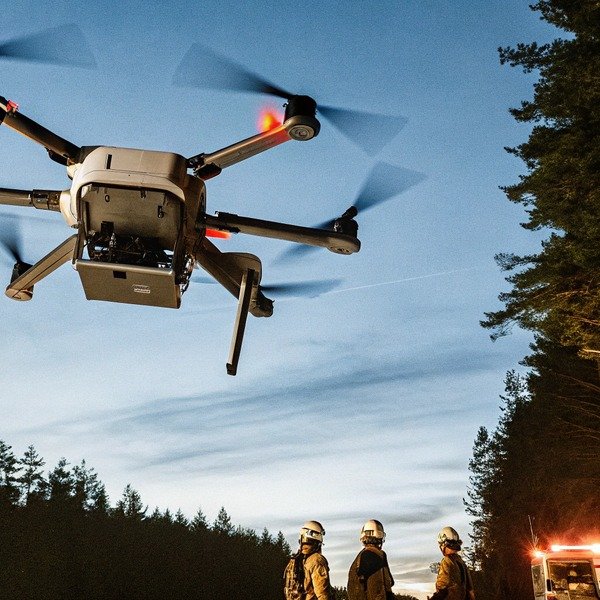
Seeing a drone lose power in the middle of a critical operation is every commander’s nightmare. During flight tests at our Xi’an facility, we realized that standard batteries often fail to provide the persistence needed for smoke monitoring, risking the loss of vital intelligence.
For surveillance tasks requiring long-duration hovering, tethered power systems are the optimal choice because they provide unlimited flight time via a continuous ground power source. While hybrid engines offer mobility for 3-hour missions, tethered solutions eliminate downtime entirely, making them superior for persistent monitoring of stationary wildfire hotspots.
Read on to analyze the specific trade-offs of each power configuration for your department’s needs.
Is a tethered power system the most reliable option for my continuous aerial monitoring tasks?
Constant battery swaps disrupt the workflow and leave blind spots during an emergency. We often explain to our US clients that interrupting a live video feed to land and recharge during a structure fire is both dangerous structure fire 1 and inefficient.
Yes, tethered power systems are the most reliable option for continuous aerial monitoring as they bypass battery capacity limits entirely. They deliver secure, unjammable data transmission and 24/7 hovering capability through a direct cable connection, ensuring your thermal cameras never miss critical developments due to power exhaustion.
The Mechanics of Unlimited Flight
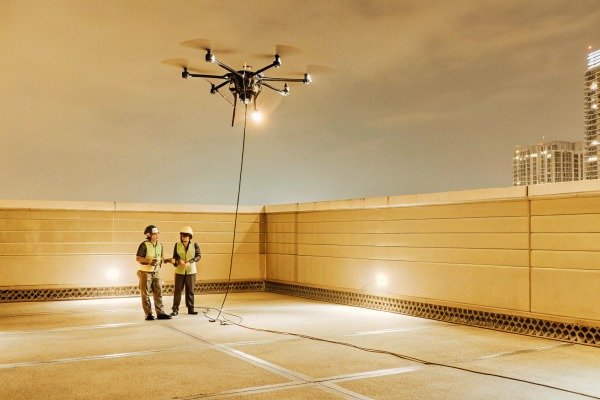
When we design systems for static surveillance, we look beyond the aircraft itself. A tethered system replaces the traditional battery reliance with a thin, high-tensile cable connected to a ground station. This station can be powered by a generator, a firefighting truck's inverter, or the grid. For fire departments, this means the drone becomes a virtual mast. It can hover at 100 meters indefinitely, acting as an eye in the sky without the pilot worrying about a "Low Battery" warning.
The reliability comes from the simplicity of the energy source. Unlike batteries, which suffer from voltage sag under heavy load or extreme heat caída de voltaje 2, mains power is constant. In our factory tests, we have run tethered units for over 24 hours straight to simulate long-term incident command scenarios.
Data Security and Interference
One aspect procurement managers often overlook is signal integrity. In a chaotic fire scene, radio frequency (RF) interference is common due to multiple radios, metal structures, and other drones.
Because the tether cable contains fiber optics or copper data lines, the video feed is hardwired. This makes the connection unjammable and immune to RF noise. RF noise 3 We recommend this setup for urban fires where signal congestion is high. You get a crystal-clear thermal picture of the roof structure regardless of the electromagnetic environment.
Weather and Winch Technology
Modern tether stations are not just "dumb" cables. They utilize smart winches. These automated systems sense the tension on the cable. If the drone moves due to wind gusts, the winch releases more cable. If the drone descends, it retracts the slack.
This active tension control is crucial for stability. It allows the drone to maintain a precise hover position even in turbulent air caused by the fire's updraft. Below is a comparison of how tethered systems stack up against standard options for stationary tasks.
Comparison: Tethered vs. Standard Battery
| Característica | Tethered Power System | Standard LiPo Battery |
|---|---|---|
| Tiempo de vuelo | Unlimited (24/7 capacity) | 30–45 Minutes |
| Enlace de datos | Hardwired (Secure, Unjammable) | Wireless (Subject to RF Interference) |
| Mobility | Limited by cable length (e.g., 100m) | High (Limited only by signal range) |
| Tiempo de Configuración | 5–10 Minutes (Station setup) | < 2 Minutes (Propellers on & go) |
| Mejor caso de uso | Perimeter monitoring, incident command | Quick reconnaissance, search and rescue |
Can hybrid gas-electric engines offer the long-duration hovering capability I need for complex missions?
Tether cables drastically limit your operational range. When our engineers conduct field tests in vast mountain ranges, we clearly see that static lines fail to cover spreading wildfires or search missions that cover miles of terrain.
Hybrid gas-electric engines can indeed provide long-duration hovering for complex missions, offering flight times up to three hours without cables. They combine the energy density of gasoline with electric precision, making them ideal for covering large geographic areas where ground infrastructure is inaccessible or tether restrictions are impractical.
Bridging the Gap Between Endurance and Agility
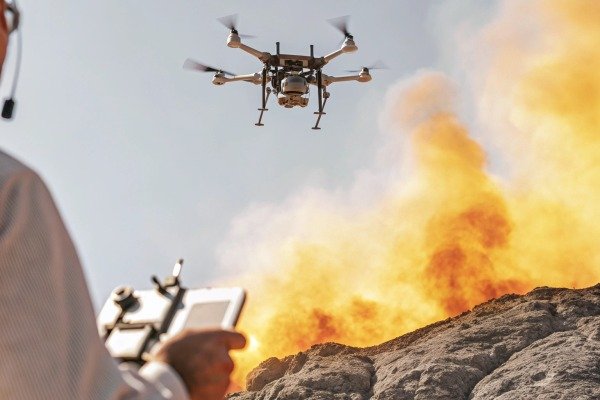
A hybrid system essentially puts a flying generator on the drone frame. An internal combustion engine spins a generator, which produces electricity internal combustion engine 4 to power the motors and charge a small buffer battery. This setup solves the biggest problem of pure electric drones: energy density. densidad energética 5 Liquid fuel carries far more energy per pound than any current battery technology.
For a fire chief, this means the drone can launch from a base, fly 5 miles to a ridge line, hover for two hours to monitor a fire break, and return home. A tethered drone cannot do this. A standard battery drone would need to return after 20 minutes.
The Vibration Challenge
However, we must address the engineering trade-offs. Engines vibrate. In our development process, we spend months tuning isolation dampers. If the vibration is not managed, it ruins the video feed, causing the "jello jello effect 6 effect."
For surveillance, you need stable footage. If you choose a hybrid system, you must ensure the manufacturer has high-quality gimbal damping. Without it, the long-range zoom capabilities of your camera are useless because the image will be too shaky to identify heat signatures accurately.
Noise and Altitude Considerations
Hybrid drones are loud. They sound like a lawnmower in the sky. In a search and rescue mission where you might need to listen for victims, this is a disadvantage. In a wildfire scenario, the noise is usually negligible compared to the roar of the fire itself.
Another critical factor is altitude. Combustion engines lose power in thin air. If your jurisdiction includes high mountains (above 6,000 feet), a gas engine loses efficiency. We often have to re-calibrate the fuel injection systems for clients in high-altitude regions like Colorado or parts of Europe.
Efficiency at Different Altitudes
| Altitude (Feet) | Hybrid Engine Efficiency | Battery Efficiency |
|---|---|---|
| Nivel del mar | 100% | 100% |
| 5,000 ft | ~85% (Requires tuning) | 98% (Minimal loss) |
| 10,000 ft | ~70% (Significant power loss) | 95% (Propeller pitch matters more) |
How do I determine the optimal balance between battery weight and flight time for my specific payload?
Heavy thermal cameras drain power rapidly. We frequently adjust our airframe designs because adding just 500 grams of payload can slash flight time by over twenty percent, forcing customers to rethink their mission profiles.
To determine the optimal balance, you must calculate the specific power-to-weight ratio of your drone against the optical payload’s mass. Prioritize high-density solid-state or LiPo batteries if agility is key, but accept that heavier high-zoom cameras will inevitably reduce hovering endurance to under 45 minutes on pure electric setups.

The Physics of Hovering
Hovering is the most energy-intensive state for a multirotor drone. Unlike a plane that generates lift from wings, a drone fights gravity purely with motor thrust. generates lift from wings 7 The heavier the drone, the harder the motors work, and the faster the amps are drained from the battery.
When we consult with procurement managers, we ask for the exact weight of their desired camera. A simple thermal sensor weighs very little. A triple-sensor payload with a laser rangefinder and 30x optical zoom is heavy. You cannot have maximum flight time y maximum payload weight simultaneously. It is a mathematical impossibility with current Lithium-Polymer (LiPo) technology. Lithium-Polymer (LiPo) technology 8
Exploring High-Density Alternatives
To mitigate this, the industry is moving toward new technologies. Hydrogen fuel cells are the leading contender here. They offer a middle ground Celdas de combustible de hidrógeno 9 between the endurance of gas hybrids and the low vibration of electric systems. A hydrogen drone can hover for up to 4 hours.
However, hydrogen infrastructure is scarce. For most departments, the practical choice is high-voltage LiPo batteries or emerging semi-solid-state batteries. These offer a slight improvement in energy density (Watt-hours per kilogram).
Calculando sus necesidades
To find the balance, look at the "Hover Power Consumption" spec. If a drone consumes 1000 Watts to hover and has a 1000 Watt-hour battery, it will fly for one hour (theoretically). If you add a heavy camera, consumption might jump to 1300 Watts, reducing flight time to 46 minutes.
Always aim for a 20% buffer. If your mission requires 30 minutes of eyes-on-target, buy a system rated for at least 45 minutes. Batteries degrade, and wind increases power consumption.
Payload Impact on Endurance (Example Data)
| Tipo de Carga Útil | Weight (approx) | Flight Time Impact (Standard Drone) | Recommended Power System |
|---|---|---|---|
| Térmico Básico | 300g | -5% flight time | Standard LiPo Battery |
| Dual Sensor + Zoom | 800g | -15% flight time | High-Capacity LiPo or Hydrogen |
| LiDAR / Heavy Cargo | 2kg+ | -40% flight time | Hybrid or Tethered |
What are the long-term maintenance costs associated with different high-endurance power systems?
Buying cheap gear often leads to expensive repairs down the road. Our service team has noticed that ignored engine maintenance or mishandled battery cycles costs departments thousands in premature replacements and operational failures.
Long-term maintenance costs vary significantly; hybrid systems require frequent engine servicing and fuel filter changes similar to lawn equipment. In contrast, tethered systems have lower mechanical upkeep but higher upfront costs, while standard batteries incur high replacement costs annually due to cycle degradation from frequent, rapid charging.

The Hidden Costs of Batteries
Batteries seem maintenance-free, but they are consumables. A high-performance drone battery typically lasts 200 to 300 cycles before its capacity drops below safe levels. If your department flies daily, you will be replacing the entire battery fleet every year.
Furthermore, "storage voltage" management is critical. If your team leaves batteries storage voltage 10 fully charged on the shelf for weeks, the internal chemistry degrades. We see this often with municipal clients who fly sporadically. This mismanagement destroys the battery's value, forcing expensive repurchases.
Hybrid Engine Maintenance
Hybrid systems introduce mechanical complexity. You are maintaining a small 2-stroke engine. This involves:
- Mixing oil and gas precisely.
- Cleaning or replacing spark plugs every 25–50 hours.
- Replacing fuel filters and diaphragms.
- Overhauling the engine (piston rings) after 100–200 hours.
While the fuel is cheap, the labor hours add up. You need a technician who understands small engines, not just electronics. If the engine fails mid-flight, the drone runs on backup batteries for a minute or two, but the risk of a crash increases if maintenance is neglected.
Tether System Economics
Tether stations have the highest upfront cost but the lowest variable cost. Electricity is cheap. The main wear component is the tether cable itself. It can fray over time if dragged over rough terrain like concrete or rocks. The winch motor is generally robust.
From a Total Cost of Ownership (TCO) perspective, a tethered system is cheaper over 3 years for a department that does frequent, stationary surveillance (like monitoring a specific high-risk facility). For mobile teams, the versatility of batteries or hybrids justifies their higher running costs.
Conclusión
In summary, the choice of power system dictates your operational capability. For stationary, indefinite surveillance, sistemas anclados are the undisputed king. For long-range, mobile missions where noise is acceptable, hybrid engines offer the best endurance. For short, rapid-response tactical views, standard batteries remain the standard. Evaluate your primary mission profile—whether it is guarding a perimeter or scouting a forest—to make the right investment.
Notas al pie
1. Provides statistical context on structure fires from a leading fire safety organization. ↩︎
2. Explains the technical phenomenon of voltage drops in electrical systems. ↩︎
3. Official government guide on radio frequency interference and signal noise. ↩︎
4. General background information on the mechanics of combustion engines. ↩︎
5. Department of Energy resource explaining battery metrics and energy storage concepts. ↩︎
6. Definition of the visual distortion artifact common in digital imaging. ↩︎
7. Scientific explanation of aerodynamic lift principles by NASA. ↩︎
8. Academic research context on current lithium battery technology and limitations. ↩︎
9. Industry leader documentation on hydrogen power applications for UAVs. ↩︎
10. Manufacturer guidelines on proper battery maintenance and storage procedures. ↩︎

 English
  Español de México
  Deutsch
  Français
  Русский
  العربية
