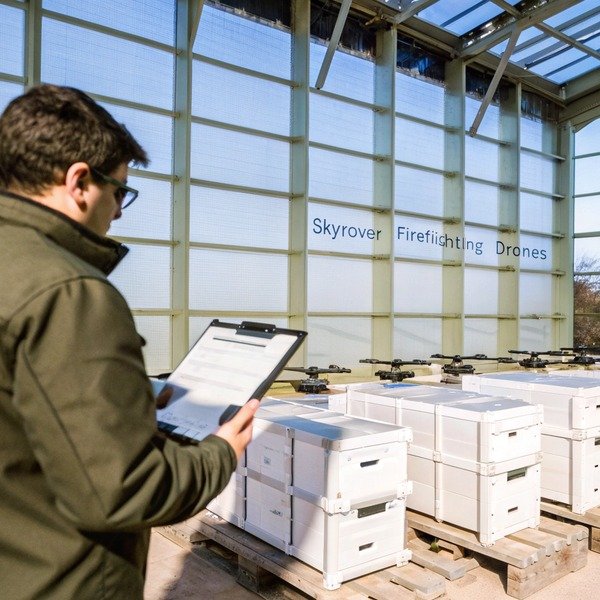
When our team at the Xi’an facility prepares a shipment for export, we understand the immense pressure procurement managers face. You are not buying toys; you are acquiring life-saving equipment that must perform in high-temperature, high-risk environments. A single failure GPS lock failure 1 in the field is not an option when a wildfire is spreading. wildfire is spreading 2 We often see clients struggle to balance thorough quality checks with tight delivery deadlines, worrying that a missed defect could lead to mission failure.
You should utilize the ISO 2859-1 (ANSI/ASQ Z1.4) standard tables to determine the specific sample size based on your total lot quantity. We recommend applying General Inspection Level II for visual checks, enforcing an AQL of 0 for critical safety defects, and setting an AQL of 1.0 to 1.5 for major functional issues.
Let’s break down exactly how to apply these standards to your next industrial drone order.
Which AQL standard should I follow for industrial drone quality control?
In our experience exporting to the United States and Europe, many buyers initially lack a clear framework exporting to the United States 3 for acceptance criteria. We find that vague quality requirements lead to disputes and delays. Without a standardized language for defects, a minor cosmetic scratch might be treated with the same severity as a motor malfunction, confusing the inspection process.
ANSI/ASQ Z1.4 (ISO 2859-1) is the globally accepted standard for inspecting industrial drone shipments. You should use General Inspection Level II for standard visual and mechanical checks. However, for critical systems like flight controllers, you must enforce a strict Acceptable Quality Limit (AQL) of 0 to ensure absolute safety.
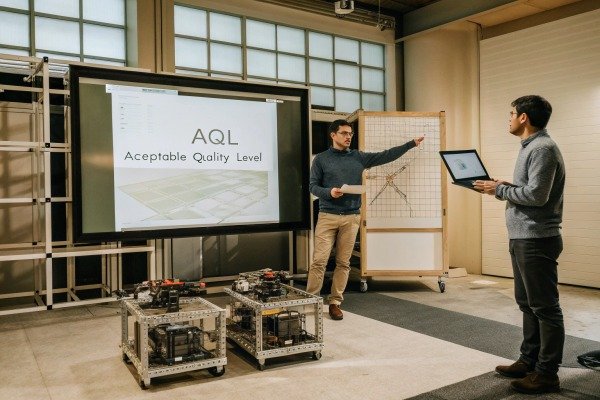
Understanding the AQL (Acceptable Quality Limit) framework is essential for maintaining the reliability Límite de Calidad Aceptable 4 of your fleet without inspecting every screw on every unit. At our factory, we use these standards to align our internal quality control with our clients’ expectations. The standard divides defects into three categories: Critical, Major, and Minor.
For high-value items like our heavy-lift firefighting drones, you cannot use the same loose standards applied to consumer electronics. A “Critical” defect in our industry is anything that compromises safety, such as battery swelling, structural cracks in the carbon fiber arms, or a failure in the emergency parachute system. emergency parachute system 5 brazos de fibra de carbono 6 These must have a zero-tolerance policy (AQL 0).
Defining Defect Categories for Drones
When you send your third-party inspector to our warehouse, or when we conduct our final pre-shipment checks, we categorize issues to determine if a lot passes or fails. A “Major” defect might be a sensor malfunction or a GPS lock failure—issues that prevent the drone from doing its job but might not immediately endanger life. “Minor” defects are usually cosmetic, like a peeled sticker or a scratch on the landing gear.
Here is the standard framework we recommend for your inspection protocols:
| Categoría de Defecto | AQL recomendado | Definition in Firefighting Drones | Ejemplos |
|---|---|---|---|
| Crítico | 0 | Hazardous or unsafe conditions; regulatory non-compliance. | Battery swelling, exposed wiring, cracked propeller mount, parachute failure. |
| Mayor | 1.0 – 1.5 | Reduces usability or causes functional failure. | Thermal camera calibration error, motor twitching, inability to hold altitude. |
| Menor | 2.5 – 4.0 | No reduce la usabilidad; solo cosmético. | Scratches on the shell, slightly misaligned labels, damaged outer packaging box. |
Why General Level II?
We generally use General Inspection Level II because it offers the best balance between risk and cost. General Inspection Level II 7 It provides a sample size that is statistically significant enough to catch bad batches without requiring us to unpack 50% of the shipment. If your supplier suggests Level I (a smaller sample), be cautious. That is usually reserved for suppliers with a long, flawless track record. Given the complexity of 150kg payload drones, sticking to Level II ensures we catch potential firmware hash inconsistencies or assembly errors before the goods leave China.
Is it better to conduct a 100% full inspection for critical firefighting drones?
When we discuss orders with fire departments or government contractors, the question of “full inspection” often comes up. Clients naturally assume that checking 100% of the products is the only way to guarantee perfection. However, full inspections can introduce human error fatigue and massive delays, potentially missing the delivery window for the fire season.
While 100% inspection guarantees checking every unit, it is often impractical for large orders due to time and costs. However, for critical safety components like payload release mechanisms and emergency parachutes, a mandatory 100% functional test is required regardless of statistical sampling limits to prevent life-safety failures.

There is a nuanced approach that we advocate for. A blanket 100% inspection on every aspect of the drone is inefficient. Inspecting the paint job on 500 units is a waste of resources. However, inspecting the functional safety of critical systems on every single unit is necessary. This is where we distinguish between “sampling inspection” and “100% functional testing.”
The Hybrid Inspection Strategy
We recommend a hybrid strategy. Use the AQL sampling method for the airframe, packaging, and accessories. But for specific, high-risk components, we bypass sampling and test every single unit. For example, our firefighting drones carry heavy loads of fire retardant. The payload release mechanism is a critical point of failure. If that mechanism jams over a fire, the mission fails.
Therefore, we perform a 100% functional test on the release mechanism and the emergency parachute system. We also mandate 100% Internal Resistance (IR) testing on batteries. Internal Resistance (IR) testing 8 Simple voltage checks are not enough; high-discharge operations require cells that can sustain power without overheating. A sample is not enough for these specific components.
Where Sampling Fails
Statistical sampling accepts that a small percentage of defects might exist in the batch. In a lot of 1,000 propellers, if 2 are scratched, that might be acceptable. But if you have 100 drones, and 1 has a faulty thermal camera that blinds the pilot in smoke faulty thermal camera 9, that is unacceptable. This is why we treat the “flight critical” path differently from the “manufacturing quality” path.
| Enfoque de Inspección | Recommended Method | Razón | Impacto en los costos |
|---|---|---|---|
| Visual / Cosmetic | Muestreo Estadístico (AQL) | Low risk impact; high volume makes 100% check too costly. | Bajo |
| Estabilidad de vuelo | Statistical Sampling | Flight testing is time-consuming (30+ mins/drone). | Medio |
| Liberación de carga útil | 100% Full Check | Mission-critical; failure renders drone useless. | Alto |
| Seguridad de las baterías | 100% IR Testing | Fire risk; ensures cells handle high discharge. | Medio |
By adopting this hybrid model, you ensure that every drone capable of flying has had its critical systems verified, while still keeping the procurement timeline reasonable.
How do I determine the optimal sample size based on my total order quantity?
We often receive orders ranging from small batches of 20 units for pilot programs to bulk shipments of 200+ units for state-wide deployment. The math changes with the order size. Many procurement managers find the ISO tables confusing and struggle to pinpoint exactly how many boxes need to be opened.
Refer to the ANSI/ASQ Z1.4 tables to find your code letter based on lot size. For a shipment of 91 to 150 drones, use Code Letter F, requiring a sample of 20 units. Larger lots increase sample size but decrease the percentage of total inventory tested, optimizing inspection efficiency.

Determining the sample size is a straightforward process once you know how to read the “Code Letters.” The ISO standard assigns a letter based on your total order quantity (Lot Size). This letter then dictates how many units you must inspect. It is designed to be statistically representative.
Reading the Code Letters
Let’s say you place an order with us for 100 firefighting drones. Looking at the standard tables for General Inspection Level II, a lot size of 91 to 150 corresponds to Code Letter **F**. Moving to the sampling table, Letter F requires a sample size of **20 units**. This means your inspector will randomly select 20 drones from the shipment to test.
If you increase your order to 500 drones (Lot size 281 to 500), the Code Letter becomes **H**, which requires a sample size of **50 units**. Notice that while the order size increased by 5 times, the sample size only increased by 2.5 times. This efficiency is why bulk ordering is advantageous.
Special Inspection Levels (S-3, S-4)
Sometimes, standard sampling isn’t enough for destructive tests. You cannot crash-test 20 drones to see if the frame holds up. for these types of tests, we use “Special Inspection Levels” like S-3 or S-4. These utilize much smaller sample sizes.
For example, we might need to validate the heat resistance of the thermal shielding wiring. This is a destructive test—the wiring is ruined afterwards. For a lot of 500 units, using S-3 might strictly require testing only 4 units. This validates the materials without destroying your inventory.
Quick Reference for Drone Shipments
Here is a simplified lookup table based on General Inspection Level II, which covers most of our export scenarios:
| Total Order Quantity (Lot Size) | Code Letter (Level II) | Sample Size (Standard Check) | Sample Size (S-3 Destructive Test) |
|---|---|---|---|
| 26 to 50 | D | 8 | 2 |
| 51 to 90 | E | 13 | 2 |
| 91 to 150 | F | 20 | 2 |
| 151 to 280 | G | 32 | 3 |
| 281 to 500 | H | 50 | 4 |
We always encourage our clients to confirm these numbers before the inspection date so our warehouse team can prepare the random selection efficiently.
How does the chosen sampling ratio affect my inspection costs and delivery timeline?
Our logistics team works backward from your required delivery date, but a rigorous inspection plan can throw a wrench in the works if not accounted for. We have seen shipments delayed by days because a client requested a high sampling ratio without realizing the labor hours required to flight-test that many units.
Higher sampling ratios significantly increase labor hours and potential delays. Inspecting 10% of a shipment takes longer than the standard ISO ratios, potentially adding days to the timeline. You must balance the cost of inspection man-days against the financial risk of deploying a faulty drone in a wildfire.

Inspection is not free, neither in terms of money nor time. For a complex product like a quadcopter drone, an inspection is not just a visual glance. quadcopter drone 10 It involves unpacking, assembling propellers, powering on, checking firmware, calibrating the compass, potentially flying the unit, and then repacking it securely.
The Hidden Costs of Time
A professional third-party inspector typically checks about 10 to 15 complex drones per day if functional flight tests are included. If you order 150 drones and strictly follow the Level II standard (Sample size: 20), one inspector can finish in 1.5 to 2 days. This is manageable.
However, if you demand a 50% inspection rate to be “extra safe,” that is 75 drones. That requires 5 to 7 days of inspection time. This not only increases the billable man-days you pay to the inspection agency but also delays the shipment leaving our factory by a week. If you are racing against a customs clearance deadline, this delay can be critical.
Balancing Risk vs. Budget
The goal is to spend your budget where it reduces risk the most. Spending thousands of dollars to visually inspect every battery label is inefficient. Spending that budget to perform deep-cycle stress tests on a smaller sample (S-3) or full functional tests on the payload system is smarter.
You must also consider the cost of failure. If a $20,000 drone fails during a fire rescue because of a defect we could have caught, the cost is far higher than the inspection fee. Conversely, if over-inspection delays the equipment so it misses the fire season, the investment is wasted.
Maximizing Efficiency
To keep costs down and speed up the timeline, we suggest:
- Pre-Shipment Documentation: Let us send you the internal QC reports and firmware hash logs before your inspector arrives. This speeds up the on-site data verification.
- Batching: If the order is large, inspect and ship in batches. You don’t need to wait for all 500 units to be ready to inspect the first 100.
- Defined Pass/Fail Criteria: Clear instructions prevent the inspector from wasting time on subjective cosmetic issues that don’t affect performance.
Conclusión
Selecting the right sampling ratio is a strategic decision that balances safety, cost, and speed. For industrial firefighting drones, we strongly advise sticking to the ANSI/ASQ Z1.4 General Inspection Level II standard, while overlaying a 100% functional test for critical safety mechanisms like payload releases and parachutes. By setting an AQL of 0 for critical defects and understanding the trade-offs between sample size and inspection time, you ensure that the fleet you deploy is reliable and ready for the heat of the job. At SkyRover, we are ready to collaborate with your quality teams to implement these protocols effectively.
Notas al pie
1. Official US government information on Global Positioning System accuracy and performance standards. ↩︎
2. Official US Forest Service guidelines on using unmanned aircraft systems for wildfire management. ↩︎
3. Official US Customs and Border Protection resources regarding import/export regulations. ↩︎
4. General background definition of the statistical quality control term AQL. ↩︎
5. Reference to ASTM F3322, the standard specification for sUAS parachutes. ↩︎
6. Link to a major manufacturer of carbon fiber materials explaining material properties. ↩︎
7. Authoritative resource from the American Society for Quality regarding the Z1.4 standard. ↩︎
8. Research from the University of Maryland’s Center for Advanced Life Cycle Engineering on battery health. ↩︎
9. Manufacturer documentation on the application of thermal imaging in firefighting scenarios. ↩︎
10. General overview of quadcopter configuration and mechanics. ↩︎

 English
  Español de México
  Deutsch
  Français
  Русский
  العربية
