
When our engineering team in Xi’an tests new heavy-lift prototypes, we simulate the harshest conditions imaginable, because a firefighting drone losing orientation near a burning structure is a nightmare scenario LiDAR 1. We have seen high-end equipment drift dangerously simply because the compass could not handle the magnetic noise from a nearby fire truck or steel reinforcement bars.
To evaluate compass calibration, prioritize drones featuring triple-redundant magnetometers and external mast-mounted sensors that isolate hardware interference. Ensure the flight controller uses Extended Kalman Filtering (EKF) to reject erratic data and supports World Magnetic Model (WMM) calibration methods, eliminating the need for impossible physical rotations of heavy equipment.
Let’s examine the specific technical criteria you must assess to ensure mission safety.
Why does strong magnetic interference pose a significant risk to my firefighting drone's flight stability?
We often analyze flight logs from clients where a drone suddenly fought against pilot commands, a situation usually triggered by invisible magnetic fields distorting the onboard navigation. If the drone cannot distinguish between Earth’s magnetic north and the field Earth’s magnetic north 2 generated by a high-voltage power line, the consequences can be catastrophic.
Strong magnetic fields from steel structures or high-current wires distort the magnetometer’s reading of Earth’s north. This causes the flight controller to miscalculate heading, leading to the “toilet bowl effect” where the drone spirals uncontrollably or triggers a fly-away event by attempting to correct a false yaw error.

The Physics of Magnetic Confusion
At our factory, we emphasize that a drone's magnetometer is incredibly sensitive. It is designed to detect Earth's magnetic field, which is relatively weak (approximately 0.5 Gauss). However, firefighting environments are filled with "hard iron" and "soft iron" interference hard iron 3 that can be orders of magnitude stronger.
When a drone flies close to a burning building reinforced with steel rebar, or hovers near a fire truck (which is essentially a giant block of metal), the local magnetic field warps. The flight controller expects a clean vector pointing North. When it receives a distorted vector, it assumes the drone has physically rotated. The drone then tries to "correct" this rotation by yawing in the opposite direction. This creates a feedback loop known as the "Toilet Bowl Effect" (TBE), where the drone flies in increasingly larger circles until it crashes or flies away.
Internal vs. External Interference
The risk is not just external. We design our SkyRover heavy lifters to manage internal currents. As stated in the Perplexity research, magnetic field strength ($B$) is proportional to the current ($I$). In a large firefighting quadcopter, the motors draw massive currents during a rapid ascent. If the compass is not shielded or placed far enough away (following the inverse inverse cube law 4 cube law $1/z^3$), the drone's own power system will blind its navigation sensors.
Common Magnetic Hazards in Firefighting
To help you assess the environment, we have categorized the most common interference sources we encounter during field testing.
| Interference Source | Type | Impact Level | Descripción |
|---|---|---|---|
| High-Current Cabling | Internal/External | Critical | Fields generated by the drone's own battery-to-ESC wires or nearby power lines. |
| Steel Structures | Soft Iron | Alto | Warehouses, reinforced concrete buildings, and bridges that distort magnetic flux lines. |
| Emergency Vehicles | Hard/Soft Iron | Alto | Fire trucks, pumps, and generators act as massive magnets, especially if the drone takes off from their roof. |
| High-Power Payloads | Electromagnetic | Medio | Searchlights or tethered power systems that create localized fields when activated. |
What specific sensor redundancy features should I prioritize to prevent compass errors in high-metal environments?
In our experience exporting to the US, we find that procurement managers often overlook the internal architecture of the flight controller. A single compass is a single point of failure; reliable operation in hazardous zones requires a system that can “vote out” bad data.
You should prioritize drones equipped with triple-redundant magnetometers and dual-antenna RTK GPS systems. Dual RTK determines heading via antenna spacing rather than magnetic fields, providing immunity to interference. Additionally, look for internal Electromagnetic Interference (EMI) shielding on high-voltage motor wiring to prevent self-generated magnetic noise during high-throttle operations.

The Necessity of Dual Antenna RTK
For large firefighting drones, we strongly advocate for Dual Antenna RTK (Real-Time Kinematic) systems Dual Antenna RTK 5. Traditional drones rely solely on a magnetometer for heading (yaw). A Dual Antenna system uses two GPS receivers spaced apart on the airframe. By calculating the fixed position of Antenna A relative to Antenna B, the drone knows exactly which way it is facing without relying on magnetic north.
This is a game-changer for industrial applications. Even if the drone is flying inside a steel warehouse where the magnetic field is chaotic, the Dual RTK system maintains a lock on the heading.
Sensor Fusion and Voting Logic
When we configure our flight controllers (often based on robust architectures like PX4 or ArduPilot PX4 6), we utilize "Sensor Fusion." This involves an Extended Kalman Filter (EKF) Extended Kalman Filter 7. The EKF takes data from:
- Magnetometers (Compass)
- Gyroscopes (Rotation speed)
- Accelerometers (Movement)
- GPS/RTK (Position)
If the drone has three magnetometers (triple redundancy), the EKF constantly compares their readings. If Mag #1 and Mag #2 agree, but Mag #3 suddenly shows a 45-degree deviation (perhaps due to a nearby steel beam), the system identifies Mag #3 as "unhealthy" and ignores it. This voting logic is essential for safety.
Visual Positioning Systems (VPS) as a Last Resort
We also recommend ensuring the drone has optical optical flow 8 flow sensors or LiDAR. If complete magnetic failure occurs and GPS is denied (e.g., under a bridge), the VPS allows the drone to hold its position visually.
| Sensor Architecture | Immunity to Interference | Mejor caso de uso | Cost Impact |
|---|---|---|---|
| Single Magnetometer | Bajo | Open fields only (Agriculture) | Bajo |
| Triple Redundant Mag | Medio | General inspection, light interference | Medio |
| Dual Antenna RTK | High (Recommended) | Firefighting, Complex Structures | Alto |
| Visual/LiDAR Odometry | High (Non-magnetic) | Indoor, GPS-denied environments | Muy alto |
How can I verify the anti-interference capabilities of a drone through supplier test reports or live demos?
We always tell our clients not to trust the brochure alone; the real proof lies in the telemetry logs. When we validate our units for export, we perform specific stress tests that reveal how the sensors behave under load, and you should demand the same visibility.
Request flight logs showing magnetometer noise levels while the drone hovers near large metal objects or high-voltage sources. Verify that the “magnetic health” metric remains stable and that the system automatically switches to fallback sensors like internal IMUs or optical flow without operator intervention when saturation thresholds are exceeded.

The "Speaker Magnet" Simulation
During a factory acceptance test or a live demo, ask the supplier to perform a controlled interference test. While the drone is on the ground (disarmed), move a strong magnet or a high-current device near the compass module. Watch the Ground Control Station (GCS) screen Ground Control Station (GCS) 9.
- Good Result: The system flags a "Mag Error" or "Compass Variance" alert immediately, preventing arming.
- Bad Result: The horizon line on the screen tilts or drifts slowly without an error message. This implies the software is blindly accepting bad data.
Analyzing the Flight Logs
If you are evaluating a demo unit, ask for the .bin o .ulog flight data. You don't need to be an engineer to check this; you can use free tools like Flight Review. Look for the magnetic field strength graph (measured in Gauss or Tesla).
- Throttle vs. Mag Interference: Check the graph where the throttle (current) spikes. If the magnetic field reading spikes in perfect sync with the throttle, the drone has poor internal shielding. The wiring is creating an electromagnetic field that will confuse the compass during high-speed flight.
Physical Inspection of the Hardware
We strictly follow the "15cm Rule" in our designs. The GPS/Compass module should be mounted on a mast, lifting it away from the high-current distribution board and batteries.
- Measure the Mast: Ensure the compass is at least 15cm (6 inches) away from the main power cables.
- Check the Wiring: Ask if the power cables are twisted pairs twisted pairs 10. Twisting positive and negative cables cancels out the magnetic fields they generate.
Critical Questions for the Supplier
- "Does the drone inhibit arming if magnetic interference is detected on the ground?"
- "What is the fail-safe behavior if the compass fails mid-flight? Does it switch to Altitude Hold or attempt RTH?"
- "Can you show me a log file of a high-current punch-out to prove the compass is isolated?"
Will the drone's calibration software allow my team to quickly reset sensors during urgent field operations?
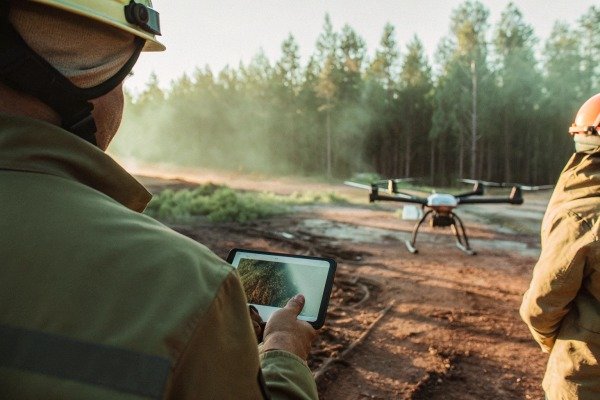
Our engineers understand that in a real emergency, you cannot ask two firefighters to pick up a 25kg drone and dance in circles to calibrate it. We have integrated smarter software solutions that respect the operational reality of heavy industrial equipment.
Advanced calibration software utilizing the World Magnetic Model (WMM) allows for “Large Vehicle Calibration.” This estimates offsets using known geographical data without requiring full six-axis rotation. Ensure the system supports in-flight “MagFit” learning maneuvers and allows for simple one-button sensor resets via the ground control station.
The Problem with Traditional "Compass Dancing"
Consumer drones typically require the "Compass Dance"—rotating the drone 360 degrees horizontally and then nose-down. For a large firefighting quadcopter loaded with fire retardant, this is physically dangerous and often impossible. If a supplier tells you that you must manually rotate the drone for every calibration, their technology is outdated for this weight class.
Modern Solutions: WMM and In-Flight Learning
Top-tier industrial flight controllers (like those running modified PX4 stacks) use the World Magnetic Model (WMM).
- How it works: The drone uses its GPS coordinates to look up what the magnetic field should be in that location. It then calculates the difference between the expected field and the measured field to correct for "Hard Iron" offsets (biases from the drone's own metal parts). This happens without spinning the drone.
In-Flight Calibration (MagFit)
Another feature we implement is in-flight calibration. Instead of calibrating on the ground (where rebar in the concrete might skew results), the pilot takes off in "Acro" or "Stabilize" mode (which doesn't rely on the compass). Once in the air, away from ground interference, the pilot performs a few simple maneuvers (yaw spins). The software records the data and updates the calibration offsets dynamically. This is the gold standard for large-scale drones.
Calibration Feature Checklist
When evaluating the software interface, look for these specific capabilities:
| Característica | Importance | Benefit for Firefighting |
|---|---|---|
| Large Vehicle Mag Cal | Critical | Calibrate heading without lifting/rotating the drone. |
| Auto-Declination | Alto | Automatically updates magnetic north vs. true north based on GPS. |
| Soft Iron Compensation | Medio | Maps distortions caused by fixed payloads (like cameras or tanks). |
| Temperature Compensation | Alto | Prevents sensor drift when the drone heats up near a fire. |
Conclusión
Reliable navigation in a fire zone requires more than just a compass; it demands a robust architecture of redundancy and intelligent software. When evaluating a supplier, look beyond the flight time. Demand Dual Antenna RTK, verified isolation of internal wiring, and "Large Vehicle" calibration features. Choosing the right hardware ensures your team focuses on combating the fire, not fighting the flight controls.
Notas al pie
1. Government overview of LiDAR technology. ↩︎
2. Authoritative definition of geomagnetic north. ↩︎
3. Official explanation of magnetic anomalies. ↩︎
4. Physics concept explaining field strength reduction. ↩︎
5. Industry explanation of dual-antenna heading technology. ↩︎
6. Official website of the flight control architecture. ↩︎
7. Technical documentation for the specific filter used. ↩︎
8. General overview of optical flow technology. ↩︎
9. Official site for the mentioned software. ↩︎
10. Engineering principles of cabling to reduce interference. ↩︎

 English
  Spanish
  German
  French
  Dutch
Dutch  Arabic
