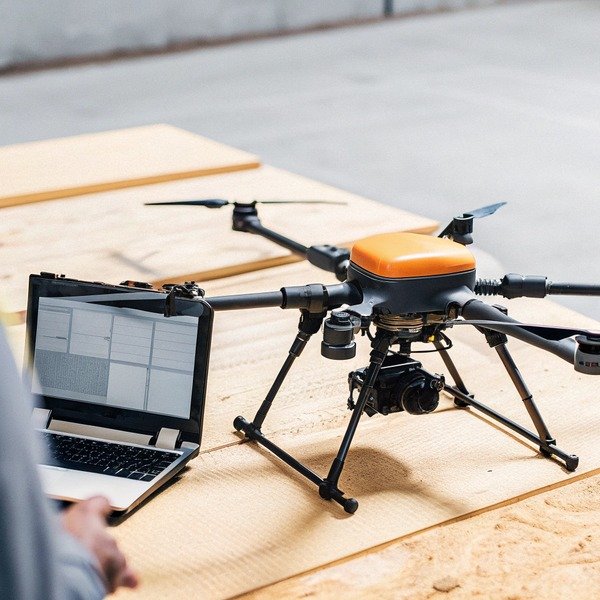
We often see critical rescue missions delayed because a charging unit failed immediately upon arrival. At our factory, we meticulously test every power supply to prevent these costly and dangerous disruptions.
To ensure compatibility, verify the charger’s input label explicitly lists 100V–120V AC at 60Hz. Confirm it uses a switching power supply design with NEMA 5-15 grounding plugs. Always check for UL or ETL safety certifications on the casing to meet US electrical code requirements.
Let’s break down exactly what specifications protect your equipment and personnel.
What specific input voltage range should I look for on the product datasheet?
Our engineering team has seen generic chargers fail simply because they couldn't handle grid fluctuations. grid fluctuations 1 You cannot afford equipment that shuts down or overheats when plugged into a standard wall outlet.
Look for a switching power supply specification stating an input range of 100V–240V AC. This wide range ensures the charger automatically adapts to the US standard 120V grid without external transformers. Avoid units labeled strictly 220V, as they will require bulky adapters and may overheat.
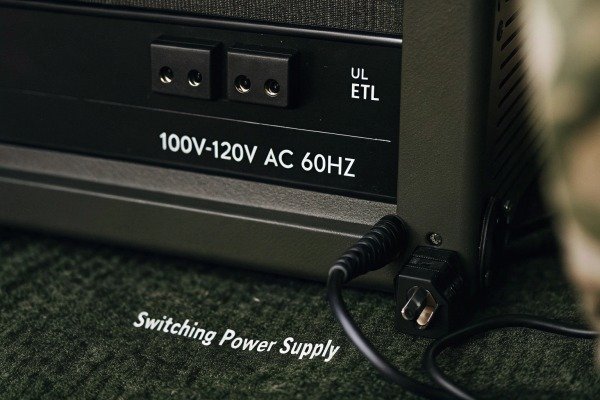
Understanding the input voltage on a datasheet is the first line of defense against equipment failure. In the United States, the standard grid voltage is 120V at a frequency of 60Hz. 120V at a frequency of 60Hz 2 standard grid voltage 3 However, many industrial drones are manufactured in regions where 220V/50Hz is the standard. If you plug a charger designed only for 220V into a US outlet, it will not function, or worse, it will attempt to draw double the current to compensate for the lower voltage, leading to catastrophic failure.
The "Switching" Advantage
You need a charger described as a "Universal Switching Power Supply." Switching Power Supply 4 These devices use internal electronics to detect the incoming voltage and adjust accordingly. On the datasheet, this is often listed as "Input: AC 100-240V, 50/60Hz." If the datasheet shows a narrow range like "AC 220V ±10%," that unit is incompatible with US infrastructure without a heavy, expensive step-up transformer.
The Hidden Trap: Power Throttling
We advise our clients to look deeper than just the voltage range. Some high-amperage chargers (above 2000W) feature a "dual-voltage" input but perform differently depending on the source.
- At 220V: The charger might deliver its full 2500W capacity, charging your batteries in 20 minutes.
- At 110V: The same charger might automatically throttle down to 1200W to protect internal components.
This throttling can double your charging time. For a firefighting team, waiting 40 minutes instead of 20 minutes for a battery swap is a significant operational handicap. Always ask for the "Power Output Curve" relative to input voltage.
Frequency Matters
Do not ignore the "Hz" rating. The US operates on 60Hz. While most modern electronics handle 50/60Hz, some older or cheaper magnetic components designed strictly for 50Hz can run hotter and less efficiently on 60Hz power, shortening the lifespan of the unit.
Table 1: Input Voltage Compatibility Checklist
| Característica | US Compatible Spec | Incompatible/Risky Spec | Consequence of Mismatch |
|---|---|---|---|
| Input Voltage | 100V–240V AC (Wide Range) | 220V Only / 200-240V | Charger will not start or will overheat. |
| Frequency | 50Hz / 60Hz (Auto-sensing) | 50Hz Only | Reduced efficiency and excess heat. |
| Power Supply Type | Switching Mode | Linear / Transformer Based | Heavy weight, fixed voltage, usually incompatible. |
| Input Current | 15A or 20A max (for standard plugs) | >20A (Requires special wiring) | Trips standard US circuit breakers. |
Do I need to explicitly request US-standard NEMA plugs when placing my order?
We customize thousands of shipments yearly, yet we still see buyers struggling with travel adapters in the field. Loose connections during a fire response create unacceptable safety risks for your team.
Yes, you must explicitly request NEMA 5-15 (Type B) grounded plugs or NEMA 1-15 (Type A) plugs. While adapters exist, they add resistance and fail under high-amperage loads. A factory-installed US cable ensures proper grounding continuity, which is vital for preventing static discharge explosions.
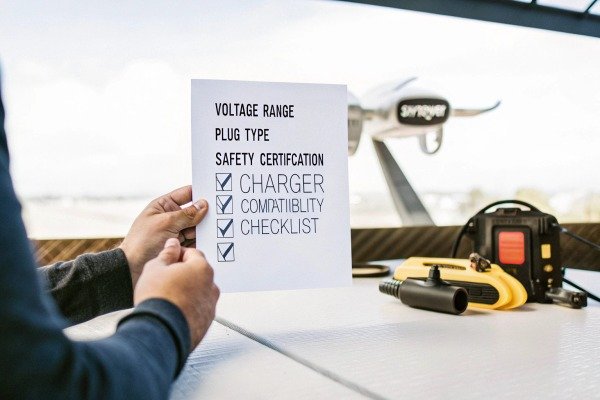
The physical connection between your charger and the wall outlet is often the weak link in the power chain. Firefighting drones use high-capacity LiPo batteries (often 6S to 14S configurations) that require substantial energy transfer. A typical fast charger might draw 12 to 15 amps continuously.
Why Travel Adapters Fail
Standard travel adapters are designed for low-power devices like laptops or phone chargers. They are rarely rated for the continuous high-amperage load of an industrial drone charger. Using an adapter introduces two points of failure:
- Increased Resistance: The contact points inside cheap adapters heat up under load, potentially melting the plastic casing.
- Loose Fit: A heavy charger cable can pull an adapter loose, interrupting the charge cycle. In a balance charging mode, an interruption can cause cell voltage errors.
The Importance of Grounding
Firefighting environments are hazardous. You are dealing with dry ash, synthetic materials, and often water. Static electricity is a real threat. Static electricity 5
- NEMA 5-15 (Type B): This is the standard US 3-pin plug. The third pin is the ground.
- NEMA 1-15 (Type A): This is the 2-pin ungrounded plug.
For any industrial drone charger, you must insist on Type B. The metal chassis of the charger needs to be grounded to the building's earth. If an internal short circuit occurs, the ground pin directs the electricity safely away, tripping the breaker rather than electrifying the charger case. We strictly prohibit shipping high-voltage chargers with ungrounded plugs to US clients.
The IEC Solution
Many professional chargers use a removable power cable with an IEC C13 or C19 connector on the charger side IEC C13 or C19 6 (like a desktop computer cable). If your supplier cannot provide a NEMA cable, verify that the charger uses a standard IEC port. This allows you to buy high-quality, UL-listed US power cables locally rather than relying on dangerous adapters.
Table 2: Plug Types and Safety Ratings
| Plug Type | Pins | Grounded? | Max Amperage (Typical) | Suitability for Firefighting Drones |
|---|---|---|---|---|
| NEMA 5-15 | 3 | Sí | 15 Amps | Ideal (Standard US Wall Outlet) |
| NEMA 1-15 | 2 | No | 15 Amps | Avoid (Safety Risk – No Ground) |
| NEMA 5-20 | 3 | Sí | 20 Amps | Excelente (Requires T-slot outlet) |
| Universal Adapter | Varía | Usually No | < 5-10 Amps (Real world) | Dangerous (Melting Risk) |
Which electrical safety certifications must the charger have to be legal in the US?
During export compliance checks, we find that many generic power supplies lack the markings required by US insurance policies. Using uncertified gear can void your department’s liability coverage in the event of an accident. liability coverage 7
The charger must carry a UL (Underwriters Laboratories) or ETL (Intertek) certification mark to comply with OSHA workplace safety standards. Additionally, FCC certification is required to ensure the high-power electronics do not cause radio frequency interference with your drone's communication systems during flight operations.
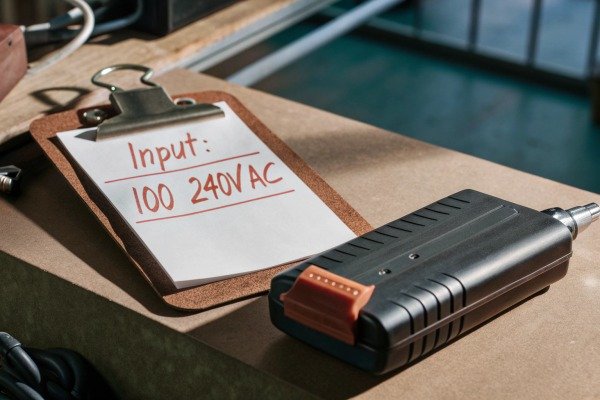
Safety certifications are not just stickers; they are proof that the device has undergone rigorous testing to handle the electrical stresses of the US grid. For government agencies and fire departments, purchasing non-certified equipment is often a violation of procurement policy. procurement policy 8
UL vs. CE: Knowing the Difference
Many chargers exported from Asia carry the CE mark. While important for Europe, CE is a self-declaration by the manufacturer. It does not carry the same weight in the US as UL (Underwriters Laboratories) or ETL (Intertek).
- UL/ETL Listed: Indicates the product has been tested by a Nationally Recognized Testing Laboratory (NRTL). This is often required by OSHA for workplace equipment.
- FCC Part 15: This is crucial for drones. Chargers are high-frequency switching devices. If not properly shielded (as verified by FCC testing), a charger can emit radio frequency noise. If you are charging batteries near your ground control station, this noise can interfere with video feeds or telemetry data.
The NDAA Factor
For US fire departments, especially those using federal grant money, compliance with the National Defense Authorization Act (NDAA) is critical. This restricts telecommunications and video surveillance equipment from certain prohibited vendors. While chargers are technically power accessories, sourcing them from compliant supply chains ensures you do not face audits or bans later. We ensure our supply chain remains transparent to assist with this compliance.
Fire Risk and Insurance
If a battery charger malfunctions and causes a fire station to catch fire, the insurance investigator's first step is to check the equipment. If the charger lacks a UL or ETL listing, the claim could be denied on the grounds of using negligence. UL or ETL listing 9 Firefighting drones deal with volatile Lithium Polymer (LiPo) chemistries Lithium Polymer (LiPo) chemistries 10; the charger is the primary safety gatekeeper for these batteries.
Table 3: Certification Hierarchy for US Buyers
| Certificación | Type | Mandatory? | What it Validates |
|---|---|---|---|
| UL / ETL | Safety | Highly Recommended (OSHA) | Fire safety, electric shock protection, component quality. |
| FCC | Interference | Yes (Legal Requirement) | Electromagnetic interference limits (won't jam radios). |
| CE | General | No (EU Standard) | General health/safety (Self-declared). |
| RoHS | Medioambiental | No | Absence of hazardous materials like lead. |
How can I validate the charger's compatibility during the sample testing phase?
Before we authorize bulk production for a client, we insist on a rigorous sample validation process. Paper specifications can lie, but physical performance tests under load never do.
Validate compatibility by measuring the output voltage under load using a multimeter while connected to a 110V source. Check for excessive heat buildup on the casing and verify that the charging speed matches the rated amperage, as some units significantly throttle power on lower voltage inputs.

Once you receive a sample unit, do not simply plug it in and walk away. You must perform an active acceptance test to prove it works safely on your specific electrical circuits.
The 110V Load Test
Connect the charger to a standard 110V outlet. Connect a discharged battery (at storage voltage, approx. 3.8V per cell).
- Monitor Amperage: Use the charger’s display or an external watt-meter to see the charging current. If the spec sheet promises 25 Amps but you only see 12 Amps, the charger is throttling due to the lower input voltage.
- Check the "Power Factor": US grids struggle with devices that have a "poor power factor." A good charger has Active Power Factor Correction (PFC) near 0.99. Without this, the charger draws "dirty" power, which can trip sensitive breakers on fire trucks or generators.
Thermal Profiling
US 110V power requires double the current on the input side to create the same watts as 220V.
- Example: To get 1000W output, a charger needs ~4.5 Amps at 220V, but ~9 Amps at 110V.
This doubled input current generates significantly more heat in the AC-to-DC conversion components. During your test, run a full charge cycle. Touch the casing. If it becomes too hot to touch (over 60°C/140°F), the internal cooling is insufficient for 110V operation, posing a fire risk.
Generator Compatibility
Firefighting drones often charge in the field using portable generators or fire truck inverters. These power sources often output "Modified Sine Wave" rather than "Pure Sine Wave."
- The Test: Connect the charger to a standard field generator.
- The Risk: Modified sine waves can cause cheap charger capacitors to buzz, overheat, and explode. High-quality chargers have input filtering to handle this "dirty" power safely. If your sample unit buzzes loudly or fluctuates on a generator, it is not fit for field duty.
Documentation Review
Finally, inspect the physical label on the device. Does it match the datasheet? We have seen instances where a supplier sends a US-compatible sample, but the bulk shipment contains domestic Chinese market units. The label on the bottom of the device is the binding legal specification.
Conclusión
Ensuring your firefighting drone charger works with US voltage is about more than just finding a plug that fits. It requires verifying 110V input support, demanding UL/ETL safety certifications, and testing for power throttling. By strictly validating these specs, you protect your investment and ensure your fleet is ready when the alarm rings.
Notas al pie
1. Official EIA explanation of electricity delivery and grid stability. ↩︎
2. Official NIST reference for US electrical units and standards. ↩︎
3. Provides background on global mains electricity standards. ↩︎
4. Technical standard for switching power supplies from IEEE. ↩︎
5. NFPA 77 provides recommended practice on static electricity safety. ↩︎
6. Manufacturer guide for IEC power cord standards and types. ↩︎
7. News report on insurance implications for commercial drone operations. ↩︎
8. Official federal acquisition regulations regarding procurement policies. ↩︎
9. Official site for UL safety certification and listing services. ↩︎
10. Educational resource from MIT on battery specifications and chemistries. ↩︎

 English
  Spanish
  German
  French
  Dutch
Dutch  Arabic
