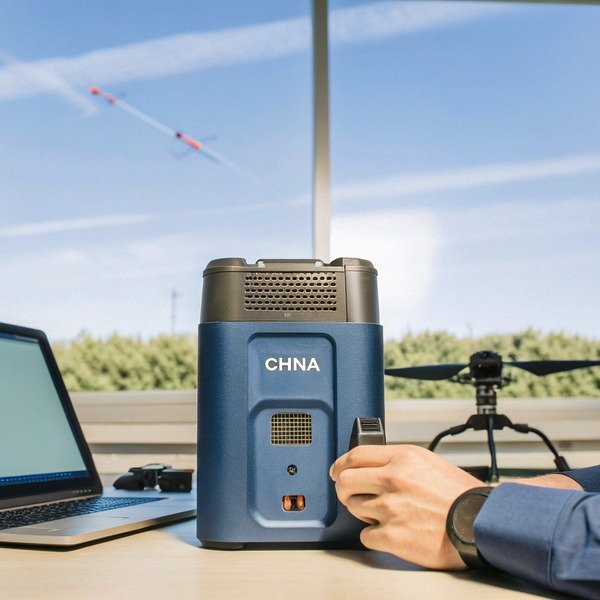
When we assemble heavy-lift quadcopters in our Xi’an facility, we know that the power supply system is just as critical to mission success as the flight controller or motors.
To verify compliance, verify the charger’s input label states 100-240V 50/60Hz support and physically confirm a Type C or F plug. You must also demand valid CE certificates covering Low Voltage (LVD) and EMC directives, specifically testing the charger against EU safety standards.
Let’s break down the exact steps you need to take to ensure your equipment is safe and legal for import.
Which specific safety certifications should I request to prove the drone chargers meet EU standards?
During our export process to Germany and France, we constantly update our compliance files to match the strict customs documentation requirements for high-voltage electronics.
You must request a valid CE Declaration of Conformity (DoC) supported by specific test reports for the Low Voltage Directive (2014/35/EU) and Electromagnetic Compatibility (EMC). Additionally, ensure the charger complies with RoHS standards to restrict hazardous materials like lead.

When sourcing industrial firefighting drones, simply seeing a "CE" sticker on the charger is not enough. The CE mark is a self-declaration by the manufacturer, and unfortunately, it is sometimes misused. To protect your company from liability and customs seizures, you need to look behind the sticker at the technical documentation.
The "Big Three" Directives
For a high-power drone charger to be legally sold in the EU, it must comply with three main directives. You should request the full test reports for these, not just the certificate.
- Low Voltage Directive (LVD): This is critical for electrical safety. It ensures the charger won't cause electric shock or fire. Since firefighting drones often use large 6S or 12S LiPo batteries, the charging current is high, making LVD compliance non-negotiable.
- Electromagnetic Compatibility (EMC): This ensures the charger doesn't emit interference that disrupts other electronics (like radio equipment) and isn't susceptible to interference itself.
- RoHS (Restriction of Hazardous Substances): This confirms the unit doesn't contain lead, mercury, or cadmium 1 banned levels of lead, mercury, or cadmium.
Verifying the CE Mark
A common issue we see in the market China Export 2 involves the "China Export" logo, which looks nearly identical to the official CE mark. The difference lies in the spacing. On the official European Conformity mark, the European Conformity mark 3 'C' and 'E' are formed from two circles that overlap. If the letters are too close together, it is likely a fake mark.
We recommend checking the issuing laboratory. If the test reports come from a reputable notified body 4, notified body (like TÜV, SGS, or Intertek), the credibility is much higher. You can verify the certificate number on the issuing body’s website.
Documentation Checklist
Use the following table to track the documents you request from your supplier.
| Nombre del documento | Objetivo | Key Verification Point |
|---|---|---|
| Declaration of Conformity (DoC) | Legal statement of compliance | Must be signed by the manufacturer or authorized EU representative. |
| LVD Test Report | Proof of electrical safety testing | Check that the model number on the report matches your charger exactly. |
| EMC Test Report | Proof of interference testing | Ensure the standards cited (e.g., EN 55032) are current. |
| RoHS Report | Chemical safety compliance | Verify the date of testing is recent (within 1-2 years). |
How can I confirm the charger's input voltage matches the 230V standard used in my European market?
We design our power systems to handle global logistics, knowing that a voltage mismatch can instantly destroy expensive avionics or cause significant delays in deployment.
Check the rating label on the charger for a wide input range, typically "INPUT: 100-240V ~ 50/60Hz," which covers the EU's 230V standard. Avoid chargers labeled only "220V/50Hz" or "110V," as these lack the tolerance for voltage fluctuations common in European grids.
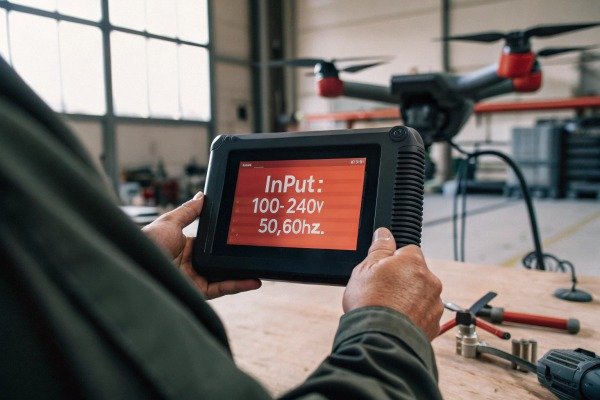
Voltage compatibility is often misunderstood. While China uses 220V and Europe uses a nominal 230V, the distinction is vital when dealing with sensitive, high-load charging equipment for firefighting drones.
The Universal Standard
Modern industrial chargers should use Switching Mode Power Supplies (SMPS) 5 Switching Mode Power Supplies (SMPS). These are designed to accept a wide range of input voltages. Your goal is to confirm the label explicitly reads 100-240V. This "universal" input allows the charger to operate safely in the UK (230V), US (120V), and mainland Europe (230V) without a transformer.
If a charger is labeled strictly "220V," it might work in Europe, but it runs a risk. European voltage can fluctuate by ±10% (up to 253V). A charger built with narrow tolerances for the Chinese grid might overheat or fail when exposed to the upper limits of the European grid.
Frequency Matters: 50Hz vs. 60Hz
Voltage is only half the equation. You must also check the frequency.
- Europe: 50Hz
- USA: 60Hz
- China: 50Hz
While China and Europe share the 50Hz frequency, a charger designed solely for the US market (60Hz) might overheat if plugged into a European outlet. Always ensure the label says 50/60Hz, indicating it can handle both cycles.
Why Adapters Are Not the Solution
We strongly advise against using travel adapters for industrial drone chargers. Firefighting drone batteries often require high amperage (10A to 30A) to charge quickly.
- Resistance: Adapters add contact resistance, which generates heat contact resistance 6.
- Grounding: Many cheap adapters do not connect the earth pin 7 earth pin. If the charger has a metal casing and an internal fault occurs, the casing could become live, posing a lethal shock hazard.
- Stability: A heavy charger brick hanging off a travel adapter is mechanically unstable and prone to arcing if it slips.
Always require the supplier to provide a IEC C13 or C5 cable 8 native cable that connects directly from the wall to the charger unit (often an IEC C13 or C5 cable) rated for the correct voltage.
What details must I include in my purchase order to ensure the factory provides the correct European plug type?
When our sales team processes orders for large-scale tenders, vague specifications often lead to production delays or clients receiving incorrect hardware that requires replacement.
Explicitly specify the exact plug type, such as "Type F (Schuko) with grounding clips" or "Type C (Europlug)," rather than generic terms like "European Standard." Include photos of the required plug in your PO and mandate that the cable gauge handles the specific amperage of the drone battery.
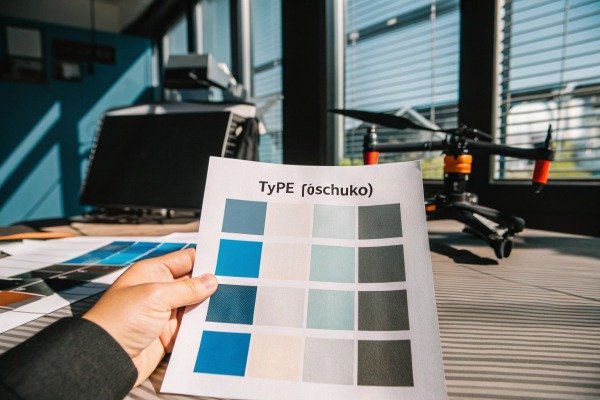
The term "European Plug" is dangerous because Europe uses several different standards. If you do not specify the exact type, a factory might send you the cheapest option available, which may not be suitable for heavy-duty firefighting equipment.
Distinguishing Plug Types
For industrial drone applications, grounding is essential. This usually rules out the simple flat Europlug (Type C) 9, two-pin Europlug (Type C) for the main charger unit, as it lacks an earth connection.
- Type F (Schuko): This is the standard in Germany, Austria, the Netherlands, and Spain. It has two round pins and two earthing clips on the side. It is rated for up to 16 Amps, making it ideal for drone chargers.
- Type E: Used primarily in France, Belgium, and Poland. It is similar to Type F but has a hole in the plug to accept the socket's male grounding pin.
- Hybrid E/F: Most modern high-quality cables come with a hybrid plug that works in both Type E and Type F sockets. This is the safest bet for broad EU compatibility.
Cable Gauge Specifications
The physical plug is important, but the wire behind it is critical. Firefighting drone batteries are large capacity (e.g., 22,000mAh) and charge at high currents. A thin cable can melt.
In your Purchase Order (PO), you should specify the wire cross-sectional area.
- Standard cable: 0.75mm² (okay for low power).
- Required for Drones: Minimum 1.0mm² or preferably 1.5mm² pure copper wire.
Visual Specification Guide
To avoid any confusion with your supplier, include a visual guide in your PO. Words can be mistranslated; pictures cannot.
| Plug Type | Primary Countries | Grounded? | Suitability for Heavy Drones |
|---|---|---|---|
| Type C (Europlug) | All EU (except UK/Ireland) | No | Low. (Max 2.5A. Only for small accessories). |
| Type F (Schuko) | Germany, Spain, Sweden | Sí | High. (Max 16A. Standard for industrial gear). |
| Type E | France, Belgium, Poland | Sí | High. (Max 16A). |
| Type G | UK, Ireland, Malta | Sí | High. (Requires fused plug). |
Should I hire a third-party inspection agency to test the electrical compliance of the chargers before shipment?
We welcome external audits at our facility because they provide our clients with absolute peace of mind regarding safety and demonstrate our commitment to quality control.
Yes, hiring a third-party agency is highly recommended for high-value industrial equipment. They perform critical on-site checks, including Hi-Pot (dielectric withstand) testing, physical plug verification, and ensuring the internal components match the approved CE construction file, preventing the shipment of substandard goods.
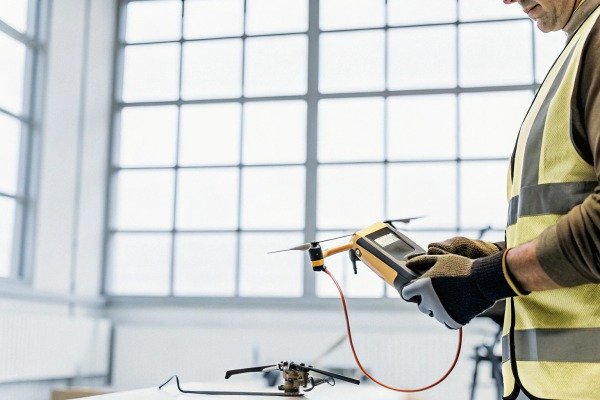
For a single consumer drone, a third-party inspection might be overkill. However, for a batch of industrial firefighting drones costing tens of thousands of dollars, the cost of inspection is a tiny fraction of the potential loss.
What an Inspector Checks
When you hire an agency like SGS, Bureau Veritas 10 SGS, Bureau Veritas, or a specialized electronics inspection firm, they don't just count the boxes. You should instruct them to perform specific electrical safety tests on a random sample of chargers.
- Hi-Pot Test (High Potential): The inspector applies a high voltage (usually 1500V or 3000V) between the input and output to ensure the insulation does not break down. This simulates a power surge and ensures the user won't get shocked.
- Earth Continuity Test: This confirms that the grounding pin on the plug is actually connected to the metal casing of the charger. We have seen instances in the market where "fake" ground pins were not connected to anything inside.
- Internal Construction Check: The inspector opens up a unit to verify that the internal components (like the transformer and fuse) match the specifications listed in the CE report (CDF – Construction Data File). This prevents "Golden Sample" fraud, where the factory sends a perfect unit for testing but mass-produces a cheaper version.
Cost vs. Risk Analysis
An inspection typically costs between $200 and $300 per man-day. Compare this to the cost of a fire caused by a faulty charger in a fire station, or the cost of having your entire shipment seized by EU customs because the documentation didn't match the product.
Inspection Protocol
Create a clear protocol for the inspection agency.
- Sample Size: Level II (Standard).
- AQL (Acceptable Quality Limit): Critical Defects = 0 (Safety issues like exposed wires). Major Defects = 2.5 (Functionality issues).
- Specific Instructions: "Technician must plug the charger into a 230V source and run a full charge cycle on a dummy load to check for overheating."
By enforcing this step, you signal to the supplier that you are a professional buyer who understands technical safety, which inevitably leads to better quality production.
Conclusión
Ensuring charger safety protects your investment and reputation. Correct voltage, clear plug specs, and independent verification guarantee your fleet is mission-ready immediately upon arrival.
Notas al pie
1. Official EU RoHS directive page restricting these specific hazardous substances. ↩︎
2. Encyclopedia entry explaining the common misconception regarding this logo. ↩︎
3. Official EU Commission guide on the design and requirements of the CE mark. ↩︎
4. Official EU definition and database of notified bodies for compliance testing. ↩︎
5. Technical documentation from a major manufacturer explaining SMPS technology. ↩︎
6. Scientific overview of contact resistance in electrical engineering contexts. ↩︎
7. Industry safety organization explaining the importance of grounding connections. ↩︎
8. Product category page from a major manufacturer of compliant power cables. ↩︎
9. International Electrotechnical Commission standard definition for Type C plugs. ↩︎
10. Website of a major testing and certification company mentioned in the text. ↩︎

 English
  Spanish
  German
  French
  Dutch
Dutch  Arabic
