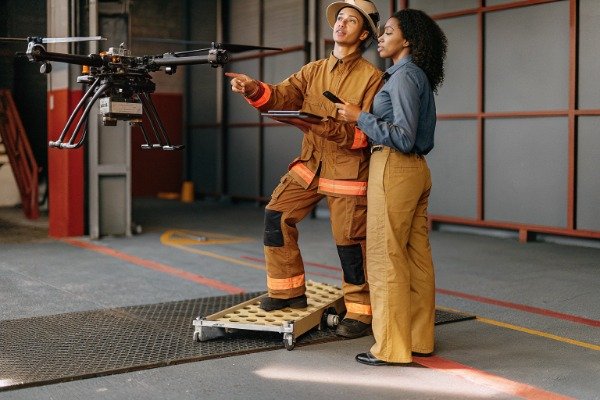
At SkyRover, we frequently see procurement managers struggle to balance payload weight with flight stability during critical missions. You need a system that delivers agents reliably without compromising the drone’s safety.
You must evaluate the payload capacity, release mechanism compatibility, and aiming precision. Crucial details include the specific type of agent supported (powder, foam, or projectiles), the recoil management system for flight stability, and the integration of thermal sensors for accurate targeting through smoke.
Let’s break down the technical specifics to ensure you choose the right equipment for your fleet.
Is the release mechanism compatible with standard fire extinguishing balls?
We often customize drop racks for clients who need flexibility with local ammunition supplies to avoid supply chain bottlenecks.
supply chain bottlenecks 1
Most industrial drones feature modular release mechanisms adaptable to standard fire extinguishing balls, but verify the specific diameter and weight limits. Universal drop racks often support 1.3kg balls, yet proprietary launchers may require specific brands, affecting your long-term supply chain and operational costs.

Understanding Release Mechanism Types
When we design our heavy-lift drones in Chengdu, we prioritize modularity. However, not all "universal" mounts are truly universal. The compatibility of a release mechanism dictates your operational flexibility. If you are locked into a proprietary shape or size of fire extinguishing ball, you might face sourcing issues during an emergency.
There are generally three types of release mechanisms you will encounter in the market:
- Gravity-Drop Racks: These are simple, mechanical claws or trapdoors. They rely on gravity to release the ball. They are reliable but offer less precision.
- Pneumatic Launchers: These use compressed air to shoot the ball or projectile. They offer range and precision but add weight and complexity.
- Linear Actuator/Servo Grippers: These provide a balance, using a motor to release the payload.
The Importance of Diameter and Weight
Standard fire extinguishing balls typically come in sizes like 150mm diameter weighing around 1.3kg. However, we have seen variations in the market ranging from 0.5kg to 4kg. A mechanism designed for a 1.3kg ball may fail or jam if loaded with a slightly larger generic brand.
Furthermore, the grip strength of the mechanism matters. In our flight tests, we found that high-speed maneuvers can dislodge balls from poorly designed gravity racks if the grip isn’t calibrated for the specific friction coefficient of the ball’s casing.
Chemical Agent Considerations
Beyond the physical fit, you must consider the agent inside. Some balls are designed for ignition (controlled burns) rather than suppression. Using an ignition sphere in a suppression rack is a recipe for disaster. Always verify that the release mechanism is rated for the specific "Dangerous Goods" classification of the payload.
controlled burns 2
Comparison of Common Projectile Types
To help you evaluate what your fleet needs, here is a comparison of the common projectile types we integrate:
| Projectile Type | Typical Weight | Release Mechanism | Mejor caso de uso |
|---|---|---|---|
| Standard AFO Ball | 1.3 kg | Gravity Drop / Servo Claw | General fire suppression in open areas. |
| Precision Capsule | 0.5 – 1 kg | Pneumatic Launcher | High-rise window penetration or spot fires. |
| Ignition Sphere | < 0.1 kg | Dispenser Chute | Controlled burns for forestry management. |
| Liquid "Bomb" | 5 – 25 kg | Heavy-Duty Latch | Large area saturation (requires heavy-lift drone). |
How precise is the aiming system for high-altitude targeting?
Our engineering team spends months tuning algorithms to ensure accuracy even when high winds buffet the aircraft near a blaze.
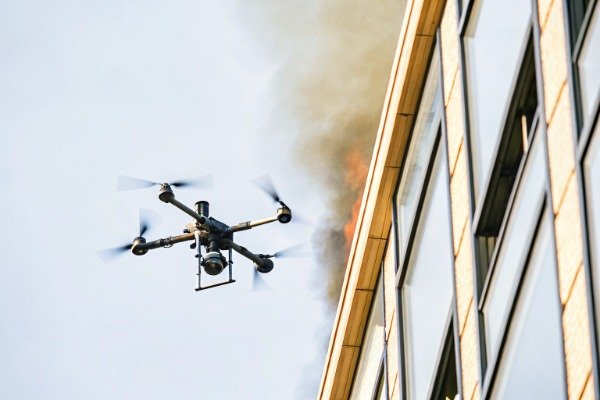
Precision depends on the integration of laser rangefinders and real-time ballistic calculators within the flight controller. High-end systems achieve centimeter-level accuracy by compensating for wind speed, drone velocity, and altitude, ensuring the projectile hits the fire core rather than just the building exterior.
The Role of Integrated Sensors
Accuracy is not just about the pilot’s skill; it is about the hardware assisting them. When we export to the US, our clients often demand high-altitude capabilities for skyscrapers. At 100 meters up, a small deviation in aim results in a missed shot.
The core of a precise system is the Laser Rangefinder. This sensor measures the exact distance to the target. Without it, the pilot is guessing the trajectory. In our SkyRover high-end models, we link the rangefinder data directly to the camera gimbal. This creates an "impact point" overlay on the pilot’s screen, showing exactly where the projectile will land.
Recoil and Stability Management
One factor often overlooked is recoil. Launching a 1.3kg projectile creates a significant backward force. If the drone’s flight controller does not anticipate this, the drone will pitch up or drift backward, ruining the aim for follow-up shots.
We utilize "feed-forward" algorithms in our flight controllers. When the trigger is pulled, the motors instantly spin up to counter the recoil before the physical movement even happens. This keeps the camera steady on the target.
Thermal Imaging for Smoke Penetration
Visible light cameras are useless in thick smoke. A precise aiming system must include a thermal camera. The thermal sensor identifies the hottest part of the fire (the core), not just the flames.
- Hotspot Tracking: Advanced AI can lock onto the heat signature.
- Dual-Sensor Alignment: The thermal image must be perfectly aligned with the visual camera and the launcher. If these are offset by even a few centimeters without software calibration, accuracy suffers at long distances.
Ballistics and Environmental Factors
Finally, the system must account for physics. A ball dropped from a hovering drone falls straight down (mostly). A ball launched from a pneumatic tube follows an arc.
We recommend systems that include a Ballistic Calculator. This software takes into account:
- Wind Speed: Measured by the drone’s internal sensors.
- Drone Velocity: Is the drone moving forward?
- Angle of Attack: How steep is the launch angle?
Targeting Technology Tiers
| Tech Level | Key Components | Typical Accuracy | Recommended Application |
|---|---|---|---|
| Basic | Visual Camera, Manual Aim | +/- 5 meters | Low-altitude, open field fires. |
| Intermediate | Laser Rangefinder, Static Crosshair | +/- 2 meters | Mid-rise buildings, general structure fires. |
| Advanced | Thermal Tracking, Ballistic Calculator, Recoil Comp. | +/- 0.5 meters | High-rise windows, specific equipment fires. |
What is the reload time required between sorties?
We know that in a raging fire, every second spent on the ground counts against you and allows the fire to spread.
Reload time varies significantly between modular cartridge systems and fixed tank designs, typically ranging from two to ten minutes. Quick-swap payload bays allow ground crews to replace empty launchers instantly, whereas liquid refill systems require pumping equipment that extends downtime during critical missions.
The Logistics of "Turnaround Time"
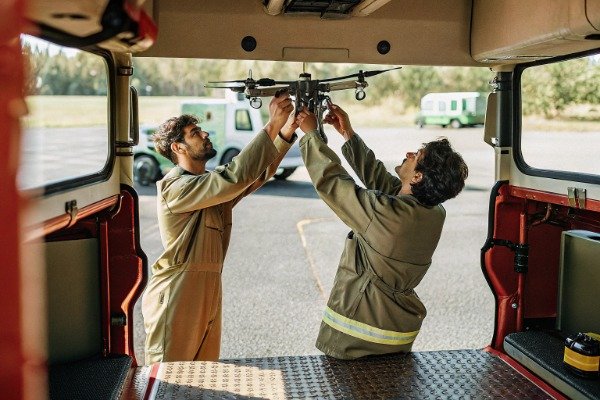
In our experience serving fire departments, the drone is only as good as its uptime. If a drone drops its payload in 30 seconds but takes 20 minutes to reload, the fire will regenerate. We call this the "suppression gap."
To minimize this gap, you need to look at the Payload Interface.
- Quick-Release Mounts: Does the launcher snap off? Or do you have to unscrew bolts? The best systems use a slide-and-lock mechanism.
- Pre-Loaded Cartridges: We advise clients to buy multiple launcher magazines. Ground crews can load spare magazines while the drone is flying. When the drone lands, it takes 10 seconds to swap the empty magazine for a full one.
Liquid vs. Solid Reloading
If you are using a liquid agent delivery system (like a hose spray or a dropped water bomb), reloading is messier and slower.
- Liquid Tanks: You need a pump and a water source. Refilling a 20-liter tank takes time and introduces air bubbles that can affect flight stability (sloshing).
- Solid Projectiles: These are dry and easy to handle. A crate of fire balls can be kept in a pickup truck.
Battery Swapping Synchronization
Reloading the agent is only half the battle. You also need to swap batteries.
Smart design synchronizes these two events. If your drone flies for 20 minutes but runs out of ammo in 5 minutes, you are wasting flight time returning to base. Conversely, if the ammo lasts longer than the battery, you are carrying dead weight.
fail-safe 3
We design our mission profiles so that the payload is exhausted roughly when the battery reaches 30%. This allows for a "Pit Stop" approach:
- Drone lands.
- Team A swaps the battery.
- Team B swaps the payload cartridge.
- Drone takes off.
Total time: Under 3 minutes.
dangerous goods 4
Operational Efficiency Comparison
| System Type | Reload Method | Estimated Ground Time | Crew Requirements |
|---|---|---|---|
| Modular Cartridge | Swap entire launcher unit | 1 – 2 Minutes | 1 Person |
| Manual Loading | Insert balls one by one | 5 – 8 Minutes | 2 People (one holds drone) |
| Liquid Tank | Pump from reservoir | 5 – 10 Minutes | 2 People + Pump Equipment |
| Tethered System | Continuous supply (Hose) | N/A (Continuous) | Truck Support Required |
Does the system have safety locks to prevent accidental discharge?
Safety is our priority at the factory; we rigorously test fail-safes before shipping any unit to ensure no harm comes to the operators.
liquid agent delivery system 5
Yes, professional firefighting drones must include dual-stage safety locks, combining mechanical pins with software arming protocols. These systems prevent accidental release during takeoff or transport by requiring a specific "arm" command from the pilot and often feature physical safety switches on the payload itself.

Mechanical vs. Software Safety
When dealing with explosives or heavy projectiles, "oops" is not an option. We have seen cheap retrofit kits that rely solely on a toggle switch on the remote. This is dangerous. If the pilot bumps the switch while the drone is on the ground, a projectile could injure the crew.
Visible light cameras 7
Mechanical Safety Pins:
Just like a fire extinguisher has a pin, a drone launcher should have a physical barrier that prevents the mechanism from moving. This pin is removed by the ground crew only immediately before takeoff. This ensures that during transport and setup, the system is physically incapable of firing.
Software Arming:
Once in the air, the software takes over. A good system requires an "Arming Sequence." The pilot usually has to toggle a switch and confirm on the screen.
- Geofencing: Some advanced systems prevent discharge if the drone is inside a "No Fire Zone" (like over the command center).
- Altitude Locks: The system can be set to only allow firing if the drone is above 5 meters, preventing ground misfires.
Dangerous Goods Regulations
Transporting these drones and their ammo requires compliance. In the US and Europe, fire extinguishing cartridges are often classified as dangerous goods. The safety locks are part of the certification process.
feed-forward 8
If a supplier cannot explain their safety redundancy (i.e., what happens if the flight controller crashes?), be wary. The launcher should have a "Fail-Safe" state. If power is lost, does the claw open (dropping the load) or stay closed? For heavy areas, "Fail-Safe Closed" is usually preferred to prevent dropping a bomb on a house during a power outage.
camera gimbal 9
Maintenance of Safety Mechanisms
Residue from fire environments can corrode safety latches.
- Corrosion: Fire extinguishing powder is corrosive. If a previous mission left residue, a mechanical safety latch might seize up.
- Inspection: We recommend a pre-flight check specifically for the safety lock. It must move freely.
Safety Feature Checklist
When evaluating a vendor, ask for these specific features:
- Physical Safety Pin: Red flag if missing.
- Dual-Confirmation Trigger: Requires two distinct inputs to fire.
- Visual Status Indicator: An LED on the drone showing Red (Armed) or Green (Safe).
- Fail-Safe Protocol: Defined behavior on signal loss.
Conclusión
Selecting the right delivery system ensures safety and efficiency. You must balance payload compatibility, aiming precision, and rapid reloading to maximize ROI. Contact us for tailored drone solutions.
friction coefficient 10
Notas al pie
- Defines the economic concept regarding procurement delays mentioned in the text. ↩︎
- Provides context on the forestry management technique used with ignition spheres. ↩︎
- Defines the safety engineering principle required for drone launchers. ↩︎
- Cites regulations concerning the transport of hazardous firefighting payloads. ↩︎
- Links to standard aerial firefighting methods for comparison with solid projectiles. ↩︎
- References the onboard technology used to measure environmental data like wind. ↩︎
- Distinguishes standard optical imaging from the thermal imaging required in smoke. ↩︎
- Explains the control theory algorithm used to anticipate recoil. ↩︎
- Defines the stabilizing hardware used to align the laser rangefinder. ↩︎
- Explains the physical property affecting the grip mechanism’s reliability. ↩︎

 English
  Spanish
  German
  French
  Dutch
Dutch  Arabic
