
When we guide clients through our assembly line in Chengdu, we often notice they feel overwhelmed by the sheer volume of technical specifications on our data sheets. Buying the wrong equipment is a costly mistake that leads to inefficient field coverage and frequent downtime during critical spraying seasons.
You should prioritize payload capacity relative to your field size, ensuring battery charging speed supports continuous cycling. Critical parameters include nozzle technology for droplet control, RTK positioning for centimeter-level accuracy, and an IP67 rating to protect components from corrosive chemicals and allow for necessary daily cleaning.
Let’s break down the specific technical metrics that actually impact your daily farming operations.
How do I determine the optimal tank capacity and spray width for my farming operations?
During the design phase of our SkyRover frames, we constantly balance the trade-off between heavy lifting capacity and flight agility. Many buyers assume bigger is always better, but carrying a massive tank on a small plot destroys efficiency due to unnecessary battery drain and transport difficulties.
Calculate your tank capacity based on average field size; 10-liter tanks suit small plots, while 30-50 liter tanks serve large commercial operations. Spray width depends on flight height and nozzle type, where wider effective widths reduce total passes, significantly increasing hectares covered per battery cycle.
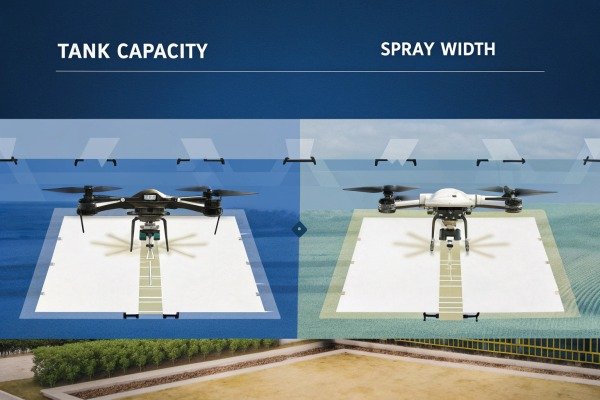
To make the right choice, you need to look beyond the marketing numbers and understand the physics of application. A drone’s efficiency is a function of how much liquid it can carry versus how fast it depletes its energy source.
Analyzing Payload to Field Ratio
In our testing, we have found that an oversized drone on a small, irregular field is cumbersome. It requires more time to set up and is harder to maneuver around obstacles. Conversely, a small drone on a massive farm requires constant landing and refilling, which kills productivity.
- Entry-Level (8L – 10L): Best for small farms, nurseries, or testing. These units are highly portable and can often be carried by one person.
- Mid-Range (16L – 25L): The sweet spot for most diversified farms. They offer a balance of flight time and coverage.
- Heavy-Duty (30L – 50L): Designed for broad-acre crops. These require heavy-duty batteries and often a team of two to handle safely on the ground.
The Physics of Spray Width
Spray width is not a static number. It changes based on your altitude and the type of nozzles installed. When we calibrate our flight controllers, we define the "effective spray width" based on a standard height of 2 to 3 meters above the crop canopy.
If a manufacturer claims a 10-meter spray width, verify the altitude required to achieve it. Flying too high to get a wider swath increases the risk of drift, where chemicals blow onto neighboring crops.
Nozzle Technology: Pressure vs. Centrifugal
Your choice of nozzle affects the width and quality of the spray.
- Pressure Nozzles: Standard flat fans. They are reliable but can clog with thick fluids.
- Centrifugal (Rotary) Atomizers: These spin to create droplets. They offer adjustable droplet size (50-500 μm) via software, allowing you to widen the spray pattern without changing physical parts.
We have compiled a general guideline based on our export data to help you match specs to your needs:
| Farm Size (Acres) | Recommended Tank Capacity | Ideal Spray Width | Typical Flight Height |
|---|---|---|---|
| < 50 Acres | 10 Liters | 3 – 4.5 Meters | 1.5 – 2 Meters |
| 50 – 500 Acres | 20 – 30 Liters | 5 – 7 Meters | 2 – 3 Meters |
| > 500 Acres | 40 – 50 Liters | 8 – 11 Meters | 3 – 4 Meters |
What battery life and charging speed specifications are critical for my daily workflow?
We stress test our lithium polymer cells in extreme temperatures lithium polymer cells 1 because we know a drone that sits on the ground charging is a drone that isn’t making money. Farmers often focus on total flight time, but the true bottleneck in commercial operations is almost always the charger’s cooling and output speed.
You require a battery ecosystem that charges fully in 9 to 15 minutes to enable continuous operations with just two or three battery sets. Look for smart batteries with high C-ratings for rapid discharge and robust thermal management systems that prevent overheating during rapid charge cycles.
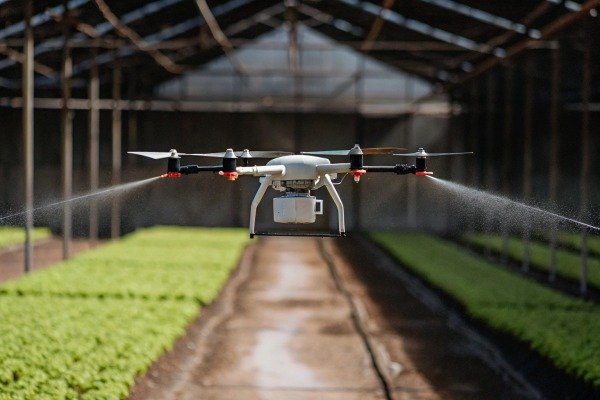
Battery technology is the limiting factor in electric aviation. However, the goal is not necessarily to have a battery that flies for an hour. The goal is to have a continuous workflow.
The "Continuous Duty" Cycle
In professional drone spraying, "flight time" is less important than "turnaround time." A drone carrying a 40kg payload might only fly for 7 to 10 minutes. If your battery takes 60 minutes to charge, you need six costly batteries to keep flying non-stop.
However, if your system supports Ultra-Fast Charging (typically 9 to 15 minutes), you only need:
- One battery in the air.
- One battery on the charger.
- (Optional) One battery cooling down.
Real-World Flight Time vs. Specs
Marketing materials usually list "hovering time without payload," which might be 20+ minutes. This is irrelevant to your work. You need to know the Loaded Flight Time.
- Hovering (No Load): 20-25 minutes.
- Spraying (Full Load): 7-12 minutes.
When we engineer our power distribution boards, we aim for the drone to empty its tank exactly as the battery hits its safety threshold (usually 15-20%). If the battery dies before the tank is empty, you are wasting efficiency carrying dead liquid weight back to base.
Cooling is Critical
Fast charging generates immense heat. High-end chargers, like the ones we source for our heavy-lift units, use active air cooling or water cooling tanks. If a battery is too hot after a flight, the charger’s safety sensors will refuse to charge it until it cools down, causing delays.
Here is a comparison of how charging infrastructure impacts your initial investment and daily output:
| System Type | Charging Speed | Batteries Needed for Non-Stop Work | Est. Daily Coverage (8 hrs) |
|---|---|---|---|
| Standard Charging | 45 – 60 Minutes | 5 – 6 Batteries | 40 – 50 Hectares |
| Fast Charging | 20 – 30 Minutes | 3 – 4 Batteries | 60 – 70 Hectares |
| Ultra-Fast Charging | 9 – 12 Minutes | 2 Batteries | 80 – 100+ Hectares |
Do I really need RTK positioning and obstacle avoidance radar for my agricultural tasks?
Our software engineers spend months refining the algorithms that interpret sensor data because manual flight is simply too imprecise for modern agriculture. modern agriculture 2 While you might think you can fly straight manually, visual fatigue sets in quickly, leading to skipped rows and wasted chemicals.
RTK is essential for preventing dangerous overlaps and untreated gaps by maintaining centimeter-level precision, while obstacle avoidance radar is non-negotiable for autonomous safety. These systems allow the drone to follow uneven terrain Terrain following radar 3 automatically and stop instantly before hitting pylons or trees.
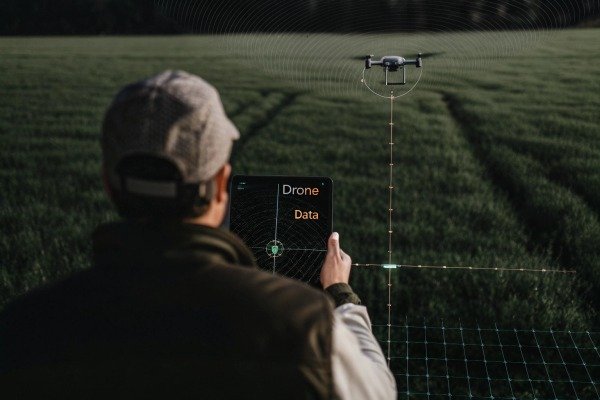
The difference between a toy and a tool lies in its sensors. In agriculture, precision equals profit. If you double-spray a crop, you might burn it or waste expensive inputs. If you miss a spot, pests survive and spread.
The Necessity of RTK (Real-Time Kinematic)
Standard GPS, like on your phone or basic camera drones Standard GPS, like on your phone 4, has an accuracy of roughly ±1 to 2 meters.
- Scenario without RTK: You program a flight path. The drone drifts 1.5 meters to the right. You now have a 1.5-meter gap where no pesticide is applied.
- Scenario with RTK: The drone communicates with a base station or network. Accuracy tightens to ±10 centimeters. The spray rows line up perfectly like a printed pattern.
For high-value crops or automated flight paths (A-B point mode), RTK is mandatory. It also allows the drone to resume exactly where it left off after a battery swap, known as "breakpoint resumption."
Terrain Following Radar
Fields are rarely perfectly flat. If a drone flies at a fixed altitude (e.g., 20 meters relative to the takeoff point) and the hill rises 10 meters, the drone is now only 10 meters above the crop. This changes the spray width and drift potential drift potential 5.
Terrain following radar points downward, measuring the distance to the canopy in real-time. It adjusts the drone's throttle hundreds of times per second to keep a constant height (e.g., exactly 2.5 meters above the plants) regardless of the slope.
Omnidirectional Obstacle Avoidance
Early agricultural drones only had front-facing radar. When they flew autonomously and turned to switch rows, they often drifted sideways into trees. Modern systems, including those we integrate, use 360-degree rotating radar or binocular vision binocular vision 6. This detects thin wires, utility poles, and branches at night or in bright sunlight, automatically halting the drone or planning a bypass route.
Comparison of Positioning Tech
| Característica | Standard GPS | RTK System | Benefit to Farmer |
|---|---|---|---|
| Horizontal Accuracy | ± 1.5 Meters | ± 0.10 Meters | Prevents crop burn (overlap) and pest outbreaks (gaps). |
| Vertical Accuracy | ± 0.5 Meters | ± 0.10 Meters | Ensures consistent spray height for uniform coverage. |
| Drift Resistance | Bajo | Alto | Keeps drone stable in strong winds. |
| Anti-Magnetic Interference | Bajo | Alto | Safer near high-voltage power lines and metal structures. |
What IP protection ratings should I look for to ensure my drone withstands harsh field conditions?
We treat the frames of our SkyRover drones with specialized coatings because we know the corrosive nature of fertilizers and pesticides will destroy fertilizers and pesticides 7 unprotected aluminum in weeks. A drone is not just flying in the rain; it is living in a cloud of corrosive mist and needs aggressive cleaning.
Look for a minimum rating of IP67 for the core avionics and IP65 for the propulsion systems to ensure water and dust tightness. This level of protection ensures the drone can withstand corrosive fertilizer dust and allows you to wash the entire unit with water after every operation.
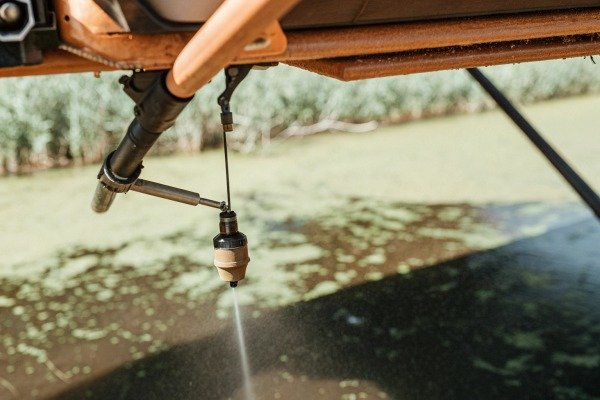
Agriculture is a dirty environment. Dust, pollen, and chemical residue accumulate on every surface. If you cannot wash your drone, those chemicals will eventually eat through wiring insulation and seize motors.
Decoding the IP Rating
The "IP" stands for Ingress Ingress Protection 8 Ingress Protection 9 Protection.
- First Digit (Solids/Dust): A '6' means the unit is completely dust-tight. No fertilizer granules or fine dust can enter the casing.
- Second Digit (Liquids/Water):
- '5' protects against low-pressure water jets (like a garden hose).
- '7' protects against immersion in water up to 1 meter for 30 minutes.
For the core module (where the flight controller and electronics live), IP67 is the standard we recommend. This guarantees that even if you accidentally blast it with a pressure washer or it lands in a wet paddy field, the brain of the drone survives.
Material Selection against Corrosion
Protection isn't just about sealing gaps; it's about materials.
- Carbon Fiber: We use this for arms and frames. It is light, strong, and completely immune to rust.
- Aviation Aluminum: Used for folding joints. It must be anodized or coated to resist corrosion.
- Potted Electronics: The best ESCs (Electronic Speed Controllers) are "potted," meaning they are encased in a solid resin. This prevents vibration damage and completely blocks moisture.
Maintenance and Longevity
If you buy a drone with a low IP rating (like IP54), you are limited to wiping it down with a damp cloth. This leaves residue in crevices. Over time, urea and other fertilizers react with humidity to form corrosive acids.
With an IP67 system, your post-flight workflow is simple: remove the battery, hose down the entire aircraft, and let it dry. This significantly extends the lifespan of your investment.
Conclusión
Selecting the right agricultural drone requires looking past the shiny exterior and focusing on the core parameters that drive ROI drive ROI 10: payload capacity tailored to your acreage, fast-charging batteries for continuous uptime, precise RTK systems, and rugged IP67 protection. By matching these technical specs to your specific field conditions, you ensure reliable, efficient operations for years to come.
Notas al pie
1. Background on the battery chemistry used in agricultural drones. ↩︎
2. FAO resources on how digital technology is transforming global farming. ↩︎
3. Technical explanation of terrain following systems. ↩︎
4. Official US government source explaining GPS accuracy standards. ↩︎
5. EPA guidelines on reducing pesticide drift in agriculture. ↩︎
6. Scientific overview of binocular vision technology in robotics. ↩︎
7. Official US government guidance on safe pesticide application and regulation. ↩︎
8. Official definition from the International Electrotechnical Commission. ↩︎
9. Explains the international standard for sealing electrical enclosures. ↩︎
10. Authoritative definition of ROI from Harvard Business Review. ↩︎

 English
  Spanish
  German
  French
  Dutch
Dutch  Arabic
