
When our engineering team reviews supplier documentation, we often find wind tunnel test reports that raise more questions than they answer life-safety applications 1. Missing data points, vague testing conditions, and unverified facilities can put your entire firefighting operation at risk.
To verify a supplier’s wind tunnel test report, check for third-party lab accreditation, confirm testing conditions match real firefighting scenarios, review uncertainty analysis methods like Monte Carlo simulations, and demand complete documentation including instrumentation calibration records and model specifications.
This guide walks you through practical steps to evaluate wind tunnel reports, spot red flags, and ensure your firefighting drone can handle the harsh conditions of wildfire operations.
How can I verify that my supplier's wind tunnel test report is authentic and legally valid?
Our quality control team has rejected more than a few test reports over the years. The difference between authentic documentation and questionable data often comes down to specific details that many buyers overlook.
An authentic wind tunnel test report must include third-party laboratory accreditation (such as SGS, TÜV, or Intertek), complete test facility documentation, calibration certificates for all instrumentation, and compliance with recognized standards like AIAA G-160-2025. Legal validity requires full traceability to the specific drone model being purchased.

Key Elements of an Authentic Test Report
When we prepare test documentation for our export customers, we include several critical elements that distinguish genuine reports from fabricated ones. First, look for the laboratory's accreditation number and verify it directly with the accrediting body. Second, check that the test date, facility location, and equipment serial numbers are all documented.
The test report should reference specific drone configurations. A generic report covering "quadcopter drones" without specifying your exact model, payload configuration, and firmware version is essentially useless.
Documentation Checklist for Legal Validity
| Tipo de documento | What to Verify | Red Flag |
|---|---|---|
| Lab Accreditation | ISO 17025 certification number 2 | No verifiable certification |
| Test Protocol | AIAA G-160-2025 3 or equivalent standard | "Internal standards" only |
| Calibration Records | Recent calibration dates for all sensors | Outdated or missing certificates |
| Model Specification | Exact match to purchased drone | Generic model references |
| Uncertainty Analysis | Monte Carlo or Taylor Series method documented | No error bounds provided |
| Raw Data | Available upon request | Supplier refuses access |
Cross-Referencing with Regulatory Requirements
In our experience exporting to the US and Europe, we've learned that different markets have different documentation requirements. The FAA and EASA are increasingly requiring validated aerodynamic data for drone certifications. Your supplier should provide a full technical file that includes not just the wind tunnel report, but also the EU Declaration of Conformity 4 and evidence of component traceability.
Contact the testing laboratory directly. Reputable labs like SGS and TÜV maintain databases of issued certificates. If the lab cannot confirm the report, you have your answer. Additionally, check if the test facility follows NIST recommendations 5 for wind effects assessment. Facilities that skip full documentation often produce results that vary significantly from real-world performance.
Understanding Chain of Custody
The digital integrity of test data matters more than many buyers realize. Ask your supplier how test data is transmitted and stored. Secure, immutable records prevent tampering. Some advanced facilities now use blockchain-verified data chains. While not yet universal, this trend is growing as cyber-physical security concerns increase.
What specific wind resistance metrics should I look for to ensure my firefighting drone is stable?
When we calibrate our flight controllers for firefighting operations, we focus on metrics that matter in real wildfire conditions. Gusty, unpredictable winds near active fires demand specific performance characteristics that standard drone specs often ignore.
Critical wind resistance metrics include maximum operational wind speed, gust tolerance factor, drag coefficient at various angles of attack, lift stability under turbulent conditions, and payload retention force. For firefighting drones, look for tested performance at wind speeds exceeding 15 m/s with gust factors of 1.5 or higher.

Core Aerodynamic Measurements
Wind tunnel tests measure several forces that directly impact your drone's stability. Lift keeps the aircraft airborne, drag opposes forward motion, and moments affect rotation around different axes. For firefighting drones carrying water tanks or retardant dispersal systems, these measurements must account for payload weight distribution.
Our engineers always review the Reynolds number 6 used during testing. This dimensionless value must match real-world operating conditions for the data to be meaningful. Scale model tests that don't properly account for Reynolds number effects can produce misleading results.
Wind Resistance Specifications Table
| Metric | Minimum Standard | Firefighting Requirement | Testing Method |
|---|---|---|---|
| Max Wind Speed | 10 m/s | 15+ m/s | Continuous airflow |
| Gust Tolerance | 1.2x base | 1.5x base | Turbulence grid simulation |
| Drag Coefficient | <0.5 | <0.4 (with payload) | Force balance measurement |
| Pitch Stability | ±5° recovery | ±3° recovery | Moment coefficient analysis |
| Yaw Control Authority | 15°/s | 25°/s | Rotational force testing |
| Payload Retention | 1.5x weight | 2x weight (dynamic) | Vibration and gust combination |
Understanding Turbulence Profiles
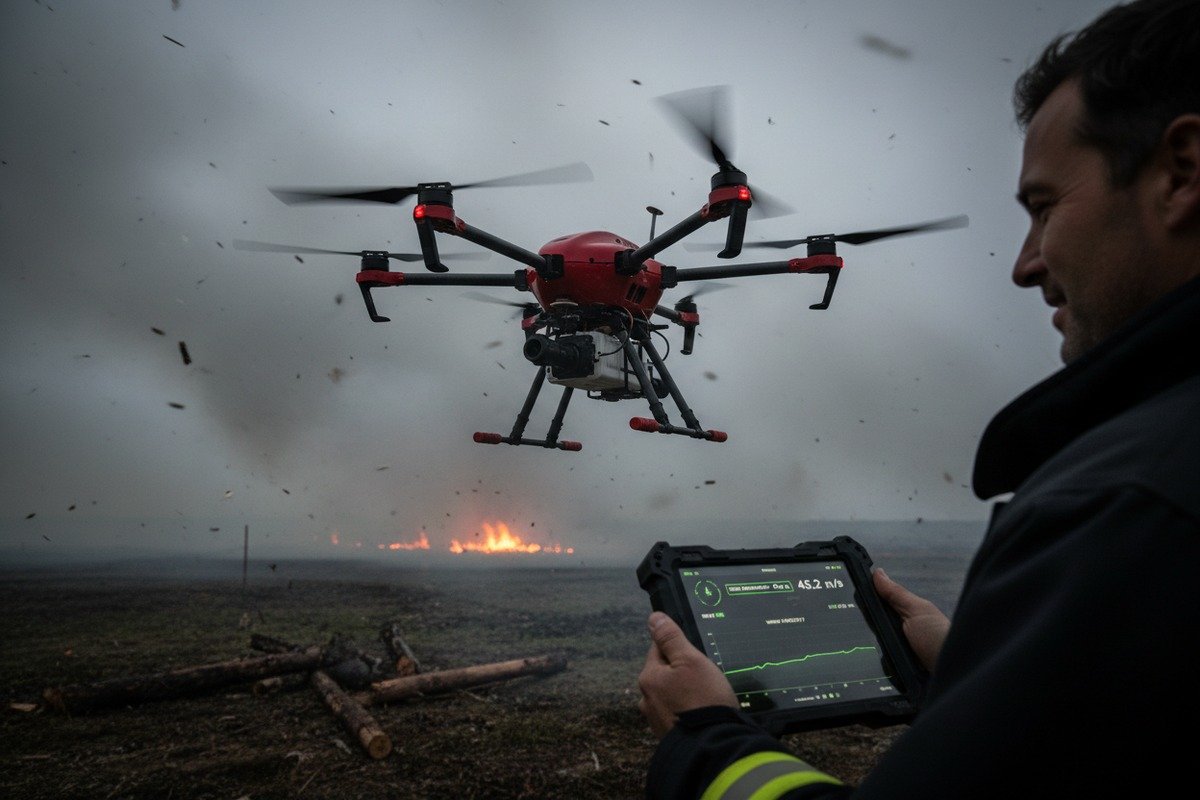
Standard wind tunnel tests use laminar flow—smooth, predictable air movement. But wildfire conditions create severe turbulence. Advanced facilities use active grids to simulate the chaotic airflow your drone will actually encounter. Ask your supplier if their test facility can replicate turbulent conditions with varying intensity levels.
The test report should include turbulence intensity values, typically expressed as a percentage. Real firefighting scenarios often involve turbulence intensities of 15-25%, far higher than the 1-5% found in many standard tests.
Flutter and Structural Integrity
Flutter 7 is a dangerous oscillation that can destroy aircraft structures. Wind tunnel tests should include flutter onset speed measurements, especially for drones with long arms like octocopters. In 2022, test programs for advanced drones validated flutter models that enabled 50-200kg weight reductions while maintaining safety margins.
Your supplier should provide data on structural resonance frequencies and how they relate to operational wind speeds. If the drone's natural frequency approaches wind-induced vibration frequencies, catastrophic failure becomes possible.
Thermal Effects on Performance
Standard wind tunnels operate at room temperature. Firefighting drones operate near active fires where air temperatures can exceed 60°C. While full thermal testing requires specialized facilities, your supplier should at least provide material specifications showing how frame components and electronics perform under thermal stress.
Should I trust my manufacturer's internal test data or insist on a third-party lab report?
On our production floor, we conduct extensive internal testing before any drone ships. But we also understand why professional buyers demand independent verification. The question isn't about trust—it's about risk management.
Internal test data provides valuable development insights but should not replace third-party verification for procurement decisions. Insist on third-party lab reports from accredited facilities for any drone that will operate in life-safety applications like firefighting, where equipment failure could endanger firefighters or civilians.
The Case for Internal Testing
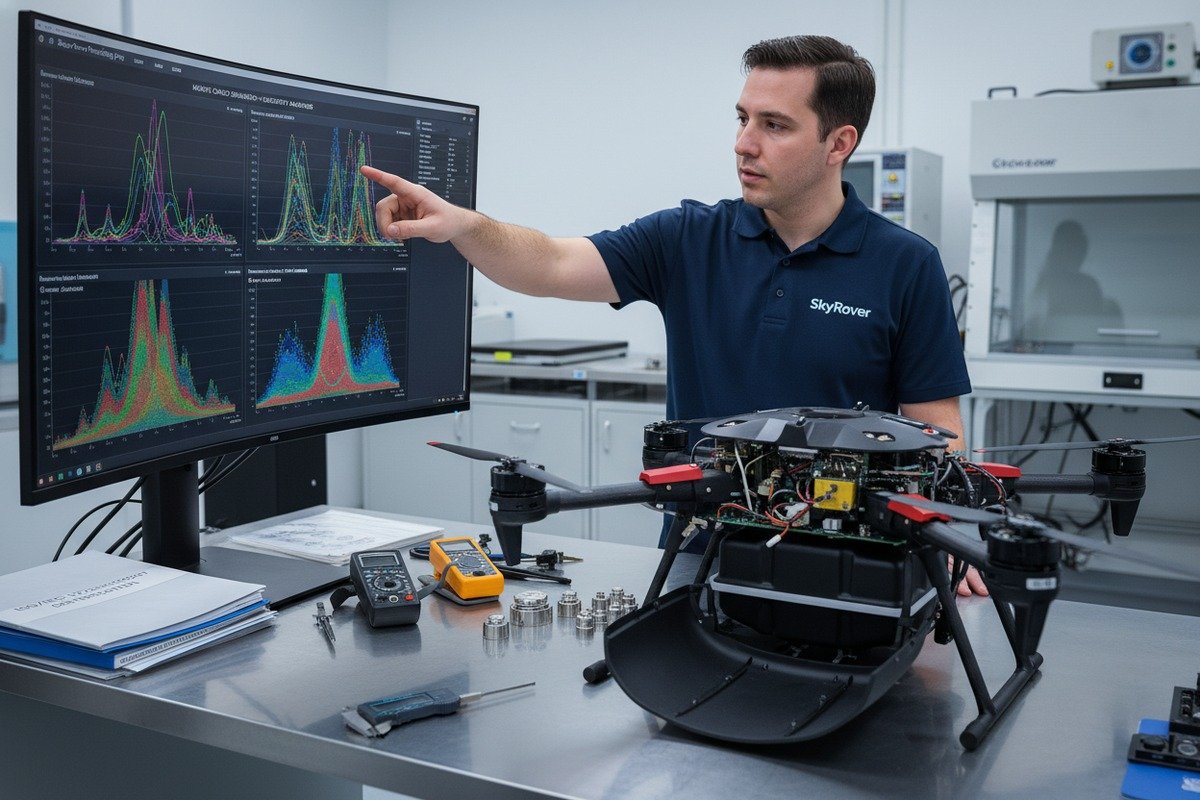
Internal testing isn't worthless. Our development team uses internal wind tunnel data to iterate designs quickly. We can test dozens of configurations in the time it takes to schedule one third-party session. This rapid feedback loop produces better products.
Internal data also provides baseline comparisons. When we modify a design, we can compare new results against previous internal tests using identical equipment and procedures. This consistency helps identify small performance changes that might be lost in the variability between different external facilities.
Why Third-Party Verification Matters
Independent laboratories bring critical advantages. They have no financial stake in your supplier's success. Their reputation depends on accurate results, not sales numbers. Accredited labs also follow standardized protocols that allow meaningful comparisons across different manufacturers.
NIST research has documented significant variability between wind tunnel facilities. Two labs testing the same model can produce "widely different results" if procedures aren't standardized. Third-party accreditation ensures consistent methodology.
Cost-Benefit Analysis
| Factor | Internal Testing | Third-Party Testing |
|---|---|---|
| Cost per Test | Lower | Higher |
| Credibility | Limitado | Alto |
| Standardization | Variable | Accredited protocols |
| Turnaround Time | Fast | Weeks to months |
| Legal Standing | Weak | Strong |
| Insurance Acceptance | Unlikely | Usually required |
| Bias Risk | Present | Minimized |
A Balanced Approach
The most reliable verification strategy combines both sources. Request internal development data to understand how the drone evolved. Then require third-party validation of final production specifications. This dual approach catches both design issues (visible in development data) and manufacturing variation (caught by independent testing).
For firefighting applications, some insurance providers and government procurement contracts explicitly require third-party certification. Check your end customer's requirements before accepting internal data alone. A drone that can't be insured or doesn't meet contract specifications is worthless regardless of its actual performance.
Evaluating Third-Party Lab Quality
Not all third-party labs are equal. Look for ISO 17025 accreditation specific to aerodynamic testing. Ask about the lab's experience with UAS platforms. Traditional aerospace wind tunnels designed for fixed-wing aircraft may lack the instrumentation needed for multirotor drones.
The best labs publish their uncertainty budgets openly. They use modern analysis methods like Monte Carlo simulations 8 rather than relying solely on legacy Taylor Series approaches. They can explain their results clearly and provide raw data access upon request.
How do I confirm my drone supplier has the engineering expertise to explain these wind tunnel results to me?
When we train our technical sales team, we emphasize that customers deserve clear explanations, not jargon. A supplier who cannot explain their own test data either doesn't understand it or is hiding something.
Confirm engineering expertise by requesting a technical meeting with the supplier's aerodynamics team, asking them to explain uncertainty quantification methods, testing limitations, and how results translate to real-world performance. Knowledgeable suppliers can discuss Reynolds number matching, turbulence modeling, and specific design trade-offs.
Questions That Reveal Expertise
Start with fundamental questions. Ask the supplier to explain the difference between epistemic and aleatory uncertainty in their test results. Epistemic uncertainty can be reduced with better data or methods. Aleatory uncertainty is inherent randomness that can only be quantified, not eliminated. A knowledgeable engineer distinguishes between these clearly.
Follow up by asking how they validated their scale model. Did they match Reynolds numbers correctly? How did they account for propeller effects? What corrections did they apply for wind tunnel wall interference? These questions expose whether the supplier truly understands their data.
Technical Competency Indicators
| Expertise Area | Basic Understanding | Advanced Understanding |
|---|---|---|
| Uncertainty Analysis | Mentions error bars | Explains Monte Carlo vs. Taylor Series methods |
| Model Scaling | Knows scale matters | Discusses Reynolds number matching specifically |
| Turbulence Effects | Acknowledges turbulence | Describes active grid testing and intensity levels |
| Payload Integration | Tests with weight | Analyzes center of gravity shifts and dynamic effects |
| Flight Control Integration | Mentions software | Explains SIL/HIL simulation validation |
| Real-World Correlation | Claims field testing | Provides documented comparisons with tunnel predictions |
Evaluating Technical Communication
Pay attention to how the supplier communicates. Do they answer your questions directly, or do they deflect with marketing language? Can they admit limitations in their testing methodology? A confident engineering team acknowledges what they don't know and explains how they mitigate those gaps.
Request a technical presentation, not a sales pitch. Ask to speak directly with engineers who conducted or analyzed the wind tunnel tests. If the supplier only provides sales representatives who read from scripts, their technical depth is questionable.
Documentation Quality
Review the quality of written technical documentation. Competent engineering teams produce clear, well-organized reports with proper figure labeling, unit consistency, and logical structure. Sloppy documentation often indicates sloppy engineering.
Ask for test facility photographs showing your specific drone model in the wind tunnel. Request calibration certificates with specific dates and equipment serial numbers. Capable suppliers maintain this documentation routinely and provide it without hesitation.
Long-Term Technical Support
Engineering expertise matters beyond the initial sale. When problems arise in the field, you need a supplier who can analyze flight data, correlate it with wind tunnel predictions, and diagnose issues. Ask about their post-sale technical support structure. Do they have engineers available for remote consultation? Can they provide on-site support for complex integrations?
For firefighting applications, conditions change constantly. Your supplier should be able to advise on operational limits for specific weather conditions based on their wind tunnel data. This requires genuine understanding, not just test reports filed away.
Industry Involvement
Suppliers with real expertise often participate in industry organizations and standards development. Ask if their engineers contribute to AIAA, SAE, or other relevant bodies 9. Do they publish technical papers or present at conferences? Active industry involvement indicates ongoing commitment to engineering excellence.
Conclusión
Verifying wind tunnel test reports for firefighting drones requires attention to accreditation, metrics, testing sources, and supplier expertise. Taking time to properly evaluate this documentation protects your investment and ensures operational safety.
Notas al pie
1. Defines systems and applications designed to protect occupants in emergencies. ↩︎
2. Details the international standard for the competence of testing and calibration laboratories. ↩︎
3. Provides details on the AIAA guide for assessing experimental uncertainty in wind tunnel testing. ↩︎
4. Defines the mandatory document for manufacturers declaring products comply with EU requirements. ↩︎
5. Offers guidance from NIST on assessing wind effects and related engineering. ↩︎
6. Describes a dimensionless quantity in fluid dynamics crucial for predicting flow patterns. ↩︎
7. Explains a dangerous aeroelastic oscillation that can destroy aircraft structures. ↩︎
8. Explains how Monte Carlo simulations are used for accurate uncertainty analysis in measurements. ↩︎
9. Introduces the American Institute of Aeronautics and Astronautics as a leading aerospace professional organization. ↩︎

 English
  Spanish
  German
  French
  Dutch
Dutch  Arabic
