
When our production floor receives orders from European distributors, one question comes up repeatedly: how can buyers confirm that CE markings 1 are genuine? Fake certificates flood the market, and customs authorities are rejecting shipments daily.
To verify EU CE certification for agricultural drones, buyers must inspect the physical CE marking and Class Identification Label on the drone itself, request the EU Declaration of Conformity document, validate Notified Body involvement for applicable drone classes, and cross-check technical documentation against Delegated Regulation (EU) 2019/945 requirements.
This guide breaks down every verification step. We will cover certificate authentication, required directives, technical documentation, and how OEM modifications affect compliance EU Declaration of Conformity document 2. Let us start with the basics.
How do I verify that my Chinese supplier's CE certificate for agricultural drones is actually authentic?
Our export team has seen buyers burned by counterfeit certificates more times than we can count Notified Bodies (NANDO database) 3. The problem is real: a fake CE mark looks identical to a genuine one at first glance. But the consequences of importing non-compliant drones include customs seizures, fines, and liability issues Radio Equipment Directive 2014/53/EU 4.
Authentic CE certificates can be verified through three main channels: physical inspection of the drone's CE marking and Class Identification Label, validation of the EU Declaration of Conformity document with matching serial numbers, and confirmation of Notified Body accreditation through the EU NANDO database for higher-risk drone classes.
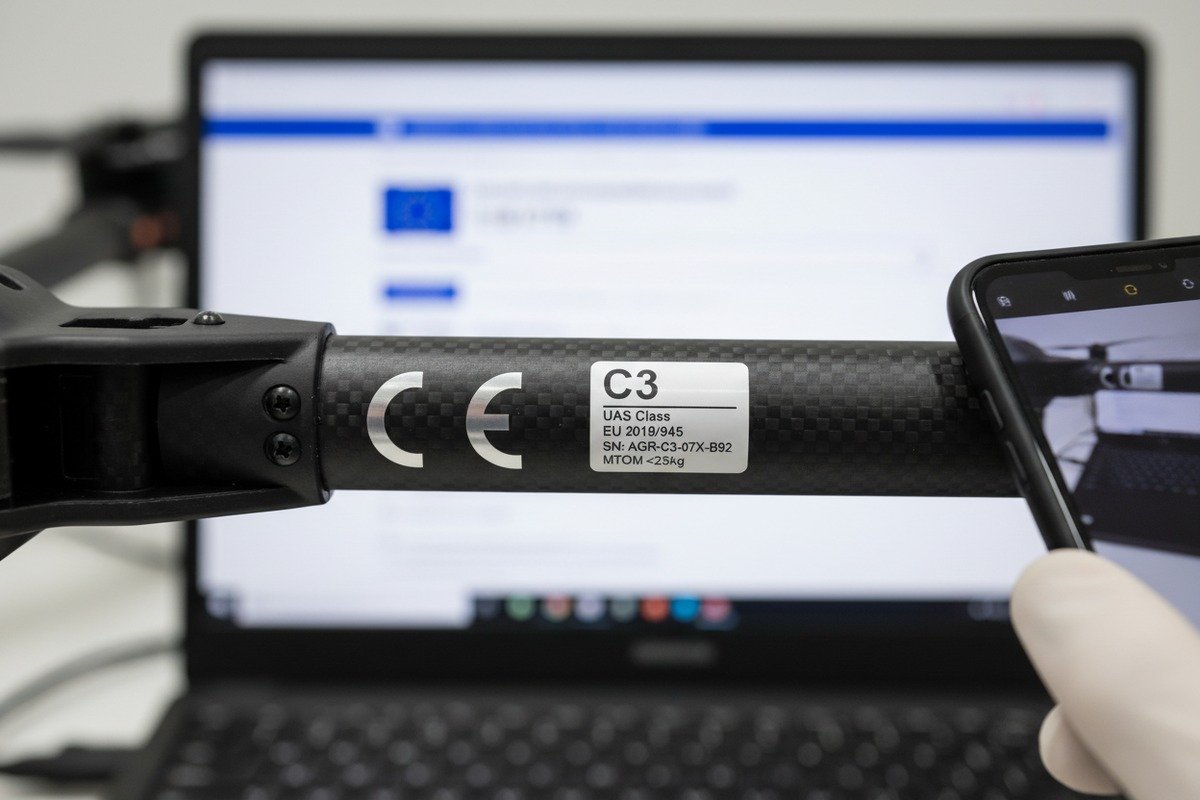
Physical Inspection Checklist
Start with the drone itself. A genuine CE marking has specific requirements. It must be visible, legible, and indelible. The marking should appear on the drone body, not just the packaging.
For agricultural drones, you also need to find the Class Identification Label. This label shows C0 through C6 depending on the drone class. Most agricultural spraying drones fall into C2, C3, or higher categories due to their weight and operational requirements.
| Inspection Point | Qué buscar | Señales de alerta |
|---|---|---|
| CE Mark Location | On drone body, clearly visible | Only on packaging, easily rubbed off |
| CE Mark Quality | Sharp, proportional letters, min 5mm height | Blurry printing, incorrect proportions |
| Class Label | C0-C6 logo matching drone specs | Missing label, mismatched class |
| Serial Number | Matches Declaration of Conformity | No serial number, different numbers |
| Manufacturer Info | Complete name and EU address | Missing contact details |
Document Verification Steps
Request the EU Declaration of Conformity directly from your supplier. This document is not optional. It is a legal requirement under Regulation 2019/945.
The Declaration must include the manufacturer's name and address, product identification with serial number, reference to applicable EU directives and harmonized standards, and the signature of an authorized person.
Using the NANDO Database
For drones requiring third-party testing (C3 and above), verify the Notified Body through the NANDO database 5. This is the official EU registry of accredited testing organizations.
Go to the European Commission's NANDO website. Search for the Notified Body number listed on your certificate. Confirm they are authorized to test under Regulation 2019/945. If the number does not match, the certificate is fake.
Common Fake Certificate Indicators
In our experience working with European importers, these patterns signal fraudulent certificates:
- Certificates issued by non-existent Notified Bodies
- Declaration of Conformity dates before the drone model was manufactured
- Generic certificates covering multiple unrelated products
- Missing reference to specific EU regulations
- Test reports with inconsistent dates or missing laboratory details
Which specific EU directives and standards should I look for on my agricultural drone's Declaration of Conformity?
When we prepare export documentation for our agricultural drone lines, we reference multiple EU directives. Missing even one directive can result in your shipment being held at customs. Understanding these requirements protects your investment.
Agricultural drones must comply with Delegated Regulation (EU) 2019/945 for drone-specific requirements, the Radio Equipment Directive 2014/53/EU for wireless functions, the EMC Directive 2014/30/EU for electromagnetic compatibility, and potentially the Machinery Directive 2006/42/EC for automated spraying systems. The Declaration of Conformity must list all applicable directives.

Core Regulations for All Drones
Delegated Regulation (EU) 2019/945 6 sets the design and manufacturing requirements for drones sold in the EU market. This regulation became fully mandatory on January 1, 2024. It defines the seven drone classes (C0-C6) and their requirements.
Implementing Regulation (EU) 2019/947 covers the operational side. While this mainly affects drone operators, it determines which class your agricultural drone needs to fall into based on intended use.
Directive Reference Table
| Directive/Regulation | Full Name | Applies When |
|---|---|---|
| (EU) 2019/945 | Delegated Regulation on UAS | All drones sold in EU |
| (EU) 2019/947 | Implementing Regulation on UAS Rules | All drone operations |
| 2014/53/EU | Radio Equipment Directive (RED) | Drones with radio/WiFi/GPS |
| 2014/30/EU | EMC Directive | All electronic products |
| 2006/42/EC | Machinery Directive | Drones with automated functions |
| 2011/65/EU | RoHS Directive | Electrical equipment |
| 2014/35/EU | Low Voltage Directive | If battery >75V DC |
Harmonized Standards to Expect
The EN 4709 series provides the technical standards for drone compliance. Your supplier should reference these on technical documentation:
- EN 4709-001: Product identification and information
- EN 4709-002: Requirements for UAS operations
- EN 4709-003: Specific category requirements
- EN 4709-004: Higher risk operation requirements
For radio equipment testing, look for EN 300 328 (WiFi), EN 301 489 (EMC), and EN 62311 (human exposure to electromagnetic fields).
Agricultural-Specific Considerations
Agricultural drones often carry spraying equipment. This adds complexity. The spraying mechanism may trigger Machinery Directive requirements. Liquid tanks and pumps must meet safety standards.
Our engineering team designs agricultural drones with these dual requirements in mind. The flight system meets drone regulations. The spraying system meets machinery standards. Both must appear on the Declaration of Conformity.
Remote ID Requirements
Since 2024, drones in classes C1 and above must have built-in Direct Remote Identification. This cannot be a retrofit add-on module. The Remote ID function must be factory-integrated and tested as part of the CE certification process.
What technical documentation must I request from my drone manufacturer to ensure a smooth EU customs clearance process?
Our logistics department has handled hundreds of EU shipments. We know exactly what customs officers look for. The right documentation package makes the difference between a one-day clearance and a month-long hold.
For smooth EU customs clearance, request the complete Technical File including design drawings, risk assessment documents, test reports from accredited laboratories, EU Declaration of Conformity, user manual with compliance statements, and UN38.3 certification for lithium batteries. All documents must reference the specific drone model and serial number range.
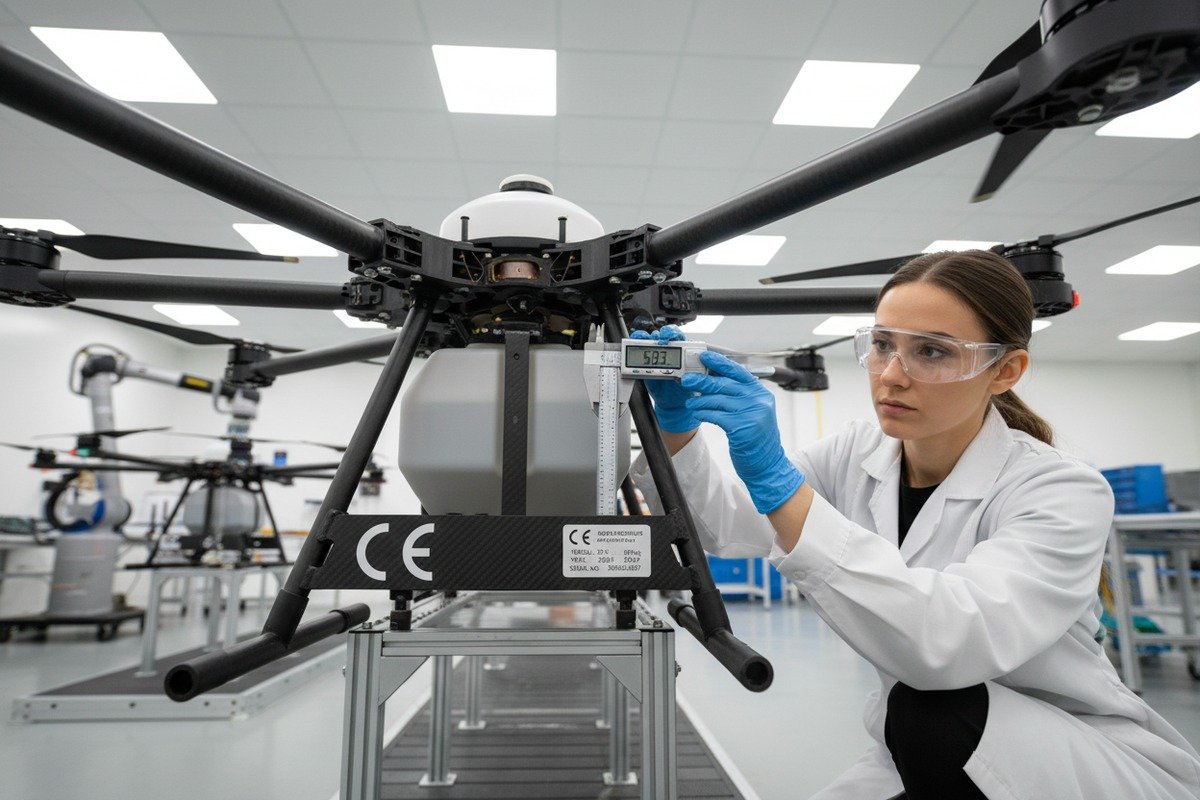
The Technical File Components
The Technical File is the master document package that proves compliance. EU authorities can request this at any time. Your supplier must provide access to these documents.
| Tipo de documento | Contents | Por qué es importante |
|---|---|---|
| Design Documentation | CAD drawings, schematics, component specs | Proves drone matches tested design |
| Risk Assessment | Hazard analysis per EN ISO 12100 | Shows safety evaluation process |
| Test Reports | RF, EMC, battery, durability results | Confirms compliance testing |
| Quality Control Records | Production testing procedures | Demonstrates consistent quality |
| User Manual | Operating instructions, warnings | Required for end-user safety |
| Declaration of Conformity | Legal compliance statement | Official compliance declaration |
Test Report Essentials
Test reports must come from accredited laboratories. Look for ISO 17025 accreditation 8. The reports should cover:
RF Testing: Verifies radio emissions meet EU limits. Look for tests against EN 300 328 and EN 301 893 standards. The report should include frequency measurements, power output levels, and spurious emission tests.
EMC Testing: Confirms the drone does not interfere with other equipment. Tests should reference EN 301 489-1 and EN 301 489-17. Both emissions and immunity tests are required.
Battery Safety: Lithium batteries require UN38.3 certification 9. This is a transport safety requirement. The test covers altitude simulation, thermal testing, vibration, shock, short circuit, impact, overcharge, and forced discharge.
Structural Tests: For C2 and above, expect impact resistance and material durability tests. The EN 4709 series specifies these requirements.
Documentation Red Flags
Based on our export experience, these issues cause customs problems:
- Test reports with different model numbers than the shipped drones
- Missing UN38.3 battery certificates
- Declaration of Conformity without specific directive references
- User manuals without EU compliance statements
- Documents in non-EU languages without translations
Pre-Shipment Documentation Checklist
Before your supplier ships, verify you have:
- EU Declaration of Conformity (original or certified copy)
- Summary of Technical File
- Test reports with matching model numbers
- UN38.3 battery test report
- User manual with CE marking instructions
- Commercial invoice with correct HS codes
- Packing list with serial numbers
Working with Your Supplier
Request documentation samples before placing large orders. Our team provides documentation previews to importers for exactly this reason. Review the documents with your customs broker. Identify any gaps early.
Some documents contain proprietary information. Suppliers may provide summaries instead of full technical files. This is acceptable as long as the summary contains sufficient detail for customs verification.
How does a custom OEM design affect my agricultural drone's existing CE certification status?
Our OEM development team works with distributors on custom configurations regularly. This is where many buyers make costly mistakes. They assume the original CE certification transfers automatically. It does not work that way.
Custom OEM modifications to an agricultural drone typically invalidate the existing CE certification and require partial or complete re-certification. Changes to weight, software, radio systems, or structural design all trigger re-testing requirements. The extent of re-certification depends on which aspects of the original type-tested design are modified.
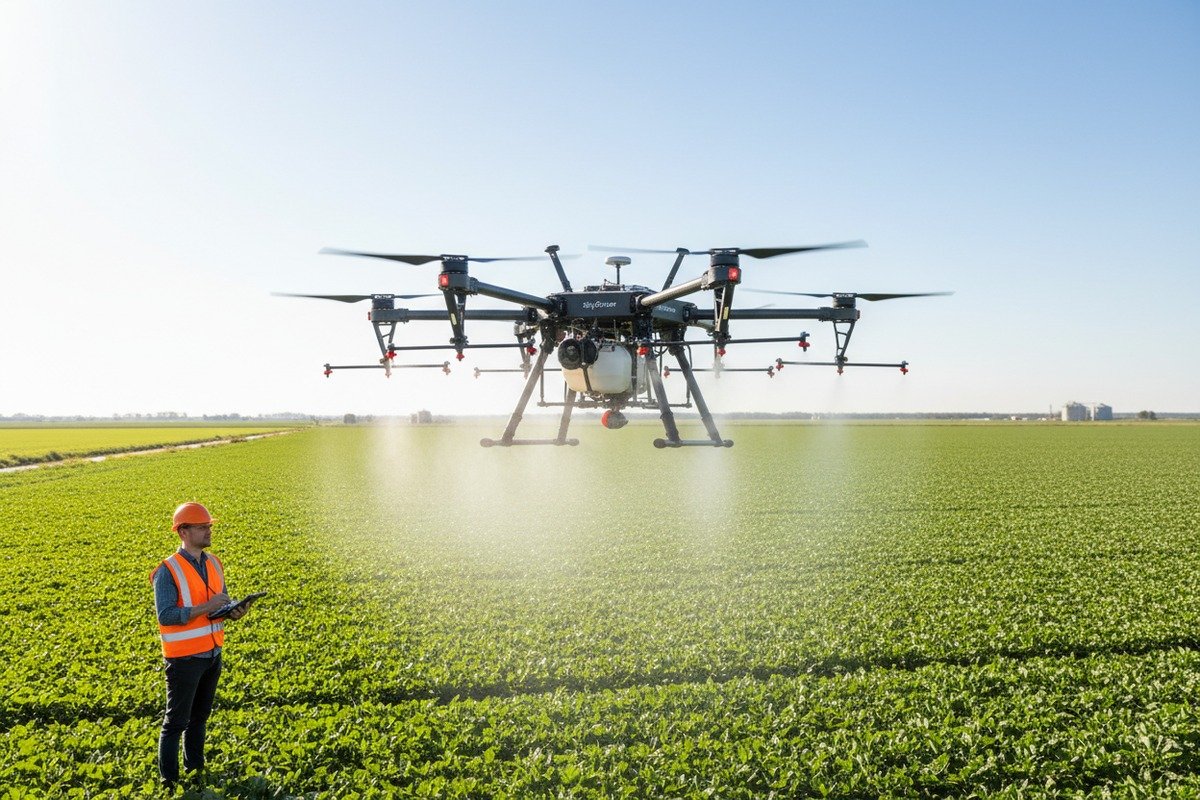
Modifications That Trigger Re-Certification
Not all changes are equal. Some modifications require full re-testing. Others need only documentation updates. Understanding this saves time and money.
| Modification Type | Certification Impact | Se requiere acción |
|---|---|---|
| Cosmetic (colors, decals) | Ninguno | Update documentation only |
| Branding (logos, nameplates) | Minimal | New Declaration of Conformity |
| Weight changes (tank size) | Moderate to High | May change drone class, re-test |
| Radio module swap | Alto | Full RF/EMC re-testing |
| Software/firmware changes | Moderate to High | Cybersecurity review, possible re-test |
| Structural modifications | Alto | Full mechanical re-testing |
| Battery capacity change | Moderate | Battery tests, weight impact review |
The Class Change Problem
Agricultural drones often face class changes during OEM customization. Here is a common scenario:
You want a larger spray tank for efficiency. The base drone is certified as C2 (under 4kg). Adding a 10-liter tank pushes the total weight over 4kg. The drone now requires C3 certification. This is a different certification process requiring Notified Body involvement.
Our engineering team can help calculate weight budgets before you commit to modifications. We map out exactly how changes affect the certification status.
OEM Software Customization
Software changes present unique challenges. The EU has introduced cybersecurity requirements for drones. Custom software must meet these standards.
Firmware updates can trigger re-testing requirements. If your OEM software changes flight control algorithms, geo-awareness functions, or Remote ID behavior, expect re-certification.
We recommend documenting all software versions and changes. This creates an audit trail for compliance purposes.
Maintaining Certification During OEM Development
The most efficient approach is collaborative development from the start. When our partners come to us early in the process, we design modifications within the existing certification boundaries.
This means:
- Selecting components that maintain the same drone class
- Using pre-approved radio modules
- Keeping software changes within tested parameters
- Documenting every modification for the technical file
Shared Responsibility Model
In OEM arrangements, certification responsibilities must be clearly defined. The original manufacturer holds the CE certification. When you modify the drone, responsibility can shift.
If you only apply branding and packaging changes, the original certification often remains valid. You become an importer or distributor under EU law.
If you make technical modifications, you may become the manufacturer under EU regulations. This brings full compliance responsibility to your company.
Our contracts with OEM partners clearly specify these responsibilities. We recommend all buyers establish the same clarity with their suppliers.
Cost and Timeline Considerations
Re-certification costs vary widely based on modification scope:
- Documentation updates only: 1-2 weeks, minimal cost
- Partial re-testing (one directive): 4-8 weeks, moderate cost
- Full re-certification: 12-20 weeks, significant investment
Planning modifications early in your product development cycle minimizes both cost and timeline. Retrofit changes to existing certified products are almost always more expensive than designing compliance in from the start.
Conclusión
Verifying EU CE certification for agricultural drones requires systematic inspection of markings, documents, and Notified Body credentials. Request complete technical documentation before ordering. Plan OEM modifications carefully to avoid costly re-certification. Your due diligence protects your business and ensures market access.
Notas al pie
1. Official EU guidance on CE marking requirements and significance. ↩︎
2. Official EU source for Declaration of Conformity. ↩︎
3. Official EU NANDO database for Notified Bodies, mentioned in article context. ↩︎
4. Official text of the EU directive for placing radio equipment on the market. ↩︎
5. Official EU database for searching accredited Notified Bodies by legislation. ↩︎
6. Official text of the EU regulation on unmanned aircraft systems. ↩︎
7. Official text of the EU directive on machinery, relevant for spraying systems. ↩︎
8. Authoritative information on ISO/IEC 17025 for laboratory competence. ↩︎
9. Explains UN38.3 certification for safe transport of lithium batteries. ↩︎

 English
  Spanish
  German
  French
  Dutch
Dutch  Arabic
