
We often see clients struggle to integrate fire-extinguishing bombs onto our heavy-lift platforms. Miscommunication leads to crashes, but clear specs prevent these costly failures and ensure safety.
To communicate custom solution requirements effectively, provide a detailed technical specification sheet listing the payload's exact weight, dimensions, and power consumption. Clearly define the operational use case, such as wildfire monitoring or liquid delivery, and establish a formal project roadmap with the supplier to ensure airframe compatibility and safety.
Understanding the nuances of technical communication is vital for a successful partnership. Let's explore the specific details you need to share to ensure a successful integration.
What technical specifications must I provide for the custom payload integration?
Our engineering team cannot guess your needs; vague requests delay production. Precise data ensures your fire suppression system fits our drone frames perfectly and functions reliably.
You must provide the payload's net weight, physical dimensions (length, width, height), and center of gravity coordinates. Additionally, specify power voltage requirements, communication protocols like CAN bus or UART, and any thermal shielding needs to ensure seamless integration with the drone's flight control system.

The Foundation of Compatibility: Mechanical Specifications
When we receive a request for a custom firefighting drone, the first hurdle is often physical compatibility. It is not enough to say, "I have a fire extinguishing bomb." We need to know the exact geometry. You must provide a 3D CAD model or detailed technical drawings of your equipment. This allows our engineers to simulate the fit within the landing gear and under the fuselage.
3D CAD model 1
For example, if you are using a modular design similar to the Fly4Future or Spider-i UAV systems, which might carry multiple capsules, we need to know the spacing between each release mechanism. If the payload is a single large tank, like those used on the DJI Agras T40 adapted for fire suppression, the mounting points must align with the drone's hardpoints.
DJI Agras T40 2
Electrical and Data Requirements
Beyond the physical shape, the "nervous system" of the integration is critical. Many clients overlook the power draw. If your payload requires power from the drone's main battery, we need to know the voltage range (e.g., 12V, 24V, or 48V) and the peak current draw. High-power winches or release servos can cause voltage sags that might trigger the drone's safety failsafes if not accounted for.
Furthermore, communication is key. Does your payload need to talk to the flight controller? For instance, if you require the drone to trigger a drop based on GPS coordinates, we need to establish the communication protocol. Common standards include:
GPS coordinates 3
- PWM (Pulse Width Modulation): Simple trigger mechanisms.
- UART/Serial: For two-way data transfer.
- CAN Bus: For robust, noise-resistant communication in complex systems.
- SDK/API Access: If you are developing custom software for autonomous fire tracking.
Defining the Payload Type
We also categorize payloads into "Dispensable" and "Continuous" loads, as this affects how we tune the flight controller. A dispensable payload, like a 25kg dry chemical bomb, changes the drone's weight instantly upon release. A continuous load, like a water sprayer, changes weight gradually.
flight controller 4
Checklist for Supplier Communication
To streamline your inquiry, we have compiled a checklist of data points you should prepare before contacting us or any other manufacturer.
| Categoría de especificaciones | Data Points Required | Por qué es importante |
|---|---|---|
| Physical Dimensions | Length, Width, Height (mm), Mounting Bolt Pattern | Ensures the payload fits between landing skids and aligns with frame hardpoints. |
| Weight Metrics | Net Weight (kg), Loaded Weight (kg) | Determines if the drone stays within Max Takeoff Weight (MTOW) limits. |
| Power Interface | Voltage (V), Max Current (A), Connector Type (e.g., XT90) | Prevents electrical overloads and ensures the drone battery can support the device. |
| Data Protocol | PWM, UART, CAN Bus, S.Bus | Ensures the remote controller or flight computer can trigger the payload functions. |
| Environmental | IP Rating, Heat Resistance, Vibration Tolerance | Critical for firefighting drones operating near high heat or water spray. |
By providing this level of detail upfront, you move the conversation from "Can you do this?" to "Here is how we will execute this," significantly shortening the development timeline.
How do I ensure the drone's center of gravity remains balanced with my equipment?
We have seen unstable flights caused by lopsided water tanks. Ignoring balance risks the drone flipping during takeoff, endangering your crew and equipment, and voiding warranties.
Ensure balance by calculating the combined center of gravity (CoG) of the drone and payload. Share your equipment's mass distribution data with the supplier so they can adjust the mounting position or battery placement to maintain the aircraft's stability within the flight controller's safety margins.
Understanding the Center of Gravity (CoG)
The Center of Gravity (CoG) is the theoretical point where the entire weight of the drone and payload is concentrated. For a multi-rotor drone to fly stably, this point must align closely with the geometric center of the motors. When we design our SkyRover heavy-lift drones, we calibrate the flight controller assuming a centered load.
Center of Gravity (CoG) 5
If your custom payload is front-heavy—perhaps due to a sensor array or a forward-mounted camera—the front motors have to work harder than the rear motors to keep the drone level. This creates an imbalance in motor output. In extreme cases, the front motors may reach 100% capacity while the rear motors are at 40%, leaving no headroom for maneuvering or fighting wind gusts. This often leads to a loss of control.
The Problem with Liquid Payloads
Firefighting drones often carry liquid payloads (water or retardant). Liquids present a unique challenge known as the "sloshing effect." As the drone accelerates or brakes, the liquid moves inside the tank, constantly shifting the CoG.
When we collaborate with clients on liquid payload integration, we often recommend or design tanks with internal baffles. These baffles reduce the movement of the liquid, stabilizing the CoG. If you are supplying your own tank, you must inform us so we can adjust the PID (Proportional-Integral-Derivative) gain settings on the flight controller. Higher gains can sometimes compensate for the shifting weight, but hardware solutions (baffles) are always superior.
internal baffles 6
Adjusting the Airframe for Balance
When you provide us with the CoG coordinates of your payload relative to its mounting point, we can counter-balance the drone. We typically use two methods:
- Sliding Battery Mounts: We can design the battery tray to slide forward or backward. If your payload is tail-heavy, we move the heavy flight batteries forward to compensate.
- Custom Mounting Brackets: We can machine the payload interface to position your equipment exactly under the drone's center.
Impact of Imbalance on Flight Performance
It is vital to understand that a balanced drone is a safe drone. Below is a breakdown of how CoG shifts affect performance.
| CoG Status | Motor Behavior | Flight Consequence | Risk Level |
|---|---|---|---|
| Perfectly Centered | All motors operate at equal RPM for hovering. | Maximum stability, optimal flight time, responsive control. | Bajo |
| Slightly Off-Center | Some motors spin 10-15% faster to compensate. | Reduced flight time due to inefficiency; slight drift in wind. | Moderate |
| Severely Off-Center | Motors on the heavy side near max capacity. | Overheating motors, potential ESC failure, inability to recover from gusts. | Alto |
| Dynamic Shift (Sloshing) | Motor RPM fluctuates wildly and unpredictably. | Oscillations (wobbling), potential "toilet bowl" effect, crash risk. | Critical |
We always recommend a "bench test" where the fully loaded drone is suspended to physically verify the balance before the first flight. This simple step saves thousands of dollars in potential crash damage.
Will the supplier assist with designing a custom mounting interface?
Standard brackets rarely fit custom extinguishers, causing frustration during field assembly. We prefer collaborating early to engineer secure, quick-release mounts that save you time and ensure reliability.
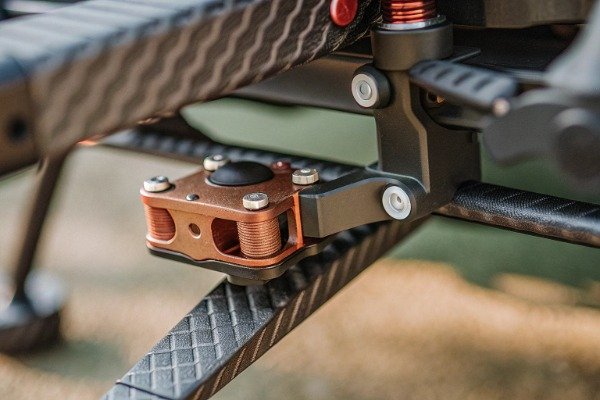
Most reputable industrial drone manufacturers offer OEM services to design custom mounting interfaces. You should request a collaborative design phase where the supplier creates CAD models for brackets or quick-release mechanisms that match your specific payload attachment points and vibration isolation requirements.

The Value of OEM Collaboration
Many procurement managers assume they must force their payload onto a standard rail system. However, at our factory, and indeed at most high-end manufacturers like those producing the H300 or Griff Aviation models, we expect to customize. The mounting interface is the critical link between your expensive payload and the aircraft. A generic strap or makeshift bracket is a liability.
When you ask, "Will you assist with design?" the answer should be a resounding yes. We use industrial-grade CAD software to design interfaces that are lightweight yet incredibly strong. We typically utilize materials like aviation-grade aluminum (7075 or 6061) or carbon fiber plates.
aviation-grade aluminum 7
Key Design Considerations for Mounts
- Quick-Release Mechanisms: In firefighting, speed is everything. You do not want your team fumbling with screws while a fire spreads. We often design slide-lock or latch-based systems that allow you to swap empty tanks for full ones in seconds.
- Vibration Isolation: Drones produce high-frequency vibrations. If your payload contains sensitive electronics or sensors (like thermal cameras for fire spotting), hard-mounting it to the frame will ruin the data quality. We integrate rubber dampers or wire rope isolators into the custom mount to "float" the payload.
- Thermal Protection: For firefighting specifically, the mount must withstand heat. Plastic 3D-printed parts are unacceptable near the combustion zone. We ensure the interface acts as a thermal barrier or is made of heat-resistant alloys.
The "Fail-Safe" Protocol
A critical part of the mounting design is the release mechanism itself. If you are carrying a drop payload (like fire extinguishing balls), the mechanism must be fail-safe. We design circuits that prevent accidental release on the ground but ensure positive release in the air.
We also discuss "emergency jettison." If the drone suffers a critical battery failure, you might need to drop the payload instantly to reduce weight and glide to safety. We can program a specific channel on the remote controller to trigger a mechanical release of the entire payload mount in emergencies.
Collaborative Workflow
To give you an idea of how this process works, here is a typical workflow we establish with our clients:
- Phase 1: Requirement Gathering: You send the 3D files of your payload.
- Phase 2: Draft Design: We send back a PDF or 3D viewer file of the proposed mount on the drone frame.
- Phase 3: Simulation: We run stress tests in software to ensure the mount can handle the G-forces of flight.
- Phase 4: Prototyping: We CNC machine a sample and ship it to you (or test it with your dummy payload at our facility).
- Phase 5: Production: Once approved, we manufacture the batch.
This structured approach ensures that when you receive the drone, your equipment clicks into place perfectly.
How does the added payload weight affect the estimated flight time?
Overloading a drone drastically cuts mission time, leaving fires burning. We simulate these scenarios daily to help you predict exactly how long you can fly safely.
Added payload weight increases motor power consumption, significantly reducing flight endurance. To estimate flight time accurately, ask the supplier for a thrust-to-weight ratio chart and battery discharge curves specific to your total takeoff weight, ensuring the drone retains a safety margin for return and landing.
The Physics of Weight and Endurance
There is no way to cheat physics. Every gram you add to the drone requires the motors to spin faster to generate sufficient lift. This draws more amps from the battery. The relationship is not linear; as the motors work harder, they become less efficient, generating more heat and using power faster.
For a heavy-lift drone like the H300 or our SkyRover heavy-lift series, the difference is stark. An unloaded drone might fly for 45 to 50 minutes. However, adding a 50kg payload might drop that time to 20 minutes. Adding 100kg might drop it to 10-12 minutes.
Thrust-to-Weight Ratio
When communicating with us, you must understand the "Thrust-to-Weight Ratio." For industrial applications, we aim for a ratio of at least 2:1. This means if the total drone plus payload weighs 100kg, the motors must be capable of generating 200kg of thrust at full throttle.
If you overload the drone so the ratio drops to 1.5:1 or lower, the drone will feel sluggish. It will struggle to stop its momentum and will be dangerous to fly in windy conditions. We always calculate the payload limit based on maintaining this 2:1 safety ratio.
Battery Management and Safety Margins
In firefighting, you cannot fly until the battery hits 0%. You need a reserve to return home and land. We typically recommend landing with 20-25% battery remaining.
When we provide flight time estimates, we base them on hovering conditions. Forward flight can sometimes be more efficient due to aerodynamic lift, but aggressive maneuvering consumes more power. We also have to account for altitude. If you are operating in high-altitude areas (like mountainous wildfires), the air is thinner. The propellers generate less lift, forcing the motors to spin faster, which further reduces flight time.
Estimating Your Mission Profile
To help you plan, we provide data tables similar to the one below. This helps you decide if you need to reduce your payload weight or invest in higher-capacity batteries.
| Total Payload Weight (kg) | Estimated Hover Time (Minutes) | Thrust-to-Weight Ratio | Recommended Mission Type |
|---|---|---|---|
| 0 kg (Empty) | 45 – 50 min | 4.0 : 1 | Reconnaissance / Thermal Spotting |
| 25 kg | 35 – 38 min | 3.2 : 1 | Patrol / Light Delivery |
| 50 kg | 22 – 25 min | 2.5 : 1 | Fire Retardant Spraying |
| 100 kg | 12 – 15 min | 1.8 : 1 | Heavy Drop (Emergency Only) |
| 150 kg | < 8 min | 1.4 : 1 | NOT RECOMMENDED / UNSAFE |
Note: These figures are illustrative based on typical heavy-lift platforms. Always consult the specific manual for your model.
Thrust-to-Weight Ratio 8
By analyzing this data, you might decide that carrying two smaller loads (25kg each) for longer durations is more effective than one massive load (50kg) that forces a landing every 20 minutes. We can help you run these calculations to optimize your operational efficiency.
cámaras térmicas 9
Conclusión
Effective communication regarding specs, balance, mounting, and weight ensures your custom firefighting drone operates safely and efficiently.
sloshing effect 10
Notas al pie
1. Defines the standard digital format required for engineering design and collaboration. ↩︎
2. Official product page for the specific agricultural drone model mentioned. ↩︎
3. Official US government site explaining the Global Positioning System. ↩︎
4. Explains the central processing unit that stabilizes and controls the drone. ↩︎
5. Authoritative NASA resource defining center of gravity in aircraft physics. ↩︎
6. Describes the mechanical structures used to reduce fluid movement in tanks. ↩︎
7. Provides technical details on the high-strength 7075 alloy used in aerospace. ↩︎
8. Explains the critical ratio determining an aircraft’s performance and lift capability. ↩︎
9. Defines the infrared imaging technology used for fire detection. ↩︎
10. Explains the fluid dynamics phenomenon that affects vehicle stability. ↩︎

 English
  Spanish
  German
  French
  Dutch
Dutch  Arabic
