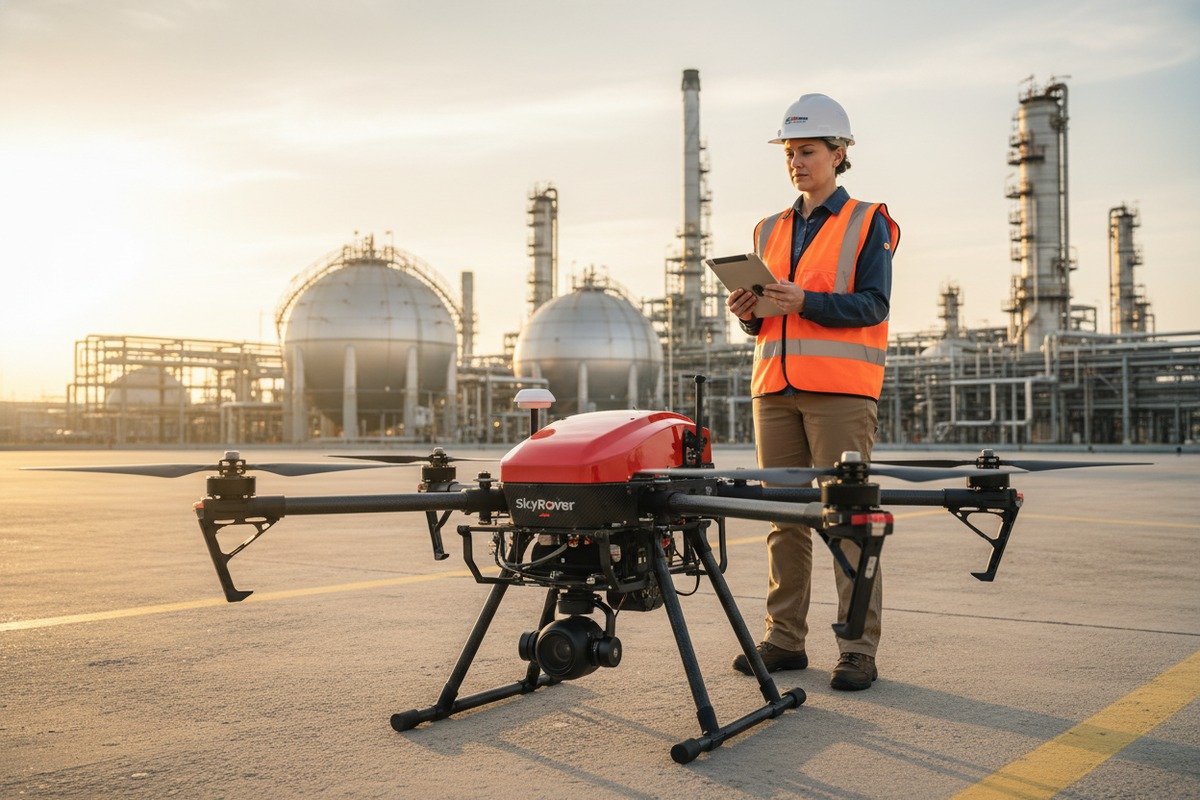
When our engineering team first received urgent calls from US energy facility managers after a refinery blaze, we realized how critical proper drone selection had become NFPA 2400 standards 1. The problem was clear: traditional firefighting methods exposed personnel to explosive hazards, toxic vapors, and extreme heat. The agitation grew as facility operators watched competitors deploy drones while struggling to understand NFPA compliance requirements 2.
To select US NFPA compliant firefighting drones for energy facilities, verify manufacturer adherence to NFPA 2400 standards, ensure FAA Part 107 certification compatibility, prioritize thermal imaging and rugged construction for high-heat environments, and confirm the supplier provides comprehensive technical support for seamless deployment.
This guide walks you through every critical step Certificación FAA Parte 107 3. We will cover verification methods, technical specifications, customization options, and logistics support. Let us dive into what you need to know before making this important procurement decision.
How do I verify that a Chinese drone manufacturer meets specific US NFPA standards for my energy facility?
In our experience exporting industrial drones to US energy companies, we have seen procurement managers struggle with verification processes IP67 or higher ratings 4. They receive marketing claims but lack concrete methods to confirm compliance. This uncertainty creates real risk when deploying drones in hazardous energy environments.
To verify a Chinese manufacturer meets NFPA standards, request documented compliance with NFPA 2400 for sUAS public safety operations, confirm FAA Part 107 certification compatibility, review third-party test reports from recognized laboratories, and validate that equipment specifications match NFPA appendix evaluation criteria for operational requirements.
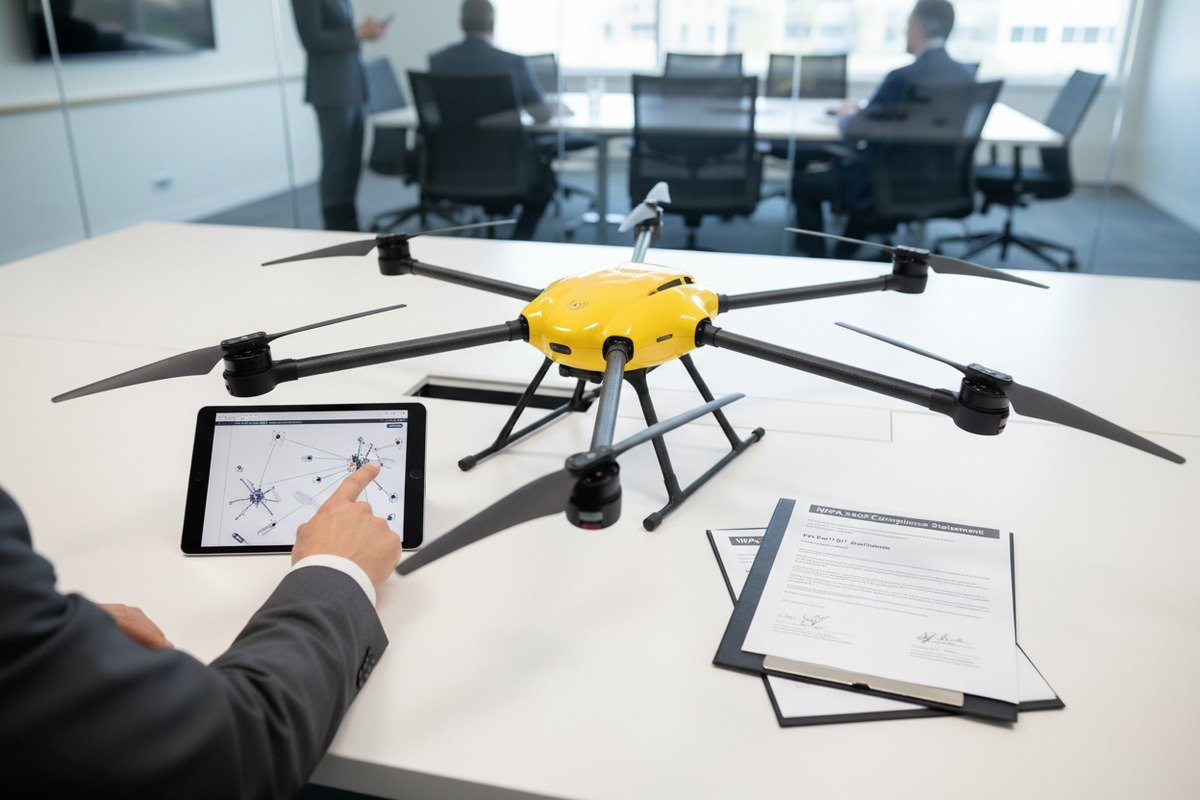
Understanding NFPA 2400 Requirements
NFPA 2400 is the core standard for small unmanned aircraft systems 5 used in public safety operations. First released around 2019 and updated in 2024, it covers program creation, pilot qualifications, maintenance protocols, and operational procedures. The standard is voluntary but provides a roadmap that helps energy facilities avoid liability issues.
When we prepare export documentation, we align our product specifications with three main NFPA chapters. These cover program operations, personnel qualifications, and equipment maintenance. The appendices contain equipment evaluation criteria that specify operational requirements and comparative model data.
Key Documents to Request
Before purchasing, ask manufacturers for specific documentation. This protects your investment and ensures regulatory alignment.
| Tipo de documento | Objetivo | Método de verificación |
|---|---|---|
| NFPA 2400 Compliance Statement | Confirms alignment with public safety sUAS standards | Review against current NFPA edition requirements |
| FAA Part 107 Compatibility Certificate | Validates US airspace operation readiness | Cross-reference with FAA database |
| Third-Party Test Reports | Provides independent performance verification | Contact testing laboratory directly |
| IP Rating Certification | Confirms environmental protection levels | Check against IP67/IP68 standards |
| Thermal Imaging Calibration Data | Ensures accurate temperature readings | Compare with NIST measurement standards |
Critical Questions for Manufacturers
Our clients often ask us pointed questions during procurement discussions. You should do the same with any manufacturer you evaluate.
First, ask about BVLOS waiver compatibility 6. The FAA granted its first firefighting BVLOS waiver in 2021. Your drone must support extended operations over energy sites without constant visual contact. Second, inquire about incident command integration. NFPA 2400 mandates that drones work within existing ICS structures.
Third, verify the manufacturer understands UFC 3-600-01 fire codes 7. These exceed NFPA minima for military and energy sites. Storage and protection requirements differ significantly from standard commercial applications.
Red Flags to Watch
Some manufacturers make broad compliance claims without substance. Watch for vague language about "meeting international standards" without specific NFPA references. Be cautious when manufacturers cannot provide test data from recognized US or international laboratories. If a supplier has no experience with US energy facility regulations, they may not understand the full compliance landscape.
What technical performance features should I look for to ensure my drones operate reliably in high-risk energy zones?
When we design firefighting drones for energy facility applications, our engineers prioritize survival in extreme conditions. Refineries generate temperatures exceeding 1000°C during fires. Battery storage facilities release toxic gases. Solar farms create unique thermal signatures that confuse standard sensors.
Essential technical features include dual thermal and optical cameras for hotspot detection through smoke, IP67 or higher ratings for heat and water resistance, minimum 45-minute flight endurance with hot-swappable batteries, real-time data streaming to command centers, and ruggedized construction tested to withstand temperatures above 60°C ambient.

Camera and Sensor Requirements
Thermal imaging forms the backbone of firefighting drone capability. Our production line integrates radiometric thermal cameras 8 that measure precise temperatures rather than just displaying heat differences. This matters because energy facility fires require accurate temperature data to determine suppression strategies.
Look for drones with both thermal and optical sensors. The optical camera provides situational awareness while thermal imaging detects hotspots invisible to the human eye. This combination reduces rekindle risks that plague energy facility fires.
| Sensor Specification | Minimum Requirement | Recommended for Energy Facilities |
|---|---|---|
| Thermal Resolution | 320 × 240 pixels | 640 × 512 pixels |
| Temperature Range | -20°C to 150°C | -40°C to 550°C |
| Optical Sensor | 12MP | 20MP with 30x optical zoom |
| Frame Rate | 30 fps | 60 fps for both sensors |
| Smoke Penetration | Basic | Enhanced with multi-spectral capability |
Flight Performance Standards
Flight time determines operational effectiveness. Energy facilities cover large areas. A drone with only 20 minutes of flight time spends more time swapping batteries than monitoring fires. Our octocopter designs achieve 55-minute flight times specifically for extended energy facility operations.
Hot-swappable batteries enable continuous operations without powering down the entire system. This feature maintains situational awareness during critical moments. The drone lands, receives fresh batteries, and returns to station within minutes.
Environmental Resistance
High-risk energy zones demand rugged construction. IP ratings tell part of the story. IP67 means complete dust protection and water immersion survival. But energy facilities present additional challenges.
Carbon fiber frames resist heat better than plastic alternatives. Our matte black carbon fiber construction withstands ambient temperatures that would warp consumer-grade drones. The vibrant red and yellow housings on our models use heat-resistant polymers that maintain structural integrity in extreme conditions.
Communication and Integration
Real-time video streaming requires robust transmission systems. Energy facilities often have electromagnetic interference from heavy equipment. Look for drones with encrypted, redundant communication links that maintain connection in challenging RF environments.
Integration with existing systems multiplies drone value. SCADA and DCS integration 9 allows drones to receive automated alerts when sensors detect anomalies. GIS integration helps operators track drone positions relative to facility infrastructure.
| Integration Capability | Benefit | Implementation Requirement |
|---|---|---|
| SCADA/DCS Connection | Automated anomaly response | API compatibility |
| GIS Integration | Spatial awareness | Standard mapping protocols |
| Incident Command Link | Coordinated response | Radio frequency alignment |
| Cloud Data Storage | Post-incident analysis | Secure server access |
Hazmat Detection Payloads
Energy facilities contain chemicals that standard firefighting approaches cannot address safely. Our drones support specialized hazmat detection payloads that identify specific gases common in refineries and battery storage facilities.
Gas sensors detect hydrogen sulfide, methane, benzene, and other hazardous compounds 10. This information helps incident commanders make informed decisions about evacuation zones and suppression methods. The payload capacity of our industrial quadcopters accommodates multiple sensor packages without compromising flight performance.
Can I customize the drone hardware and software to match my specific industrial fire safety requirements?
Our development team works closely with US energy facility operators to understand their unique challenges. Every refinery has different layouts. Each solar farm faces distinct environmental conditions. Battery storage facilities vary in chemistry and configuration. One-size-fits-all solutions rarely address real operational needs.
Yes, reputable manufacturers offer extensive customization including modified payload configurations, specialized sensor integration, custom flight control parameters, branded interfaces, facility-specific autonomous navigation programming, and software development for integration with existing emergency management systems and SCADA infrastructure.

Hardware Customization Options
When we collaborate with clients on design and development, hardware modifications address specific operational requirements. Payload bays can accommodate different sensor combinations based on facility hazards. Arm length and motor configurations adjust for varying lift requirements.
Our octocopter design with eight dual-blade propellers provides redundancy that single-motor-per-arm configurations cannot match. If one motor fails, the remaining seven maintain controlled flight. This matters when operating over critical infrastructure where crashes create additional hazards.
| Customization Category | Available Options | Lead Time |
|---|---|---|
| Payload Bay Configuration | Single, dual, or triple mount | 2-4 semanas |
| Sensor Package | Thermal, optical, LiDAR, gas detection | 3-6 weeks |
| Frame Material | Carbon fiber, reinforced polymer | 2-3 weeks |
| Motor Rating | Standard, high-thrust, extended endurance | 1-2 semanas |
| Battery Capacity | 10,000-30,000 mAh configurations | 1-2 semanas |
| Housing Color | Standard or custom corporate branding | 2-3 weeks |
Software Development Capabilities
Software customization often delivers more value than hardware modifications. Our engineers develop custom flight control parameters that match facility-specific requirements. Automated survey patterns cover entire facility footprints efficiently. Geofencing prevents drones from entering restricted airspace or hazardous zones.
AI-powered autonomous navigation helps drones operate in complex facility layouts. The software learns building positions, equipment locations, and flight corridors. Real-time anomaly detection identifies potential fire hazards before they become emergencies.
Integration with Existing Systems
Energy facilities already operate sophisticated monitoring systems. Your drones should enhance these systems rather than create parallel infrastructure. Our software team develops custom APIs that connect drone data streams to existing SCADA platforms.
When sensors on the ground detect temperature anomalies, integrated systems can automatically deploy drones to investigate. This reduces response time from minutes to seconds. The drone provides visual confirmation before human responders enter potentially dangerous areas.
OEM and White-Label Options
Many of our US clients prefer branded equipment that matches their corporate identity. We offer complete OEM services including custom logos, color schemes, and interface branding. Training materials and documentation carry your company branding rather than manufacturer marks.
This approach helps distributors and dealers build their own brand equity. End users associate quality with your brand while benefiting from our manufacturing expertise. We handle production while you focus on customer relationships and market development.
Collaborative Development Process
True customization requires partnership rather than simple order processing. Our process begins with detailed requirement analysis. We discuss facility layouts, hazard profiles, existing systems, and operational protocols. Engineers then propose solutions that balance performance, cost, and timeline.
Prototype testing happens before full production. Clients validate that customizations meet their specific needs. Revisions happen quickly because our 70-person team includes dedicated development engineers. Final production begins only after client approval.
What logistics and technical support should my supplier provide to ensure a seamless import and deployment process?
After years of exporting to the United States, we understand that product quality means nothing if drones sit in customs or arrive without proper documentation. Our clients experience pain when suppliers lack export experience. Delivery delays cause economic losses. Missing certifications trigger customs holds.
Your supplier should provide complete export documentation including customs clearance support, door-to-door delivery coordination, pre-shipment inspection reports, remote technical support with US-compatible hours, on-site training options, spare parts inventory with fast shipping, and ongoing maintenance guidance aligned with NFPA 2400 requirements.

Documentation and Customs Requirements
Importing industrial drones into the United States requires specific documentation. Export licenses, end-user certificates, and technical specifications must align with US import regulations. Missing paperwork triggers delays that can stretch weeks into months.
Our logistics team prepares comprehensive documentation packages before shipment. This includes commercial invoices with accurate HS codes, packing lists with detailed component descriptions, certificates of origin, and compliance declarations. We coordinate with freight forwarders experienced in drone imports to prevent customs complications.
| Required Document | Objetivo | Responsibility |
|---|---|---|
| Factura comercial | Customs valuation | Manufacturer |
| Certificado de origen | Trade compliance | Manufacturer |
| Licencia de exportación | Regulatory approval | Manufacturer |
| Technical Data Package | End-use verification | Both parties |
| Compliance Declaration | Standards confirmation | Manufacturer |
| Import Permit | US entry authorization | Buyer |
Delivery and Shipping Options
Door-to-door delivery eliminates complexity for buyers. We handle freight booking, export clearance from China, international transit, and customs brokerage coordination at US ports. Buyers receive drones ready for deployment rather than crates requiring additional logistics work.
Shipping methods vary based on urgency and budget. Air freight delivers within 5-7 days but costs more. Sea freight takes 3-4 weeks but reduces shipping expenses for larger orders. We advise clients on optimal shipping methods based on their timeline requirements.
Pre-Deployment Support
Drones arriving without proper configuration create frustration. Our pre-shipment process includes complete system testing, firmware updates, and configuration based on client specifications. Quality control inspectors verify every unit before boxing.
We provide detailed inspection reports with photographs documenting drone condition at departure. This protects both parties and creates clear records for warranty purposes. Video demonstrations show proper unpacking and initial setup procedures.
Technical Support Structure
Remote technical support addresses most issues without requiring on-site visits. Our support team maintains US-compatible hours to ensure timely responses. Video calls enable visual diagnosis of problems. Screen sharing assists with software configuration.
Some situations require hands-on assistance. We offer on-site training and deployment support for major installations. Our engineers travel to client facilities, conduct operator training, and ensure successful initial deployment. This option proves valuable for facilities deploying multiple drones or complex configurations.
Spare Parts and Maintenance
Durable products still require maintenance. Propellers wear. Batteries degrade. Sensors need calibration. Without accessible spare parts, grounded drones become expensive paperweights.
We maintain spare parts inventory with fast international shipping. Common components ship within 48 hours of order confirmation. Custom or specialized parts ship within two weeks. Pricing remains reasonable because we manufacture components rather than sourcing from third parties.
Long-Term Partnership Approach
The best supplier relationships extend beyond initial purchase. Firmware updates improve performance over time. Regulatory changes require configuration adjustments. New sensor technologies enable capability upgrades.
We view each sale as the beginning of a partnership. Regular communication keeps clients informed about improvements. Upgrade paths allow existing drones to incorporate new capabilities. Training refreshers ensure operators maintain proficiency as procedures evolve.
| Support Element | Standard Offering | Premium Offering |
|---|---|---|
| Remote Support | Email within 24 hours | Video call within 4 hours |
| Spare Parts Shipping | 5-7 days | 48-hour express |
| Actualizaciones de firmware | Trimestral | As released |
| On-Site Training | Additional cost | Included |
| Warranty Period | 12 meses | 24 meses |
Conclusión
Selecting NFPA compliant firefighting drones requires careful verification, technical evaluation, customization assessment, and logistics planning. We have covered the essential criteria that protect your investment and ensure successful deployment at your energy facility.
Notas al pie
1. Provides details on the standard for small unmanned aircraft systems. ↩︎
2. Explains the National Fire Protection Association’s role in safety standards. ↩︎
3. Replaced HTTP 404 with current FAA page on becoming a certificated remote pilot. ↩︎
4. Explains Ingress Protection ratings for environmental resistance. ↩︎
5. Defines sUAS, a key term in drone technology and regulations. ↩︎
6. Explains Beyond Visual Line of Sight operations for drones. ↩︎
7. Provides information on Unified Facilities Criteria for fire protection. ↩︎
8. Describes advanced thermal imaging technology for accurate temperature measurement. ↩︎
9. Describes integration with industrial control systems for automation. ↩︎
10. Replaced HTTP 404 with the current OSHA page providing an overview of chemical hazards and toxic substances. ↩︎

 English
  Spanish
  German
  French
  Dutch
Dutch  Arabic
