
When our engineering team receives a new prototype from the production line, the first question is always the same: does this drone meet the standards required for life-saving firefighting missions 1? A single loose connector or poor wiring choice can mean failure when it matters most.
To evaluate firefighting drone build quality via prototype teardown, systematically inspect the frame materials and welds, examine internal wiring organization and shielding, verify connector quality and component mounting, and assess design modularity for maintenance. This process reveals manufacturing quality that specifications alone cannot show.
This guide walks you through our proven teardown evaluation process aerospace-grade fasteners 2. We will cover structural assessment, wiring inspection, component verification, and durability indicators. Each section provides actionable steps you can apply today.
How can I evaluate the structural integrity and material quality of a firefighting drone frame during a teardown?
Our production team inspects hundreds of frames each month. We have learned that small defects in frame construction lead to big failures in the field. Firefighting environments push drones to their limits with heat, smoke, and turbulent air.
Evaluate frame structural integrity by inspecting carbon fiber weave consistency, checking all welds and joints for cracks or gaps, measuring wall thickness at stress points, and verifying that mounting hardware uses aerospace-grade fasteners. Quality frames show uniform material texture, clean joint lines, and no visible voids or delaminations.

Start With Visual Frame Inspection
Begin your teardown by removing all external covers and housings. Look at the bare frame under good lighting. Run your fingers along carbon fiber 3 surfaces. Quality carbon fiber has a consistent weave pattern with no dry spots or resin pooling. Our quality control team rejects frames with weave irregularities because they indicate weak points.
Check every joint where frame arms connect to the central hub. These joints bear the most stress during flight. Look for:
- Clean, even welds without bubbles or gaps
- Consistent adhesive application if bonded joints are used
- No hairline cracks around bolt holes
- Proper alignment of mating surfaces
Measure Critical Dimensions
Use calipers to measure wall thickness at several points. Manufacturers sometimes cut costs by reducing material in hidden areas. Our engineering specifications require minimum wall thickness of 2mm for arm tubes on heavy-lift firefighting drones.
| Frame Component | Minimum Wall Thickness | Acceptable Material |
|---|---|---|
| Main arm tubes | 2.0 mm | Carbon fiber composite |
| Central hub walls | 2.5 mm | Carbon fiber or aluminum alloy |
| Motor mount plates | 3.0 mm | Aluminum 6061-T6 or carbon fiber |
| Landing gear struts | 2.5 mm | Carbon fiber or reinforced polymer |
Test Joint Strength
Apply moderate twisting force to each arm. Quality joints show no movement or creaking sounds. Any play in the joints indicates poor manufacturing. We test joint strength on our production line using calibrated torque fixtures. A firefighting drone arm joint should withstand at least 50 Nm of torque without any deflection.
Examine how the frame handles payload mounting points. Firefighting drones carry heavy equipment like thermal cameras and fire suppression systems. The mounting areas need reinforcement. Look for:
- Metal inserts in carbon fiber at bolt locations
- Backup plates distributing load across larger areas
- Thread engagement of at least 1.5 times bolt diameter
Material Certification Matters
Ask your supplier for material certificates. Quality manufacturers track material batches from raw material to finished product. Our factory maintains full traceability for every frame we produce. This documentation proves the carbon fiber came from certified sources and meets aerospace standards.
What specific signs of professional internal wiring and electrical shielding should I look for in my prototype?
In our experience exporting to the US market, we find that wiring quality separates premium drones from cheap alternatives. Professional wiring practices protect against electromagnetic interference 5, heat damage, and vibration failures. Poor wiring causes most in-flight electrical problems.
Professional internal wiring shows organized harnesses with consistent color coding, secure strain relief at all connectors, proper gauge selection for current loads, and shielded cables separating signal wires from power lines. Look for silicone-insulated wires rated for high temperatures and connectors with positive locking mechanisms.

Inspect Wire Organization and Routing
Open the electronics bay and observe the overall wiring layout. Professional assembly shows:
- Wire bundles grouped by function (power, signal, control)
- Consistent routing paths with no crossing or tangling
- Adequate service loops for maintenance access
- Clear labeling or color coding
Our assembly technicians follow strict wiring diagrams. Every wire has a designated path and anchor point. Random wire placement indicates rushed production or lack of engineering oversight.
Check Wire Gauge and Insulation
Verify that wire gauge matches current requirements. Undersized wires overheat under load. This table shows our minimum wire gauge standards:
| Circuit Type | Maximum Current | Minimum Wire Gauge (AWG) | Insulation Type |
|---|---|---|---|
| Main battery to ESC | 100A | 8 AWG | Silicone, 200°C rated |
| ESC to motor | 60A | 12 AWG | Silicone, 200°C rated |
| Flight controller signals | 1A | 22 AWG | PVC or silicone |
| Sensor data lines | 0.5A | 24 AWG | Shielded twisted pair |
| Payload power | 20A | 14 AWG | Silicone, 150°C rated |
Silicone insulation 6 is essential for firefighting drones. Standard PVC insulation melts at temperatures common near fire operations. Our production uses only silicone-insulated wire for power circuits.
Evaluate Connector Quality
Examine every connector in the system. Professional connectors have:
- Gold-plated contacts 7 for corrosion resistance
- Positive locking mechanisms that click when engaged
- Strain relief preventing wire pull-out
- Adequate current ratings with safety margin
Look for oxidation or discoloration on contacts. New connectors should be bright and clean. Dull or tarnished contacts indicate poor storage or cheap materials.
Assess EMI Shielding Practices
Firefighting drones operate near radio equipment and high-power transmission lines. Electromagnetic interference can cause GPS dropouts or telemetry failures. Professional designs separate sensitive signal wires from power lines.
Check for:
- Shielded cables on GPS antenna connections
- Physical separation between high-current and low-current wiring
- Ferrite cores on power cables entering the flight controller bay
- Grounded shielding connected at one end only
Our engineers route GPS and telemetry cables at least 5cm away from motor power wires. We also use twisted pair wiring for all sensor connections to cancel electromagnetic noise.
Solder Joint Inspection
If the design uses soldered connections, inspect each joint carefully. Quality solder joints are:
- Shiny and smooth, not dull or grainy
- Properly wetted to both wire and pad
- Free of cold joints or insufficient solder
- Without burn marks on adjacent components
Use a magnifying glass or microscope for this inspection. Our quality team photographs every solder joint during production for traceability records.
How do I verify that the internal components and connectors meet the high-end standards required for my industrial operations?
When we calibrate our flight controllers before shipment, we also verify every component meets specifications. Industrial firefighting operations demand components that perform reliably over thousands of flight hours. Consumer-grade parts fail quickly under professional use.
Verify high-end component standards by checking manufacturer certifications, measuring actual performance against datasheets, inspecting for genuine parts versus counterfeits, and confirming temperature and vibration ratings match operational requirements. Industrial-grade components display clear part numbers, lot codes, and certification marks.
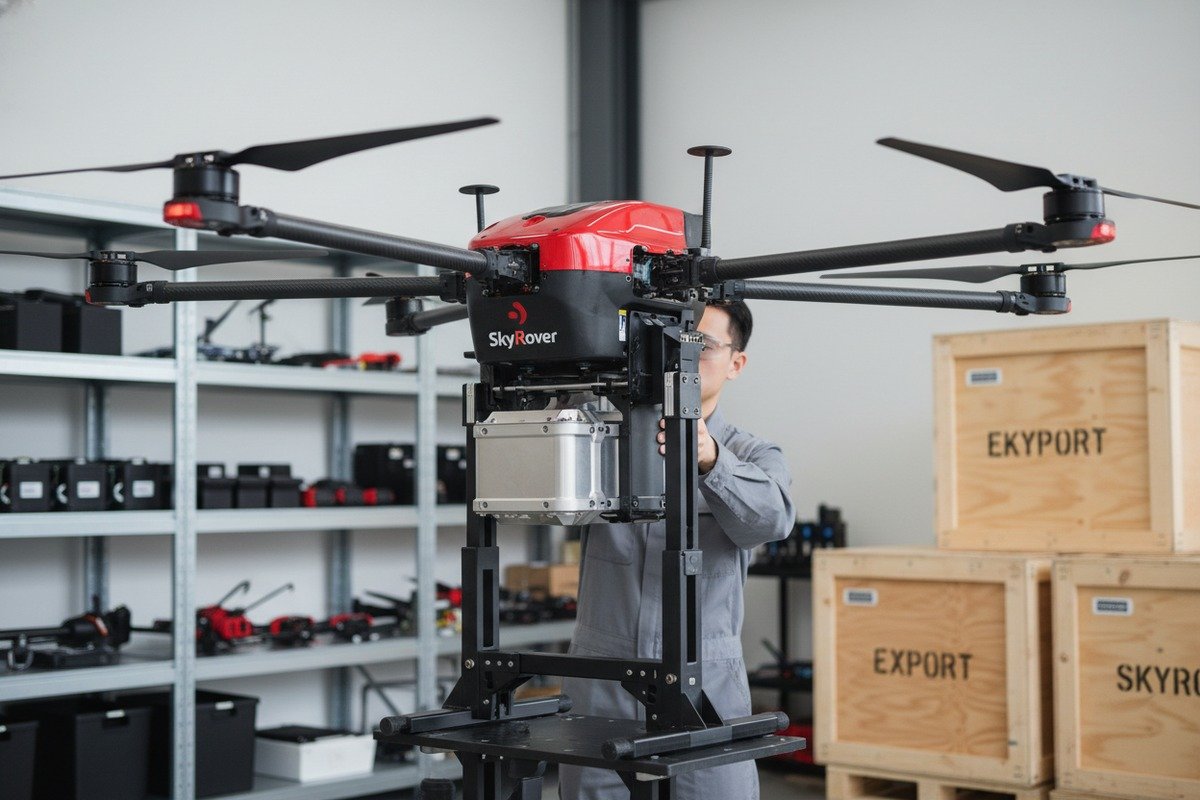
Identify Component Manufacturers
Remove covers from major electronic modules and read component markings. Quality manufacturers use identifiable parts from reputable suppliers. Look for:
- Clear part numbers you can verify online
- Lot codes and date codes for traceability
- Manufacturer logos on integrated circuits
- Certification marks (CE, UL, FCC) where applicable
Unknown or unmarked components are red flags. Counterfeit electronic parts are common in drone manufacturing. Our procurement team sources only from authorized distributors with full documentation.
Verify ESC and Motor Specifications
Electronic speed controllers and motors are critical for flight safety. Verify that installed components match claimed specifications:
| Componente | Specification to Verify | Test Method |
|---|---|---|
| ESC | Current rating | Check part number against manufacturer datasheet |
| ESC | BEC output voltage | Measure with multimeter |
| Motor | KV rating | Match part number to specifications |
| Motor | Maximum continuous current | Verify thermal rating |
| Propeller | Material and pitch | Visual inspection and measurement |
Check Flight Controller Quality
The flight controller is the brain of the drone. Industrial applications require flight controllers with:
- Redundant IMU sensors 8 (at least dual gyroscope and accelerometer)
- Industrial temperature range (-20°C to +60°C minimum)
- Vibration isolation mounting
- Reliable firmware with proven track record
Our drones use flight controllers from established manufacturers with strong technical support. We avoid no-name controllers that lack documentation and firmware updates.
Test Actual Component Performance
Where possible, test components before final assembly. Simple tests reveal quality issues:
- Measure battery internal resistance
- Check motor resistance across phases
- Verify sensor outputs with known inputs
- Test communication link range and reliability
Our factory performs 100% testing of critical components. We maintain test records for every drone we ship. This documentation helps troubleshoot any field issues quickly.
Connector Rating Verification
Verify that connector ratings exceed actual current requirements by at least 50%. This safety margin accounts for:
- Connector resistance increasing with wear
- Higher currents during aggressive maneuvers
- Temperature derating in hot environments
Our standard practice uses connectors rated for 150% of maximum expected current. This approach prevents connector overheating and voltage drops.
Assess Component Mounting Security
Industrial drones experience significant vibration. All components need secure mounting:
- Flight controllers on vibration-damping mounts
- Batteries with secure straps and padding
- Cameras on stabilized gimbals
- Sensors positioned away from vibration sources
Shake the drone gently and listen for rattling. Any loose components will fail quickly in actual flight conditions.
What indicators of long-term durability and ease of maintenance can I identify from a detailed inspection of the drone's assembly?
Our service technicians repair drones returned from the field every week. We have learned which design features predict long service life and which cause repeated problems. Maintenance-friendly design saves significant time and money over a drone's operational life.
Identify durability indicators by examining modular component design, evaluating access to serviceable parts, checking for standardized fasteners and connectors, and assessing protection against environmental factors. Durable drones use quick-release connections, accessible mounting points, and components available as spare parts.

Evaluate Modular Design
Modular design allows quick replacement of failed components. Look for:
- Arms that detach without disassembling the entire frame
- Motors with standard mounting patterns
- Plug-and-play sensor connections
- Battery bays with quick-release mechanisms
Our firefighting drones use folding arms with quick-release latches. A damaged arm can be replaced in the field within five minutes. This design philosophy extends to all serviceable components.
Check Fastener Standardization
Count the different fastener types required for complete disassembly. Fewer fastener types means simpler maintenance. Our design standard limits fasteners to three sizes:
| Fastener Size | Application | Tool Required |
|---|---|---|
| M3 | Electronics mounting, small brackets | 2.5mm hex |
| M4 | Arm attachment, motor mounts | 3mm hex |
| M5 | Landing gear, payload mounts | 4mm hex |
Drones requiring specialized tools or unusual fastener sizes create maintenance headaches. Standardization speeds repairs and reduces tool inventory requirements.
Assess Environmental Protection
Firefighting drones face water, smoke, and chemical exposure. Evaluate protection features:
- Conformal coating 9 on circuit boards
- Sealed connectors or protective boots
- Drainage paths in the frame
- Ventilation that excludes water ingress
Our production applies conformal coating to all exposed circuit boards. This silicone-based coating protects against moisture and contamination while allowing heat dissipation.
Inspect Wear Points
Identify components that will wear over time:
- Battery connector contacts
- Propeller attachment mechanisms
- Landing gear contact surfaces
- Hinge points on folding mechanisms
These areas should use durable materials and be easily accessible for inspection. Our designs use replaceable wear components rather than integrated parts that require major disassembly.
Review Spare Parts Availability
Ask about spare parts before committing to a drone purchase. Important questions:
- Are individual components available for purchase?
- What is the lead time for spare parts?
- Are wiring harnesses available as assemblies?
- Can firmware be updated in the field?
We maintain spare parts inventory for all current products plus five years after discontinuation. Our customers receive parts within one week for standard items.
Consider Field Repair Capability
Some repairs must happen in the field. Evaluate whether common repairs can be completed without specialized equipment:
- Motor replacement without soldering
- Propeller changes with basic tools
- ESC swap using plug-in connections
- Battery replacement without disassembly
Our drones allow motor replacement in under ten minutes using only a hex wrench. This capability keeps firefighting teams operational when every minute counts.
Conclusión
Prototype teardown evaluation reveals manufacturing quality that specifications cannot capture. Our systematic approach examines structural integrity, wiring practices, component quality, and maintenance design. Apply these methods to your next procurement decision for better outcomes.
Notas al pie
1. Found a working article on the same domain about drones in firefighting. ↩︎
2. Details the stringent requirements and standards for fasteners in aerospace applications. ↩︎
3. Provides a general overview of carbon fibers and their properties. ↩︎
4. Explains how weave consistency indicates the quality of carbon fiber. ↩︎
5. Explains what electromagnetic interference is and its potential effects on electronics. ↩︎
6. Explains the material properties, benefits, and applications of silicone wire insulation. ↩︎
7. Highlights the benefits of gold plating for electrical contacts, including corrosion resistance. ↩︎
8. Explains the role and benefits of redundant IMU sensors in unmanned systems for navigation. ↩︎
9. Describes what conformal coating is and its importance for protecting circuit boards. ↩︎

 English
  Spanish
  German
  French
  Dutch
Dutch  Arabic
