
When our engineering team developed drone interfaces for European clients, we discovered that what works in Asia often fails in Berlin or Barcelona. The frustration is real—buyers invest in capable hardware only to watch it gather dust because operators cannot navigate the software.
To evaluate agricultural drone UI for European user habits, verify multilingual support with metric measurements, assess interface simplicity for diverse technical proficiencies, confirm GDPR-compliant data management, check offline functionality for rural areas, and ensure integration with existing farm management systems that European operators already use.
This guide breaks down the specific evaluation criteria you need. We will examine language support, intuitive design features, data privacy compliance, and OEM customization options that matter most to European agricultural buyers.
How can I verify if the drone software supports the specific languages and metric measurements my European clients need?
Our export team learned this lesson the hard way. A German distributor returned an entire shipment because the interface defaulted to imperial units and lacked proper German terminology. metric measurements 1 The hardware was perfect. The software made it unusable.
Verify language support by requesting live software demonstrations in target languages, checking for localized agricultural terminology beyond basic translation, confirming metric system defaults, and testing regional weather data integration. Request documentation showing supported languages and measurement standards before placing orders.

Why Basic Translation Is Not Enough
Many manufacturers claim multilingual support but deliver Google Translate quality. European farmers need more than word-for-word translation. They need localized agricultural terminology 2 that matches regional practices.
For example, soil health indicators vary by country. French farmers use different classification systems than Polish farmers. The UI must reflect these differences.
| Language Feature | Basic Support | Professional Support |
|---|---|---|
| Menu Translation | Simple word replacement | Context-aware terminology |
| Agricultural Terms | Generic farming words | Region-specific vocabulary |
| Measurement Units | Manual switching option | Auto-detect by location |
| Date/Time Format | US format only | Local format default |
| Weather Integration | Global sources | Regional meteorological data |
Testing Metric System Integration
When we calibrate our flight controllers, metric precision matters. European farmers work in hectares, not acres. They measure spray rates in liters per hectare, not gallons per acre.
Ask suppliers to demonstrate:
- Default unit settings by region
- Conversion accuracy between systems
- Field boundary measurements in local standards
- Altitude readings in meters
- Speed displays in km/h
Regional Weather Data Sources
European farmers rely on local meteorological services. The UI should pull data from relevant sources:
| European Region | Preferred Weather Source | Key Data Points |
|---|---|---|
| Alemania | DWD (Deutscher Wetterdienst) 3 | Precipitation, wind speed |
| Francia | Météo-France | Soil moisture, temperature |
| España | AEMET | Solar radiation, drought index |
| Poland | IMGW | Frost warnings, humidity |
| Netherlands | KNMI | Wind patterns, cloud cover |
Request proof that the software integrates with these regional sources. Generic global weather data often lacks the precision European precision agriculture 4 demands.
Documentation Checklist
Before signing any contract, request written confirmation of:
- Complete list of supported languages
- Screenshot evidence of localized interfaces
- Measurement unit default settings by country
- Weather API integration documentation
- Update schedule for language packs
What UI design features should I prioritize to ensure the interface is intuitive enough for European agricultural operators?
In our experience exporting to European markets, we have seen expensive drones become paperweights because the interface overwhelmed operators. A Dutch dealer told us his customers abandoned a competitor's product after two weeks—the learning curve was simply too steep for seasonal workers.
Prioritize one-screen dashboards with clear visual hierarchy, automated flight planning that reduces manual input, mobile-responsive design for field use, dark mode for early morning operations, and customizable alert systems. The interface should require less than two hours of training for basic operations.

The Two-Hour Training Rule
European farm operations often employ seasonal workers with limited technical backgrounds. If your software cannot be learned in a single training session, adoption will fail.
When our engineers design interfaces, they follow these principles:
- Maximum three clicks to any function
- Color-coded status indicators
- Large touch targets for gloved hands
- Consistent navigation patterns across screens
- Immediate visual feedback for every action
Dashboard Design Evaluation
The main dashboard should display critical information without scrolling. Test this by asking:
| Dashboard Element | Good Design | Poor Design |
|---|---|---|
| Battery Status | Large percentage with color | Small text buried in menu |
| GPS Signal | Visual indicator always visible | Requires navigation to view |
| Weather Alerts | Pop-up notifications | Hidden in settings |
| Flight Area | Map view on main screen | Separate application needed |
| Mission Progress | Real-time percentage bar | Status text only |
Mobile-First Considerations
European farmers access drone data from tractors, barns, and fields. The software must work seamlessly on smartphones and tablets.
Test mobile interfaces for:
- Touch responsiveness with work gloves
- Screen visibility in direct sunlight
- Offline mission planning capability
- Data synchronization when connectivity returns
- Battery efficiency during extended field use
Dark Mode and Environmental Adaptability
European farming schedules often start before sunrise and continue after sunset. Dark mode reduces eye strain during these hours.
Beyond aesthetics, dark mode serves practical purposes:
- Lower power consumption extends mobile device battery
- Reduced light pollution during night operations
- Better visibility of thermal imaging overlays
- Decreased distraction during sensitive operations
Automated Flight Planning
Manual flight path creation wastes time and introduces errors. Evaluate automation features:
| Automation Feature | Benefit | Verification Method |
|---|---|---|
| Field Boundary Detection | Reduces setup time | Upload test field data |
| Obstacle Avoidance Integration | Improves safety | Request obstacle demo |
| Weather-Based Rescheduling | Prevents failed missions | Check trigger settings |
| Battery Swap Optimization | Maximizes coverage | Review route algorithms |
| Return-to-Home Automation | Ensures drone recovery | Test signal loss response |
Does the drone's data management interface meet the strict GDPR and privacy expectations of my European buyers?
When we began shipping to EU countries, our compliance team had to completely redesign our data architecture. What passed inspection in other markets triggered immediate rejection from European partners. One Italian buyer demanded a full audit before even discussing hardware specifications.
GDPR-compliant drone software must offer transparent data storage locations, clear consent mechanisms, data export and deletion capabilities, encrypted transmission protocols, and documented retention policies. Request written compliance certifications and audit trails showing how the software handles agricultural data collection and processing.
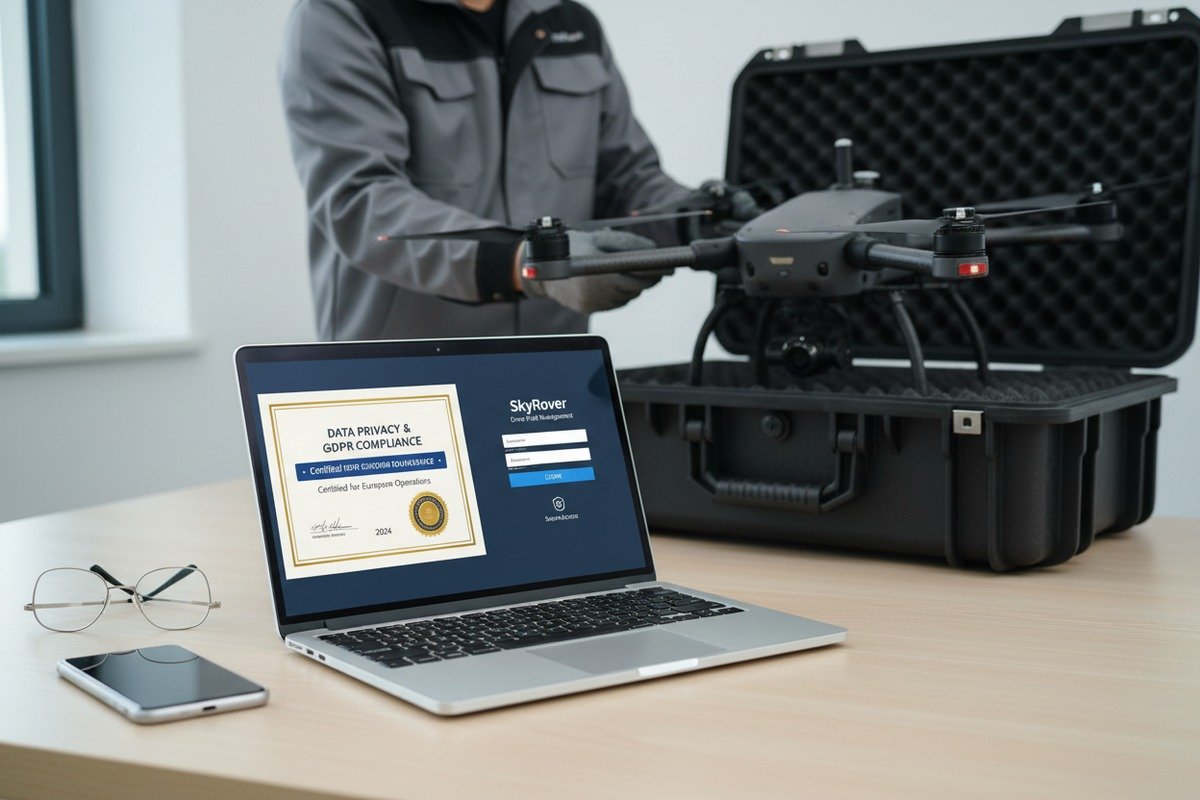
Understanding GDPR Requirements for Agricultural Drones
Agricultural drones collect sensitive data. Field boundaries reveal property information. Crop health data has commercial value. Flight logs show operational patterns.
European regulations treat this data seriously. Your suppliers must demonstrate compliance in specific areas:
| GDPR Requirement | Drone Software Application | Verification Question |
|---|---|---|
| Data Minimization | Collect only necessary information | What data points are mandatory vs. optional? |
| Storage Limitation | Clear retention periods | How long is flight data stored? |
| Right to Access | User data export | Can farmers download all their data? |
| Right to Erasure 5 | Delete functionality | Can users permanently remove data? |
| Data Portability | Standard export formats | What file formats are supported? |
Data Storage Location Matters
European buyers increasingly demand EU-based servers. When flight data crosses borders, compliance becomes complicated.
Ask suppliers directly:
- Where are primary servers located?
- Do backup servers exist outside the EU?
- Can customers choose data center regions?
- What happens to data if the company is acquired?
Encryption and Security Standards
Data protection extends beyond legal compliance. European agricultural operations face real cybersecurity threats.
Evaluate encryption at three levels:
- Data at rest: How is stored information protected?
- Data in transit: What protocols secure uploads and downloads?
- Device storage: Is local data encrypted on mobile devices?
Consent and Transparency Mechanisms
The software interface must make data practices clear to users. Hidden terms in lengthy agreements do not satisfy GDPR requirements 6.
Look for:
- Plain language privacy notices
- Granular consent options for different data types
- Easy access to privacy settings
- Clear explanations of third-party data sharing
- Notifications when privacy policies change
Audit Trail Capabilities
Professional European buyers want proof of compliance history. The software should generate audit logs showing:
- Who accessed what data
- When changes were made
- What data was exported or deleted
- System security events
- Compliance check timestamps
Can I request custom UI modifications or OEM branding to better suit the professional aesthetic of my European market?
Our partnership model has evolved specifically because European distributors demanded more than generic white-label options. A French partner wanted specific color schemes matching their existing product line. A UK dealer needed custom reporting templates for their government clients. Standard OEM packages simply did not meet these needs.
Most professional agricultural drone manufacturers offer tiered OEM customization including logo placement, color scheme modifications, custom boot screens, branded documentation, and interface layout adjustments. Advanced customization may include custom feature development, API integrations, and co-branded software development for established distributor partnerships.

Understanding OEM Customization Levels
Not all customization requests require the same investment. Understanding the tiers helps set realistic expectations:
| Customization Level | Typical Inclusions | Timeline | Investment Level |
|---|---|---|---|
| Basic Branding | Logo, company name, contact info | 2-4 semanas | Bajo |
| Visual Customization | Color schemes, icons, boot screens | 4-8 semanas | Medio |
| Interface Modification | Menu reorganization, feature visibility | 8-12 weeks | Medium-High |
| Feature Development | Custom tools, unique reporting | 12-24 weeks | Alto |
| Full Co-Development | Ground-up interface design | 6-12 months | Very High |
What to Request in Basic OEM Packages
Even standard packages should include essential branding elements:
- Logo placement on main dashboard
- Company name in header and footer
- Branded loading screens
- Custom color for primary UI elements
- Localized contact information for support
- Branded PDF report templates
- Custom email notification headers
Advanced Customization Considerations
European professional markets often require deeper modifications. Discuss these possibilities early:
Reporting Customization
Government contractors need specific report formats. Agricultural cooperatives require data in particular structures. Custom report templates save hours of manual reformatting.
Integration Development
European farms commonly use established management systems. Custom API development enables data flow between your branded drone software and existing platforms like:
- John Deere Operations Center 7
- CLAAS TELEMATICS
- Trimble Ag Software
- 365FarmNet
- Agrirouter
Feature Visibility Control
Some markets need simplified interfaces. Others want advanced options visible. Customization should allow toggling feature visibility without removing underlying capabilities.
Protecting Your Brand Investment
When negotiating OEM agreements, secure your customization investment:
- Exclusive branding rights for your territory
- Source file ownership for custom graphics
- Update commitments maintaining customization
- Exit provisions returning your branded elements
- Non-compete clauses for your specific market
Quality Assurance for Custom Interfaces
Custom software requires additional testing. Ensure your supplier commits to:
- User acceptance testing with your team
- Bug fix guarantees for customized elements
- Performance benchmarks matching standard software
- Update compatibility commitments
- Documentation for custom features
Conclusión
Evaluating agricultural drone UI 8 for European markets requires systematic attention to language localization, intuitive design, GDPR compliance, and customization capabilities. The investment in proper evaluation prevents costly returns, supports faster adoption, and builds lasting distributor relationships across diverse European agricultural markets.
Notas al pie
1. Explains the importance of metric units in global farming contexts. ↩︎
2. Replaced with a comprehensive agriculture glossary, which provides relevant terminology. ↩︎
3. Official website for Germany’s national meteorological service. ↩︎
4. Provides the official definition from the International Society for Precision Agriculture. ↩︎
5. Direct legal text for the ‘right to be forgotten’ under GDPR. ↩︎
6. Outlines the core principles and requirements of the GDPR. ↩︎
7. Official page for John Deere’s farm management software platform. ↩︎
8. Guide on UI/UX design principles for agriculture apps. ↩︎

 English
  Spanish
  German
  French
  Dutch
Dutch  Arabic
