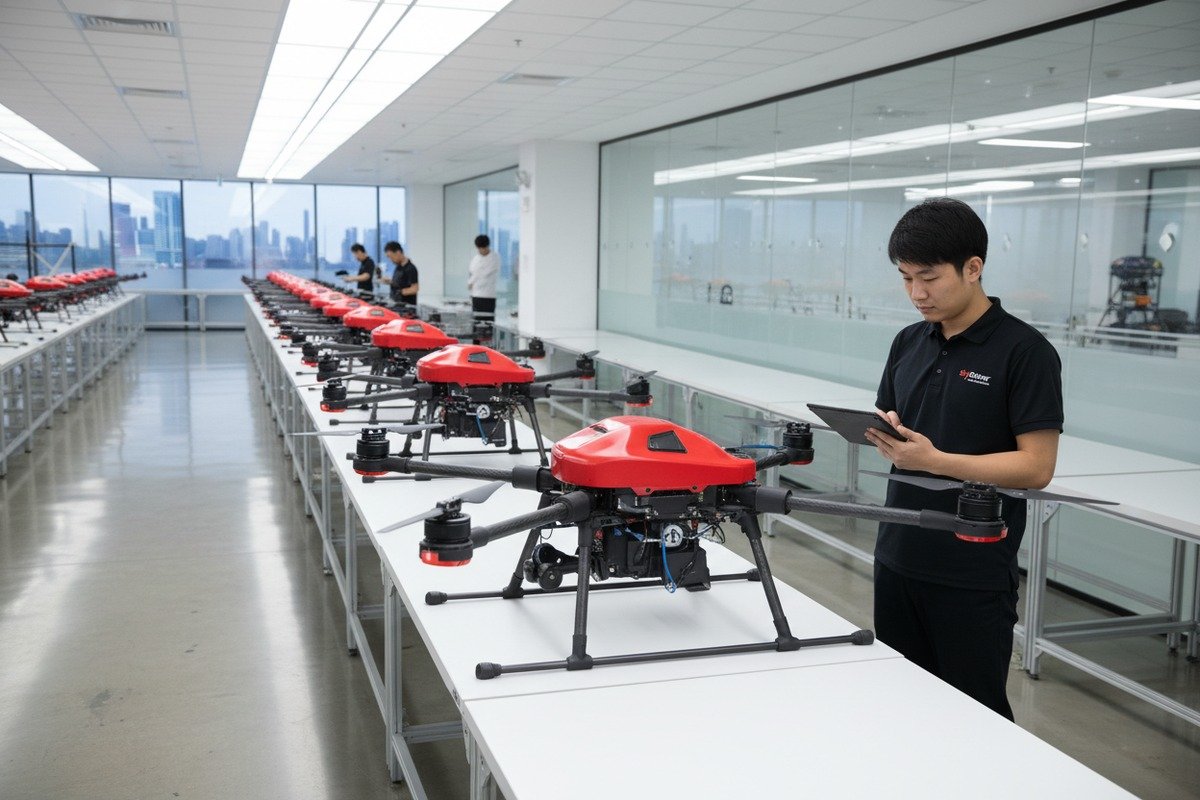
When our production line scaled from 50 units to 500 units monthly, we faced a nightmare scenario. Three firefighting drones failed thermal tests. The root cause? A supplier quietly changed battery cell chemistry 1. This single incident taught us that sample excellence means nothing without iron-clad mass production controls.
To ensure mass-produced firefighting drones maintain sample performance, manufacturers must implement end-to-end quality control including component traceability, standardized environmental stress testing, automated inspection systems, and continuous feedback loops between field deployment and production. Every unit must undergo the same rigorous validation as the original prototype.
Below, we break down the exact protocols, tests, and systems that keep every drone in your fleet performing like the sample you approved. Let’s dive into the specifics.
How can I verify that my bulk order of firefighting drones matches the sample's flight stability?
Our engineering team has spent years perfecting flight controller calibration 2. Yet we still see customers receive units that drift or wobble. The gap between a perfect sample and a problematic bulk unit often comes down to one thing: testing consistency.
To verify flight stability consistency, request documented proof of standardized flight tests for every unit, including hover stability data, wind resistance metrics, GPS accuracy logs, and automated flight path deviation reports. Each drone should pass identical test parameters that the approved sample met before shipment.

Understanding Flight Stability Variables
Flight stability in firefighting drones depends on multiple interconnected systems. The flight controller, IMU sensors 3, motor synchronization, and propeller balance all contribute to stable hover and controlled movement. When we calibrate our flight controllers, we use reference data from the approved sample unit. This creates a baseline that every production unit must match.
In our experience, the most common causes of stability drift in mass production include:
- Slight variations in motor KV ratings
- Inconsistent propeller manufacturing tolerances
- IMU sensor calibration drift
- Flight controller firmware version mismatches
Key Flight Stability Metrics to Request
| Metric | Sample Benchmark | Acceptable Variance | Test Condition |
|---|---|---|---|
| Hover Drift | < 0.5m horizontal | ± 0.1m | No wind, 10m altitude |
| Wind Resistance | Stable at 39 f/s | ± 2 f/s | Wind tunnel test |
| GPS Position Hold | < 0.3m deviation | ± 0.1m | Open field, 8+ satellites |
| Altitude Hold | < 0.2m fluctuation | ± 0.05m | Barometer calibrated |
| Yaw Stability | < 1° drift per minute | ± 0.5° | Static hover test |
Automated Testing Systems
We invested in automated flight test chambers 4 three years ago. These chambers simulate wind conditions, temperature extremes, and GPS environments. Every drone spends 15 minutes in automated hover testing before leaving our facility. The system logs data automatically and flags any unit that deviates from sample benchmarks.
Ask your supplier if they use automated testing or manual spot checks. Automated systems provide consistent, unbiased data. Manual testing relies on operator skill and can miss subtle issues.
Request Documentation
Before accepting bulk delivery, request these documents:
- Individual flight test certificates for each unit
- Comparison reports showing sample vs. production unit data
- Calibration records for IMU and flight controller
- Motor and propeller matching records
This documentation creates accountability. If a unit fails in the field, you can trace back to the production test data and identify where quality control failed.
What quality control protocols should I demand to ensure consistent performance across every unit?
When we first exported to the US market, a customer returned 12 units within two months. The failures were random—some motors, some sensors, some batteries. We traced the problem to inconsistent incoming component inspection. That experience transformed our entire QC approach.
Demand ISO 9001-certified manufacturing, 100% incoming component inspection, in-process quality gates at assembly stages, environmental stress screening, and final acceptance testing. These protocols must be documented and auditable, with clear pass/fail criteria matching your approved sample specifications.

The Five-Stage Quality Control Framework
Quality control for firefighting drones cannot happen only at the end of production. end-to-end quality control 5 It must be embedded throughout the manufacturing process. Our facility uses a five-stage framework:
Stage 1: Incoming Material Inspection
Every component batch is tested before entering production. Batteries undergo capacity and discharge rate testing. Motors are checked for KV rating consistency. Carbon fiber frames are inspected for structural integrity.
Stage 2: Sub-Assembly Verification
After each major sub-assembly (power system, avionics, airframe), quality gates verify correct integration. This catches problems early when fixes are cheap.
Stage 3: Pre-Flight System Check
Before any flight test, automated diagnostics verify all systems communicate correctly. Sensors are calibrated. Firmware versions are confirmed.
Stage 4: Environmental Stress Screening
Units undergo temperature cycling, vibration testing, and humidity exposure. This screens out components with latent defects that would fail in field conditions.
Stage 5: Final Acceptance Testing
Full flight tests, thermal imaging validation, payload capacity verification, and communication range testing. Only units passing all parameters ship to customers.
Quality Control Protocol Comparison
| Protocol | Basic QC | Standard QC | Premium QC |
|---|---|---|---|
| Incoming Inspection | Sampling only | 50% batch | 100% components |
| Assembly Gates | Final only | 2 checkpoints | Every stage |
| Environmental Testing | Ninguno | Temperature only | Full stress screen |
| Flight Testing | Spot check | 30% units | 100% units |
| Documentación | Batch certificates | Unit summary | Full traceability |
| Cost Impact | Lowest | Moderate | Highest |
Certifications That Matter
ISO 9001 certification is the baseline. ISO 9001-certified manufacturing 6 It proves the manufacturer has documented quality management systems. However, certification alone doesn't guarantee execution. Request audit reports and corrective action logs.
For firefighting drones specifically, look for:
- NFPA compliance documentation
- IP54 or IP55 rating test reports
- Heat resistance testing certificates
- EMC compliance for communication systems
Supplier Audit Rights
Include audit rights in your purchase agreement. This allows you or a third party to inspect the factory, review quality records, and witness testing. Reputable manufacturers welcome audits. Reluctance to allow audits is a red flag.
How do I confirm that the internal components in my mass-produced drones are identical to the prototype?
Last year, we discovered a supplier substituted capacitors in our power distribution boards without notification. The substitution passed basic function tests but failed under high-load firefighting operations. This taught us that component authenticity requires proactive verification systems.
Confirm component identity through detailed Bill of Materials matching, component serialization with database tracking, incoming inspection against approved vendor lists, and blockchain-based supply chain verification where available. Request component-level certificates of conformity for critical parts including batteries, motors, flight controllers, and sensors.

Critical Components That Must Match
Not all components affect performance equally. Focus verification efforts on these critical categories:
Batteries and Power Systems
Battery chemistry, cell configuration, and BMS firmware directly impact flight time, safety, and reliability. Even small variations in battery quality cause inconsistent performance. Our facility tests every battery pack individually before installation.
Flight Controllers and IMU
The flight controller is the drone's brain. Different hardware revisions or firmware versions create different flight characteristics. IMU sensors from different suppliers may have varying accuracy specifications.
Motors and ESCs
Motor KV rating variations affect thrust output and flight stability. ESC timing and response characteristics must match across all units. Mismatched components cause vibration and control issues.
Thermal Imaging Sensors
Thermal camera calibration and sensitivity specifications must match your sample exactly. Different sensor generations may have different detection ranges or accuracy.
Component Traceability Methods
| Método | Implementation | Reliability | Costo |
|---|---|---|---|
| Visual Inspection | Check labels/markings | Bajo | Minimal |
| Serial Number Database | Log all component serials | Medio | Bajo |
| Barcode/QR Tracking | Scan at each production stage | Medium-High | Moderate |
| Blockchain Verification | Immutable supply chain record | Alto | Más alto |
| Third-Party Testing | Independent component analysis | Highest | Highest |
Approved Vendor Lists
Request your supplier's Approved Vendor List 8 (AVL) for critical components. This document identifies which manufacturers and part numbers are authorized. Any deviation from the AVL should require your approval.
When we onboard new component suppliers, they go through a qualification process:
- Sample testing against specifications
- Production capability assessment
- Quality management system review
- Trial batch production and evaluation
- Ongoing performance monitoring
Engineering Change Control
Manufacturers sometimes improve components during production. These changes should follow formal Engineering Change Notice (ECN) procedures. You should receive notification of any changes affecting form, fit, or function.
Ask suppliers about their change control process:
- How are changes documented?
- Who approves changes?
- How are customers notified?
- Can you reject changes and maintain original specifications?
Physical Verification Options
For high-value orders, consider third-party inspection services. Companies like SGS, Bureau Veritas, or Intertek can inspect components at the factory before assembly. They can verify markings, measure specifications, and confirm authenticity against your approved sample.
What steps can I take to guarantee that my fleet's durability won't degrade during large-scale manufacturing?
Our engineers have found that durability problems often appear months after deployment. A frame that passed factory stress tests fails after 200 flight hours. The culprit? Manufacturing shortcuts that compromise long-term reliability. Durability must be designed in and verified continuously.
Guarantee fleet durability by requiring accelerated life testing on sample units, demanding durability-focused specifications in purchase contracts, implementing incoming inspection for structural components, requesting production process controls documentation, and establishing warranty terms tied to specific performance criteria over defined operational periods.

Durability Risk Factors in Mass Production
When production scales, cost pressure increases. This creates temptation to cut corners. Common durability compromises include:
- Thinner carbon fiber layups in frames
- Lower-grade fasteners and connectors
- Reduced adhesive curing times
- Abbreviated quality hold points
- Component substitutions
These shortcuts save pennies per unit but create field failures that cost thousands in warranty claims, reputation damage, and safety incidents.
Accelerated Life Testing
Before approving mass production, require accelerated life testing 9 on pre-production samples. This testing compresses years of wear into weeks by amplifying stress factors.
| Tipo de prueba | What It Simulates | Duración | Key Metrics |
|---|---|---|---|
| Thermal Cycling | Hot/cold extremes | 100 cycles | Frame integrity, solder joints |
| Vibration Testing | Flight hours | 50 hours | Fastener loosening, connector wear |
| Salt Spray | Marine environments | 48 hours | Corrosion resistance |
| UV Exposure | Sunlight aging | 500 hours | Plastic degradation |
| Drop Testing | Handling impacts | 10 drops | Structural damage, functionality |
| Motor Endurance | Continuous operation | 100 hours | Bearing wear, thermal performance |
Durability Specifications in Contracts
Your purchase agreement should include specific durability requirements:
Frame and Structure
- Minimum material specifications (carbon fiber weight, resin type)
- Impact resistance ratings
- Heat resistance temperature thresholds
Motors and Propulsion
- Minimum bearing life in flight hours
- Operating temperature range
- Efficiency retention over time
Electronics
- Connector insertion cycle ratings
- Conformal coating requirements
- EMC shielding specifications
Baterías
- Cycle life guarantees
- Capacity retention after specified cycles
- Safety certification requirements
Production Process Controls
Durability depends on consistent manufacturing processes. Request documentation on:
Adhesive and Bonding
- Cure times and temperatures
- Surface preparation procedures
- Bond strength testing frequency
Fastener Installation
- Torque specifications
- Thread locking requirements
- Inspection procedures
Protección del medio ambiente
- Conformal coating coverage
- Seal integrity testing
- IP rating verification methods
Warranty Structure
Structure your warranty to incentivize durability. Instead of simple time-based warranties, consider:
- Flight hour warranties (e.g., 500 hours or 2 years, whichever comes first)
- Performance retention guarantees (e.g., 90% battery capacity at 300 cycles)
- Prorated repair costs tied to documented maintenance compliance
This approach aligns manufacturer incentives with your fleet's long-term reliability needs.
Field Data Feedback Loops
Establish systems to collect field performance data and feed it back to manufacturers. Digital twin technology enables real-time monitoring of each drone's operational stresses. This data helps identify durability issues before they become widespread and guides manufacturing improvements.
Conclusión
Maintaining sample performance across mass-produced firefighting drones requires systematic quality control at every stage. From component verification to flight testing to durability assurance, each protocol builds on the others. Partner with manufacturers who welcome transparency, provide documentation, and invest in quality infrastructure.
Notas al pie
1. Explains the fundamental chemical principles behind battery cells and their operation. ↩︎
2. Provides a comprehensive guide on calibrating drone flight controllers for stable performance. ↩︎
3. Explains the meaning, definition, and working principles of Inertial Measurement Unit (IMU) sensors. ↩︎
4. Discusses the role of automated testing, including simulation and HIL, for drone flight systems. ↩︎
5. Found a relevant page from a company specializing in quality control that provides a good overview of end-to-end quality control. ↩︎
6. Details the importance and benefits of ISO 9001 certification for manufacturing quality management. ↩︎
7. Found an authoritative Wikipedia page providing a clear definition and overview of Environmental Stress Screening. ↩︎
8. Explains the Approved Vendor List (AVL) as a critical tool for strategic sourcing and quality control. ↩︎
9. Found a highly authoritative government source (.gov) from NIST that provides a detailed explanation of Accelerated Life Testing. ↩︎

 English
  Spanish
  German
  French
  Dutch
Dutch  Arabic
