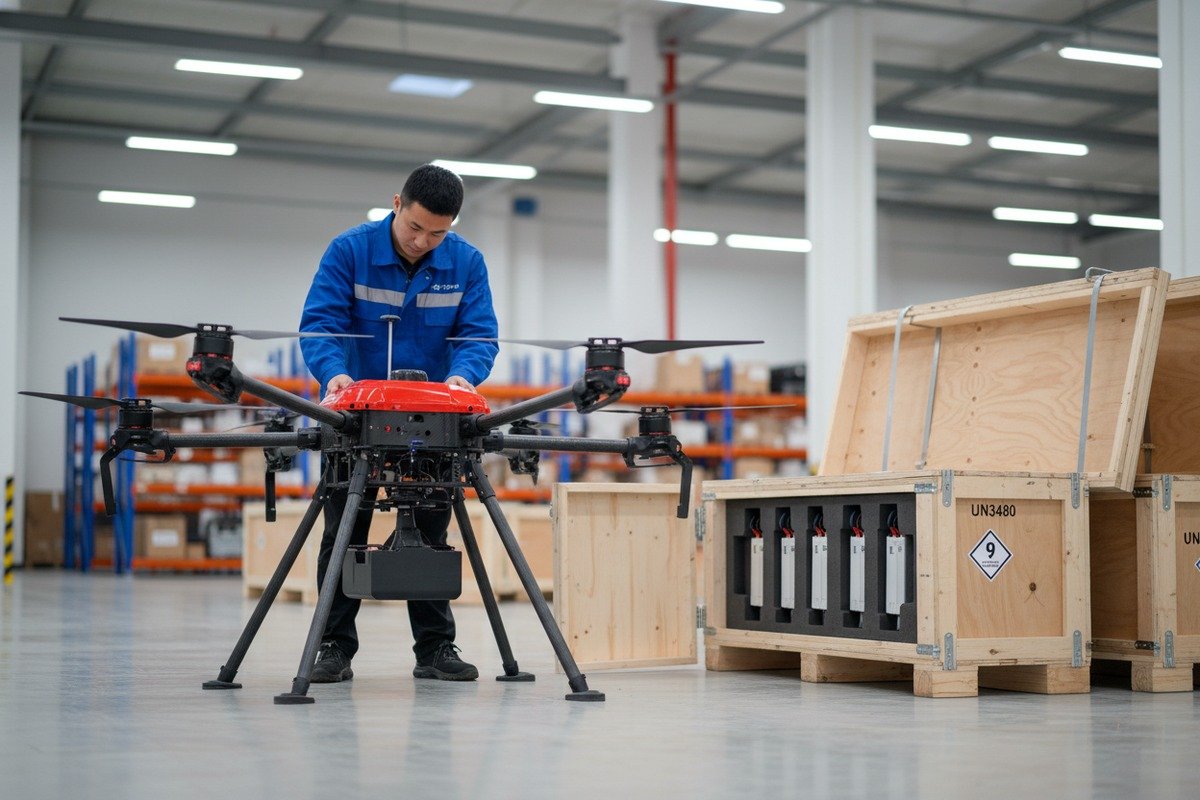
When our production team packs high-capacity lithium batteries 1 for firefighting drones, one question keeps coming up: will this shipment clear customs without delays or fines?
To ensure IATA compliance for firefighting drone battery shipments from China, you must classify batteries as UN3480 (Class 9 Dangerous Goods), obtain UN38.3 test certificates, limit State of Charge to 30% or below, follow Packing Instructions PI 965-970, apply correct labels, and prepare complete documentation including a Shipper’s Declaration for Dangerous Goods.
This guide walks you through every step of the process UN38.3 test summary certificates 2. From collecting supplier documents to securing smooth door-to-door delivery, you will find practical answers below.
What documentation must I collect from my supplier to prove my drone batteries meet IATA safety standards?
Our engineering team learned early on that missing paperwork causes more shipping delays than faulty batteries Material Safety Data Sheets 3. A single rejected shipment can cost weeks and thousands of dollars.
You must collect UN38.3 test summary certificates, Material Safety Data Sheets (MSDS), a Shipper's Declaration for Dangerous Goods (DGD), proof of State of Charge below 30%, and export licenses from China's General Administration of Customs (GACC) to prove your drone batteries meet IATA safety standards.

The UN38.3 Test Summary Explained
The UN38.3 test is non-negotiable. This certification proves your lithium batteries can handle extreme transport conditions Class 9 hazard labels 4. The test covers altitude simulation, thermal cycling, vibration, shock, external short circuit, impact, overcharge, and forced discharge.
At our facility, we run these tests before any battery leaves the assembly line. The test summary must include the battery manufacturer name, test laboratory details, unique battery identification, and a clear statement confirming the battery passed all eight tests.
Essential Documents Checklist
| Documento | Objetivo | ¿Quién lo proporciona? |
|---|---|---|
| Resumen de la prueba UN38.3 | Proves battery passed safety tests | Battery manufacturer or certified lab |
| Hoja de datos de seguridad de materiales (MSDS) | Details chemical composition and hazards | Battery manufacturer |
| Shipper's Declaration for Dangerous Goods 5 | Legal declaration for air transport | Shipper (you or your forwarder) |
| State of Charge Certificate | Confirms battery is at ≤30% SoC | Manufacturer with discharge records |
| GACC Export License | Chinese export approval | Supplier via Chinese customs |
| Packing List with Wh Rating | Shows battery specifications | Manufacturer |
State of Charge Documentation
Starting January 1, 2026, the 30% State of Charge limit 6 applies to batteries inside equipment too. This is a major change. Before this date, drone batteries installed in the aircraft had more flexibility.
We now provide a signed affidavit in both Chinese and English. This document states the exact SoC percentage at the time of packing. Many freight forwarders now require this affidavit before accepting any lithium battery shipment.
Watt-hour Rating Calculations
The Wh rating determines which packing instruction applies. For firefighting drone batteries, this number is often above 100Wh. Here is the formula:
Wh = Voltage (V) × Ampere-hour (Ah)
A typical firefighting drone battery might be 44.4V at 22Ah. That equals 976.8Wh. This high capacity triggers stricter requirements under Section IA of PI 965.
How can I verify that my firefighting drone batteries are packaged and labeled correctly for air freight from China?
In our warehouse, we have a dedicated inspection station just for dangerous goods packaging. One wrong label can ground an entire shipment and trigger fines exceeding $100,000.
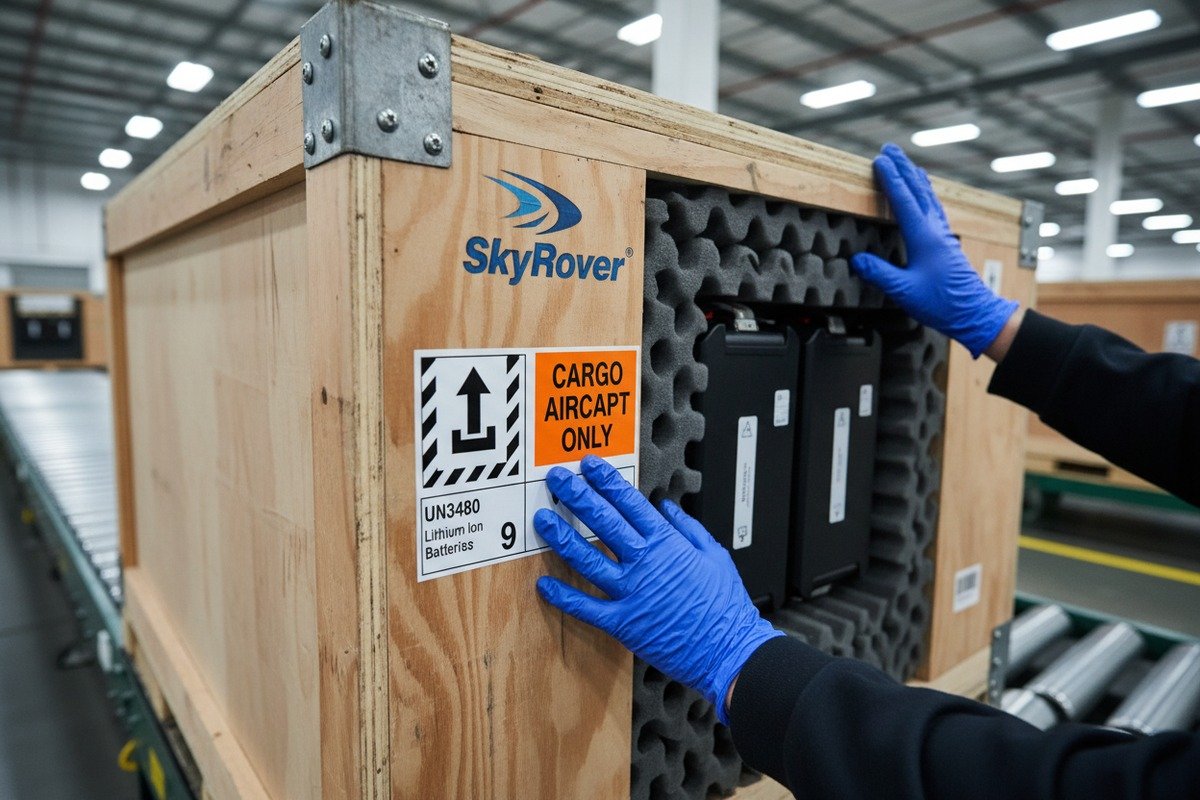
Verify correct packaging by confirming rigid outer containers, inner cushioning to prevent movement and short circuits, and compliance with Packing Instructions PI 965-970. Check for Class 9 hazard labels, Cargo Aircraft Only labels, lithium battery handling marks, UN numbers (UN3480 or UN3481), and proper shipping names on all outer surfaces.
Understanding Packing Instructions
Different configurations require different packing instructions. Here is how they break down:
| Packing Instruction | Battery Configuration | Requisitos clave |
|---|---|---|
| PI 965 Section IA | Standalone batteries >100Wh | Metal or rigid container, max 35kg net weight |
| PI 965 Section IB | Standalone batteries ≤100Wh | Rigid outer packaging, 2.5kg max per package |
| PI 965 Section II | Small quantities | 1 package per consignment limit |
| PI 966 | Batteries packed with equipment | Equipment and batteries in same outer package |
| PI 967 | Batteries contained in equipment | Drone with battery installed |
| PI 968-970 | Lithium metal variations | Similar structure to PI 965-967 |
For firefighting drones with batteries above 100Wh, PI 965 Section IA or PI 967 typically applies. Packing Instructions PI 965 7
Physical Packaging Requirements
The outer container must be rigid. Cardboard alone does not qualify for high-capacity batteries. We use reinforced fiberboard boxes with internal plastic or metal enclosures.
Inner packaging must prevent battery movement. Use foam inserts custom-cut to hold each battery cell. All terminals need protection from short circuits. We cover positive terminals with insulating caps and wrap batteries in non-conductive material.
Label Placement and Specifications
Every outer package needs multiple marks visible on the same side:
- Class 9 Hazard Label: Diamond shape with black and white stripes
- Cargo Aircraft Only Label: Orange rectangle, required for UN3480 shipments
- Lithium Battery Handling Label: Shows battery type and emergency contact
- UN Number: "UN3480" for standalone, "UN3481" for batteries with equipment
- Proper Shipping Name: "Lithium ion batteries" in letters at least 12mm high
Pre-Shipment Inspection Checklist
Before sealing any package, our quality team verifies:
- Battery SoC meter shows ≤30%
- No visible swelling, leaks, or damage
- Terminals are insulated
- Inner cushioning is secure
- All labels are correct and legible
- Documentation matches package contents
What should I look for in a drone manufacturer to ensure they can handle complex dangerous goods shipping requirements?
When customers visit our Xi'an facility, they often ask how we manage the logistics of shipping batteries worldwide. The answer lies in building dangerous goods expertise into our operations from day one.
Look for manufacturers with in-house dangerous goods trained staff, established relationships with DG-certified freight forwarders, documented UN38.3 testing procedures, controlled SoC discharge processes, proper packaging facilities, and a track record of successful international lithium battery shipments to your target country.

Essential Manufacturer Capabilities
Not every drone factory can handle dangerous goods shipping. Here are the capabilities that separate qualified manufacturers from the rest:
| Capability | Por qué es importante | How to Verify |
|---|---|---|
| DG-trained personnel | Correct classification and documentation | Ask for training certificates |
| Battery testing equipment | Verify SoC and Wh ratings on-site | Request facility photos or video tour |
| Packaging materials inventory | Correct containers always available | Ask about supplier relationships |
| Forwarder partnerships | Faster, cheaper DG shipping | Request forwarder references |
| Export license readiness | GACC compliance | Ask for previous export documentation samples |
| English documentation capability | Clear communication with customs | Review sample documents |
Questions to Ask Your Potential Supplier
During our conversations with buyers, certain questions reveal whether a manufacturer truly understands dangerous goods shipping:
- Who prepares your Shipper's Declaration for Dangerous Goods?
- How do you discharge batteries to 30% SoC before shipping?
- Which freight forwarders do you use for lithium battery shipments?
- Can you provide sample UN38.3 test summaries?
- What happens if a shipment is rejected at the airport?
A manufacturer who hesitates on these questions may lack the experience you need.
Red Flags to Avoid
Watch for these warning signs during supplier evaluation:
- No UN38.3 certificates available
- Claims that "documentation is the forwarder's job"
- Inability to explain SoC discharge procedures
- No experience shipping to your target country
- Unwilling to share previous export records
The Value of Integrated Support
Our team handles the entire chain. We test batteries, discharge them to compliant levels, package them correctly, prepare all documentation, and coordinate with DG-certified forwarders. This integration prevents gaps where compliance failures typically occur.
We also provide technical support after delivery. If your customs broker has questions about battery specifications, our engineers respond within hours. This ongoing support resolves issues before they become costly delays.
How do I secure door-to-door delivery and smooth customs clearance for my high-capacity lithium battery shipments?
Our export team has shipped firefighting drones to over 30 countries. The difference between smooth deliveries and customs nightmares often comes down to preparation and partner selection.
Secure door-to-door delivery by partnering with DG-certified freight forwarders experienced in China-origin lithium shipments, pre-clearing documentation with destination customs brokers, coordinating airline-specific requirements, arranging proper insurance coverage, and building buffer time into delivery schedules for the mandatory 30% SoC discharge process.

Choosing the Right Logistics Partners
Not all forwarders handle dangerous goods equally. For lithium battery shipments from China, you need partners who understand both IATA regulations and CAAC (China Civil Aviation Authority) requirements.
Major carriers like FedEx, DHL, and UPS have dedicated dangerous goods services. However, their mass limits and battery restrictions vary. Always confirm current policies before booking.
Airline and Carrier Restrictions
| Carrier Type | Typical Restrictions | Pre-Booking Action |
|---|---|---|
| Major integrators (FedEx, DHL) | Battery mass limits, route restrictions | Contact DG desk for current policies |
| Commercial airlines (Air China, Cathay) | State variations, approval requirements | Submit battery specs 48+ hours ahead |
| Charter cargo | More flexibility, higher cost | Negotiate terms for recurring shipments |
Customs Clearance Preparation
Smooth customs clearance requires documentation alignment between origin and destination. For US imports, your customs broker needs:
- Commercial invoice with Wh ratings and SoC confirmation
- UN38.3 test summary
- Packing list showing IATA-compliant packaging
- Import permits if required by state or federal agencies
We prepare dual-language documents. Chinese customs requires certain forms in Mandarin, while US CBP needs English versions. Mismatches between these documents cause clearance delays.
Managing the 30% SoC Discharge Process
Discharging batteries to 30% SoC adds 1-2 days to production schedules. We use controlled discharge stations that monitor temperature and voltage throughout the process.
This step cannot be rushed. Rapid discharge generates heat and can damage cells. We discharge at rates recommended by the cell manufacturer, typically C/5 or slower for high-capacity packs.
Plan your orders accordingly. If you need firefighting drones for a specific date, add discharge time to your lead time calculations.
Insurance and Liability Considerations
Standard cargo insurance may exclude dangerous goods. Verify your policy covers lithium battery shipments specifically. The premium is higher, but the protection is essential given the regulatory fines possible for non-compliance.
Document everything. Take photos of packaging, labels, and sealed containers before handover to the forwarder. This evidence protects both parties if disputes arise.
Building Long-term Shipping Success
The first shipment is always the hardest. Once you establish compliant procedures with your manufacturer and forwarder, subsequent shipments become routine. We maintain detailed records of every successful shipment, including carrier, route, and documentation versions. This library helps us replicate success and troubleshoot problems quickly.
Conclusión
IATA compliance for firefighting drone batteries requires attention to classification, documentation, packaging, labeling, and logistics partnerships. Work with manufacturers who understand these requirements from production through delivery.
Notas al pie
1. PHMSA guide outlines regulations for shipping high-capacity lithium batteries as Class 9 hazardous material. ↩︎
2. IATA fact sheet details the requirement for UN38.3 test summaries for lithium battery air transport. ↩︎
3. Wikipedia explains the purpose and content of Safety Data Sheets (SDS), formerly Material Safety Data Sheets (MSDS). ↩︎
4. DSV explains Class 9 miscellaneous dangerous goods, including lithium batteries, and the associated labels. ↩︎
5. IATA’s official page explains the Shipper’s Declaration for Dangerous Goods (DGD) and its electronic counterpart. ↩︎
6. IATA’s guidance document details the 30% State of Charge limit for lithium batteries, including 2026 changes. ↩︎
7. Replaced with a detailed explanation of IATA Packing Instruction 965. ↩︎
8. Lion Technology details when Cargo Aircraft Only (CAO) labels are required for IATA hazmat air shipments. ↩︎

 English
  Spanish
  German
  French
  Dutch
Dutch  Arabic
