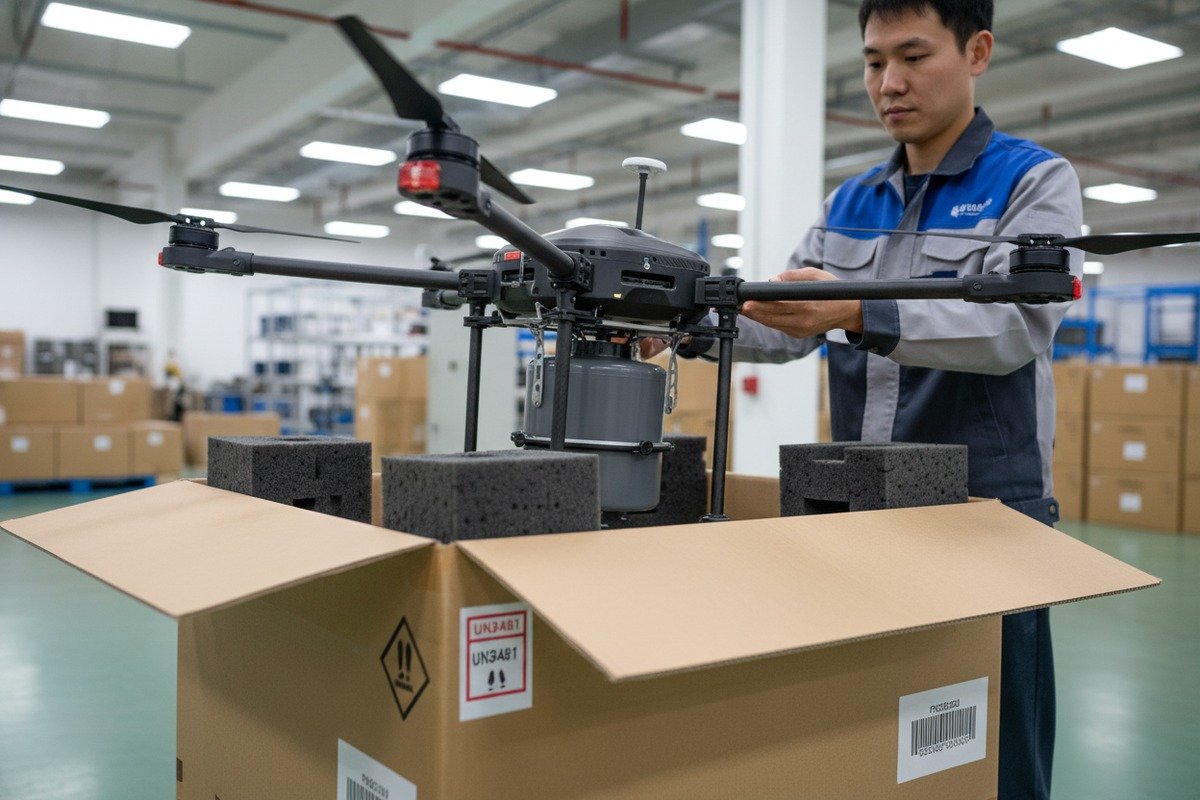
When our production lines started shipping agricultural hexacopters 1 globally, we faced a brutal reality. Nearly 12% of customer complaints traced back to packaging failures during transit. Cracked propellers, dented spray tanks, and damaged flight controllers cost us thousands in replacements and eroded buyer trust.
To ensure agricultural drone packaging meets Amazon and e-commerce standards, you must verify drop-test certifications, include required hazmat labels for lithium batteries, use custom foam inserts for fragile components, and optimize box dimensions to meet carrier guidelines while protecting sensitive electronics during multi-stage shipping.
This guide walks you through every critical step Amazon FBA intake requirements 2. From international testing protocols to Amazon FBA requirements, we cover what our engineering team has learned through years of exporting to the US and Europe. Let’s dive into the specifics.
How do I verify that my agricultural drone packaging passes international drop tests for fragile electronics?
Our quality control team learned this lesson the hard way. A major US distributor rejected an entire shipment because the packaging lacked proper drop-test documentation. The drones were fine, but missing paperwork cost us weeks of delays and frustrated customers.
To verify drop-test compliance, request ISTA 3A or 6-SAMSCLUB test reports from your supplier, confirm packaging survives drops from 76-91 cm on all corners and faces, and ensure testing covers both the outer carton and internal foam cushioning systems for electronics weighing over 10 kg.

Understanding ISTA Testing Standards
ISTA stands for International Safe Transit Association 3. They set the global benchmarks for package testing. For agricultural drones, you need ISTA 3A certification 4 at minimum. This standard simulates the real-world abuse packages face during e-commerce shipping.
The test sequence matters. Packages undergo compression, vibration, and drop tests in specific orders. For heavy items like agricultural hexacopters, drops occur from heights between 76 cm and 91 cm depending on package weight.
Key Drop Test Parameters for Drones
| Test Type | Height | Surfaces Tested | Pass Criteria |
|---|---|---|---|
| Corner Drop | 76 cm | All 8 corners | No internal damage |
| Edge Drop | 76 cm | All 12 edges | Foam compression <30% |
| Flat Drop | 91 cm | All 6 faces | Electronics functional |
| Vibration | N/A | Random frequency | No loose components |
| Compression | N/A | 200+ kg load | Box integrity maintained |
What to Request From Suppliers
Ask your supplier for these specific documents before placing orders. First, get the complete ISTA test report with photos. Second, request the testing laboratory's accreditation certificate. Third, confirm the exact packaging configuration tested matches what you will receive.
Our engineers always send sample units to independent labs for verification. This costs around $500-800 per test but saves thousands in damaged goods later.
Specialized Considerations for Agricultural Drones
Agricultural drones have unique challenges. Spray tanks create unbalanced weight distribution. Propeller arms extend far from the center. Battery compartments need extra shock absorption.
We design packaging with multi-density foam. The drone body sits in high-density foam rated at 2.0 lb/ft³. Propellers get softer 1.2 lb/ft³ foam that cushions without crushing. This layered approach passes ISTA tests consistently.
What specific labeling and certification marks must my supplier include to meet Amazon FBA intake requirements?
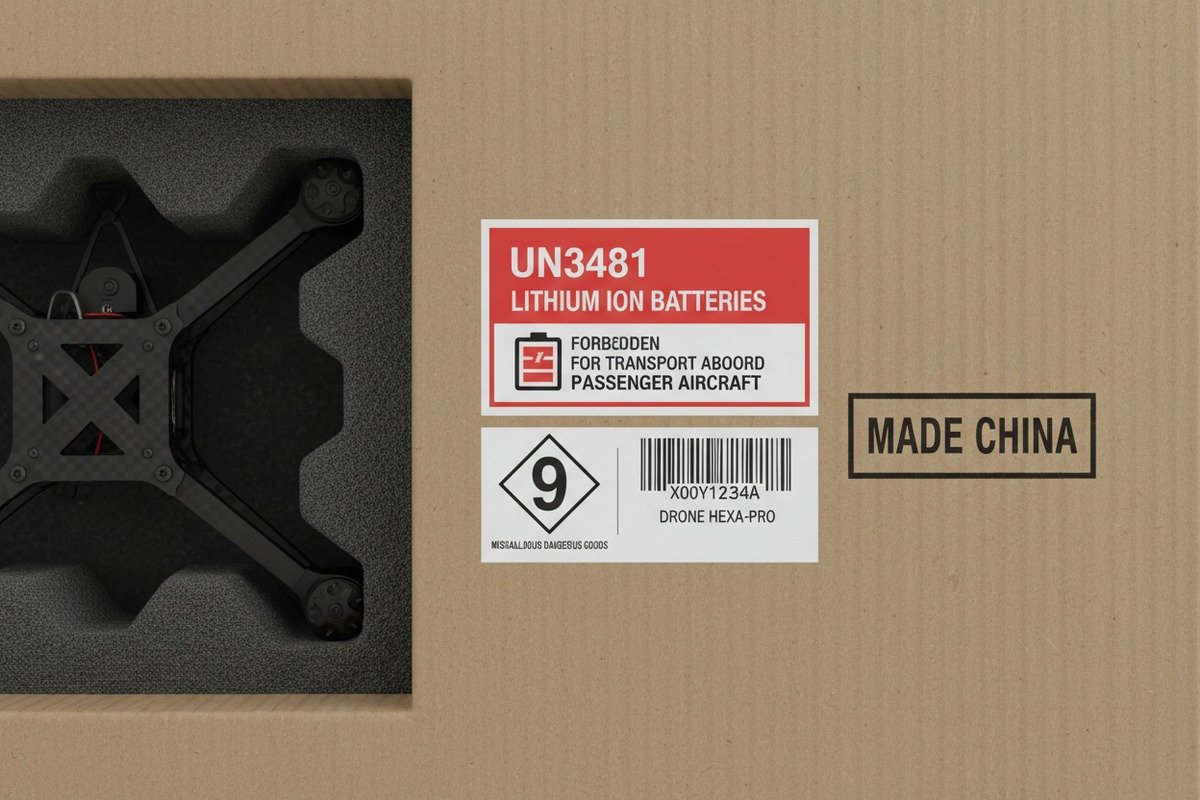
During our first Amazon FBA shipment attempt, warehouse staff rejected 40 units at intake. The reason? Missing UN3481 lithium battery labels 5. This single oversight delayed our product launch by three weeks and frustrated our US distribution partner.
Amazon FBA requires UN3481 lithium battery handling labels, Class 9 hazmat diamonds for batteries over 100Wh, FNSKU barcodes on each unit, suffocation warnings on polybags, and country-of-origin markings. For agricultural drones with chemical residue potential, additional hazmat declarations may be needed.
Mandatory Amazon FBA Labels
Amazon has strict intake requirements. Miss one label, and your entire shipment gets rejected. Our logistics team maintains a pre-shipment checklist that we verify on every outbound container.
| Label Type | Requirement | Placement |
|---|---|---|
| FNSKU Barcode | Unique to each ASIN | Scannable, flat surface |
| UN3481 | Lithium batteries included | Two opposite sides |
| Class 9 Diamond | Batteries >100Wh | Near UN3481 label |
| Suffocation Warning | Polybags used | Visible on exterior |
| Country of Origin | "Made in China" | Permanent marking |
| Fragile/Handle with Care | Recommended | Top and sides |
Lithium Battery Shipping Regulations
Agricultural drone batteries typically range from 400Wh to 800Wh. This exceeds standard shipping limits. FAA PackSafe guidelines 6 restrict lithium batteries to 100Wh for passenger aircraft without special approval.
For larger batteries, you must ship via cargo aircraft or ground transport. Each battery needs individual packaging with terminals protected against short circuits. We use non-conductive caps and tape on all exposed contacts.
Certification Marks for US Import
Beyond Amazon's requirements, US customs expects certain certifications. FCC marks confirm radio frequency compliance for drone controllers. The drone itself needs FAA-compliant labeling if sold as a commercial aircraft.
Our export documentation always includes the FCC ID number, CE marking 7 for European destinations, and UL certification for charging equipment. Missing any of these creates customs delays.
Chemical Residue Considerations
Agricultural drones may ship with residual pesticide or fertilizer traces from factory testing. This triggers hazmat protocols. Even trace amounts of certain chemicals require Material Safety Data Sheets in the shipping documentation.
We flush all spray systems with clean water and dry them completely before packaging. This simple step prevents hazmat classification and simplifies Amazon intake.
A distributor in Texas once told us something that changed our approach. He said customers filmed unboxing videos for YouTube, and generic packaging made his brand look cheap compared to DJI. Within three months, we developed a complete custom packaging program.
Yes, you can fully customize both internal foam and external branding. Work with your supplier to design precision-cut EVA or EPE foam inserts, print branded exterior boxes, include branded accessory pouches, and add professional documentation. Most manufacturers offer OEM packaging services with minimum orders of 50-100 units.

Internal Foam Customization Options
Custom foam inserts protect your drones and impress customers. We offer several foam types based on component sensitivity and budget.
| Foam Type | Density | Ideal para | Cost Level |
|---|---|---|---|
| EPE (Expanded PE) | 18-25 kg/m³ | General protection | Bajo |
| EVA (Ethylene VA) | 30-50 kg/m³ | Premium feel | Medio |
| PU (Polyurethane) | 25-40 kg/m³ | Shock absorption | Medium-High |
| XPE (Cross-linked PE) | 30-45 kg/m³ | Maximum protection | Alto |
Each compartment gets CNC-cut to exact component dimensions. Propellers, batteries, chargers, and controllers each have dedicated slots. Nothing moves during shipping.
External Branding Elements
Your box is the first thing customers see. Make it count. Standard customization includes four-color printing on corrugated cardboard, embossed logos on rigid cases, and branded tape for outer sealing.
Our design team works with clients to create packaging that reflects their brand identity. Matte finishes convey professionalism. Gloss coatings pop on retail shelves. Spot UV highlights logos without overwhelming the design.
Documentation and Accessories
Premium unboxing extends beyond the drone itself. Include branded quick-start guides, warranty cards with your company contact information, and professional accessory pouches for spare propellers.
We print multi-language manuals in-house. English, Spanish, French, and German are standard for North American and European markets. Custom inserts showcase your brand story and support contact details.
Minimum Order Requirements
Customization has practical limits. Printing plates for boxes cost $300-500 to produce. Foam cutting dies run $200-400 each. These setup costs make small orders expensive per unit.
Our minimum for full customization is 50 units. This spreads tooling costs reasonably while allowing smaller distributors to access premium packaging. Orders over 200 units receive significant per-unit discounts.
How can I optimize the packaging dimensions to reduce my e-commerce shipping costs without compromising drone safety?
Our logistics manager calculated something shocking last year. A 3-inch reduction in box height saved one US client over $4,200 annually on shipping costs. Dimensional weight pricing 8 makes every cubic inch expensive.
To optimize packaging dimensions, request nested component layouts from your supplier, use foldable propeller arms when possible, separate batteries into secondary boxes for hazmat compliance, and target dimensional weight thresholds for your primary carriers. Most savings come from reducing height, as carriers measure the longest dimensions.

Understanding Dimensional Weight Pricing
Carriers charge based on actual weight or dimensional weight, whichever is higher. Dimensional weight penalizes oversized packages. The formula varies by carrier but typically divides cubic inches by 139 for domestic US shipping.
For agricultural drones, dimensional weight almost always exceeds actual weight. A hexacopter weighing 15 kg might have a dimensional weight of 25 kg due to propeller span requirements.
Strategic Component Arrangement
We redesign packaging layouts to minimize dead space. Propellers nest under the drone body rather than beside it. Batteries stack vertically in corner spaces. Chargers fill gaps between arm supports.
| Packaging Strategy | Dimension Reduction | Cost Impact |
|---|---|---|
| Propeller nesting | 15-20% height | -$3-5/unit |
| Vertical battery stacking | 10-15% width | -$2-4/unit |
| Detachable arm shipping | 25-30% length | -$5-8/unit |
| Flat-packed accessories | 5-10% depth | -$1-2/unit |
Carrier-Specific Optimization
Different carriers have different threshold pricing. UPS charges differently than FedEx. Amazon's partnered carriers have their own breakpoints. We study rate cards and design packaging around these thresholds.
For example, UPS has pricing tiers at 1 cubic foot, 2 cubic feet, and 3 cubic feet. Designing a package at 1.9 cubic feet instead of 2.1 cubic feet can save significant money per shipment.
Separating Components for Compliance
Sometimes splitting components into separate packages actually saves money. Large lithium batteries shipped separately via ground transport cost less than air freight for the complete unit.
We offer kitted shipping where drones, batteries, and accessories ship in separate boxes to the same destination. This avoids hazmat air freight surcharges while meeting delivery timelines through ground carriers.
Balancing Protection and Size
Smaller packaging cannot compromise safety. We maintain minimum foam thickness of 25mm around fragile components regardless of space optimization. The goal is finding the smallest safe package, not the smallest possible package.
Testing validates our optimized designs. Every new packaging configuration undergoes ISTA testing before production approval. We never sacrifice protection for shipping savings.
Conclusión
Getting agricultural drone packaging right requires attention to drop tests, labeling, customization, and dimension optimization. Our team has refined these processes over years of exporting to demanding markets. Work closely with your supplier on these details, and your drones will arrive safely while your brand stands out.
Notas al pie
1. USDA provides an authoritative overview of drones in agriculture. ↩︎
2. Official Amazon Seller Central documentation on FBA policies and requirements. ↩︎
3. Official website of the International Safe Transit Association. ↩︎
4. UL Solutions provides information on ISTA packaging testing and certification, including ISTA 3A. ↩︎
5. IATA provides authoritative regulations for shipping lithium batteries, including UN3481. ↩︎
6. Official FAA PackSafe guidelines for shipping lithium batteries. ↩︎
7. Official European Union information on CE marking. ↩︎
8. CSCMP provides a definition and explanation of dimensional weight pricing. ↩︎

 English
  Spanish
  German
  French
  Dutch
Dutch  Arabic
