
When our engineering team tests drone samples from different suppliers, we always face the same challenge. Which unit actually performs best in real fire conditions? Flight specs on paper rarely tell the full story.
To compare handling differences between firefighting drone samples, you must conduct controlled flight tests evaluating wind resistance, payload stability, control responsiveness, and ground station usability. Request side-by-side demonstrations under simulated fire conditions, benchmark RTK precision, and verify autonomous obstacle avoidance performance across all supplier units.
This guide walks you through exactly how to evaluate drone handling from multiple suppliers. We will cover high-altitude stability tests, payload response characteristics, ground control station comparisons, and extreme environment performance indicators.
How do I evaluate the flight stability and precision of different firefighting drone samples during high-altitude maneuvers?
In our production facility, we run every drone through rigorous altitude hold tests before shipment. Yet we know buyers need their own evaluation methods to compare samples objectively.
Evaluate flight stability by testing altitude hold accuracy, GPS positioning precision, and response to sudden directional commands at heights above 100 meters. Use RTK systems for centimeter-level measurements, conduct wind tunnel simulations at Force 4-5 conditions, and record deviation data from preset hover points across all samples.

Understanding Altitude Hold Systems
High-altitude maneuvers demand rock-solid altitude hold. This feature uses barometric pressure sensors combined with GPS data. When our engineers calibrate flight controllers, we focus on how quickly the drone corrects altitude drift.
A good firefighting drone maintains position within 0.5 meters vertically. Lesser models drift 2-3 meters, which creates problems when deploying fire suppressant at precise locations.
RTK Precision Testing Protocol
Real-Time Kinematic positioning separates professional units from basic models. Request RTK demonstration from each supplier. Set up ground control points. Command the drone to hover at five different coordinates. Measure actual position versus commanded position.
| Test Parameter | Acceptable Range | Premium Range | Test Method |
|---|---|---|---|
| Horizontal Drift | < 1.5 m | < 0.1 m (RTK) | GPS logging at hover |
| Vertical Drift | < 1.0 m | < 0.3 m | Barometer + GPS fusion |
| Return-to-Home Accuracy | < 3.0 m | < 0.5 m | Measured landing deviation |
| Heading Hold | < 5° drift | < 1° drift | Compass calibration test |
| Position Recovery Time | < 3 seconds | < 1 second | After wind gust simulation |
Wind Resistance Benchmarks
Force 5 wind resistance is now standard for professional firefighting drones. But specifications mean nothing without field validation. Create standardized wind exposure during your tests. Industrial fans work for controlled environments. Natural wind conditions provide real-world data.
Our experience exporting to the US taught us that buyers often underestimate wind effects. A drone rated for 12 m/s winds may still oscillate badly at 10 m/s if the control algorithms are poorly tuned.
Document pitch and roll angles during wind exposure. Stable drones maintain less than 15-degree tilt. Unstable units exceed 25 degrees and require constant pilot correction.
Six-Directional Sensing Evaluation
Modern units like the DJI Matrice 300 RTK feature six-directional obstacle sensing. Test each sensor direction individually. autonomous obstacle avoidance 1 Approach obstacles from front, back, left, right, top, and bottom. Record stopping distance and reaction speed.
Poor obstacle avoidance creates handling problems. The drone jerks or overcompensates. Good systems provide smooth deceleration and confident navigation around hazards.
What specific handling traits should I look for when testing a drone's responsiveness under a full payload of fire suppressant?
When we load our heavy-lift frames with 30-kilogram suppressant tanks, the flight characteristics change dramatically. Buyers must understand these changes to make informed comparisons.
Look for stable throttle response, minimal pitch oscillation during acceleration, consistent yaw control, and predictable descent rates when testing loaded drones. The best units maintain handling characteristics within 15% of unloaded performance, while inferior samples show 40% or greater degradation in control precision.
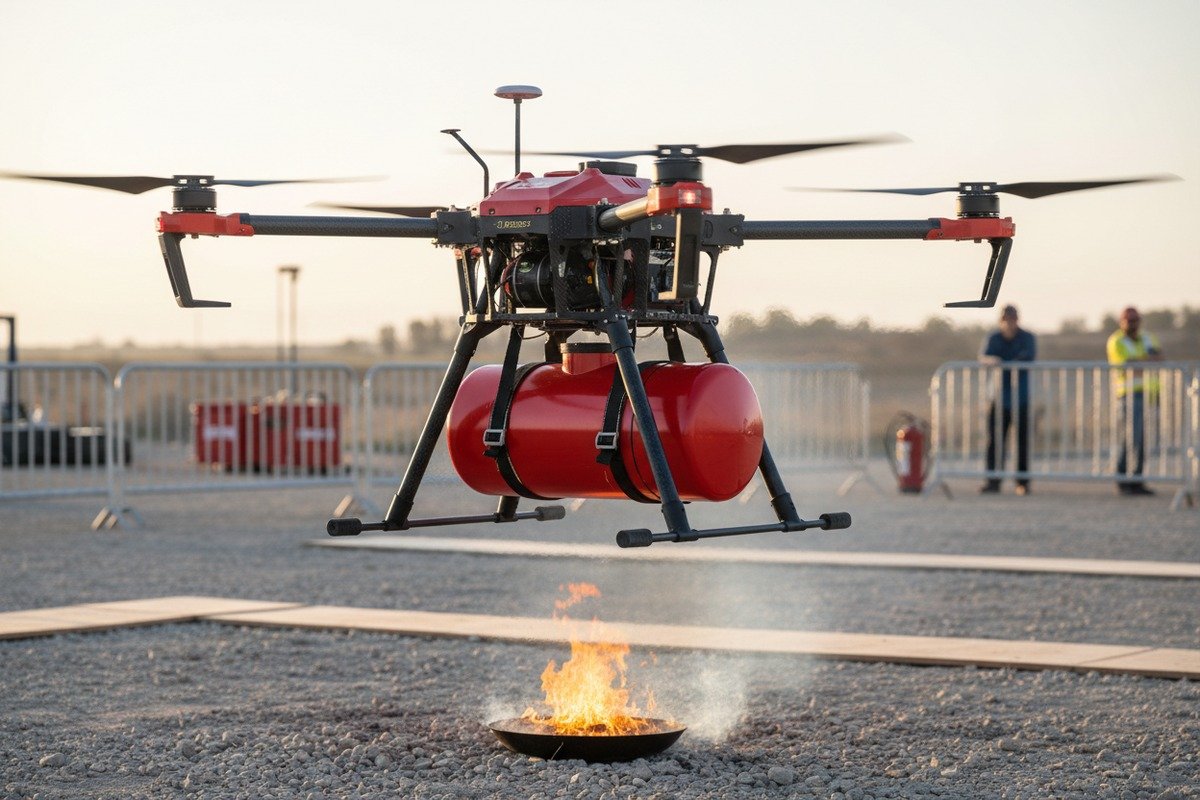
Center of Gravity Shifts
Adding fire suppressant moves the center of gravity. Well-designed drones place payload attachment points at or below the geometric center. Center of Gravity Shifts 2 This maintains stability.
Poorly designed units mount payloads high or off-center. The result is constant correction from flight controllers. Pilots feel this as "mushiness" or delayed response.
Test each sample with identical payload configurations. Use water to simulate suppressant weight. Start at 50% capacity, then test at 100%. Document handling differences at each load level.
Throttle Response Under Load
Loaded drones require more power for the same maneuvers. Good flight controllers anticipate this. They apply extra throttle automatically during climbs and turns.
Lesser systems lag behind pilot inputs. The drone sinks before recovering. In firefighting scenarios, this sink creates dangerous situations near structures or terrain.
| Payload Condition | Expected Climb Rate | Acceptable Response Delay | Power Reserve Required |
|---|---|---|---|
| Unloaded | 5-6 m/s | < 0.3 seconds | 20% |
| 50% Payload | 3-4 m/s | < 0.5 seconds | 35% |
| 100% Payload | 2-3 m/s | < 0.8 seconds | 50% |
| Emergency Climb (loaded) | 1.5 m/s minimum | < 1.0 seconds | 60% |
Yaw Authority Testing
Spinning the drone while loaded reveals control authority limits. Command full-speed yaw rotations. Measure rotation rate at various payload levels. Yaw Authority Testing 3
Strong yaw authority matters for positioning suppressant delivery. Weak yaw makes the drone sluggish when pivoting to track moving fire lines.
Our heavy-lift octocopter designs maintain 60-degree-per-second yaw rates even at maximum payload. Some competitor samples drop to 20 degrees per second, making precise targeting nearly impossible.
Descent Rate Control
Descending with a heavy payload risks dangerous sink rates. Test controlled descents from 50 meters. Command slow descent rates of 1-2 m/s. Watch for overshooting or oscillation.
The best drones allow precise descent control regardless of payload. They automatically limit descent speed to prevent ground strikes. Test this automatic limiting function on each sample.
Payload Release Dynamics
If the drone releases suppressant mid-flight, weight changes suddenly. This creates trim changes and altitude excursions. Good systems compensate instantly. Poor systems require several seconds to restabilize.
Conduct release tests at hover. Drop payload rapidly. Time the restabilization period. Units that recover in under 2 seconds demonstrate superior flight controller tuning.
How can I compare the ease of use and control sensitivity between various supplier-provided ground control stations?
Our team designs ground control interfaces with real operators in mind. But every supplier has different philosophies. Comparing these systems requires structured evaluation approaches.
Compare ground control stations by measuring time-to-first-flight, evaluating control stick sensitivity curves, testing emergency override speed, and assessing screen readability in bright sunlight. The best GCS systems enable productive operation within 60 seconds of power-on with intuitive layouts requiring minimal training.

Time-to-First-Flight Measurement
Professional operations demand rapid deployment. Start your timer when the operator opens the case. Stop when the drone achieves stable hover. Repeat this test three times per system. Average the results.
Enterprise-grade systems like our integrated controllers achieve 45-60 second deployment. Consumer-derived systems often require 3-5 minutes due to complex pairing procedures and calibration requirements.
Control Sensitivity Curve Evaluation
Stick sensitivity determines how pilot inputs translate to drone movement. Some systems use linear curves—small stick movements produce proportional responses. Others use exponential curves—small inputs produce gentle responses while large inputs produce aggressive responses.
Neither approach is universally superior. But firefighting requires precise, predictable control. Test both fine positioning tasks and rapid maneuvers. Document which sensitivity approach suits your operational needs.
| GCS Feature | Basic Requirement | Professional Requirement | Expert Requirement |
|---|---|---|---|
| Screen Brightness | 500 nits | 1000 nits | 2000 nits (sunlight readable) |
| Control Latency | < 200 ms | < 100 ms | < 50 ms |
| Stick Resolution | 1024 steps | 2048 steps | 4096 steps |
| Programmable Buttons | 2 minimum | 6 minimum | 12+ with layers |
| Battery Life | 2 horas | 4 horas | 8 hours or external power |
Emergency Override Testing
When automated systems malfunction, pilots need instant manual control. Test the emergency override function on each GCS. Engage autonomous mode. Then attempt immediate manual takeover. Measure response time.
Good systems provide instant cutover. The pilot moves the sticks and automation disengages. Poor systems require button sequences or confirmation dialogs—dangerous delays during emergencies.
Interface Layout Assessment
Cluttered screens create cognitive overload during stressful operations. Evaluate information hierarchy. Primary flight data should dominate. Secondary information should be accessible but not distracting.
Ask operators with varying experience levels to identify critical information. Time their responses. Intuitive interfaces allow finding altitude, battery status, and GPS lock within 2 seconds. Confusing interfaces require 5-10 seconds of searching.
Software Integration Capabilities
Fire departments use incident command software. The GCS should integrate with these systems. Request API documentation from suppliers. Verify data export formats match your existing tools.
Our controllers support standard data formats and provide SDK access. Some suppliers use proprietary systems that create integration barriers. This affects long-term operational efficiency.
Which performance indicators will tell me if a drone sample can maintain stable handling in extreme heat or turbulent wind conditions?
At our testing facility, we simulate extreme conditions that drones face during actual wildfires. These tests reveal weaknesses that normal flight testing misses.
Key performance indicators include thermal throttling thresholds, motor temperature rise under sustained hover, GPS accuracy degradation in turbulence, and battery discharge rates at elevated temperatures. Drones that maintain 85% or better performance at 45°C ambient temperature with 15 m/s wind gusts demonstrate professional-grade thermal and aerodynamic management.

Thermal Throttling Analysis
Electronic components reduce performance when overheated. This "thermal throttling" appears as sluggish response and reduced power. Thermal Throttling Analysis 4 Test drones in heated environments above 40°C. Monitor motor controller temperatures and flight performance.
Professional units use active cooling or high-temperature-rated components. Budget units throttle significantly, sometimes losing 30-40% of available power. This directly impacts handling authority.
| Environmental Condition | Performance Target | Warning Threshold | Failure Threshold |
|---|---|---|---|
| Ambient 25°C baseline | 100% handling | N/A | N/A |
| Ambient 40°C | > 95% handling | < 90% handling | < 80% handling |
| Ambient 50°C | > 85% handling | < 80% handling | < 70% handling |
| Wind 10 m/s sustained | < 10° attitude deviation | > 15° deviation | > 25° deviation |
| Wind 15 m/s gusts | < 15° attitude deviation | > 20° deviation | > 30° deviation |
Motor Temperature Monitoring
Request access to motor temperature telemetry during testing. Sustained hover for 10 minutes reveals cooling adequacy. Motors should stabilize below 80°C in moderate conditions.
When we design motor mounts, we incorporate heat dissipation features. Some suppliers minimize material to save weight, creating thermal problems during extended operations.
GPS Accuracy in Turbulent Air
Turbulence causes erratic GPS readings as the drone moves unpredictably. Advanced flight controllers use sensor fusion to filter this noise. Basic controllers pass errors directly to position hold algorithms.
Create controlled turbulence using large fans with irregular airflow. Monitor position hold accuracy. Professional units maintain sub-meter accuracy. Inferior units wander several meters during gusts.
IP Rating Verification
IP45 to IP66 ratings indicate dust and water resistance. But ratings alone mean nothing. Request documentation of actual testing methods. IP Rating Verification 5 Some suppliers self-certify without rigorous testing.
Conduct your own water exposure tests. Light spray at IP45 levels. Brief submersion for IP67 claims. Electronics that survive indicate genuine build quality.
Battery Performance at Temperature Extremes
Lithium batteries lose capacity in both heat and cold. Test flight times at 0°C and 45°C. Compare against room temperature baselines. Good battery management systems maintain 80% or better capacity across this range.
Hot-swap capability matters for extended operations. Time the battery exchange procedure. Our systems allow under-60-second swaps without powering down avionics. This maintains situational awareness during critical missions.
Redundancy System Validation
Professional firefighting drones include redundancy features. Dual GPS receivers, redundant IMUs, motor failure compensation. Redundancy System Validation 6 Test these systems by inducing controlled failures during flight.
Simulate GPS loss by enabling GPS-denied mode. Observe navigation stability. Test motor-out scenarios if the manufacturer supports this. Drones that continue stable flight demonstrate true operational resilience.
Conclusión
Comparing firefighting drone handling requires systematic testing beyond specification sheets. Evaluate flight stability with RTK precision 7 measurements, test payload response through loaded flight trials, compare ground control stations 8 for operational efficiency, and verify extreme condition performance through environmental stress testing.
Notas al pie
1. Describes the technology enabling drones to sense and navigate around objects safely. ↩︎
2. Discusses how payload distribution affects a drone’s stability and flight performance. ↩︎
3. Defines yaw control and its importance for precise drone maneuverability. ↩︎
4. Details how electronic components reduce performance to prevent overheating damage. ↩︎
5. Explains ingress protection ratings and their significance for drone durability in harsh environments. ↩︎
6. Highlights the design principles and importance of backup systems for drone flight safety. ↩︎
7. Explains how RTK positioning enhances drone accuracy for precise operations. ↩︎
8. Provides a comprehensive overview of the components and functions of drone control interfaces. ↩︎

 English
  Spanish
  German
  French
  Dutch
Dutch  Arabic
