
At SkyRover, we know that missing a smoldering ember during a test flight is a nightmare. You need certainty, not just a heat map, when lives and property are at stake.
To determine sensitivity, verify the Noise Equivalent Temperature Difference (NETD) is below 50mK for detecting subtle heat variances. Ensure the resolution is at least 640×512 pixels for clarity at distance, and confirm the sensor operates in the 8-14μm LWIR spectrum to effectively penetrate thick smoke.
Let’s break down the specific technical metrics you must check before signing that purchase order.
What resolution is necessary for identifying small hotspots from a distance?
When we test our firefighting drones in Chengdu, low-resolution sensors often fail to distinguish small heat sources from background noise, risking mission failure during critical operations.
For identifying small hotspots from a safe operational altitude, a resolution of 640×512 pixels is necessary. This density ensures enough "pixels on target" to visualize distant heat signatures clearly, whereas lower resolutions like 320×256 often blur critical details when flying above 100 meters.
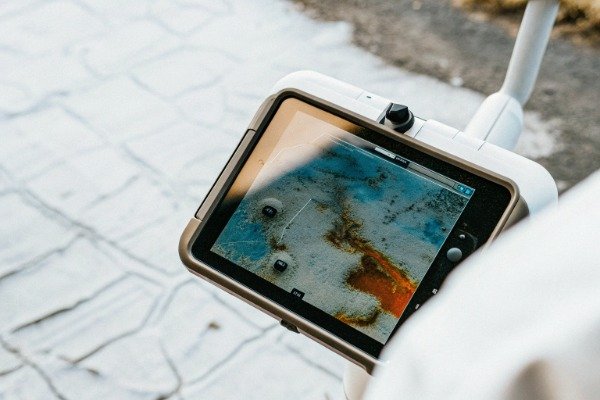
Resolution is often the first specification buyers look at, but it is frequently misunderstood in the context of thermal imaging versus visual photography. In our manufacturing process, we emphasize that thermal resolution dictates the maximum distance at which a drone can fly while still providing actionable data. A standard visual camera might have 20 megapixels, but thermal sensors are much lower in pixel count due to the cost and complexity of the sensor material (microbolometers).
sensor material (microbolometers) 1
The "Pixels on Target" Rule
To simply detect that something is hot, you might only need one or two pixels. However, to identify what that object is—for example, distinguishing a small fire starter from a hot rock or a vehicle engine—you need significantly more pixels on the target. This is known as Johnson’s Criteria in the industry.
Johnson’s Criteria 2
If you opt for a budget-friendly 320×256 resolution sensor, you are effectively cutting your operational distance in half compared to a 640×512 sensor. For a procurement manager sourcing equipment for fire departments, this is a safety hazard. It forces the pilot to fly the drone closer to the fire to get a clear image, exposing the equipment to higher heat and turbulence.
Digital Zoom Limitations
Many distributors will claim that a camera has "8x Zoom." You must ask: is this optical or digital? In 90% of industrial thermal cameras, the zoom is digital. This means the software is simply cropping the center of the image and blowing it up. If your base resolution is low (320×256), zooming in results in a pixelated, unusable blur. A 640×512 sensor allows for a 2x or 4x digital zoom that is still legible, which is vital when you are scanning a large forest area for residual heat.
zoom is digital 3
We have compiled a comparison based on our internal testing data regarding effective detection distances:
Table 1: Thermal Resolution vs. Effective Identification Distance
| Resolución del sensor | Pixel Count | Max Identification Distance (Human/Small Fire) | Caso de uso recomendado |
|---|---|---|---|
| 160 x 120 | 19,200 | ~25 meters | Indoor inspection, HVAC repair (Not for drones) |
| 320 x 256 | 81,920 | ~120 meters | Solar panel inspection, short-range search |
| 640 x 512 | 327,680 | ~450 meters | Lucha contra incendios, Search & Rescue, Powerline |
| 1280 x 1024 | 1,310,720 | ~1000+ meters | High-altitude surveillance, Military |
When evaluating suppliers, always insist on seeing raw footage from the specific resolution you are buying, not a generic marketing video. High resolution is the foundation of a reliable firefighting drone system.
Does the camera offer radiometric data for precise temperature measurement?
Our engineering team often explains to clients that seeing a bright spot isn’t enough; you must know if it is 50°C or 500°C to act correctly and safely.
Radiometric thermal cameras are essential because they measure the specific temperature of every pixel in the image, providing absolute data rather than relative contrast. This allows operators to set safety thresholds and analyze heat intensity remotely, which non-radiometric sensors cannot do.
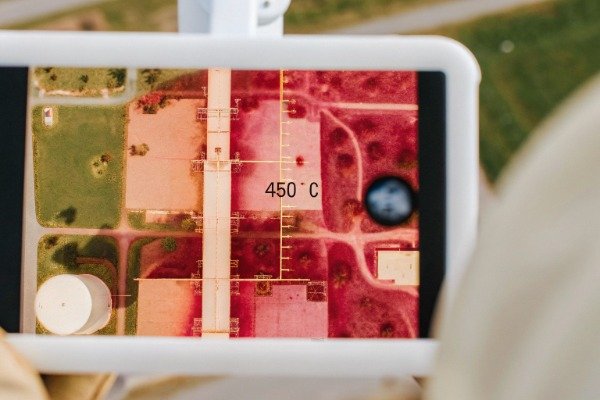
The distinction between radiometric and non-radiometric cameras is a common pain point for our customers. A non-radiometric camera provides a visual representation of heat—lighter colors are hotter, darker colors are cooler—but it does not tell you the actual temperature. It is purely qualitative. For a filmmaker, this is fine. For an industrial procurement manager, this is often insufficient.
radiometric and non-radiometric cameras 4
Why Relative Heat is Misleading
Imagine a drone flying over a roof in summer. The roof tiles might be 60°C due to the sun. A non-radiometric camera will show the roof as glowing white because it is the hottest thing in the scene. A fire spot might also be glowing white. Without temperature data, the operator cannot tell if they are looking at a sun-baked roof or a chemical fire.
Radiometric cameras calibrate the sensor data against known temperature values. This allows the software to display a specific number (e.g., "450°C") when you tap on a pixel. This capability is critical for:
- Seguridad: Knowing if a tank is about to rupture due to pressure/heat.
- Eficiencia: Ignoring false positives like solar reflections or hot asphalt.
- Reporting: Generating post-flight reports that document the exact heat levels for insurance or government records.
Spot Meter and Area Measurement
Advanced radiometric cameras, like the ones we integrate into our SkyRover platforms, offer features like "Spot Meter" and "Area Measurement."
- Spot Meter: Gives the temperature of the center point or a tapped point.
- Area Measurement: Calculates the average, lowest, and highest temperatures within a drawn box.
This is particularly useful in agricultural applications or smoldering fire cleanup (mop-up operations). You can set an alarm: "Alert me if any pixel in this box exceeds 80°C." This automation reduces operator fatigue and error.
smoldering fire cleanup 5
Table 2: Radiometric vs. Non-Radiometric Capabilities
| Característica | Non-Radiometric Camera | Radiometric Camera |
|---|---|---|
| Primary Output | Visual Heat Contrast Image | Calibrated Temperature Data Matrix |
| Temperature Readout | None (or center point only, uncalibrated) | Pixel-by-pixel temperature values |
| Precisión | N/A | Typically ±2°C or ±2% |
| Post-Processing | Image editing only | Adjust level/span, measure temps in software |
| Costo | Más bajo | Más alto |
| Ideal para | Night vision, simple search | Inspections, Firefighting, Scientific analysis |
If your clients require detailed reports or precise decision-making data, radiometric functionality is not optional—it is a requirement.
How well does the sensor penetrate thick smoke to see the fire source?
During our field simulations with heavy smoke canisters, visual cameras go blind instantly, leaving operators flying blind unless the thermal sensor cuts through the haze.
To penetrate thick smoke effectively, the sensor must operate in the Long-Wave Infrared (LWIR) spectrum, specifically between 8-14μm. This wavelength bypasses smoke particles that scatter visible light, allowing the drone to visualize the heat source hiding behind the visual obstruction.

One of the most dangerous misconceptions in the industry is that all cameras can see through smoke. Visual cameras (RGB) cannot. Near-Infrared (NIR) cameras struggle. Only Long-Wave Infrared (LWIR) thermal sensors are truly effective at this task. This capability is the primary reason fire departments import our industrial drones.
Long-Wave Infrared (LWIR) 6
The Science of LWIR and Smoke
Smoke particles are very small, but they are large enough to scatter visible light waves (which are very short, around 0.4-0.7μm). This scattering creates the opaque "wall" of grey you see with your eyes. However, thermal energy emitted by a fire travels in much longer waves (8-14μm). These waves are large enough to pass around the smoke particles without being significantly scattered or absorbed.
scatter visible light waves 7
When we configure drones for the US or European markets, we ensure the sensors are strictly LWIR. This allows the pilot to see the structure of the building, the location of the firefighters, and the heart of the fire, even when the visual feed is completely grey.
Sensitivity (NETD) in Low Contrast Environments
Penetrating smoke is not just about wavelength; it is also about sensitivity. This is measured in NETD (Noise Equivalent Temperature Difference), usually expressed in millikelvins (mK).
- High Sensitivity (<40mK or <50mK): Can detect very small temperature differences.
- Low Sensitivity (>100mK): Result implies a "noisy" or grainy image.
Smoke tends to cool the air and reduce the thermal contrast of a scene. A sensor with a high NETD (e.g., 100mK) might produce a grainy image where the fire blends into the warm smoke. A sensor with a low NETD (<50mK) will crisply define the edges of the fire source against the smoke. For our premium lines, we target <40mK to ensure that even in thick, cooling smoke, the image remains sharp.
Table 3: Sensor Spectrum Performance in Obscured Environments
| Spectrum Type | Wavelength | Performance in Smoke | Performance in Fog/Rain |
|---|---|---|---|
| Visible Light (RGB) | 0.4 – 0.7 μm | Pobre (Blocked completely) | Pobre (Reflects back) |
| Near Infrared (NIR) | 0.7 – 1.4 μm | Bajo (Scatters significantly) | Bajo |
| Mid-Wave Infrared (MWIR) | 3 – 5 μm | Bien (Used in military) | Moderado |
| Long-Wave Infrared (LWIR) | 8 – 14 μm | Excelente (Standard for Firefighting) | Bien (Better penetration) |
Always verify the spectral range in the spec sheet. If it isn’t 8-14μm, it isn’t built for structural firefighting.
Can I customize the color palettes to highlight specific temperature ranges?
We find that pilots struggle to interpret standard grey images during high-stress missions, which is why quickly switching visual modes is a standard feature on our ground stations.
Yes, professional thermal cameras allow customization of color palettes, such as "White Hot" for general scanning or "Isotherms" to highlight specific temperature bands. These modes isolate dangerous heat levels in bright colors, making them instantly visible against complex or warm backgrounds.
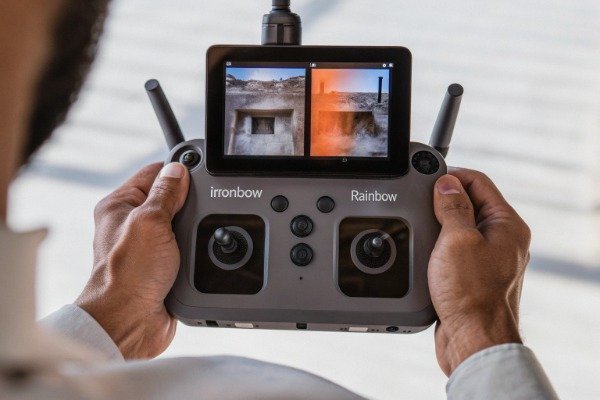
The human eye is much better at distinguishing colors than shades of grey. While "White Hot" or "Black Hot" are the industry standards for general surveillance because they offer the most detail, they can be subtle. In a chaotic environment, a fatigue-weary pilot might miss a white spot on a light grey background. This is where color palettes and isotherms become critical tools.
color palettes and isotherms 8
Utilizing Isotherms for Safety
An Isotherm is a feature that highlights a specific temperature range in a distinct color, usually bright red or yellow.
- Ejemplo: You can set the drone to color anything above 300°C in bright red, while keeping everything below that in greyscale.
- Resultado: The background (trees, buildings, roads) remains grey and detailed, but the fire source "pops" out instantly.
This is not just a visual aid; it is a cognitive load reducer. It allows the pilot to focus on flying rather than analyzing the image. In our software development at SkyRover, we allow users to customize these thresholds because a forest fire in California has different heat parameters than a chemical fire in a factory.
High Gain vs. Low Gain 9
Choosing the Right Palette for the Mission
Different palettes serve different stages of a mission:
- White Hot / Black Hot: Best for initial search and navigation. It mimics a black-and-white photo and is easiest for the brain to process for shapes and terrain.
- Ironbow: A high-contrast color palette (purple to yellow). Good for identifying heat distribution and thermal gradients.
- Rainbow: High contrast but can be confusing. Good for detecting slight temperature anomalies in industrial equipment.
- Fire Detection (Isotherm): Specifically for spotting the hottest part of the scene.
Critical Thinking: The Risk of "Over-Coloring"
While color is useful, we advise our distributors to train their customers on the risks. If a palette is too aggressive (e.g., coloring everything above 30°C as red), the entire screen will turn red on a hot summer day. This renders the thermal camera useless. The "Gain Mode" of the camera (High Gain vs. Low Gain) also affects this.
- High Gain: High sensitivity, lower temperature range (e.g., -20°C to 150°C). Good for search and rescue.
- Low Gain: Lower sensitivity, huge temperature range (e.g., 0°C to 550°C). Essential for active fires to prevent the image from "washing out" (saturation).
A good thermal camera system switches between these gain modes automatically or allows the pilot to do so with a single button press.
Diferencia de Temperatura Equivalente al Ruido 10
Conclusión
To ensure your drone can effectively detect fire sources, prioritize a 640×512 resolution for distance clarity, <50mK NETD for sensitivity, and radiometric capabilities for data accuracy. At SkyRover, we integrate these high-spec sensors to guarantee that when you fly, you see the truth through the smoke.
Notas al pie
- Defines the specific sensor technology used in thermal cameras. ↩︎
- Explains the industry standard for target detection and identification. ↩︎
- Clarifies the difference between optical and digital zoom. ↩︎
- Details the technical differences between these camera types. ↩︎
- Provides context on firefighting mop-up operations. ↩︎
- Defines the infrared spectrum used for smoke penetration. ↩︎
- Explains the physics of light scattering by smoke particles. ↩︎
- Describes how thermal palettes aid in fire detection. ↩︎
- Explains the operational difference between gain modes. ↩︎
- Defines NETD, the metric for thermal detector sensitivity. ↩︎

 English
  Español de México
  Deutsch
  Français
  Русский
  العربية
