
Nothing stalls a farming operation faster than a fried charger during the peak spraying season. When we configure our logistics for North American clients, we have seen firsthand the frustration caused by assuming all electronics are plug-and-play. A voltage mismatch can lead to destroyed equipment, fire hazards voltage mismatch 1, and significant downtime while you wait for replacements to cross the ocean.
To confirm compatibility, you must verify the charger’s rating label explicitly states “Input: 100-240V AC, 50/60Hz” to handle the US 120V grid. Furthermore, require a NEMA 5-15 (Type B) grounded plug and request FCC Part 15 documentation to ensure the device meets safety and regulatory standards for import.
Below, we outline the specific steps and technical details you need to check to ensure your agricultural drone power system is ready for the American field.
How do I verify that the charger input voltage supports the 110V standard used in the US?
We often encounter confusion regarding industrial power supplies because Chinese factories operate on a 220V standard. If we simply ship a domestic unit to a US client, the charger will either fail to start or overheat due to the frequency difference. Ensuring the hardware is built frequency difference 2 for your grid is the first step our engineering team takes before finalizing an order.
You must check the technical specification plate on the charger for a wide input range, specifically “100V-240V,” rather than a fixed “220V.” Additionally, confirm the frequency rating includes “60Hz,” as using a 50Hz-only transformer on a US 60Hz grid causes internal overheating and premature component failure.
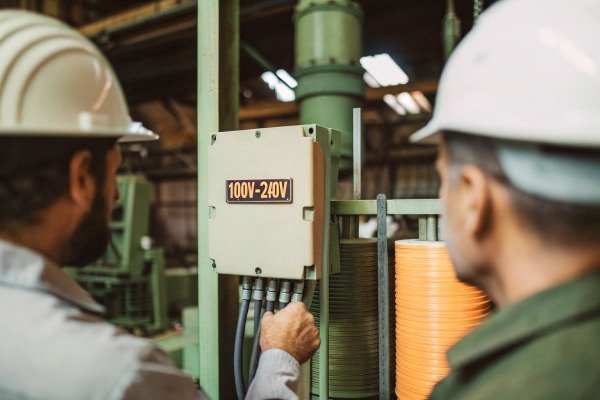
Understanding the Voltage Gap
When importing heavy-duty agricultural equipment, the stakes are higher than with consumer electronics. A standard phone charger is almost almost always universal 3 always universal, but the high-wattage chargers high-wattage chargers 4 required for 6S to 14S LiPo drone batteries are complex pieces of industrial machinery.
In our production facility, we categorize chargers into two main types:
- Switching Power Supplies (Universal): These actively detect input voltage and adjust accordingly. They are the industry standard for modern exports.
- Linear Power Supplies (Fixed): These rely on heavy transformers fixed to a specific voltage (e.g., 220V). If you plug a 220V linear charger into a 110V US outlet, it will likely output half the required voltage, failing to charge the battery or damaging the charger's internal regulation circuit.
The Frequency Factor: 50Hz vs. 60Hz
Voltage is only half the battle. The US grid operates at 60Hz US grid operates at 60Hz 5, while China operates at 50Hz. If a charger is designed strictly for 50Hz, plugging it into a 60Hz source can cause the magnetic components (like transformers and inductors) to run hotter than intended. Over time, this heat degrades the insulation, leading to short circuits.
When reviewing the spec sheet provided by your supplier, look for the following data points to ensure full compatibility:
Specification Comparison Table
| Característica | Chinese Domestic Standard | US Required Standard | What to Look for on the Label |
|---|---|---|---|
| Voltage | 220V – 240V | 110V – 120V | 100-240V ~ (Universal) |
| Frequency | 50Hz | 60Hz | 50/60Hz |
| Plug Type | Type I (3 Flat Pins) | Type A or B (Flat + Round) | NEMA 5-15 o NEMA 1-15 |
| Amperage | Lower Amps (at higher volts) | Higher Amps (at lower volts) | Ensure cable gauge handles higher amps |
Visual Verification
Do not rely solely on the printed manual, as manuals are often generic across multiple models. Ask the supplier to send a high-resolution photo of the actual sticker or nameplate on the back of the specific unit they intend to ship. If the label says "Input: 220V AC," do not buy it for use in the US, even with a voltage converter. Voltage converters for the high wattage required by ag drones (often 1000W+) are bulky, expensive, and unreliable in field conditions.
Can the manufacturer customize the power cord and plug type for American outlets?
Adapters are the weak link in any agricultural workflow; they add resistance, generate heat, and frequently vibrate loose during transport. In our assembly process, we prioritize installing native cables because we know that a loose connection in the field can ruin a workday. Customization is not just possible; it is essential for reliability.
Yes, most reputable manufacturers can customize the power cord by replacing the standard Chinese cable with a US-compliant NEMA 5-15 Type B cord. You should strictly avoid using travel adapters for agricultural drones, as they cannot handle the high current draw and pose a significant fire risk.

The Dangers of Adapters
Agricultural drone chargers often draw between 10 to 15 Amps, bordering on the maximum capacity of a standard US household circuit standard US household circuit 6. Simple "travel adapters" are typically rated for 2-5 Amps. If you attempt to pull 15 Amps through a cheap plastic adapter, it will melt, fuse to the socket, or start a fire.
We always advise our US clients to insist on a native power cord. Most industrial chargers use a detachable interface, commonly the IEC C13/C14 standard (like a desktop computer power cable) or the heavier-duty IEC C19/C20 for high-wattage units.
Customization Options
When negotiating with a supplier, you have two main options for ensuring plug compatibility:
- Hard-Wired Customization: For chargers where the cable is permanently attached, the factory must install a US plug during assembly. This may require a slightly longer lead time, but it offers the safest connection.
- Detachable Cable Swap: If the charger uses a standard IEC port, the manufacturer simply swaps the box content from a Chinese cable to a US cable. This is the fastest and most common method.
Grounding is Non-Negotiable
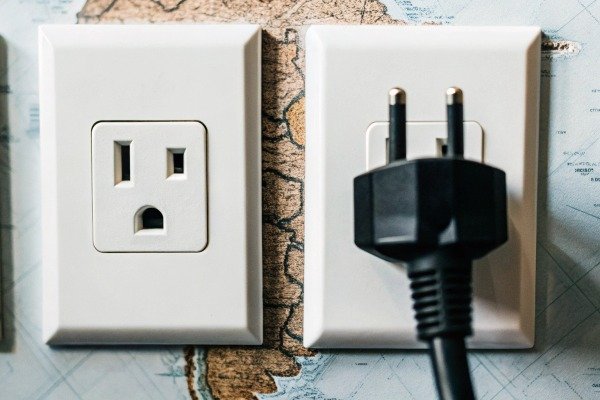
US outlets come in Type A (two prongs, ungrounded) and Type B (three prongs, grounded). Agricultural chargers generally feature metal casings and high-voltage internal components. You must request a Type B (NEMA 5-15P) plug.
The grounding pin connects the metal case of the charger to the earth ground earth ground 7 of the building. In the event of an internal short circuit or moisture ingress—common in farming environments—the ground pin trips the breaker rather than electrifying the casing. Using a "cheater plug" or a Type A cable on a Type B charger is a severe safety violation.
Plug Type Reference Table
| Plug Type | Pins | Grounded? | Compatibility Status |
|---|---|---|---|
| Type A (NEMA 1-15) | 2 Flat Parallel Pins | No | Avoid. Unsafe for industrial chargers. |
| Type B (NEMA 5-15) | 2 Flat + 1 Round Pin | Sí | Required. Standard US grounded plug. |
| Type I (CPCS-CCC) | 3 Flat Angled Pins | Sí | Incompatible. Requires adapter (Not recommended). |
| IEC C13 Cable | Connector to Charger | N/A | Standard. Allows easy cable swapping. |
Heavy Duty Cables
Since US voltage (110V) is half that of China (220V), the amperage (current) doubles for the same wattage.
- Example: A 2200W charger draws 10A at 220V but draws 20A at 110V (theoretically).
- Reality Check: Most standard US outlets limit you to 15A (approx 1500W-1600W usable continuous).
Therefore, the copper wire inside the US cable must be thicker than the Chinese version. We ensure our US-bound cables are at least 14 AWG (American Wire Gauge) to handle the increased current without heating up. Always ask your supplier: "Is the power cord rated for 14 AWG or thicker?"
What safety certifications like UL or FCC should I request to ensure regulatory compliance?
Importing uncertified electronics is a gamble that can result in customs seizures or liability lawsuits if an accident occurs on the farm. When we prepare documentation for our US distributors, we focus on providing the specific certificates that satisfy both federal regulations and insurance requirements. Ignoring these papers is a common mistake that leads to expensive delays.
You should request FCC Part 15 certification to prove the charger does not cause electromagnetic interference, which is mandatory for US customs clearance. While UL certification is voluntary, it is highly recommended for insurance purposes and ensures the device has passed rigorous safety testing against fire and shock hazards.
The Difference Between Mandatory and Voluntary
Navigating US import regulations can be tricky. Some marks are legally required to enter the country, while others are market-driven requirements for safety and liability.
FCC (Federal Communications Commission) – Mandatory
Any digital device operating at 9 kHz or higher falls under FCC jurisdiction FCC jurisdiction 8. Drone chargers use high-frequency switching circuits that generate radio frequency (RF) noise. If this noise is unchecked, it can interfere with radio communications, Wi-Fi, and even the drone's own GPS/RTK systems.
- Requirement: The charger must bear the FCC logo and the supplier must provide a Declaration of Conformity (DoC) or a test report validating compliance with FCC Parte 15.
- Risk: Without this, US Customs and Border Protection (CBP) can seize the shipment.
UL (Underwriters Laboratories) – Voluntary but Critical
UL certification (or its equivalent, ETL/CSA) proves the device won't catch fire or electrocute the user.
- Requirement: Look for UL 1012 (Power Units) or UL 60950-1 (ITE Safety).
- Reality: Full UL certification is expensive. Many smaller Chinese manufacturers may not have it for every model. However, for agricultural drones used commercially, your business liability insurance may deny claims if a fire is caused by non-UL equipment.
- Compromise: If the charger itself isn't UL listed, ensure the internal components (like the power brick or transformer) are UL recognized components UL recognized components 9.
UN38.3: A Common Confusion
Many buyers ask for UN38.3 UN38.3 10 for the charger. This is incorrect. UN38.3 is a safety test specifically for Lithium batteries during transport. You need this for the drone batteries, not the charger. Do not confuse the two when auditing supplier documents.
Certification Checklist for Importers
| Certificación | Objetivo | Mandatory for US Import? | What to Ask For |
|---|---|---|---|
| FCC Parte 15 | Electromagnetic Interference | Sí (Legal Requirement) | Test Report & FCC ID |
| UL / ETL | Electrical Safety & Fire Risk | No (But needed for Insurance) | UL Listing Number |
| RoHS | Hazardous Substances (Lead, etc.) | Varies (State level, e.g., CA) | RoHS Certificate |
| CE Mark | European Safety Standard | No (Irrelevant in US) | Not valid for US compliance |
Verifying Authenticity
Sadly, fake certificates exist. When we work with component suppliers, we verify their claims, and you should too.
- Check the Report Number: Ask for the full PDF test report, not just a certificate cover page.
- Verify the Lab: Check if the testing laboratory is an accredited body (like Intertek, SGS, TUV).
- Database Search: For UL and FCC, you can often search the ID number in their respective online databases to confirm the listing is active and applies to the specific model you are buying.
How can I validate the charger's performance and compatibility before the shipment leaves China?
Discovering a defect after the goods have arrived in the US is a logistical nightmare involving return shipping costs and lost time. We encourage our clients to perform remote validation protocols while the products are still on our factory floor. A proactive inspection process ensures that the unit specifications match the reality of your operational needs.
You can validate performance by requesting a live video demonstration where the supplier powers the charger using a 110V/60Hz variable power supply. Additionally, hire a third-party inspection agency to measure voltage output, check for overheating, and verify the physical plug type before the container is sealed.

Remote Video Verification
In the age of digital trade, you don't always need to fly to China to verify a product. We frequently set up video calls with clients to demonstrate the equipment. When requesting this, be specific about the test conditions.
The "Variable Power Source" Test:
Most factories have grid power at 220V. To prove US compatibility, the factory must use a programmable AC power source to simulate US 110V/60Hz electricity.
- Ask the engineer: "Please set your AC source to 110V and 60Hz, then plug in the charger."
- Watch for: Does the charger turn on immediately? Does the fan spin up? Does the screen display the correct status?
- Load Test: Ask them to connect a battery. A charger might turn on at 110V but fail to deliver full current. Watch the Amperage reading on the charger screen. Does it reach the advertised C-rate (e.g., 20A or 30A) even at the lower input voltage?
Third-Party Inspection Checkpoints
If your order volume is significant, hiring a third-party inspection agency (like SGS, Bureau Veritas, or V-Trust) is a wise investment. It typically costs a few hundred dollars but saves thousands in risks. Provide the inspector with a specific checklist.
Pre-Shipment Inspection (PSI) Checklist
| Inspection Item | Method | Acceptance Criteria |
|---|---|---|
| Input Voltage Label | Visual | Must read "100-240V" or include "110V". |
| Plug Type | Visual | NEMA 5-15 (3-pin US) or NEMA 1-15 (2-pin), securely molded. |
| Power Cord Text | Visual | Must indicate wire gauge (e.g., 14AWG or 16AWG) and UL markings. |
| Function Test (Hi-Pot) | Electrical Test | Pass leakage current test (safety against shock). |
| Output Voltage | Multimeter | Output matches battery specs (e.g., 51.8V for 14S) within ±0.05V. |
| Manual & Warning | Visual | English language, clear safety instructions included. |
Thermal Performance at 110V
A charger running on 110V draws twice the input current compared to 220V to produce the same output power. This generates more heat in the input cables and the rectifier bridge.
- The Risk: A poorly designed "universal" charger might work on 110V but overheat after 20 minutes, triggering a thermal shutdown.
- The Test: Ask the supplier for a "Burn-in Test Report" specifically at 110V. If they only test at 220V, ask them to run a 1-hour cycle at 110V and record the maximum casing temperature. It should not exceed 45°C – 50°C (113°F – 122°F) externally.
By enforcing these validation steps, you shift the quality control burden back to the manufacturer, ensuring that the equipment arriving at your door is ready for the rugged demands of American agriculture.
Conclusión
Successfully importing agricultural drones requires more than just selecting the right airframe; it demands a rigorous verification of the power ecosystem. By confirming the 110V/60Hz input capability, insisting on NEMA 5-15 grounded plugs, validating FCC/UL certifications, and conducting pre-shipment performance tests, you safeguard your investment against electrical failure and regulatory hurdles. Taking these technical precautions ensures your fleet remains operational, safe, and efficient throughout the farming season.
Notas al pie
1. Authoritative organization providing resources on electrical safety and hazards caused by improper voltage. ↩︎
2. Official IEC resource detailing global voltage and frequency standards by country. ↩︎
3. Wikipedia entry for switched-mode power supplies, which are typically universal. ↩︎
4. Department of Energy guide on charger efficiency and selection. ↩︎
5. US Energy Information Administration overview of the national electricity grid specifications. ↩︎
6. National Fire Protection Association standard (NEC) defining household circuit capacities. ↩︎
7. OSHA regulations regarding electrical grounding requirements for safety. ↩︎
8. Official FCC regulations regarding Part 15 compliance for digital devices. ↩︎
9. Official UL Solutions page explaining the Recognized Component Mark for internal parts. ↩︎
10. IATA guidelines on UN38.3 testing standards for lithium battery transport. ↩︎

 English
  Spanish
  German
  French
  Dutch
Dutch  Arabic
