
When our production team assembles hexacopter drones daily, we see firsthand what separates reliable suppliers from risky ones. Many procurement managers struggle with inconsistent drone quality, delayed shipments, and suppliers who vanish after the sale. These problems cost money, damage reputations, and leave farms without critical equipment during peak seasons.
To build an effective supplier scorecard for agricultural drone procurement, you should evaluate vendors across five core areas: product durability and performance metrics, OEM and customization capabilities, export and compliance experience, technical support quality, and total cost of ownership. Weight each category based on your specific operational needs and review scores monthly for strategic suppliers.
The agricultural drone market reached $2.7 billion in 2022 and is projected to hit $19.8 billion by 2029. With this rapid growth comes a flood of new suppliers, making structured evaluation more important than ever. Let me walk you through each critical component of a comprehensive scorecard.
What performance metrics should I include to ensure my agricultural drones are durable and stable?
Our engineers test every flight controller and motor assembly before shipment because we know field failures cost our customers far more than the drone itself. A single breakdown during spraying season can mean lost crops and damaged client relationships. The question is: how do you measure durability before you buy?
Include these key performance metrics in your scorecard: Mean Time Between Failures (MTBF) of at least 500 flight hours, frame material specifications (carbon fiber preferred), IP rating of IP54 or higher for dust and water resistance, motor lifespan ratings, battery cycle counts exceeding 300 cycles, and historical defect rates below 1,000 PPM from the supplier.

Core Durability Metrics to Track
Durability in agricultural drones differs significantly from consumer models. Farm drones face dust, humidity, chemical exposure, and temperature extremes. When we design our spraying drones, we test them in conditions that simulate five years of field use.
Your scorecard should track these specific measurements:
| Metric | Target Value | Por qué es importante |
|---|---|---|
| MTBF (Mean Time Between Failures 1) | ≥500 flight hours | Predicts maintenance frequency |
| Frame Material | Carbon fiber composite | Resists chemical corrosion |
| Clasificación IP 2 | IP54 mínimo | Protects against dust and spray |
| Motor Lifespan | ≥1,000 hours | Reduces replacement costs |
| Battery Cycle Count | ≥300 cycles | Determines operating cost per acre |
| Operating Temperature Range | -10°C to 50°C | Ensures seasonal reliability |
Flight Stability Indicators
Stability metrics reveal how well a drone performs its actual job. Our flight tests measure hover accuracy, wind resistance, and GPS positioning precision. A drone that drifts in moderate wind will apply chemicals unevenly, wasting product and potentially damaging crops.
Request these stability specifications from suppliers:
- Hover accuracy: ±0.5 meters horizontal, ±0.3 meters vertical
- Wind resistance: Stable operation up to 10 m/s
- RTK GPS precision 3: ±2 cm positioning accuracy
- Obstacle avoidance response time: Under 0.5 seconds
Historical Performance Data
Past performance predicts future reliability. Ask potential suppliers for their defect rate history, warranty claim percentages, and customer return rates. Suppliers who track this data demonstrate quality commitment. Those who cannot provide it may lack adequate quality control.
We maintain detailed records of every unit shipped. This transparency helps our customers make informed decisions. A supplier scorecard should weight historical data at approximately 25% of the overall durability score.
How can I evaluate a supplier's ability to handle my custom OEM design and software development needs?
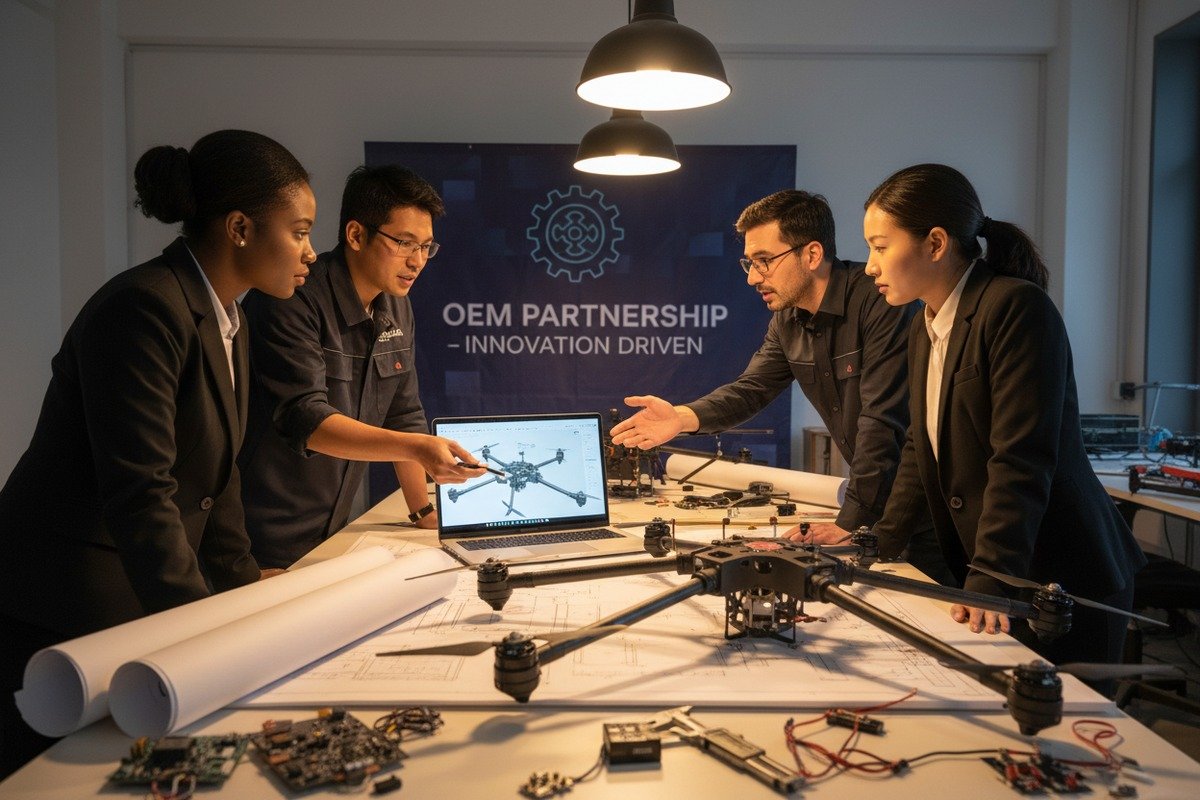
When we receive OEM requests, the first question our engineering team asks is whether the customer has clear specifications. Customization projects fail most often due to communication gaps, not technical limitations. Your scorecard must measure a supplier's collaboration capabilities, not just their manufacturing capacity.
Evaluate OEM capabilities by scoring suppliers on: engineering team size and qualifications, previous custom project portfolio, design iteration process and timeline commitments, software development stack compatibility, API documentation quality, communication responsiveness within 24 hours, and intellectual property protection agreements.
Engineering Team Assessment
A supplier's engineering depth determines their customization ceiling. Our team includes mechanical engineers, firmware developers, and application software programmers. This combination allows us to modify hardware designs while ensuring software compatibility.
Ask potential suppliers these questions:
- How many engineers work on custom projects?
- What CAD/CAM software do they use?
- Can they provide engineering change order (ECO) timelines?
- Do they have in-house PCB design capability?
Software Development Capabilities
Modern agricultural drones require sophisticated software integration. Flight planning, data collection, and fleet management all depend on software quality. When we develop custom software features, we follow documented processes that ensure reliability and maintainability.
| Capability | Evaluation Criteria | Scorecard Weight |
|---|---|---|
| SDK Availability | Open API for third-party integration | 20% |
| Custom Feature Development | Demonstrated ability to add specific functions | 25% |
| Data Format Compatibility | Support for common ag data standards | 15% |
| Update Deployment | Over-the-air update capability | 15% |
| Documentation Quality | Complete API and user documentation | 15% |
| Source Code Access | Negotiable for critical applications | 10% |
Communication and Project Management
Custom projects require constant communication. We assign dedicated project managers to OEM clients and provide weekly progress reports. Your scorecard should measure response times, meeting availability across time zones, and documentation practices.
Red flags include suppliers who:
- Take more than 48 hours to respond to technical questions
- Cannot provide project timelines with milestones
- Refuse to sign NDAs or IP protection agreements
- Have no formal change request process
Prototype and Testing Protocols
Before committing to full production, evaluate the supplier's prototyping process. Our standard practice includes functional prototypes, field testing reports, and customer approval gates before mass production begins. This prevents expensive mistakes and ensures the final product meets specifications.
Which criteria will help me assess if a drone manufacturer has the export experience to handle my US customs clearance?
In our experience exporting to the US market, we learned that proper documentation prevents weeks of customs delays. One missing certificate can hold an entire shipment at the port. Many overseas suppliers underestimate US import requirements, leaving their customers to deal with compliance problems. ITAR restrictions 4 FAA Remote ID compliance 5
Assess export experience by verifying: FCC certification for all RF-emitting components, FAA Remote ID compliance readiness, complete commercial invoice documentation, accurate HS code classification history, experience with US customs brokers, ability to provide AES filing numbers, and familiarity with ITAR restrictions for dual-use technology.

Essential Certifications for US Import
The United States requires specific certifications for drone imports. These are not optional. Shipments lacking proper documentation face seizure, fines, or return to origin. Our compliance team maintains current certifications and updates them when regulations change.
| Certificación | Requirement | Consequence of Non-Compliance |
|---|---|---|
| FCC Parte 15 | Required for all wireless devices | Shipment seizure |
| FAA Remote ID | Required for drones over 250g | Cannot legally fly in US |
| CE/UKCA | Not required but indicates quality standards | Reduced buyer confidence |
| Cumplimiento de la normativa RoHS 6 | Required for electronics | Import denial |
| Battery UN38.3 | Required for lithium batteries | Shipping rejection |
| MSDS for Chemicals | Required if drone contacts pesticides | Customs holds |
Documentation Accuracy
Accurate paperwork speeds customs clearance. We provide complete commercial invoices with correct HS codes, country of origin declarations, and component breakdowns. Errors in these documents cause delays and may trigger audits.
Your scorecard should verify that suppliers can provide:
- Commercial invoices matching packing lists exactly
- Accurate HS code classification (typically 8806.10 for agricultural drones)
- Country of origin certificates
- Component-level value declarations
- End-user certificates when required
Logistics and Delivery Experience
Export experience extends beyond documentation. Experienced suppliers understand shipping timelines, carrier requirements, and port procedures. We work with established freight forwarders who specialize in drone shipments.
Pregunte a los posibles proveedores:
- Which carriers do they use for US shipments?
- What is their average customs clearance time?
- Have they experienced US customs rejections? Why?
- Do they offer DDP (Delivered Duty Paid) terms?
- Can they provide shipment tracking throughout transit?
Regulatory Update Awareness
US drone regulations change frequently. Suppliers who track these changes protect their customers from compliance surprises. Our team monitors FAA announcements, NDAA restrictions, and CBP guidance updates. This proactive approach prevents shipments from being held due to new requirements.
What weight should I give to technical support and the availability of repair parts in my final scorecard?
When we calibrate our flight controllers at the factory, we document every setting because customers will need this information during field maintenance. A drone sitting broken in a warehouse costs money every day it cannot fly. Service Level Agreements 8 Technical support and parts availability directly impact your total cost of ownership.
Technical support and repair parts availability should comprise 25-35% of your total scorecard weight. Within this category, allocate approximately 40% to support responsiveness, 30% to parts availability and lead times, 20% to documentation quality, and 10% to training resources. Increase these weights if you operate in remote areas or have limited in-house technical staff.

Support Response Time Standards
Response time matters most during peak operational periods. We maintain support staff across time zones to ensure our US customers receive responses within their business day. Your scorecard should set clear expectations and measure actual performance.
| Support Level | Response Time Target | Resolution Target |
|---|---|---|
| Critical (drone down) | 4 horas | 24 horas |
| High (functionality impaired) | 8 hours | 48 hours |
| Medium (non-urgent issue) | 24 horas | 5 business days |
| Low (general questions) | 48 hours | 10 business days |
Parts Availability Assessment
Repair parts determine how quickly you return to operation after a failure. We stock common replacement parts and maintain relationships with US-based distributors for faster delivery. Suppliers who cannot provide parts availability data likely have poor inventory management.
Evaluate parts availability by checking:
- Stock levels for top 20 replacement parts
- Lead times for non-stocked items
- Pricing transparency for common parts
- Minimum order requirements
- Shipping options for urgent needs
Documentation and Training Resources
Good documentation reduces support requests and enables faster self-service repairs. Our technical manuals include troubleshooting guides, exploded diagrams, and calibration procedures. Video tutorials supplement written documentation for complex procedures.
Score suppliers on:
- Manual completeness and clarity
- Availability in your preferred language
- Regular updates reflecting product changes
- Video tutorial library
- Troubleshooting decision trees
Service Level Agreements
Formal SLAs protect both parties by setting clear expectations. We offer tiered SLA packages that match support levels to customer needs. Your scorecard should evaluate whether suppliers offer SLAs and what penalties apply for missed targets.
Key SLA elements include:
- Defined response and resolution times
- Escalation procedures
- Compensation for missed targets
- Coverage hours and holidays
- Remote diagnostic capabilities
Calculating Support ROI
Technical support quality affects your bottom line. Poor support leads to extended downtime, which costs money. Calculate the value of one day of drone downtime in your operation. Then evaluate whether premium support options justify their cost.
For example, if your drone generates $500 per day in revenue, and premium support reduces average downtime from 5 days to 2 days, the $300 per incident savings likely exceeds the support contract cost over a typical year.
Conclusión
Building a supplier scorecard for agricultural drone procurement protects your investment and reduces operational risk. Weight durability metrics, OEM capabilities, export experience, and technical support based on your specific needs. Review strategic suppliers monthly and update scores with each transaction. Start building your scorecard today to make better procurement decisions tomorrow.
Notas al pie
1. Replaced HTTP 404 with a working, authoritative Wikipedia page explaining Mean Time Between Failures. ↩︎
2. Explains the international standard for ingress protection against solids and liquids. ↩︎
3. Provides information on high-accuracy GPS technology for agricultural applications. ↩︎
4. Replaced HTTP unknown with a working, highly authoritative page from the U.S. Department of State explaining ITAR. ↩︎
5. Details the FAA regulation for drone identification and tracking. ↩︎
6. Replaced HTTP 404 with a working, highly authoritative page from the European Commission explaining the RoHS Directive. ↩︎
7. Explains the mandatory regulatory approval for wireless devices in the US. ↩︎
8. Defines agreements for service quality, availability, and responsibilities. ↩︎

 English
  Spanish
  German
  French
  Dutch
Dutch  Arabic
