
When our production team first started receiving support tickets from overseas distributors, we noticed a troubling pattern flight controller manuals 1. Many farmers lost entire spraying windows because no one had established a clear fault reporting process. The financial losses were real, and the frustration was mounting.
To build an effective after-sales fault reporting process for agricultural drones, you need four key elements: comprehensive technical documentation from your supplier, guaranteed remote support channels, streamlined spare parts logistics, and a standardized issue tracking template that captures recurring problems systematically.
This guide walks you through each component step by step asistencia técnica remota 2. You will learn exactly what to demand from suppliers and how to structure your internal processes for faster resolution times.
What technical documentation should I require from my supplier to simplify the fault reporting process?
Our engineering team has seen countless cases where distributors struggle with diagnostics simply because they lack the right paperwork. technical documentation 3 Without proper documentation, even simple issues like recalibrating an IMU sensor 4 become major headaches that delay repairs for days.
You should require complete flight controller manuals, wiring diagrams, error code references, firmware update guides, sensor calibration procedures, and battery management specifications from your supplier. These documents cut diagnostic time by up to 70% and enable your technicians to resolve issues independently.

Essential Documentation Categories
Not all documentation holds equal value. Some documents are critical for daily troubleshooting, while others only matter during major repairs. Here is a breakdown of what you actually need.
| Tipo de documento | Objetivo | When You Need It |
|---|---|---|
| Error Code Reference | Decode flight controller warnings | Every fault report |
| Wiring Diagrams | Trace electrical shorts and disconnects | Hardware failures |
| Firmware Update Guide | Resolve software bugs | Monthly maintenance |
| Sensor Calibration Manual | Fix GPS drift and IMU errors | Post-crash recovery |
| Battery Specs Sheet | Diagnose power failures | Battery-related faults |
| Spray System Manual | Troubleshoot nozzle and pump issues | Coverage problems |
Why Generic Manuals Are Not Enough
Many suppliers provide only basic user manuals designed for end consumers. These documents tell you how to fly the drone, not how to fix it. When our quality control team audits supplier documentation, we specifically check for service-level content.
Service manuals should include component part numbers, torque specifications for fasteners, and step-by-step disassembly procedures. Without these details, your technicians must guess or contact the manufacturer for every repair.
Requesting Digital and Searchable Formats
Paper manuals get lost. PDF files without bookmarks waste time. When negotiating with your supplier, specify that all documentation must be delivered in searchable digital formats. Some of our distribution partners have requested interactive troubleshooting guides that link error codes directly to repair procedures.
The best format allows your field technicians to search by symptom or error code and immediately find relevant repair steps. This is especially valuable for drones agrícolas 5 because operators often work in remote locations with limited connectivity.
Documentation Update Protocols
Drone firmware evolves constantly. Documentation that was accurate six months ago may now contain outdated procedures. Your procurement contract should include provisions for documentation updates whenever the manufacturer releases new firmware or hardware revisions.
At our facility, we maintain a documentation version log that tracks every update. Distributors who subscribe to our support portal receive automatic notifications when new technical bulletins become available.
How can I ensure my manufacturer provides immediate remote technical support when a drone fails in the field?
During harvest season, every hour of downtime costs money. We learned this lesson when a Central Queensland cotton farm experienced a battery failure mid-spray, and the operator had no way to reach qualified technical support. That single incident wiped out two days of crop treatment.
Secure immediate remote support by negotiating guaranteed response times in your contract, requiring video call capabilities, establishing dedicated communication channels like WhatsApp or WeChat, and ensuring your supplier has technical staff available across multiple time zones to cover your operating hours.

Defining Response Time Guarantees
Vague promises like "fast support" mean nothing when your drone is grounded. Your procurement contract should specify exact response times in hours, not days. Here is what we recommend based on issue severity.
| Severity Level | Tipo de problema | Maximum Response Time |
|---|---|---|
| Critical | Complete flight failure | 2 horas |
| Alto | Spray system malfunction | 4 horas |
| Medio | Sensor calibration errors | 8 hours |
| Bajo | Software feature questions | 24 horas |
Building Multi-Channel Communication
Email is too slow for field emergencies. Your support arrangement should include multiple real-time communication options. At SkyRover, we provide WhatsApp support for most Western markets and WeChat for Asian partners.
Video calling capability is essential. Many issues that seem complex over text become obvious when a technician can see the actual drone. We have resolved countless problems in minutes simply by watching the operator point their phone camera at the right component.
Time Zone Coverage Considerations
Agricultural operations do not follow business hours. Spraying often happens at dawn or dusk when wind speeds are lowest. If your supplier is in China and you operate in Texas, you need assurance that qualified technicians will answer at 5 AM Central Time.
Some manufacturers operate 24/7 support centers. Others maintain on-call rotations. Ask specifically about coverage during your peak operating seasons.
Remote Diagnostics Through Apps
Modern agricultural drones generate detailed telemetry data. Our flight controller software logs GPS coordinates, motor performance, battery voltage curves, and spray flow rates. When operators grant remote access, our technicians can review this data without any physical inspection.
Require that your supplier provides app-based diagnostic tools that capture and transmit flight logs automatically. This feature alone can reduce resolution time dramatically because the technician already understands what happened before the first support call.
Escalation Procedures
Not every technician can solve every problem. Your support agreement should define clear escalation paths. If the first-level technician cannot resolve the issue within a specified time, the case should automatically escalate to senior engineers.
We have structured our support team into three tiers. First-tier handles common issues like calibration and settings. Second-tier manages hardware diagnostics. Third-tier includes the actual engineers who designed the systems.
What is the best way for me to coordinate spare parts delivery and customs clearance for drone repairs?
Our export team handles customs documentation daily, and we have seen shipments stuck at ports for weeks because importers did not prepare properly. When a critical motor or ESC sits in customs, your customer loses money and patience.
Coordinate spare parts delivery by pre-positioning common components in local warehouses, establishing relationships with customs brokers who understand drone regulations, requiring proper HS codes and export documentation from your supplier, and using express couriers with DDP shipping terms for urgent repairs.
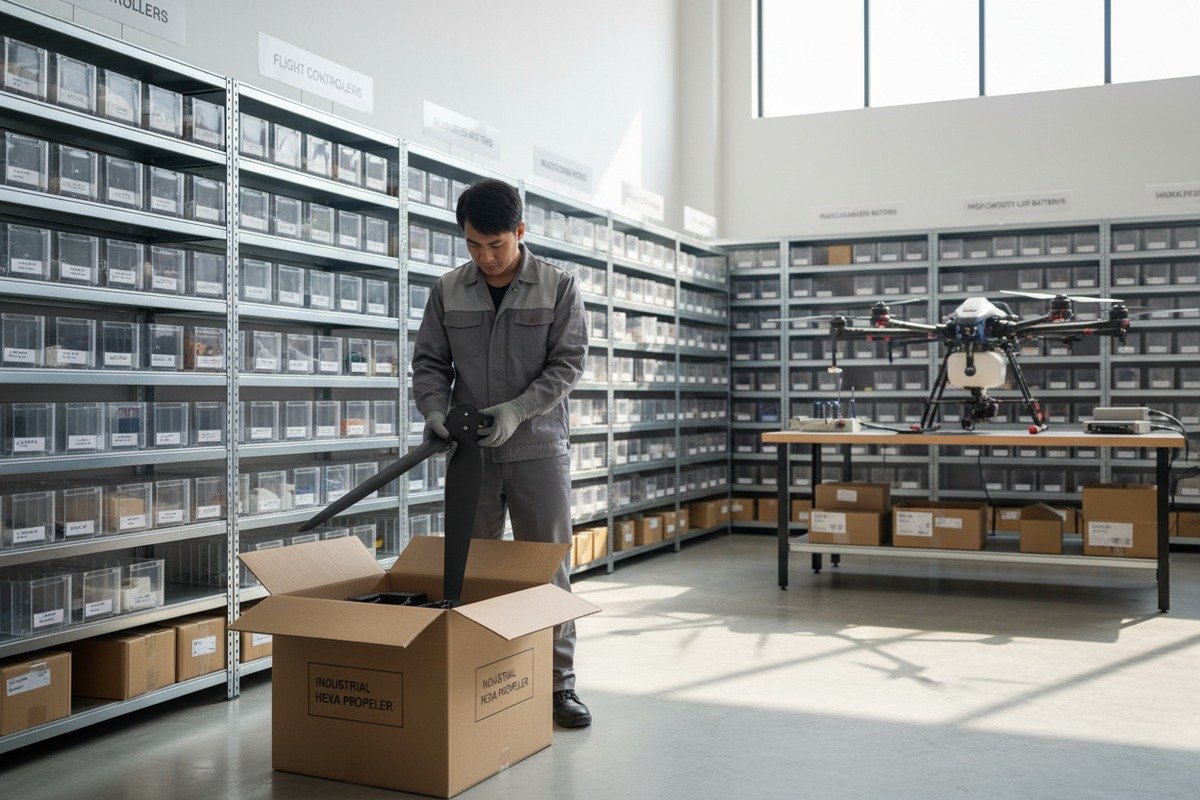
Pre-Positioning Strategy
The fastest parts delivery is no delivery at all. If you maintain local inventory of common failure components, repairs can happen within hours instead of weeks. Based on our failure rate data, here are the components worth stocking.
| Componente | Failure Frequency | Lead Time from China | Recommended Stock Level |
|---|---|---|---|
| Hélices | Alto | 3-5 days express | 20+ per drone model |
| ESC Units | Medio | 5-7 days express | 4 per drone model |
| Motores | Medio | 5-7 days express | 4 per drone model |
| Battery Packs | Medium-High | 7-14 days (hazmat) | 2-4 per drone model |
| GPS Modules | Bajo | 5-7 days express | 2 per drone model |
| Boquillas pulverizadoras | Alto | 3-5 days express | 10+ per drone model |
Understanding Customs Requirements
Drone components face scrutiny at many borders. Some countries classify certain parts as dual-use technology. Others require import permits for radio frequency equipment. Your supplier should provide accurate códigos HS 6 and any required export licenses.
When we ship to the United States, we always include a detailed commercial invoice listing each component by name, function, and value. We also provide certificates of origin and any relevant FCC documentation for radio equipment.
Choosing the Right Shipping Method
Standard air freight is economical but slow. Express couriers like DHL, FedEx, and UPS offer faster transit but cost more. For critical repairs, the extra shipping cost is insignificant compared to continued downtime.
Consider negotiating DDP terms for urgent parts shipments. Under Delivered Duty Paid terms, the supplier handles all customs clearance 7 and duties. This eliminates delays from your side and ensures the parts reach your door without unexpected fees.
Battery Shipping Challenges
Baterías de litio 8 require special handling. They cannot travel on passenger aircraft and face strict packaging requirements. Some couriers refuse battery shipments entirely. When we export replacement batteries, we use specialized hazmat shipping services that add 3-7 days to transit time.
Plan for this delay by maintaining local battery inventory. Batteries also have shelf lives, so rotate stock and monitor storage conditions carefully.
Building Broker Relationships
A good customs broker who understands drone technology can save you weeks of delays. Before your first shipment arrives, identify a broker experienced with aviation electronics or agricultural equipment. Provide them with your supplier's documentation standards so they know what to expect.
Some of our larger distributors have established bonded warehouse arrangements that allow them to import bulk spare parts with deferred duty payments. This approach improves cash flow and ensures parts are always available.
How do I build a standardized reporting template to track and resolve recurring hardware or software issues?
When we analyze warranty claims across our distribution network, patterns emerge clearly. GPS drift appears repeatedly in certain geographic regions. Battery failures cluster around specific operating temperatures. Without standardized reporting, these patterns stay hidden.
Build a standardized template by including mandatory fields for date, location, flight conditions, error codes, symptoms, and photos. Track each report in a centralized database, analyze trends monthly, and share findings with your supplier to drive product improvements and prevent recurring failures.

Core Template Fields
Your reporting template must capture enough information for remote diagnosis while remaining simple enough for field operators to complete quickly. Here are the essential fields based on our support experience.
| Field Category | Specific Data Points | Por qué es importante |
|---|---|---|
| Identification | Drone serial number, firmware version | Links issue to specific unit history |
| Timing | Date, time, flight duration at failure | Reveals time-based failure patterns |
| Environment | Temperature, humidity, wind, terrain | Identifies environmental triggers |
| Symptoms | What operator observed | Guides initial diagnosis |
| Error Codes | Flight controller warnings | Points to specific system failures |
| Evidence | Photos, flight logs, video | Enables remote visual inspection |
| Medidas adoptadas | Troubleshooting steps attempted | Prevents duplicate efforts |
Digital vs. Paper Systems
Paper forms get lost, damaged, and forgotten. Digital reporting systems offer searchable history, automatic timestamps, and easy attachment of photos and flight logs. Many farm management software platforms now include equipment maintenance modules that can be adapted for drone tracking.
If your operation is small, a shared spreadsheet may suffice initially. As you scale, consider dedicated maintenance management software that integrates with your supplier's diagnostic apps.
Analyzing Patterns Over Time
Individual reports have limited value. The real insight comes from analyzing hundreds of reports to identify trends. When our engineering team reviews quarterly failure data, we look for correlations between failures and specific conditions.
For example, we discovered that one batch of motors showed increased failure rates when operating in high-dust cotton fields. This insight led to improved motor sealing in subsequent production runs.
Closing the Feedback Loop
Reporting without action is pointless. Your process should include regular reviews where you share aggregated data with your supplier. Good manufacturers welcome this feedback because it helps them improve products.
At SkyRover, we hold monthly calls with major distributors specifically to review failure trends. When patterns emerge, our engineering team investigates root causes and implements design changes.
FAA Compliance Considerations
If you operate in the United States, certain accidents require FAA reporting 9 within 10 days. These include incidents causing serious injury, property damage exceeding $500, or loss of positive control. Your internal template should flag incidents that may trigger regulatory reporting requirements.
The FAA accepts reports through their DroneZone portal. Some operators also use the NASA Aviation Safety Reporting System for voluntary near-miss reports that help build industry safety data without penalty implications.
Template Evolution
Your first template will not be perfect. After three months of use, review which fields provide useful information and which are consistently left blank. Remove unhelpful fields and add new ones based on actual diagnostic needs.
Our support template has evolved through six versions over three years. Each revision improved based on real feedback from technicians who actually use the data.
Conclusión
Building an effective fault reporting process takes preparation before your first drone ever fails. Demand complete documentation, secure guaranteed support channels, pre-position critical spare parts, and implement standardized tracking. These steps protect your investment and keep your agricultural operations running during critical seasons.
Notas al pie
1. Describes the function and importance of a drone flight controller. ↩︎
2. Replaced with a Wikipedia article providing a general and authoritative definition of remote support in IT. ↩︎
3. Defines technical documentation and its general purpose. ↩︎
4. Explains the function of an Inertial Measurement Unit (IMU) sensor. ↩︎
5. Explains the role and benefits of drones in agriculture. ↩︎
6. Explains the Harmonized System (HS) codes for classifying goods. ↩︎
7. Provides an overview of the customs clearance process for imported goods. ↩︎
8. Details international regulations for shipping lithium batteries as dangerous goods. ↩︎
9. Outlines FAA requirements for reporting drone accidents and incidents. ↩︎

 English
  Spanish
  German
  French
  Dutch
Dutch  Arabic
