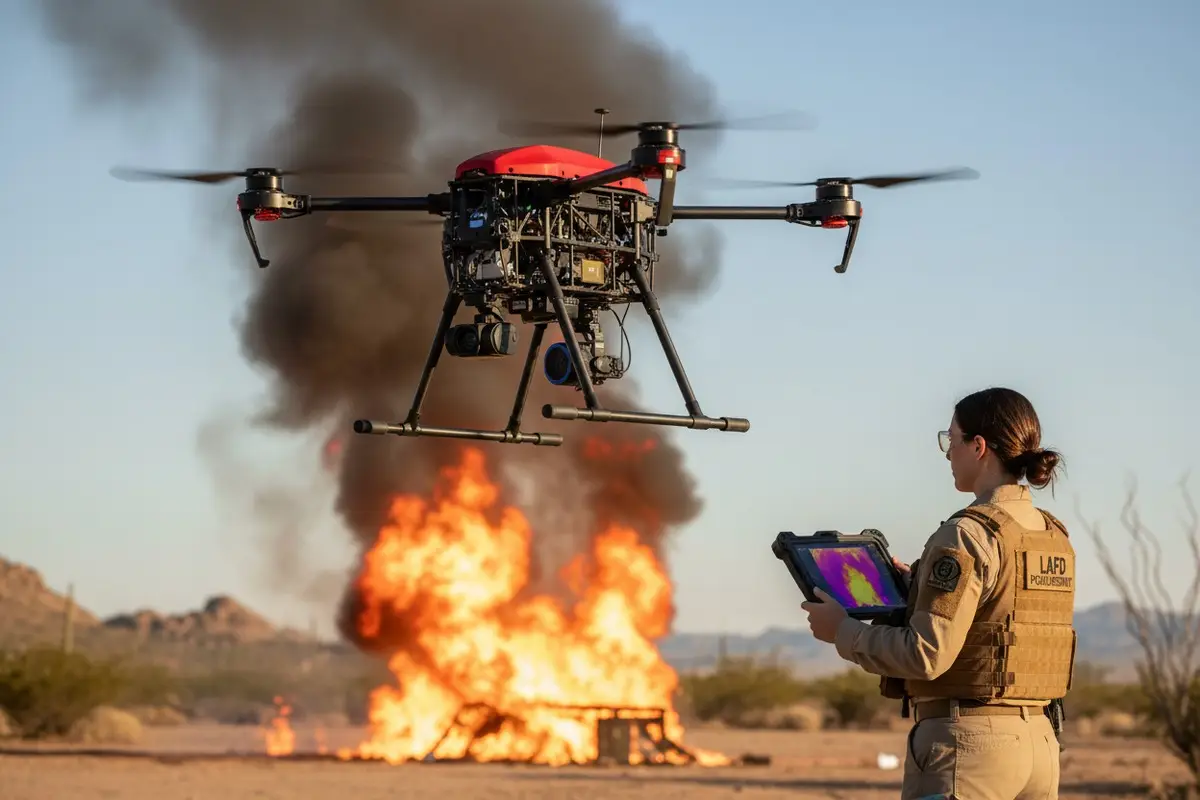

Cuando nuestro equipo de ingeniería comenzó a desarrollar drones contra incendios 1 hace cinco años, aprendimos rápidamente que las pruebas de laboratorio no significan nada si el prototipo falla en condiciones reales de incendio. Muchos departamentos de bomberos de EE. UU. se han enfrentado a esta misma frustración: comprar drones que parecen impresionantes en el papel pero se desmoronan cuando se exponen al calor y al humo reales.
Debe probar la estabilidad de vuelo bajo calor extremo, la navegación autónoma en humo, la capacidad de carga útil para supresores, la autonomía de vuelo de más de 40 minutos, la integración de imágenes térmicas en tiempo real, los mecanismos de despliegue rápido y la documentación de cumplimiento de la FAA. Estas características determinan si un prototipo puede salvar vidas en escenarios de incendios forestales, urbanos e industriales en EE. UU.
Permítanme guiarlos a través de los protocolos de prueba específicos y los requisitos técnicos que les ayudarán a evaluar prototipos de drones de extinción de incendios de manera efectiva para sus clientes en EE. UU.
¿Cómo puedo verificar la estabilidad de vuelo y la resistencia al calor de un prototipo de dron de extinción de incendios en condiciones extremas?
Nuestras instalaciones de producción realizan pruebas en cámaras de calor a diario, sin embargo, todavía nos encontramos con distribuidores que recibieron prototipos de otros proveedores que se derritieron durante su primera prueba de campo Documentación de cumplimiento de la FAA 2. Este costoso error ocurre cuando los compradores omiten rigurosos pasos de verificación.
Para verificar la estabilidad del vuelo y la resistencia al calor, exija pruebas en casas de combustión en vivo a temperaturas entre 200 °C y 1200 °C, solicite especificaciones de aislamiento cerámico o aerogel, pruebe el rendimiento del motor bajo estrés térmico y confirme que el dron mantiene un vuelo estacionario estable con una deriva de 10 cm mientras está expuesto al calor radiante durante al menos 15 minutos.

Comprensión de los estándares de protección térmica
La resistencia al calor separa los drones de extinción de incendios funcionales de los fallos costosos Resultados de la prueba de interoperabilidad de la NFPA 3. Los puntos de referencia actuales de la industria muestran una variación significativa en los enfoques de protección térmica.
| Tipo de protección | Clasificación de temperatura | Material utilizado | Mejor Aplicación |
|---|---|---|---|
| Aislamiento de Aerogel 4 | Hasta 200°C | Aerogel a base de sílice | Incendios estructurales urbanos |
| Carcasa de cerámica | Hasta 1200°C | Cerámica de alta temperatura | Incendios industriales, refinerías |
| Compuesto de fibra de carbono | Hasta 150°C | Fibra de carbono tejida | Reconocimiento de incendios forestales |
| Manta térmica enrollable | Hasta 300°C | Película reflectante multicapa | Misiones de exposición prolongada |
Cuando calibramos nuestros controladores de vuelo para entornos de alta temperatura, tenemos en cuenta la expansión térmica en la carcasa de los componentes electrónicos. Muchos prototipos fallan no porque el marco se derrita, sino porque las placas de circuito se deforman a temperaturas superiores a los 85°C.
Protocolo de pruebas de estabilidad de vuelo
Debe establecer criterios claros de aprobación/rechazo antes de que comiencen las pruebas. Aquí hay lo que recomendamos solicitar a cualquier proveedor:
Primero, exija datos de estabilidad de vuelo estacionario. El dron debe mantener su posición dentro de una esfera de 10 cm mientras está expuesto a fuentes de calor radiante que simulan condiciones de fuego activo. Segundo, verifique los tiempos de respuesta del motor. El calor hace que los lubricantes se adelgacen, lo que afecta el rendimiento de los rodamientos. Un prototipo de calidad mantiene una variación de RPM constante por debajo de 3% en todos los rangos de temperatura.
Tercero, verifique la gestión térmica del controlador de vuelo. Nuestros ingenieros instalan disipadores de calor dedicados en todas las unidades de procesamiento porque un controlador de vuelo confundido en condiciones de humo crea situaciones peligrosas para las cuadrillas terrestres.
Métodos de verificación en el mundo real
Las pruebas de laboratorio proporcionan datos de referencia, pero nada reemplaza las pruebas con fuego real. En nuestra experiencia enviando a clientes de EE. UU., la verificación más efectiva implica tres etapas:
La primera etapa utiliza casas de fuego certificadas por NIST donde los incendios controlados alcanzan temperaturas predecibles. La segunda etapa implica pruebas de proximidad en plantas de cemento o hornos industriales donde el calor radiante supera los 400°C a corta distancia. La tercera etapa requiere ejercicios de entrenamiento reales de incendios forestales con supervisión del departamento de bomberos.
Solicite documentación en video de todas las pruebas. Las imágenes térmicas que muestran la temperatura de la superficie del dron durante el vuelo proporcionan evidencia de que los sistemas de aislamiento funcionan según lo anunciado.
¿Qué opciones de desarrollo de software y personalización de OEM debo solicitar para mis clientes de lucha contra incendios con sede en EE. UU.?
Cuando colaboramos con distribuidores de EE. UU. en compilaciones de software personalizadas, la solicitud más común implica la integración de datos térmicos con sistemas existentes. sistemas de mando de incidentes 5. Sin embargo, muchos compradores subestiman el cronograma de desarrollo y los requisitos de certificación.
Solicitar arquitectura de software modular que admita la integración de API con sistemas CAD, pantallas de superposición térmica personalizables, programación autónoma de puntos de referencia para operaciones BVLOS, protocolos de coordinación de enjambres, transmisión de datos cifrada que cumpla con los estándares de seguridad CJIS y opciones de marca blanca para su red de distribución.

Características del Software Principal para Departamentos de Bomberos de EE. UU.
Los departamentos de bomberos de diferentes regiones tienen una infraestructura tecnológica variada. Sus solicitudes de personalización de software deben abordar esta realidad.
| Categoría de función | Paquete Estándar | Paquete Avanzado | Paquete Empresarial |
|---|---|---|---|
| Integración de Imágenes Térmicas | Superposición básica | Detección de puntos calientes con IA | Propagación predictiva del fuego |
| Protocolo de Comunicación | WiFi estándar | Capaz de red en malla | Cifrado de grado militar |
| Navegación autónoma | Puntos de referencia GPS | GPS + SLAM visual | Penetración de humo LiDAR 3D |
| Almacenamiento de datos | Tarjeta SD local | Copia de seguridad en la nube | Servidores compatibles con CJIS |
| Soporte para Múltiples Drones | Unidad única | Coordinación de 3 drones | Gestión completa de enjambres |
Nuestro equipo de desarrollo aprendió que los departamentos de bomberos de EE. UU. a menudo necesitan software que funcione sin conexión. La conectividad a Internet falla durante incidentes importantes. Cualquier prototipo que pruebe debe demostrar funcionalidad completa sin dependencia de la nube.
Marca y documentación del OEM
Las opciones de marca blanca son importantes para los distribuidores que construyen marcas regionales. Cuando preparamos paquetes OEM, incluimos elementos personalizables en toda la experiencia del usuario.
El software de la estación de control terrestre debe mostrar el logotipo y la combinación de colores de su empresa. Los manuales de usuario necesitan su marca e información de contacto. Los videos de capacitación requieren su voz en off e identidad visual. El embalaje debe mostrar sus marcas de cumplimiento normativo junto con las certificaciones de seguridad requeridas.
Solicite acceso al código fuente para módulos de integración críticos. Esto protege su negocio si el fabricante original suspende el soporte. Como mínimo, exija documentación detallada de la API que permita a su equipo técnico crear integraciones personalizadas de forma independiente.
Requisitos de software normativo
Las operaciones de la Parte 107 y la Parte 137 de la FAA requieren capacidades de software específicas. El prototipo debe registrar datos de vuelo en formatos aceptables para la revisión regulatoria. Los sistemas de geovallas necesitan actualizaciones que coincidan con las bases de datos actuales de TFR (Restricciones Temporales de Vuelo).
Para operaciones BVLOS 6, que la mayoría de las aplicaciones de extinción de incendios requieren, el software debe incluir funcionalidad de detección y evasión. Nuestros sistemas utilizan una combinación de receptores ADS-B y sensores a bordo para cumplir con estos requisitos. Verifique que cualquier prototipo que pruebe tenga un camino claro hacia la aprobación de exención BVLOS.
¿Cómo garantizo que la capacidad de carga útil y la autonomía de vuelo del dron cumplan con los estándares de los departamentos de bomberos locales?
Nuestros ingenieros pasaron dos años optimizando la relación potencia-peso después de recibir comentarios de un distribuidor de California cuyos clientes necesitaban una capacidad de carga útil de 45 kg con tiempos de vuelo de 40 minutos. Esta combinación lleva la tecnología de baterías actual a sus límites.
Asegure el cumplimiento probando los pesos reales de la carga útil que coinciden con los supresores previstos, verificando la autonomía de vuelo bajo carga completa en condiciones de campo, confirmando que los sistemas de baterías de intercambio en caliente permiten operaciones continuas y validando que los mecanismos de liberación de la carga útil funcionan con precisión dentro de una precisión de caída de 1 metro a altitudes operativas.

Requisitos de carga útil por tipo de incendio
Los diferentes escenarios de incendio exigen diferentes configuraciones de carga útil. Comprender estos requisitos le ayuda a especificar las características correctas del prototipo.
| Tipo de incendio | Carga útil mínima | Carga útil típica | Mecanismo de liberación | Objetivo de tiempo de recarga |
|---|---|---|---|---|
| Retardante de incendios forestales | 45 kg | 100 kg | Válvula de descarga por gravedad | Menos de 3 minutos |
| Entrega de manguera urbana | 20 kg | 50 kg | Sistema de cabrestante | No aplicable |
| Espuma industrial | 30 kg | 60 kg | Pulverización presurizada | Menos de 2 minutos |
| Caída de AED/Herramienta | 5 kg | 15 kg | Liberación de precisión | Menos de 30 segundos |
Cuando probamos sistemas de carga útil, medimos no solo la capacidad máxima sino también el rendimiento sostenido. Un dron clasificado para 50 kg debe mantener características de vuelo estables en todo el rango de carga útil, no solo en el número máximo que es amigable para el marketing.
Verificación de la autonomía de vuelo
Las especificaciones del fabricante a menudo reflejan condiciones ideales que nunca existen en las operaciones de extinción de incendios. El aire caliente reduce la eficiencia de elevación. Las partículas de humo obstruyen las entradas de aire. La turbulencia de los vientos generados por el fuego exige una compensación constante del motor.
Solicite datos de resistencia de vuelo de pruebas realizadas en condiciones que simulan entornos de fuego reales. Esto significa probar a temperaturas ambiente superiores a 35 °C, con condiciones de viento variables, mientras se transporta la carga útil operativa completa. Nuestro protocolo de prueba estándar reduce los tiempos de vuelo anunciados en un 15-25% para proporcionar expectativas realistas.
La tecnología de baterías limita la mayoría de los prototipos actuales. Los sistemas híbrido-eléctricos que combinan generadores de combustión con motores eléctricos ofrecen una mayor autonomía para aplicaciones de incendios forestales. Los sistemas puramente eléctricos proporcionan una respuesta más rápida para escenarios urbanos donde los tiempos de vuelo inferiores a 30 minutos son suficientes.
Capacidad de Operaciones Continuas
Los incidentes de incendios duran horas o días. Los vuelos de drones individuales significan poco sin sistemas de cambio rápido. Evalúe estos factores operativos:
Sistemas de baterías de intercambio en caliente 7 deben permitir que las cuadrillas terrestres reemplacen las baterías agotadas en menos de 60 segundos sin herramientas. Las estaciones de recarga de carga útil necesitan integración con el equipo existente del departamento de bomberos. El software de control terrestre debe admitir transferencias fluidas entre múltiples drones para mantener una cobertura continua.
Nuestro equipo de producción diseña compartimentos de batería para operación con guantes porque los bomberos usan equipo de protección. Pequeños detalles como pestillos sobredimensionados y codificación de colores de alto contraste son importantes en condiciones de visibilidad reducida por el humo.
¿Qué documentación de soporte técnico y certificación debo exigir a mi proveedor durante la fase de prototipo?
Cuando comenzamos a exportar a los mercados de EE. UU. hace ocho años, los retrasos en la aduana nos enseñaron que los fallos en la documentación cuestan más que los defectos del producto. Un certificado faltante puede detener un envío completo durante semanas.
Solicitar documentación de certificación de tipo de la FAA o vías de exención claras, resultados de pruebas de interoperabilidad de la NFPA, cumplimiento de la FCC para sistemas de radio, manuales de mantenimiento detallados con listas de piezas, compromisos de soporte técnico 24/7 con tiempos de respuesta definidos y programas de capacitación para el personal del departamento de bomberos del usuario final.
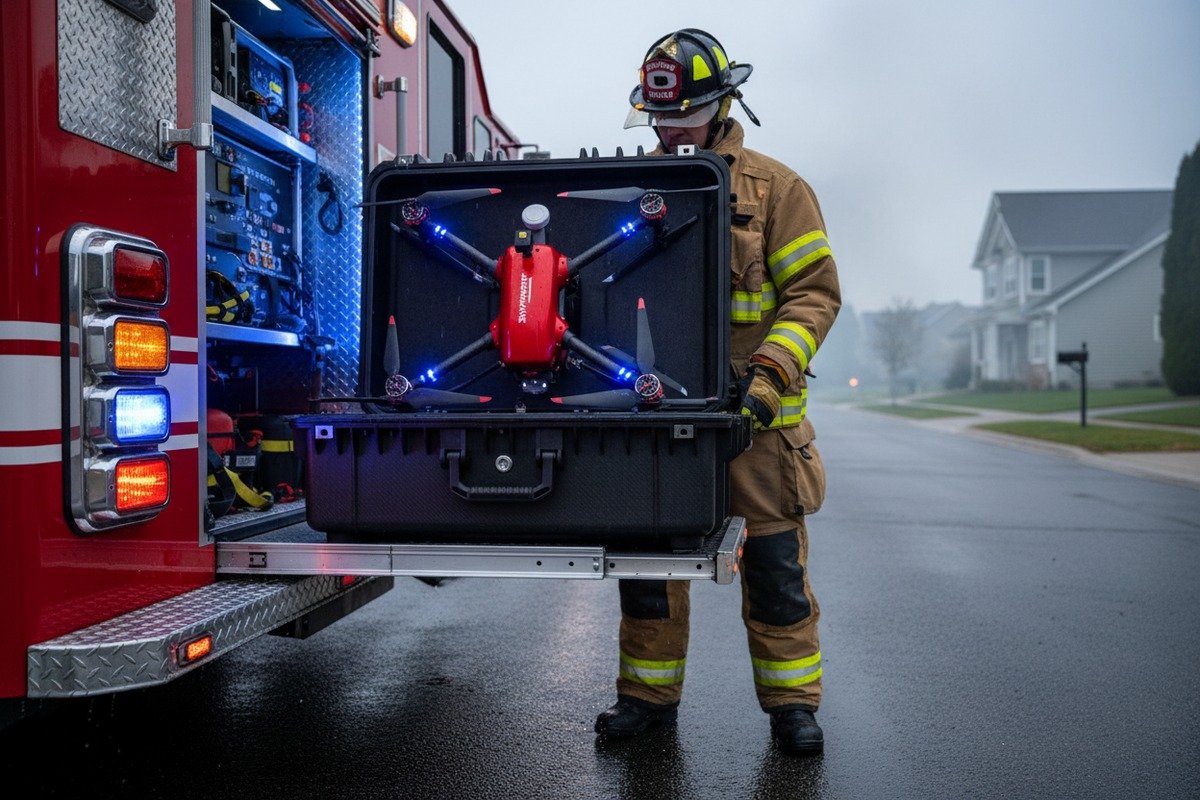
Documentos de certificación esenciales
Los requisitos de importación y operación de EE. UU. involucran a múltiples organismos reguladores. La falta de cualquier certificación individual crea problemas legales y operativos.
| Certificación | Organismo emisor | Objetivo | Cronograma Típico |
|---|---|---|---|
| Parte 107 de la FAA | Administración Federal de Aviación | Operación básica de drones | 2-4 semanas |
| FAA Parte 137 | Administración Federal de Aviación | Operaciones agrícolas/de extinción de incendios | 3-6 meses |
| ID de la FCC | Comisión Federal de Comunicaciones | Cumplimiento de las normas de radiofrecuencia | 6-8 semanas |
| Compatibilidad NFPA | Asociación Nacional de Protección contra Incendios | Integración de servicios contra incendios | Varía según el equipo |
| Listado UL | Underwriters Laboratories | Seguridad eléctrica | 8-12 semanas |
Nuestro equipo de cumplimiento mantiene documentación actualizada para todos los mercados de exportación. Proporcionamos estos documentos de forma proactiva porque los importadores experimentados saben solicitarlos antes de realizar pedidos.
Estructura de soporte técnico
Las pruebas de prototipos revelan problemas. La rapidez con la que su proveedor responda determinará si esos problemas se convierten en ajustes menores o retrasos importantes en el proyecto. Defina las expectativas de soporte por escrito antes de comprometerse con la compra de cualquier prototipo.
Las capacidades de diagnóstico remoto deberían permitir a los ingenieros del proveedor acceder a los registros de vuelo y a los datos del sistema sin acceso físico al dron. El soporte por videollamada con pantalla compartida permite la resolución de problemas en tiempo real. La disponibilidad de soporte in situ, aunque rara vez sea necesario, demuestra el compromiso del proveedor.
La disponibilidad de piezas de repuesto es enormemente importante. Nuestro almacén tiene componentes críticos para todos los productos activos con envío garantizado en 48 horas a destinos de EE. UU. Solicite compromisos específicos de disponibilidad de piezas y precios antes de que comiencen las pruebas del prototipo.
Capacitación y Transferencia de Conocimiento
Los departamentos de bomberos necesitan capacitación antes de implementar nueva tecnología. Su proveedor debe proporcionar materiales de capacitación integrales adecuados para usuarios finales con diversos antecedentes técnicos.
La capacitación de pilotos cubre las operaciones básicas de vuelo y los procedimientos de emergencia. La capacitación de mantenimiento permite a los técnicos locales realizar el servicio de rutina. La capacitación de integración ayuda al personal de TI a conectar los sistemas de drones con la infraestructura existente del departamento.
Desarrollamos programas de capacitación en colaboración con departamentos de bomberos reales para garantizar la relevancia. La capacitación genérica del fabricante a menudo omite detalles operativos críticos que los bomberos experimentados identifican de inmediato.
Documentación de Ciberseguridad
Los drones conectados crean vulnerabilidades de ciberseguridad 8. Los clientes del gobierno de EE. UU. requieren cada vez más evaluaciones de seguridad detalladas. Solicite documentación que cubra los estándares de cifrado de datos, la autenticación de actualizaciones de firmware y la protección contra ataques de interferencia o suplantación de señal.
Nuestros sistemas implementan cifrado de extremo a extremo que cumple con los requisitos actuales de CJIS. Proporcionamos documentación de arquitectura de seguridad adecuada para los procesos de revisión de adquisiciones gubernamentales.
Conclusión
La prueba de prototipos de drones de extinción de incendios requiere una evaluación sistemática de la resistencia al calor, la capacidad de carga útil, la integración del software y el cumplimiento de la certificación. Al exigir una documentación rigurosa y pruebas en el mundo real a su proveedor, protege a sus clientes estadounidenses de fallas costosas y posiciona su negocio de distribución para el éxito a largo plazo en este mercado en crecimiento.
Notas al pie
1. Página de Wikipedia que detalla el uso de drones en la gestión de incendios forestales. ↩︎
2. Reemplazado con la página principal de Sistemas de Aeronaves No Tripuladas (UAS) de la FAA, que proporciona información completa sobre las regulaciones y el cumplimiento de los drones. ↩︎
3. Página oficial de la NFPA para el Estándar 2400 sobre Sistemas de Aeronaves No Tripuladas Pequeñas para Seguridad Pública. ↩︎
4. Página de Wikipedia que explica las propiedades y usos del aerogel como aislante. ↩︎
5. Página Ready.gov de FEMA que define y explica los sistemas de gestión de incidentes. ↩︎
6. Hoja informativa oficial de la FAA sobre operaciones de drones más allá de la línea de visión visual (BVLOS). ↩︎
7. Artículo académico IEEE que detalla un sistema de reemplazo físico de batería a bordo para drones. ↩︎
8. Guía de CISA sobre riesgos de ciberseguridad y mejores prácticas para Sistemas de Aeronaves No Tripuladas (UAS). ↩︎
 English
  Español de México
  Deutsch
  Français
  Русский
  العربية
Comments
No comments yet. Be the first to share your thoughts!
Leave a Comment