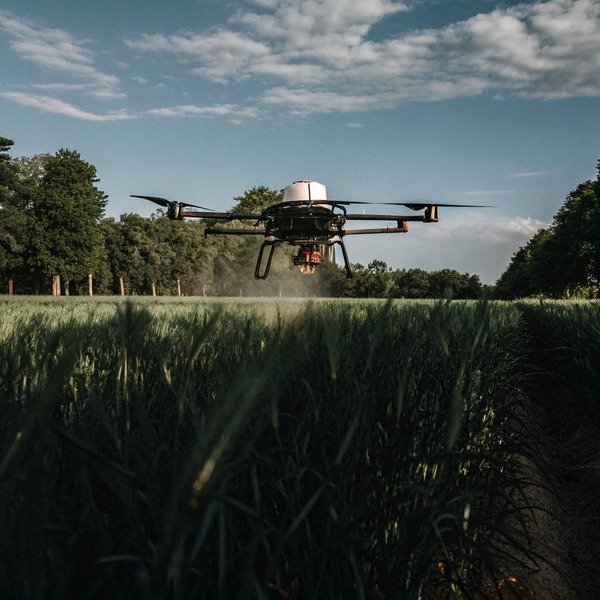
Buying advanced machinery remotely is daunting, especially when we see how frustrated customers become with confusing interfaces. advanced machinery 1 At our facility, we constantly refine our software to ensure that what works in a Xi’an test field also feels intuitive for a farmer in Iowa.
To ensure compatibility, request a live video demonstration of the Ground Control Station (GCS) software. Verify native support for Imperial Unidades imperiales 2 units like acres and gallons. Confirm the app is listed on US app stores, checks for “Global Version” firmware, and validates that map providers like Google Maps function correctly without region locks.
Navigating these technical checks requires a systematic approach to ensure your investment operates smoothly in an American field.
Can I request a live video demo to check the English UI translation quality before ordering?
When we present our systems to potential partners, we encourage live interaction because static images hide flaws. We know that a screenshot might look perfect, but the actual user experience can reveal awkward phrasing or confusing menu structures.
You absolutely can and should request a real-time video session. This allows you to inspect deep menu layers, warning pop-ups, and voice alerts for “Chinglish” phrases. Static screenshots often hide poor translations, so a live walkthrough ensures the interface logic matches American agricultural workflows.
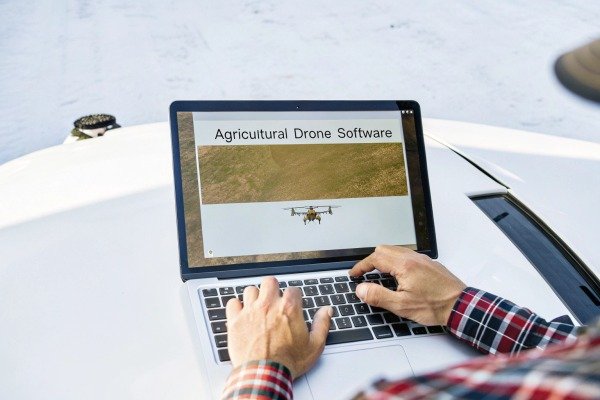
Requesting a video demonstration is the most effective way to filter out suppliers who only offer superficial English support. video demonstration 3 In our trade dealings, we often see competitors present polished marketing brochures, yet their actual software interface remains riddled with confusing syntax. A live video call, using platforms like Zoom or WhatsApp, forces the software to run in real-time, exposing any lag, hard-coded Chinese characters, or nonsensical error messages.
What to Look for During the Live Demo
Do not settle for a simple tour of the home screen. You need to ask the sales representative to simulate failures and dive into advanced settings. The main menu is usually translated well, but the deeper sub-menus often contain the most translation errors. For example, ask them to trigger a "low battery" warning or a "tank empty" alert. These pop-ups are critical for safety and must be instantly understandable to an American operator. If the warning says "electricity quantity low exception" instead of "Low Battery – Return to Home," it indicates a lack of localization.
You should also observe the font sizing and layout. English text is typically longer than Chinese characters. Poorly designed interfaces often have text bleeding off the buttons or overlapping with other elements because the UI was hard-coded for the density of Chinese script.
Analyzing the "Chinglish" Risk
"Chinglish" is not just an aesthetic issue; it is a safety hazard. In agricultural aviation, ambiguity leads to crashes. aviación agrícola 4 aviación agrícola 5 We emphasize this to our engineers: if a pilot cannot understand the "obstacle avoidance" settings immediately, they might disable a safety feature by mistake. During the demo, ask the operator to navigate through the calibration menus. These technical sections are notoriously difficult to translate correctly.
Lista de verificación para la verificación de video
Use this checklist during your call to ensure nothing is missed.
| Verification Point | What to Ask the Supplier to Do | Criterios de aprobación |
|---|---|---|
| Mensajes de error | Trigger a fail-safe (e.g., disconnect remote, low battery). | Alert is clear, concise English (e.g., "Signal Lost") not vague code. |
| Sub-Menus | Open the RTK or IMU calibration settings. | Technical terms are standard aviation English, not direct translations. |
| Voice Prompts | Enable voice feedback for flight modes. | Audio is a native or neutral English accent, not a robotic text-to-speech. |
| Text Layout | Switch between different flight modes. | Text fits inside buttons; no overlapping or cut-off sentences. |
| Carga de Mapas | Zoom in on a random US location (e.g., Kansas). | Maps load quickly via Google/Bing; no Chinese watermarks or blank grids. |
Does the agricultural drone software fully support imperial units and US map providers?
Our engineering team spends weeks adjusting firmware parameters because we understand that American farmers think in acres, not mu or hectares. Selling a drone that requires a calculator in the field is a surefire way to lose a customer.
Comprehensive support goes beyond simple unit toggles. You must verify that flight planning tools calculate spray rates in gallons per acre and that the map engine loads US satellite data instead of Chinese servers. Ensure the GPS coordinate system aligns with WGS-84 standards used in American precision farming.

The distinction between Metric and Imperial units is a massive friction point Metric and Imperial units 6 for importers. In China, we use the "Mu" for area and liters for volume. However, simply converting these numbers on a calculator is insufficient for integrated software. The software must natively calculate flow rates and flight speeds based on Imperial inputs.
The Hidden Coordinate System Trap
Map providers are another critical technical hurdle. Domestic Chinese drones use a coordinate encryption system called GCJ-02, which intentionally offsets GPS coordinates for national security reasons. If this system is not removed for the "Global Version," your drone’s position on the map will appear several hundred meters away from its actual physical location. This is disastrous for precision agriculture.
When checking the software, verify that the map source is Google Maps, Mapbox, or Bing Maps. Google Maps 7 If the interface relies on Baidu Maps or Amap (Gaode), it will likely struggle to load detailed satellite imagery of US farmland. Furthermore, the map cache speed is vital. Servers hosted inside China may deliver map tiles very slowly to US users.
Integration with US Farm Management Systems
American agriculture relies heavily on data. Farmers want to export their "as-applied" maps to systems like John Deere Operations Center John Deere Operations Center 8 or Climate FieldView. If the drone software outputs flight logs in a proprietary format or locks the data in a Chinese cloud server, it becomes useless for professional agronomy. We advise checking if the system supports standard file formats like Shapefiles (.shp) or KML/KMZ for route planning and data export.
Unit Compatibility Breakdown
The following table highlights the critical unit differences you must verify in the settings menu.
| Parámetro | Standard Chinese Setting | Required US Setting | Por qué es importante |
|---|---|---|---|
| Area Measurement | Mu (亩) or Hectares | Acres | Pricing and chemical inputs are sold by the acre in the US. |
| Liquid Volume | Litros (L) | Gallons (US) | Mixing ratios on US chemical labels use gallons. |
| Tasa de pulverización | Liters per Hectare | Gallons per Acre (GPA) | The most critical metric for regulatory compliance and efficacy. |
| Distance/Altitude | Metros (m) | Pies (ft) | FAA regulations and obstacle heights are measured in feet. |
| Velocidad | Meters/second (m/s) | Miles per hour (mph) | Easier for operators to visualize ground speed relative to vehicles. |
Is it possible to collaborate with the manufacturer to customize the software interface for my local market?
We frequently work with distributors who want the product to feel uniquely theirs, which builds stronger brand loyalty. Customizing the software is a standard request in our factory, ranging from simple logo swaps to complete functional overhauls.
Yes, OEM/ODM services often include software rebranding. This ranges from simple logo replacement on the boot screen to deep UI modifications via SDK integration. Collaboration ensures the interface reflects your brand identity and specifically caters to local operational habits and terminology.
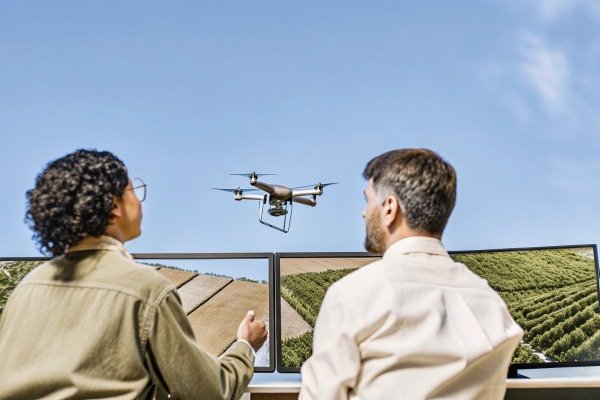
For distributors and large-scale importers, off-the-shelf software might not be enough. You might want to establish your own brand presence in the market. Manufacturers like us are generally open to this, but the level of customization depends on your order volume and technical capability.
Rebranding for Distributor Identity
The most basic level of collaboration is UI rebranding. This involves replacing the manufacturer's logo on the splash screen (the image that appears when the app loads) and the "About" section with your company's branding. This helps in building trust with your local customers. They feel they are buying a locally supported product rather than a generic import. We can also modify the color scheme of the app to match your corporate identity. For example, if your brand colors are green and yellow, we can adjust the buttons and headers to reflect that.
The Role of SDKs in Custom Apps
For deeper customization, ask if the manufacturer provides a Software Development Kit (SDK) or API access Kit de Desarrollo de Software (SDK) 9. Kit de Desarrollo de Software 10 This allows your local software engineers to build a custom application on top of the drone's flight controller. This is common for specialized applications, such as mosquito control or forestry, where standard agricultural interfaces are too cluttered or simplistic.
Using an SDK allows you to strip away unnecessary features. If your customers only spray corn, they might not need "Fruit Tree Mode" cluttering the screen. You can simplify the workflow to just three clicks: Map, Plan, Fly. This level of customization requires a strong relationship with the supplier and usually a commitment to a certain annual volume.
Niveles de Personalización de Software
Understanding what is possible helps in negotiation.
| Nivel de personalización | Descripción | Requisito Típico | Estimated Time |
|---|---|---|---|
| Marca básica | Logo change, splash screen, contact info update. | MOQ 10-50 units | 1-2 semanas |
| UI Reskin | Color changes, button icon updates, hidden menus. | MOQ 50-100 units | 3-4 semanas |
| Functional Mod | Adding new flight modes, US-specific voice packs. | MOQ 100+ units | 2-3 Meses |
| Full SDK Access | You build a custom app; we provide the data link. | Strategic Partnership | En curso |
How do I verify that the user manuals and technical support documents are in native-level English?
We know that a poorly written manual is the first step toward a customer returning a product. That is why we invest in professional technical writers, but unfortunately, many peers in the industry still rely on automated translation tools that confuse operators.
Download the digital manual before purchase to evaluate the writing quality. Look for natural phrasing in safety sections and clear, step-by-step troubleshooting guides. Poorly translated manuals often indicate a lack of dedicated English support, which can lead to operational hazards and downtime during critical farming seasons.
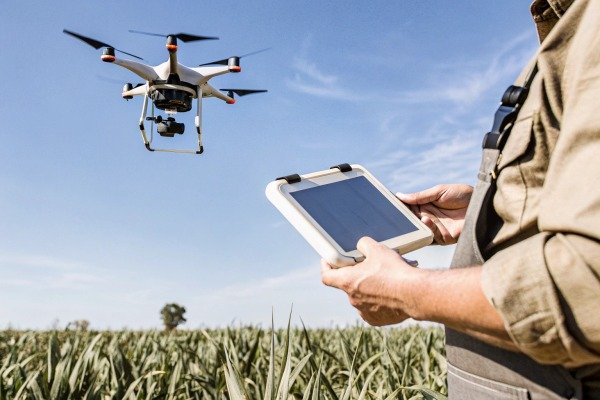
Documentation is the silent interface of the product. When the drone is 500 feet away and a red light starts flashing, the manual is the only thing standing between a safe landing and a crash.
Analyzing Syntax and Clarity
Do not wait until the shipment arrives to check the manual. Ask for a PDF copy during the negotiation phase. Read the "Safety Disclaimer" and "Battery Maintenance" sections first. These are legal and technical necessities. If you see phrases like "Do not fly in the rain of big water" instead of "Do not fly in heavy rain," it is a red flag. It suggests that the manufacturer does not understand the nuances of the language or the seriousness of the safety instructions.
The Safety Implication of Bad Translation
Inaccurate terminology can be dangerous. We have seen competitor manuals that confuse "calibration" with "configuration." If a user tries to "configure" the compass in mid-air because the manual used the wrong word, the drone could lose stability. Native-level English documentation ensures that technical procedures—like purging air from the pump or mixing chemicals—are described accurately.
Testing Support Channels
Documentation also extends to customer support. Send a technical question via email or WhatsApp and time the response. Does the reply make sense? Is it copy-pasted from a translator, or does it show genuine engineering understanding? If the support team cannot explain a software feature in clear English via email, they will certainly not be able to help you during a live troubleshooting crisis in the field.
Conclusión
Determining if a Chinese agricultural drone is truly ready for the US market requires looking beyond the hardware specs. By verifying the GCS software through live video demos, ensuring deep integration of Imperial units and US maps, and validating the quality of English documentation, you protect your investment. Whether you are an end-user or a distributor looking to customize the interface, taking these steps ensures that the technology aligns seamlessly with American farming practices.
Notas al pie
1. Major news coverage regarding the aerospace and defense technology sector. ↩︎
2. Reference for the imperial system of units used in the United States. ↩︎
3. General background on the purpose and execution of product demonstrations in business. ↩︎
4. International standard for the classification and terminology of agricultural aircraft and equipment. ↩︎
5. Official trade association for the agricultural aviation industry. ↩︎
6. US government authority on measurement systems and standards. ↩︎
7. Official documentation for Google Maps, a primary map provider for global drone software. ↩︎
8. Official product page for the specific farm management system mentioned. ↩︎
9. Authoritative definition of SDKs from a major technology leader. ↩︎
10. IEEE standard for software design descriptions, relevant to SDK and API development. ↩︎

 English
  Español de México
  Deutsch
  Français
  Русский
  العربية
