
We often see fleets grounded because procurement managers underestimate wear in smoke and heat. Don't let a missing fifty-dollar propeller halt a critical fifty-thousand-dollar rescue mission during peak fire season.
To plan inventory for firefighting drones, calculate the Average Monthly Usage multiplied by the Lead Time, then add a 50% Safety Stock buffer. For high-wear items like propellers, maintain at least three complete sets per drone. Factor in environmental severity, as smoke and heat accelerate degradation significantly.
Let's break down the specific formulas, ratios, and sourcing strategies we recommend to our clients to keep their fleets airborne and mission-ready.
What is the recommended spare parts ratio for a fleet of ten drones?
Running out of spares during a wildfire season is a logistics nightmare. Our data shows that standard manufacturer ratios often fail under high-intensity operational stress, leading to costly downtime.
For a fleet of ten firefighting drones, we recommend stocking 30 to 50 sets of propellers, 5 spare motors, and 20 extra batteries. This 3:1 to 5:1 ratio for high-wear parts ensures operational continuity during peak fire seasons when rapid deployment causes frequent component stress.
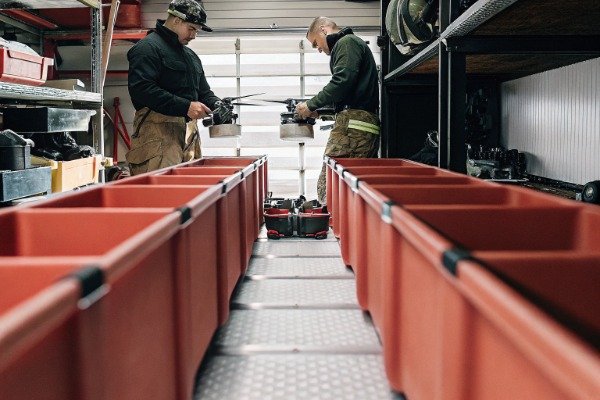
Understanding the "Mission-Type Scarcity" Model
When we assist clients in setting up their initial inventory, we do not use a "one size fits all" number. Instead, we look at where you fly. If your fleet operates primarily in confined urban environments, the risk of obstacle collision is significantly higher than in open wildlands. For urban operations, we advise increasing your propeller and landing gear stock by an additional 40%.
In our factory testing, we simulate these environments. We have found that smoke and ash act like sandpaper on moving parts. A propeller that lasts 200 flights in clean air might only last 50 flights in heavy smoke. Therefore, your inventory planning must be dynamic, not static.
The Critical Components List
You should categorize your spare parts into three tiers: Consumables, Wearable Components, and Structural Spares. Consumables (propellers) need the highest volume. Wearable components (batteries, motors) need moderate volume based on cycle counts. Structural spares (arms, landing gear) are for accidental damage.
Below is a breakdown of the recommended stock for a standard 10-drone fleet operating in mixed environments:
Table 1: Recommended Spare Parts Inventory for a 10-Unit Fleet
| Bauteil-Kategorie | Part Name | Ratio Per Drone | Total Quantity for 10 Drones | Replacement Trigger |
|---|---|---|---|---|
| High Wear | Propeller (CW/CCW) | 5 Sets | 50 Sets | Chips, cracks, or >50 hours flight time |
| High Wear | Batterien | 2 Einheiten | 20 Einheiten | >300 Cycles or voltage irregularity |
| Medium Wear | Landing Gear Skids | 0.5 Sets | 5 Sets | Stress fractures or hard landings |
| Medium Wear | Motor Arms | 0.2 Units | 2 Einheiten | Crash damage |
| Wartung | Fastener Kits (Screws) | 1 Kit | 10 Kits | Every maintenance cycle (prevent stripping) |
Implementing the "Rule of Three"
For critical missions, we teach our clients the "Rule of Three" for inventory distribution. You should never keep all your spares in one central warehouse.
- One set on the drone: The active components currently in use.
- One set in the vehicle: Every deployment truck must have a field-ready repair kit. This allows for immediate swaps if a prop snaps during a mission.
- One set in the warehouse: This is your safety stock to replenish the vehicle kits.
By following this structure, you avoid the "last mile" problem where you own the part, but it is two hours away when you need it in two minutes.
What is the typical lead time for reordering propellers and motors?
Waiting weeks for a shipment while fires burn is unacceptable for any department. We constantly adjust our production schedules, yet global logistics can still cause unexpected delays that you must plan for.
Typical lead times for specialized firefighting drone parts range from 7 to 30 days. However, you must account for "blackout periods" like Chinese New Year or National Day, which can extend delays by an additional 15 to 20 days due to factory and customs closures.

The "Holiday Effect" on Global Supply Chains
Since most industrial drone manufacturing happens in China, including our own facilities, you must align your procurement calendar with the Chinese holiday schedule. We often see international clients caught off guard in January or February.
During the Chinese New Year (Spring Festival), factories and logistics companies shut down for 2 to 3 weeks. Even after we reopen, there is a backlog of orders at customs. If you place an order for propellers one week before the holiday, it might not ship for a month. Similarly, the National Day (Golden Week) in early October creates a week-long pause.
Calculating Your Lead-Time Buffer
To avoid grounding your fleet, you should use a "Lead-Time Buffer" formula. Do not wait until you are down to your last set of spares to reorder. You need to identify your Reorder Point (ROP).
The formula is:
ROP = (Daily Usage Rate × Lead Time) + Safety Stock
If you use 2 sets of props per day across your fleet, and shipping takes 20 days, you need 40 sets just to cover the shipping time. If you add a safety stock of 10 sets, you must reorder when you still have 50 sets on the shelf.
Table 2: Impact of Major Holidays on Lead Times
| Holiday Event | Approximate Dates | Impact on Production | Impact on Shipping | Recommended Order Deadline |
|---|---|---|---|---|
| Chinese New Year | Jan/Feb (Varies) | Full Shutdown (15-20 days) | Ports Congested | 4 weeks prior |
| Labor Day | May 1st – May 5th | Partial Shutdown (5 days) | Minor Delays | 2 weeks prior |
| National Day | Oct 1st – Oct 7th | Full Shutdown (7 days) | Customs Delays | 3 weeks prior |
Logistics Channels Matter
When we export to the US or Europe, the shipping method dictates the speed.
- Air Express (DHL/FedEx): 5-7 days. Best for urgent, small items like propellers or motors.
- Air Freight: 10-15 days. Good for bulk battery orders (batteries are dangerous goods and require special handling).
- Sea Freight: 30-45 days. Only recommended for massive bulk orders of heavy equipment, not for urgent spares.
Always ask us or your supplier if they have a "door-to-door" service that handles customs clearance. If you have to handle customs yourself, add another 5-7 days of uncertainty to your lead time.
Return on Investment (ROI) 1
Do specific consumable parts have a shelf life I need to consider?
Storing parts forever isn't safe; materials degrade silently even when not in use. We have seen perfectly new propellers fail mid-air because they sat in a hot, unventilated warehouse for two years.
ozone from equipment 2
Yes, consumable parts have shelf lives. Lithium batteries degrade if left fully charged or depleted for months. Rubber gaskets, vibration dampeners, and plastic propellers can become brittle over 2 to 3 years due to environmental storage conditions, increasing the risk of mid-flight structural failure.
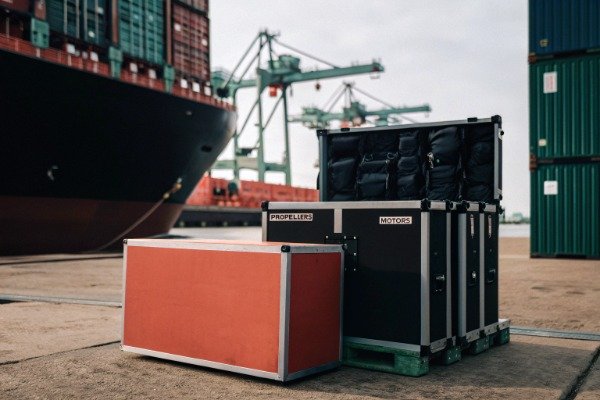
First-In, First-Out (FIFO) system 3
The Hidden Danger of Material Degradation
You might think a propeller is just a piece of plastic or carbon fiber, but environmental factors attack it constantly.
- UV Radiation: If you store parts near windows, UV light breaks down the polymer chains in plastics, making them brittle.
- Temperature Fluctuations: Extreme heat and cold cause expansion and contraction. For items with metal inserts (like where the prop attaches to the motor), this can loosen the bond over time.
- Chemical Exposure: In a fire station, ozone from equipment or fumes from trucks can degrade rubber seals and vibration dampeners.
Battery Management is Critical
Batteries are the most sensitive inventory item. You cannot simply buy 50 batteries and leave them on a shelf for a year.
- Self-Discharge: If left at 100% charge, the internal chemistry degrades, causing puffing. If left at 0%, the voltage drops below the critical threshold, and the battery brick becomes useless.
- Maintenance Charging: You must rotate your stock. We recommend a "First-In, First-Out" (FIFO) system. Use the oldest batteries first and keep the newer ones in storage mode (usually 40-60% charge).
Table 3: Shelf Life and Storage Protocols for Key Components
| Komponente | Max Shelf Life | Ideal Storage Condition | Warning Signs of Expiry |
|---|---|---|---|
| LiPo/Li-ion Batteries | 2-3 Jahre | 22°C-28°C, 50% Charge | Swelling (Puffing), Voltage imbalance |
| Carbon/Plastic Props | 3-5 Jahre | Dark, Dry, Stable Temp | Discoloration, Micro-cracks near hub |
| Rubber Dampeners | 2 Years | Sealed bag, away from ozone | Hardening, Cracking when squeezed |
| Motoren | 5+ Years | Low Humidity (Prevent Rust) | Grinding noise (bearing rust) |
Payload Seals and Gaskets
For firefighting drones specifically, pay attention to the seals on your payload drop systems (for water or retardant). The chemicals in fire retardants are corrosive. Even if the part is new in the box, if the rubber seal has dried out, it will leak the moment you pressurize the system. We advise replacing all rubber seals and gaskets every 2 years, regardless of usage.
internal chemistry degrades 4
Can I get a discount if I bundle a year's worth of spare parts with the drone order?
Buying parts ad-hoc is the most expensive way to maintain a fleet. We encourage clients to plan ahead, as it simplifies our production planning and significantly lowers your total cost of ownership.
UV light breaks down 5
Bundling a year's worth of spare parts typically secures a 10% to 20% discount on the components. Manufacturers prefer bulk orders for production stability, allowing you to negotiate for free wearing parts or reduced shipping rates as part of the total procurement package.

batteries are dangerous goods 6
The Economics of Bundling
From our perspective as a factory, processing one order for 500 propellers is much cheaper than processing 50 orders for 10 propellers. We save on administrative work, packaging materials, and logistics coordination. We are happy to pass these savings on to you.
National Day (Golden Week) 7
When you negotiate your initial drone purchase contract, do not just look at the price of the aircraft. Ask for a "Service & Maintenance Package."
- Strategie: "I am buying 5 drones. If I commit to buying 20 batteries and 50 prop sets now, what is the best price?"
- Result: You can often get the parts at wholesale distributor pricing rather than end-user retail pricing.
Negotiating for "Free" Inventory
Another effective tactic is to negotiate for free consumables instead of a cash discount. Sometimes, our margin on the drone body is tight, and we cannot lower the price further. However, the production cost of propellers or cables is lower.
- Ask: "Can you include a 'First Year Wear Kit' (2 sets of props + 1 landing gear) for free with each unit?"
- Success Rate: This is very high. It adds immense value to you but costs the manufacturer relatively little.
Local Equivalents vs. OEM Parts
A common question we get is, "Can I buy screws or cables locally to save money?"
- Yes: For standard metric screws (M3, M4) or standard cables (USB-C, HDMI), buying locally is faster and cheaper. There is no need to import a steel screw from China.
- No: For propellers, motors, and batteries. Do not use third-party "clones." They often lack the strict quality control of OEM parts. Using a non-OEM propeller that shatters mid-flight will crash your drone and void your warranty. The $20 you save is not worth the $10,000 risk.
ROI on Spare Parts Inventory
Finally, consider the Return on Investment (ROI) of having parts on hand. If a drone is grounded for 2 weeks waiting for a part, you are paying for the asset but getting zero value. If having a $100 part on the shelf prevents that downtime, the ROI is immediate.
Chinese New Year (Spring Festival) 8
By bundling, you also lock in the price. Raw material costs (lithium, copper, carbon fiber) fluctuate. Buying a year's supply now protects your budget from inflation or currency exchange rate changes later in the year.
Lead Time 9
Schlussfolgerung
To ensure mission readiness, calculate inventory based on usage plus safety stock, account for holiday-driven lead times, negotiate bulk bundles for discounts, and monitor shelf life to prevent material degradation.
safety stock to replenish 10
Fußnoten
1. Defines the financial metric used to justify inventory costs. ︎
2. Explains the phenomenon of ozone cracking which damages rubber seals. ︎
3. Defines the inventory management method recommended for battery rotation. ︎
4. Explains the chemical processes leading to battery failure and puffing. ︎
5. Details how ultraviolet radiation causes chemical degradation in polymers. ︎
6. Links to IATA regulations regarding the air transport of lithium batteries. ︎
7. Explains the specific Chinese holiday period that causes logistics pauses. ︎
8. Provides context on the major holiday affecting global manufacturing schedules. ︎
9. Explains the supply chain concept used in the reorder formula. ︎
10. Defines the inventory buffer concept mentioned in the strategy. ︎

 English
  Spanish
  German
  French
  Dutch
Dutch  Arabic
