Watching our precision-engineered drones sit idle in customs storage is painful. Unexpected delays threaten your critical fire safety contracts, but we know exactly how to prevent these expensive logistical nightmares.
Cooperating with customs requires submitting a complete document suite, including commercial invoices and HS Code 8806 declarations, immediately upon arrival. You must provide UN38.3 battery certifications and promptly pay all assessed duties to facilitate the release of your industrial octocopters.
Here is everything you need to know to clear your shipment smoothly and get your fleet operational.
What essential documents do I need to provide to clear my firefighting drones through customs?
We often see shipments flagged because a single paper is missing. Without proper documentation, your critical equipment remains stuck while storage fees accumulate rapidly and threaten your budget.
You must provide a Commercial Invoice, Packing List, and Bill of Lading. For our firefighting drones, you also need a Certificate of Origin and specific technical datasheets that verify the HS Code classification, ensuring officers can quickly validate the shipment against regulatory standards.

When we prepare a shipment from our facility in Xi'an, we ensure every piece of paper aligns perfectly with the physical cargo. The foundation of a successful import lies in the accuracy of your paperwork. If the documents do not match the cargo exactly, customs officers will flag the shipment for a physical exam, which adds days to your timeline.
The Critical Role of HS Codes
The Harmonized System (HS) code is the numerical language customs officers use Code des Harmonisierten Systems (HS) 1 to identify what is in the box. For unmanned aerial vehicles (UAVs), this is typically under heading 8806. Choosing the wrong code can lead to fines or seizure.
- 8806.22 / 8806.23: These codes often apply to the maximum take-off weight of the drone.
- 8806.99: This might apply to specific parts or accessories if shipped separately.
We provide our clients with the exact HS codes based on the payload capacity and weight of the specific octocopter model. You must ensure your customs broker files the entry using these exact codes. If the officer inspects the drone and believes it falls under a different category—perhaps due to a misunderstanding of its firefighting payload versus a standard camera drone—they may reassess the duty rate.
Essential Paperwork Breakdown
Beyond the standard shipping labels, specific documents are non-negotiable for industrial electronics. The Commercial Invoice must detail the value of the drone, the ground control station, and any separate payloads. Vague descriptions like "Electronic Equipment" are red flags. We list items specifically, such as "Unmanned Unmanned aerial vehicles 2 Aircraft for Firefighting Application."
The Packing List is equally vital. It must reference the specific serial numbers of the airframes and controllers. If customs decides to open a crate, they will check the serial number on the device against your list. Discrepancies here are fatal to a quick clearance.
Below is a breakdown of the documents you must have ready before the ship docks:
Table 1: Essential Import Documents & Functions
| Name des Dokuments | Primary Function | Key Requirement for Approval |
|---|---|---|
| Handelsrechnung | Declares value for duty assessment. | Must list unit price, total value, and currency clearly. |
| Packliste | details physical contents. | Must match carton count, weight, and dimensions exactly. |
| Bill of Lading (B/L) | Proof of ownership and transport. | Consignee details must match your business registration. |
| Ursprungszeugnis | Verifies where the goods were made. | Crucial for determining trade tariffs or exemptions. |
| Technical Datasheet | Explains product function. | Helps officers verify the HS Code classification. |
By having these ready, you prove to the officer that this is a legitimate transaction for professional equipment, not a gray-market import.
How should I handle specific regulations for drone batteries during the inspection process?
Lithium batteries are dangerous goods that trigger intense scrutiny. Lithium-Batterien 3 Improper labeling on our battery crates can cause indefinite holds, jeopardizing your operational readiness and flight schedules.
Submit valid UN38.3 test reports and Material Safety Data Sheets (MSDS) for all high-capacity lithium batteries. Ensure the outer packaging strictly adheres to dangerous goods labeling requirements, as inspectors will verify these safety marks before releasing any power units.
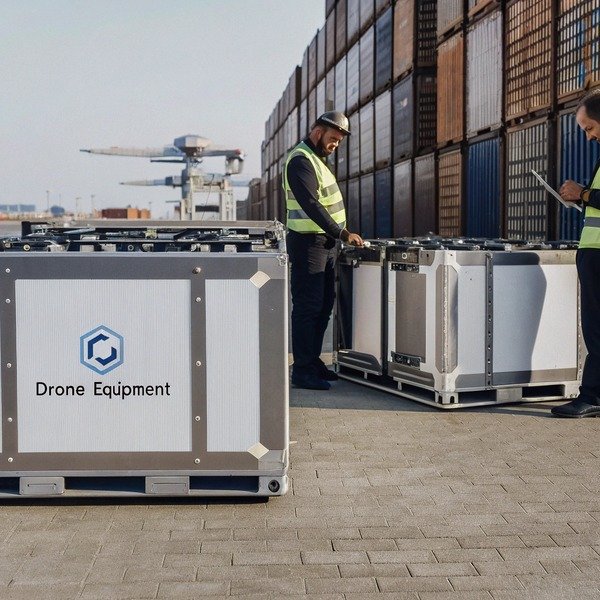
High-capacity intelligent flight batteries are the lifeblood of our heavy-lift drones, but they are also the most regulated component in the box. International shipping regulations treat large lithium-ion packs as Dangerous Goods (DG). Gefährliche Güter 4 When these arrive at the port, safety officers are not looking at the drone's flight capability; they are looking at chemical safety.
Verstehen von UN38.3 und MSDS
Before we even pack a battery, it undergoes rigorous testing testing known as UN38.3 5 known as UN38.3. This tests for altitude simulation, thermal cycling, vibration, shock, and external short circuits.
- The Requirement: You cannot simply say the batteries are safe. You must present the official UN38.3 Test Summary Report.
- The MSDS: The Material Safety Data Sheet outlines the chemical composition and emergency handling procedures. Sicherheitsdatenblatt 6
If a customs inspector sees a large battery pack without these two documents attached to the filing, the shipment will be halted immediately. They need to know that if the container gets hot or damaged, the contents are known and managed.
Packaging and Labeling Compliance
We pack batteries in specific ways to meet IATA and maritime standards, often separating them from the drone airframe or packing them "contained in equipment" depending on the Watt-hour (Wh) rating.
- Class 9 Labels: The outer boxes must display the Class 9 Dangerous Goods diamond label.
- Watt-Hour Markings: The casing of the battery itself must clearly state the voltage and capacity.
During an inspection, officers check if the physical labels match the paperwork. If your documentation says "16,000mAh" but the label is obscured or missing, they will assume the worst. We ensure these are visible, but you should instruct your broker to highlight these certificates in the submission package.
Table 2: Battery Compliance Requirements
| Compliance Factor | Beschreibung | Inspection Focus |
|---|---|---|
| UN38.3 Certification | Mandatory safety testing standard. | Verifies resistance to shock, heat, and pressure. |
| MSDS / SDS | Chemical safety document. | Used by HazMat teams in case of leaks or fires. |
| Klasse 9 Etikettierung | Visual warning on boxes. | Must be visible on the exterior of the pallet/crate. |
| Ladezustand (State of Charge, SoC) | Battery charge level limits. | usually must be ≤30% for air freight, regulated for sea. |
Do not treat batteries as accessories; treat them as regulated chemical cargo. This mindset shift prevents most battery-related delays.
What are the most common reasons my industrial drone shipment might get detained at the border?
Nothing is worse than a vague “detained” notice. Dual-Use-Technologie 7 We frequently advise clients on avoiding triggers like undeclared accessories or dual-use technology confusion that halt deliveries.
Shipments are frequently detained due to incorrect HS Code classifications, missing Country of Origin markings, or undeclared spare parts. Additionally, advanced thermal cameras may trigger dual-use technology reviews if proper end-user End-User Certificate (EUC) 8 certificates and non-military usage declarations are not filed in advance.

In our years of exporting to the US and Europe, we have seen shipments detained for reasons that seem minor but have major legal implications. Understanding these triggers allows you to preempt them.
Dual-Use Technology Concerns
Firefighting drones are equipped with powerful tools that overlap with military technology.
- Thermische Sensoren: The high-resolution thermal cameras used to spot hotspots through smoke are also controlled items in many jurisdictions. Customs officers may flag these as "dual-use" goods.
- The Fix: You may need to sign an End-User Certificate (EUC) declaring that the equipment will be used exclusively for civil firefighting and not for military application. We provide these templates, but you must sign and submit them.
If the officer suspects the thermal sensor exceeds a certain frame rate thermal sensor 9 (often 9Hz or 30Hz depending on regulation) without a license, they will detain the goods until the Commerce Department or equivalent agency clears it.
Undeclared Accessories and "Freebies"
Sometimes, a distributor might ask us to throw in a few extra propellers or a repair kit as a gesture of goodwill.
- The Trap: If these extra items are not listed on the Commercial Invoice, the piece count will not match the physical exam.
- The Consequence: Customs views this as smuggling or undervaluation. Even a $50 set of props can hold up a $50,000 drone shipment.
Country of Origin Markings
Every single item must be marked with its country of origin. "Made in China" must be visible on the drone, the controller, and the box. If we missed a sticker, or if it fell off, customs can deny entry. We are rigorous about this on our production line, but you should be aware that this is a common inspection point.
Intellectual Property (IP) Checks
Customs is the border guard for trademarks. If your paperwork claims the drone is a "SkyRover" but the logo looks different, or if there are components that look like counterfeit versions of other brands, they will pause to investigate. Ensuring you purchase directly from the manufacturer or authorized dealer eliminates this risk, as we provide the authorization letters needed to prove authenticity.
How can I work with my customs broker to resolve inspection issues efficiently?
Direct communication with officers is difficult. Relying on a passive broker can lead to weeks of silence, while your team waits for their gear.
Empower your broker by providing digital product passports and immediate responses to information requests (CF-28). Maintain open lines of communication so they can clarify technical specifications, such as frame materials or software origins, directly with the inspecting officer.

Your customs broker is your advocate, but they are only as good as the information you give them. When we ship a drone, we send a digital packet to the client, but it is your job to ensure the broker actually reads it.
The "Digital Product Passport" Strategy
Do not wait for Customs to ask questions. We recommend providing your broker with a "Digital Product Passport" before the ship arrives. This includes:
- Photos of the Cargo: Show them what the drone looks like packed and unpacked.
- Schematics: A simple diagram showing where the batteries are and what the payload is.
- Use Case Statement: A one-page letter on your department's letterhead explaining, "These drones are for the City Fire Department."
When an officer questions the import, your broker can instantly forward this file. It turns a suspicious "unidentified flying object" into a "municipal safety tool" in the officer's eyes.
Responding to Information Requests (CF-28)
In the US, Customs may issue a form CF-28 (Request for Information). form CF-28 (Request for Information) 10 They might ask, "Is this drone NDAA compliant?" or "Does it contain specific radio transmitters?"
- Speed is Key: You have a deadline, but answering immediately is better.
- Technical Accuracy: If they ask about the radio frequency, do not guess. Ask our engineering team. We can provide the FCC ID or CE certification numbers.
Handling Physical Exams
If your shipment is pulled for an Intensive Exam (where they strip the container), your broker coordinates the movement to a CES (Centralized Examination Station). You cannot stop this, but you can speed it up by paying the exam fees immediately. Delays in payment mean your box sits at the back of the queue.
Table 3: Broker vs. Buyer Responsibilities
| Responsibility | Zollmakler | Käufer (Sie) |
|---|---|---|
| Klassifizierung | Files the specific HS entry data. | Provides product description and use case. |
| Duty Payment | Transmits funds to Customs. | Authorizes payment/provides funds. |
| Inquiries | Speaks directly to Customs officers. | Provides technical answers and certificates. |
| Releasing Cargo | Issues the delivery order. | Coordinates final trucking from the port. |
By treating your broker as a partner rather than a service provider, you ensure that when complications arise, they have the ammunition to fight for your cargo's release.
Schlussfolgerung
Proactive preparation ensures your fleet arrives on time. By managing documents and battery regulations carefully, you secure your investment and operational timelines. Start this collaboration before the shipment leaves our factory.
Fußnoten
1. Official definition of the HS nomenclature by the World Customs Organization. ︎
2. Comprehensive overview of UAV technology and history. ︎
3. Educational safety guidelines regarding the handling and risks of lithium-based power cells. ︎
4. International Air Transport Association standards for shipping hazardous materials. ︎
5. Official source for the UN Manual of Tests and Criteria regarding lithium batteries. ︎
6. Government regulatory guide explaining Safety Data Sheet requirements and standards. ︎
7. Official EU guidance on regulations for items with both civil and military applications. ︎
8. Official US Department of Commerce guidance on end-user controls and certification. ︎
9. Technical documentation from a leading manufacturer on drone thermal imaging. ︎
10. Official US Customs and Border Protection page detailing Form 28 procedures. ︎

 English
  Spanish
  German
  French
  Dutch
Dutch  Arabic
