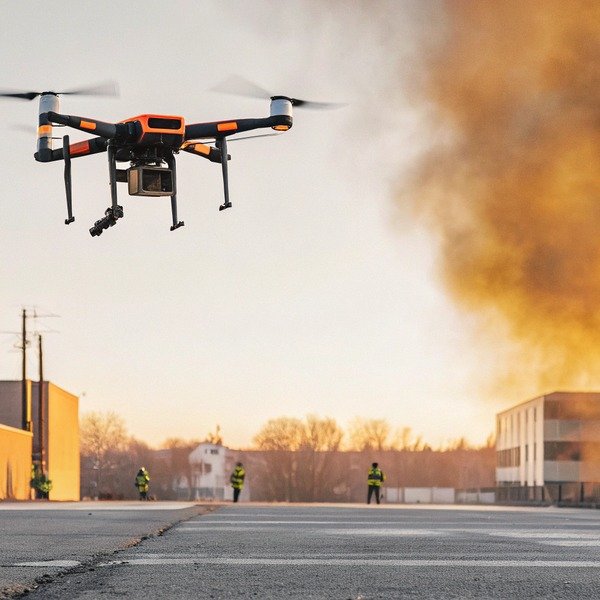
Flying heavy-lift drones into dark, smoke-filled skies is stressful enough without worrying if a manned helicopter can see your aircraft. In our testing facility in Xi’an, we often see safety managers struggle with this exact anxiety. You need to know that your fleet is visible and legal before the first emergency call comes in.
To verify compliance, you must ensure the drone is equipped with anti-collision lighting visible for at least 3 statute miles with a flash rate between 40 and 100 cycles per minute. Buyers should validate this by requesting independent photometric test reports and confirming the specifications explicitly cite FAA Part 107.29 or equivalent local aviation standards.
Let’s look at the specific rules you need to check to keep your operations safe and compliant.
What specific aviation regulations must my firefighting drone lights meet for night operations?
When we export our SkyRover units to the United States, we rigorously calibrate our lighting systems to match federal airspace requirements. We know that missing a single specification on flash frequency can ground an entire municipal fleet.
Your firefighting drone lights must adhere to FAA Part 107.29, which mandates anti-collision lights capable of being seen from 3 statute miles in all directions. Additionally, these lights must have a flash rate between 40 and 100 cycles per minute to distinguish the aircraft from ground lights and stars during civil twilight and night operations.

Understanding the Core FAA Requirements
The most critical regulation for commercial drone operators in the United States is Federal Aviation Administration (FAA) Part 107.29. FAA Part 107.29 1 While many buyers focus on the payload capacity or thermal Wärmekamera 2 camera resolution, the lighting system is the legal gateway to operating after sunset. In our engineering department, we treat lighting not as an accessory, but as a critical safety system.
The regulation is performance-based. This means the FAA does not tell us exactly which brand of LED to use, but they demand a specific outcome: visibility. The "3 statute miles" rule is non-negotiable. This is significantly farther than the visual line of sight (VLOS) required for the pilot. The purpose is to ensure that other aircraft—such as police helicopters or air ambulances often present at fire scenes—can spot your drone long before a collision occurs.
Anti-Collision vs. Position Lights
One common point of confusion we clarify for our distributors is the difference between "navigation/position" lights and "anti-collision" lights. Standard red and green LEDs on the drone arms are helpful for the pilot to determine orientation (which way the nose is pointing) determine orientation 3, but they generally do not meet the intensity required for Part 107.29 compliance.
For legal night flight, you need high-intensity strobes. high-intensity strobes 4 These are distinct from solid lights. A solid light can easily blend in with streetlights or distant tower lights. A strobe flashing at 40 to 100 times per minute triggers a primal reaction in the human eye, drawing attention immediately.
Critical Specifications for Procurement
When you are reviewing a spec sheet from a supplier, you need to look for specific numbers. "Super bright" is marketing language; "500 Lumens" or "Effective Candela" is engineering data. Below is a breakdown of the differences you must identify.
Table 1: Distinction Between Drone Light Types
| Merkmal | Anti-Collision Lights (Required) | Navigation/Position Lights (Optional but Recommended) |
|---|---|---|
| Primary Function | Collision avoidance with other aircraft. | Pilot orientation and status indication. |
| FAA Requirement | Obligatorisch for night ops (Part 107.29). | Not legally required for collision avoidance. |
| Flash Rate | 40–100 cycles per minute. | Usually solid or slow blink (status). |
| Visibility Range | Minimum 3 Statute Miles (approx. 4.8 km). | Usually visible for < 1 mile. |
| Typical Color | White (highest intensity) or Red. | Red (Port), Green (Starboard). |
| Leistungsaufnahme | Medium to High (can impact battery). | Low. |
If a supplier tries to sell you a firefighting drone with only solid red and green lights, claiming it is "night ready," they are likely incorrect regarding US regulations. You must insist on the strobes.
We often receive emails from procurement managers asking for “FAA Certification” for our drone lights, which technically doesn’t exist for component parts. Instead, we provide our partners with specific technical documentation that proves performance capability through rigorous lab testing.
You should request a manufacturer’s Declaration of Compliance supported by a photometric test report from an accredited laboratory. This report must verify the light’s effective intensity at various angles to prove 360-degree visibility and confirm the flash rate falls strictly within the required 40–100 cycles per minute range.

The "FAA Certified" Myth vs. Reality
It is vital to understand that the FAA does not issue certificates for drone accessories in the same way they certify a Boeing 737. When a vendor claims a light is "FAA Certified," they usually mean it is "FAA Compliant." The burden of proof ultimately falls on the remote pilot in command. However, as a buyer, you can mitigate this risk by demanding the right paperwork from us or any other manufacturer.
What a Photometric Report Tells You
A simple "Certificate of Conformance" (CoC) is often just a piece of paper signed by a factory manager. It is better than nothing, but for high-stakes firefighting operations, you want raw data. We recommend asking for a Photometric Test Report.
This document comes from a laboratory equipped with a goniophotometer—a device that measures light intensity from every angle. equipped with a goniophotometer 5 A light might be visible for 3 miles if you look directly at the LED, but what if the drone is tilted 30 degrees forward during high-speed flight? Or what if the drone is above the observer? The report should show a "polar plot" of light intensity, ensuring there are no blind spots caused by the drone's frame or battery placement.
NVIS Compatibility for Mixed Airspace
In firefighting scenarios, you are often sharing airspace with manned helicopters using Night Vision Imaging Systems (NVIS). Night Vision Imaging Systems 6 Standard white LEDs can sometimes be too bright for Night Vision Goggles (NVG), causing "blooming" that blinds the helicopter pilot.
While not strictly required by Part 107.29 for all users, agencies operating under a Certificate of Waiver or specific public safety authorizations often require NVIS-friendly lighting. This usually involves infrared (IR) emitters or specific wavelengths that are visible to NVGs but don't wash out the image. If your department works with air support, ask the manufacturer for NVIS compatibility specs.
Checklist for Vendor Verification
Use this table to audit the documents provided by your drone supplier.
Table 2: Compliance Documentation Checklist
| Name des Dokuments | Was zu beachten ist | Rote Fahnen |
|---|---|---|
| Technical Datasheet | Explicit mention of "3 Statute Mile Visibility" and "Flash Rate: 40-100/min." | Vague terms like "High Visibility" without numbers. |
| Photometric Test Report | Candela measurements at horizontal and vertical angles. | Report is just a generic image or lacks a testing date. |
| Konformitätserklärung | Signed statement citing FAA Part 107.29 or local equivalent (e.g., Transport Transport Canada 7 Canada). | Citations of irrelevant standards (e.g., "CE certified" refers to electronics safety, not aviation visibility). |
| Battery Impact Study | Data on how the lights affect flight time (e.g., "reduces flight time by 2%"). | No data on power consumption. |
How can I test the visibility range and intensity of the anti-collision lights before finalizing the order?
Before we ship a new model from our factory, our QA team conducts night flight tests in remote areas to visually confirm light performance. We believe that laboratory data must always be backed up by real-world validation to ensure safety in the field.
To test visibility, perform a night flight test where the drone is flown out to 3 miles (or the maximum visual line of sight allowed) while observers verify distinct strobe visibility. You can also measure the flash rate using a simple stopwatch or smartphone app to ensure it cycles 40 to 100 times per minute.

Conducting a Field Visibility Test
While lab reports are essential, nothing beats the "eyeball test." If you have a demo unit, schedule a test during civil twilight or full darkness. civil twilight 8 You will need a clear line of sight, such as a long stretch of uninhabited road or an open field.
Have the pilot fly the drone away from the observer. The observer should maintain visual contact. visual contact 9 While Part 107 requires the pilot to see the drone, the light must be visible for 3 miles. You can use GPS telemetry to confirm the distance. If the light becomes indistinguishable from background noise at 1.5 miles, it does not meet the standard, regardless of what the brochure says.
Measuring Flash Rate Accuracy
The flash rate is easier to verify. The FAA mandate of 40-100 flashes per minute (FPM) is designed to avoid frequencies that could induce seizures (stroboscopic effect) stroboscopic effect 10 while remaining fast enough to track.
- Stopwatch Method: Count the number of flashes in 60 seconds.
- Video Analysis: Record the drone lights with a smartphone camera. Play it back to count the cycles.
- Consistency Check: Ensure the rate doesn't drift. Some cheaper capacitors charge slowly, causing the flash rate to drop as the battery voltage fluctuates. The rate must remain stable throughout the flight.
Assessing 360-Degree Coverage
Firefighting drones are dynamic. They pitch, roll, and yaw. A light mounted flush on top of the drone might be invisible to a helicopter flying below the drone.
We recommend a "hover and spin" test. Hover the drone at eye level (safely distant) and rotate it 360 degrees. Then, elevate the drone and repeat. Finally, if possible, observe the drone from a lower elevation. The anti-collision lights should never disappear from view. This often requires lights to be mounted on both the top and bottom of the airframe, or on the arm extremities.
Table 3: Field Testing Protocol
| Test Phase | Aktion | Success Criteria |
|---|---|---|
| 1. Bench Test | Turn on lights and use a stopwatch for 1 minute. | Flash count is between 40 and 100. |
| 2. Coverage Test | Hover drone at 100ft, rotate yaw 360°. | Light remains bright at all yaw angles; no structural blockage. |
| 3. Distance Test | Fly drone to VLOS limit (or simulate 3 miles if permitted). | Strobe is clearly distinguishable from background stars/lights. |
| 4. Thermal Interference | Turn on drone thermal camera while lights are strobing. | No flashing artifacts or "blooming" visible on the controller screen. |
The Thermal Sensor Check
This is a specific pain point for firefighters. High-intensity strobes, if mounted incorrectly, can leak light into the drone's thermal camera lens. This creates a rhythmic "flash" on your thermal feed, which is incredibly distracting when you are trying to spot heat signatures of a lost person or a hotspot. Always test the lights mit the payload active to ensure proper shielding.
We frequently collaborate with clients to modify our standard designs, recognizing that a fire department in California has different needs than a forestry service in Canada. Customization is a standard part of our engineering support for institutional buyers.
Yes, reputable suppliers can customize lighting systems to include independent power sources, specific flash patterns, or NVIS compatibility to meet local rules like Transport Canada’s SFOC. You should request these modifications during the design phase to ensure the lights are integrated without interfering with sensors or aerodynamics.

Customizing for International Standards
While FAA Part 107 is the benchmark in the US, many of our clients operate cross-border or in jurisdictions with slightly different nuances. For example, Transport Canada often requires specific compliance declarations for "remotely piloted aircraft systems" (RPAS) used in advanced operations.
We can adjust the LED drivers to output different pulse widths or intensities. If your local authority requires a specific color (e.g., red strobes only for certain emergency vehicles), this can be changed at the manufacturing level. However, for anti-collision purposes, aviation white is almost universally preferred due to its superior intensity and reach.
Independent Power Redundancy
One of the most valuable customizations for firefighting safety is an independent power source. Standard lights draw power from the drone's main flight battery. If the main battery fails or the drone enters a "return to home" low-battery state, you don't want your lights to dim or cut out.
We can install a small, standalone battery or a capacitor backup dedicated solely to the strobe system. This ensures that even in a catastrophic power loss where the motors stop, the drone remains visible as it descends, warning people below and aiding in recovery. This is a feature often requested by risk-averse procurement managers.
Integration with Remote ID and Flight Controllers
Modern customizations go beyond just hardware. We can integrate the lighting system with the flight controller software.
- Automatic Activation: Lights can be programmed to turn on automatically when the drone arming sequence begins or when the internal clock detects civil twilight.
- Smart Dimming: For ground operations, the lights can dim automatically when the motors are idle to prevent blinding ground crew, then switch to full intensity upon takeoff.
- Remote ID Status: In some advanced configurations, the lighting pattern can indicate the health status of the Remote ID broadcast, providing a visual confirmation to the pilot that they are compliant with tracking regulations.
Avoiding "DIY" Liability
You might be tempted to buy a generic strobe from Amazon and stick it on the drone with double-sided tape. As a manufacturer, we strongly advise against this for heavy-duty firefighting drones.
- Adhesive Failure: High heat from fires can melt adhesives, causing lights to fall off.
- Aerodynamics: bulky add-ons ruin the airflow and reduce battery life.
- Warranty Void: Tapping into the drone's power wires yourself can void your warranty.
Ordering a factory-integrated, customized solution transfers the liability of installation and testing back to the manufacturer, ensuring a professional, ruggedized result that survives the heat and smoke of real operations.
Schlussfolgerung
Verifying night navigation lights is not just a checkbox exercise; it is a critical step in ensuring the safety of your firefighting crews and the airspace they occupy. By understanding the regulations, demanding the right photometric reports, and conducting your own field tests, you can deploy your fleet with confidence. At SkyRover, we are ready to support your specific needs with compliant, high-performance solutions.
Fußnoten
1. Official US federal regulation for small UAS night operations and lighting requirements. ︎
2. Industry guide on integrating thermal cameras for night-time drone operations. ︎
3. International aviation guidelines for aircraft orientation and lighting safety standards. ︎
4. Technical background on strobe light technology and its various applications. ︎
5. Industry standard definitions for the goniophotometer used in measuring light intensity. ︎
6. Technical specifications for night vision systems used in professional aviation environments. ︎
7. Official Canadian government regulations for safe and legal drone operations. ︎
8. Official definition and timing of civil twilight for aviation safety compliance. ︎
9. General background on the visual line of sight concept in aviation. ︎
10. Research on the stroboscopic effect and its impact on human vision and safety. ︎

 English
  Spanish
  German
  French
  Dutch
Dutch  Arabic
