
Every summer, our production team receives urgent calls from customers in Texas and Arizona Risiko des thermischen Durchgehens 1. Their drone batteries failed mid-flight during peak spraying season. Heat destroyed expensive equipment and delayed critical crop treatments.
When sourcing agricultural drones for high-temperature operations, ask suppliers about active cooling systems with fans or liquid cooling, passive solutions like aluminum casings, real-time temperature monitoring, hybrid thermal management, and battery cycle warranties. These questions reveal whether the thermal system protects your investment in extreme heat conditions.
Let me walk you through the exact questions our engineering team recommends asking any supplier phase change materials 2. These come from years of exporting cooling-integrated drones to hot climate regions across the United States and Europe.
How can I evaluate if a supplier's battery thermal management system is robust enough for my high-temperature agricultural operations?
Our engineers have tested countless thermal systems in chamber simulations reaching 50°C. Many suppliers claim their batteries handle heat well. But field conditions expose weaknesses that lab tests miss.
A robust thermal management system should maintain battery temperature below 45°C during continuous operation, include real-time monitoring with alerts, demonstrate at least 1,500 cycle lifespan in hot climates, and provide documented performance data from field testing in conditions similar to your operational environment.
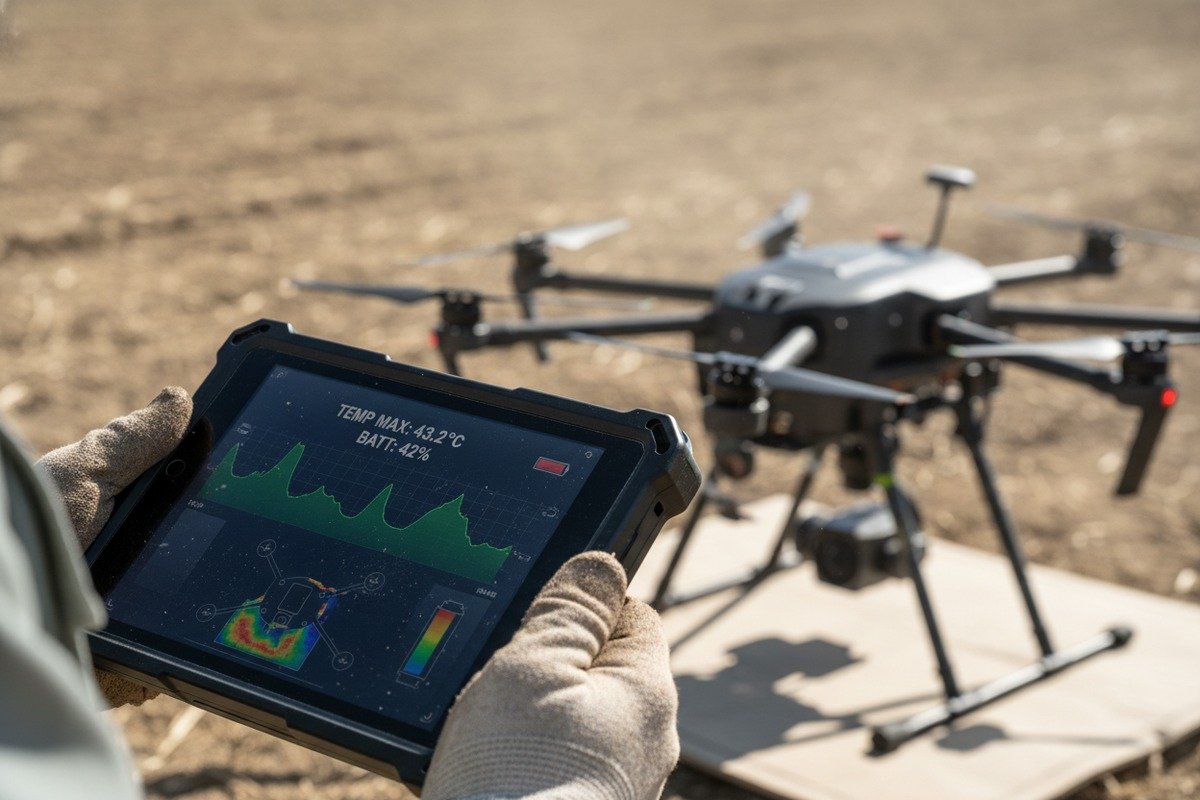
Understanding Heat Generation in Agricultural Drones
Lithium-ion batteries 3 in agricultural drones like DJI Agras T40/T50 generate significant heat. A 30,000mAh battery pack powering six rotors while carrying 40kg of pesticide creates intense thermal stress. During long spraying missions, internal temperatures can spike 20-30°C above ambient conditions.
Heat damages batteries in three ways. First, it accelerates chemical degradation 4 inside cells. Second, it causes uneven charge distribution. Third, it increases internal resistance. Together, these factors can cut battery lifespan from 1,500 cycles to under 800 cycles.
Key Evaluation Criteria for Thermal Systems
When we evaluate thermal systems at our facility, we use specific benchmarks. Here is what you should ask suppliers to demonstrate:
| Kriterien für die Bewertung | Acceptable Standard | Red Flag |
|---|---|---|
| Operating temperature range | -10°C to 50°C ambient | Only rated to 40°C |
| Heat dissipation rate | Cools battery by 15°C in 10 minutes | No specific data provided |
| Temperature sensor count | 4+ sensors per battery pack | Single sensor or none |
| Thermal runaway protection | Multi-stage cutoff system | Manual monitoring only |
| Field test documentation | Data from actual farm operations | Nur Labortests |
Fragen an Ihren Lieferanten
Ask for specific numbers. Request temperature curves showing battery behavior during a typical 30-minute spraying flight at 40°C ambient temperature. Good suppliers provide this data willingly.
Request warranty terms tied to thermal performance. Our company offers extended warranties when customers use our recommended cooling protocols. Suppliers confident in their thermal systems do the same.
Ask about failure rates. What percentage of batteries returned in the past year showed heat-related damage? Honest suppliers share this information. Evasive answers suggest problems.
What specific active or passive cooling technologies should I look for to prevent battery overheating during long spraying missions?
From our experience shipping drones to Florida citrus farms and California vineyards, we learned that cooling technology choice depends on your specific conditions. What works in moderate heat fails in extreme environments.
Look for active cooling systems with integrated fans and air-cooled heat sinks for temperatures above 35°C, or hybrid systems combining passive aluminum casings with active airflow for maximum protection. For extreme conditions above 45°C, consider liquid cooling or micro-chiller systems with precise sensor-driven temperature control.

Passive Cooling Technologies
Passive systems use no electricity. They rely on materials and design to manage heat. Common approaches include aluminum casings that conduct heat away from cells, thermal interface materials 5 that improve heat transfer, and phase change materials that absorb heat through melting.
Advantages of passive cooling include zero power draw, no moving parts to fail, and low maintenance. However, passive systems struggle when ambient temperatures exceed 35°C or during sustained heavy operations.
Active Cooling Technologies
Active systems use power to move heat. Options include fans that force air across heat sinks, liquid cooling loops 6 that pump coolant through channels, thermoelectric Peltier modules 7 for spot cooling, and mini-chillers for precise temperature control.
When we build cooling stations for DJI T30/T40/T50 batteries, we use air-cooled systems with multiple fans. Typical specifications include four fans per station, dimensions around 17x16x19 inches, and weight near 17 pounds.
| Cooling Technology | Am besten für | Power Draw | Effectiveness Above 40°C | Maintenance Level |
|---|---|---|---|---|
| Aluminum casing only | Mild climates | Keine | Poor | Sehr niedrig |
| Heat spreader + thermal paste | Moderate climates | Keine | Fair | Niedrig |
| Air-cooled fans | Hot climates | 20-50W | Gut | Mittel |
| Liquid cooling loops | Extreme heat | 50-100W | Ausgezeichnet | Hoch |
| Mini-chiller systems | Desert operations | 100-200W | Ausgezeichnet | Hoch |
Hybrid Systems for Agricultural Drones
Hybrid approaches combine passive and active elements. Our most successful designs use aluminum casings with integrated fans that activate only when temperatures exceed thresholds. This saves power during cooler operations while providing protection when needed.
For XAG drone users, hydro cooling tanks and evaporative coolers offer water-based alternatives. These work exceptionally well in dry climates where evaporation rates are high. However, they require water refills and can create moisture issues in humid environments.
Matching Technology to Your Operation
Consider your typical conditions. How hot does it get? How long are your missions? How many batteries do you cycle through daily?
For operations in the American Southwest, we recommend active cooling with liquid backup. For Midwest operations, air-cooled systems usually suffice. Talk with your supplier about your specific location and usage patterns.
Can your engineering team provide custom cooling modifications to ensure my drones perform reliably in extreme summer climates?
When we calibrate our flight controllers for American markets, we also customize cooling systems. Standard configurations work for average conditions. Extreme conditions require engineering attention.
Yes, reputable suppliers should offer custom cooling modifications including upgraded fan systems, extended heat sink arrays, liquid cooling integration, custom thermal interface materials, and firmware adjustments for temperature thresholds. Ask for engineering consultation, modification costs, warranty implications, and turnaround times before ordering.
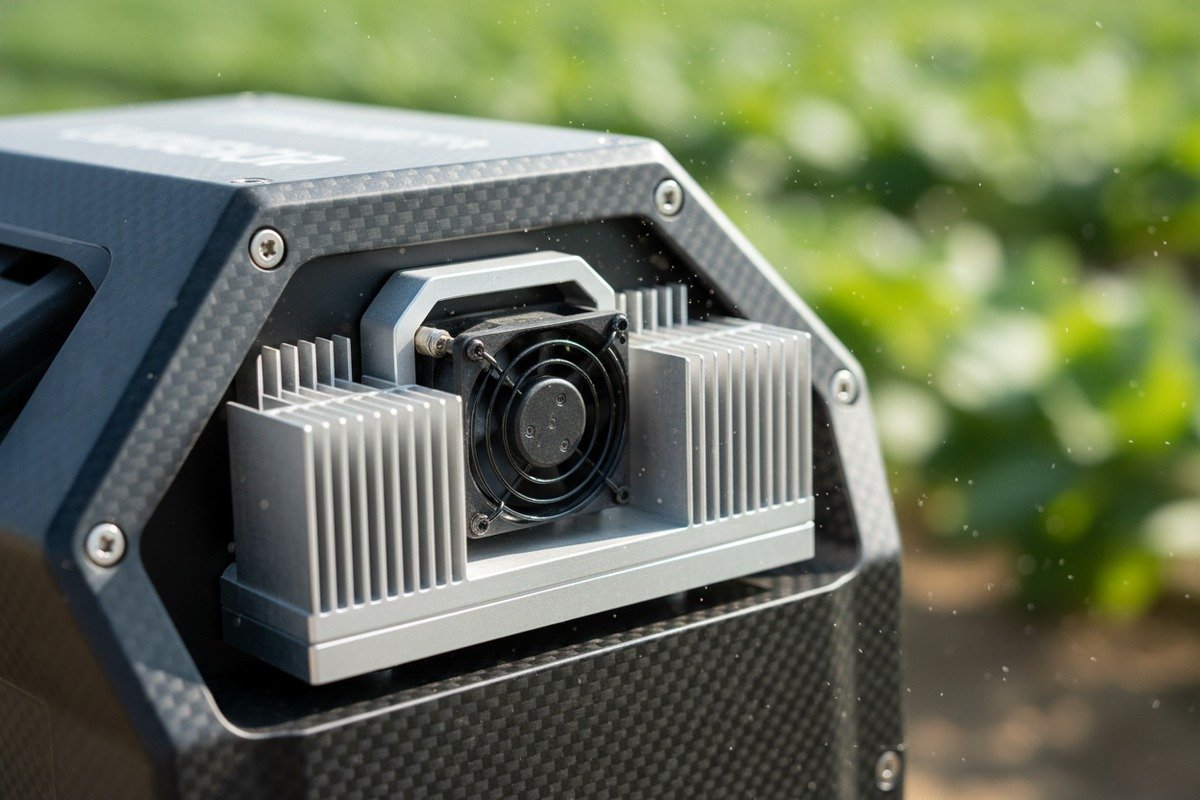
Types of Custom Modifications Available
Engineering teams can modify cooling systems at several levels. Simple upgrades include adding additional fans, upgrading to higher-capacity heat sinks, or installing better thermal paste. Complex modifications involve redesigning airflow paths, integrating liquid cooling loops, or adding dedicated chiller units.
Our team recently completed a project for a Texas distributor. Their customers operated T40 drones in 48°C ambient temperatures. Standard cooling failed repeatedly. We designed a supplementary liquid cooling jacket that reduced peak battery temperatures by 18°C.
Evaluating Supplier Engineering Capabilities
Not all suppliers have genuine engineering support. Ask specific questions to evaluate capability:
| Question to Ask | Good Answer Indicates | Poor Answer Indicates |
|---|---|---|
| "Can I speak with your thermal engineer?" | Direct access to technical staff | Sales-only contact |
| "What custom projects have you completed?" | Specific examples with results | Vague generalities |
| "What is your modification process?" | Documented steps and timelines | Ad-hoc approach |
| "How do modifications affect warranty?" | Clear written policy | Warranty void threats |
| "What testing validates modifications?" | Specific test protocols | No testing mentioned |
Cost and Timeline Considerations
Custom modifications add cost. Simple fan upgrades might add $50-100 per unit. Complex liquid cooling integration could add $500-1000 per unit. However, these costs often pay back through extended battery life and reduced failures.
Timelines vary widely. Simple modifications take days. Complex redesigns take weeks. Rush orders cost more. Plan ahead and communicate your deadlines clearly.
Protecting Your Investment
Get everything in writing. Custom modifications should come with documentation including design specifications, test results, installation instructions, and warranty terms. Keep records for future reference and potential warranty claims.
Ask about spare parts availability. Custom components may have longer lead times for replacements. Ensure your supplier stocks critical parts or provides reasonable delivery windows.
How will the cooling solution integrated into the drone affect the long-term durability and safety of my battery investment?
In our production line, we track batteries through their entire lifecycle. Proper cooling integration directly impacts how long batteries last and how safely they operate. The connection is not theoretical. It shows in real numbers.
Effective cooling integration extends battery lifespan by 40-60% compared to uncooled systems, maintains consistent discharge performance throughout battery life, reduces thermal runaway risk by keeping cells below critical temperatures, and protects your investment by preserving battery capacity over hundreds of additional cycles.

Impact on Battery Lifespan
Heat is the primary enemy of lithium-ion battery longevity. Every 10°C increase in operating temperature roughly doubles the rate of chemical degradation. Batteries that consistently operate at 45°C last half as long as identical batteries operating at 35°C.
When we test batteries with and without cooling integration, the differences are dramatic. Cooled batteries maintain 80% capacity after 1,200 cycles. Uncooled batteries in similar conditions hit 80% capacity at 600 cycles. The math is simple. Cooling doubles your battery investment return.
Safety Considerations
Thermal runaway represents the most serious safety risk. When batteries overheat beyond critical thresholds, internal reactions become self-sustaining. Temperatures spike rapidly. Fires or explosions can result.
Cooling systems provide multiple safety layers:
| Safety Layer | Funktion | Failure Consequence |
|---|---|---|
| Überwachung der Temperatur | Early warning of heat buildup | No advance warning of problems |
| Active cooling response | Prevents temperature rise | Heat continues building |
| Thermal cutoff systems | Stops operation before critical temps | Battery reaches runaway threshold |
| Heat dissipation pathways | Removes accumulated heat | Heat trapped inside pack |
Integration Quality Matters
How cooling integrates with the overall drone system affects performance. Poor integration creates air gaps that reduce heat transfer. Blocked airflow paths trap hot air near batteries. Improperly positioned sensors miss hot spots.
Quality integration requires attention to thermal interface materials, airflow design, sensor placement, and control system programming 8. Ask suppliers how they validate integration quality. Request test data showing thermal performance in assembled drones, not just isolated components.
Long-Term Maintenance Requirements
Cooling systems require maintenance. Fans collect dust and debris. Thermal paste degrades over time. Liquid cooling systems need periodic fluid checks. Factor maintenance into your total cost of ownership calculations.
Create maintenance schedules based on operating conditions. Dusty agricultural environments require more frequent filter cleaning. High-humidity areas may need anti-corrosion treatments. Your supplier should provide maintenance guidelines specific to your conditions.
Calculating Return on Investment
Better cooling costs more upfront. However, extended battery life and reduced failures create long-term savings. Consider this comparison:
| Szenario | Initial Battery Cost | Cooling Investment | Total Cycles | Cost Per Cycle |
|---|---|---|---|---|
| Standard cooling | $2,000 | $0 | 800 | $2.50 |
| Enhanced cooling | $2,000 | $400 | 1,400 | $1.71 |
| Premium cooling | $2,000 | $800 | 1,800 | $1.56 |
Premium cooling costs $800 more upfront but saves $0.94 per cycle. Over 1,800 cycles, that represents $1,692 in savings per battery. For fleet operators with dozens of batteries, these savings compound significantly.
Schlussfolgerung
Asking the right cooling questions protects your agricultural drone investment. Evaluate thermal management robustness, understand available cooling technologies, explore custom modifications, and calculate long-term durability impacts. Your batteries will last longer and perform safely.
Fußnoten
1. Describes the causes, dangers, and prevention of thermal runaway in batteries. ︎
2. Explains how PCMs store and release latent heat for thermal management. ︎
3. Explains the fundamental technology and operation of lithium-ion batteries. ︎
4. A .gov source discussing lithium-ion battery degradation mechanisms. ︎
5. Defines TIMs and their role in improving heat transfer in electronic components. ︎
6. Wikipedia provides a comprehensive overview of liquid cooling, including its applications and how it works. ︎
7. Wikipedia provides a comprehensive and reliable overview of thermoelectric heat pumps, including Peltier effect and modules. ︎
8. Highlights the software and algorithms used for battery thermal management. ︎

 English
  Spanish
  German
  French
  Dutch
Dutch  Arabic
