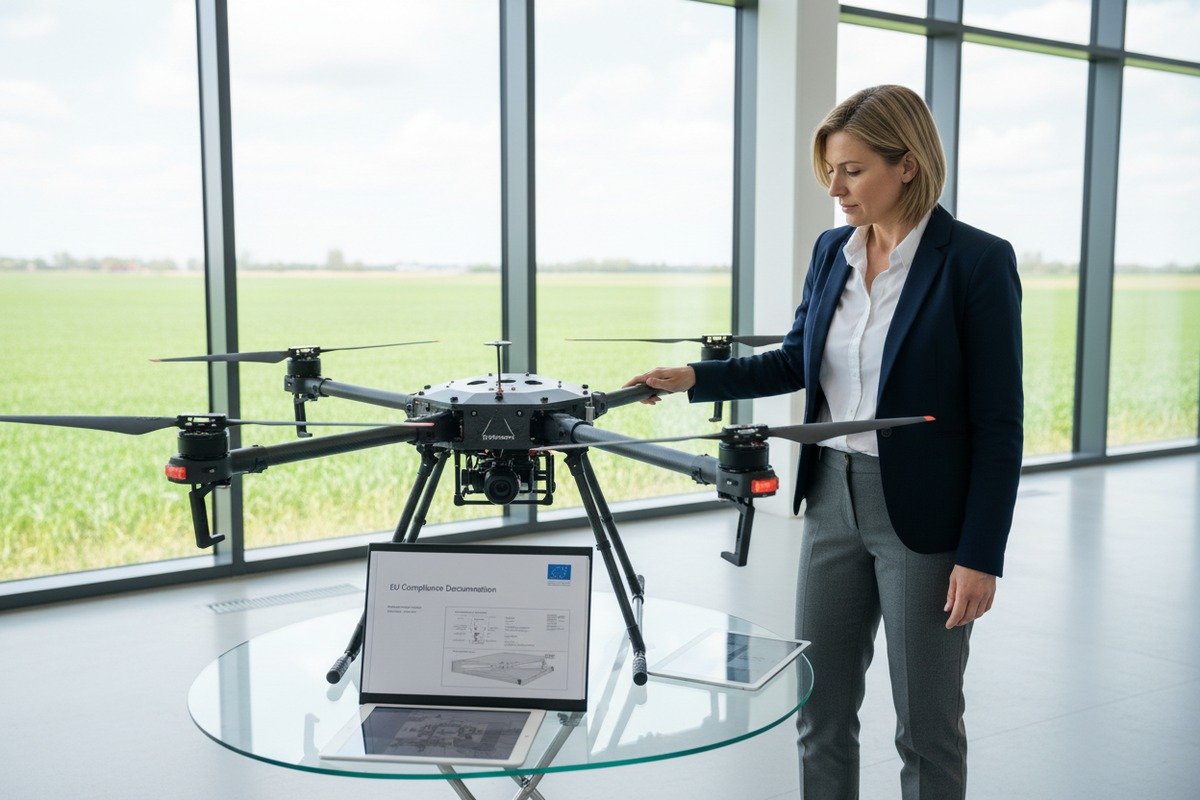
When we ship drones to European distributors, one question keeps coming up EUDR (EU Deforestation Regulation) compliance 1. Buyers want to know how to choose the right supplier amid strict EU regulations and sustainability mandates. The wrong choice means compliance headaches and wasted investment.
To vet agricultural drone suppliers for European sustainable agriculture, verify EU aviation compliance (EASA rules, CE marking), check sustainability certifications, assess software integration with AgData standards, evaluate build durability, and confirm export experience to the European market. Prioritize suppliers offering transparent documentation and long-term technical support.
This guide walks you through every critical checkpoint CE marking certificates 2. We will cover regulatory compliance, software capabilities, build quality, and export logistics. By the end, you will have a clear framework to select a supplier aligned with EU 2026 trends.
How do I verify that a drone manufacturer complies with European Union aviation and sustainability regulations?
EU regulations are complex and constantly evolving IP-Einstufungen 3. Our compliance team spends hundreds of hours each year tracking EASA updates and CAP digital requirements. Many buyers underestimate this challenge until they face customs delays or operational bans.
Verify EU compliance by requesting CE marking certificates, EASA operational category documentation, GDPR data handling policies, and proof of EUDR (EU Deforestation Regulation) compliance for material sourcing. Check if the supplier's drones meet the specific class requirements (C0-C6) for your intended operations.
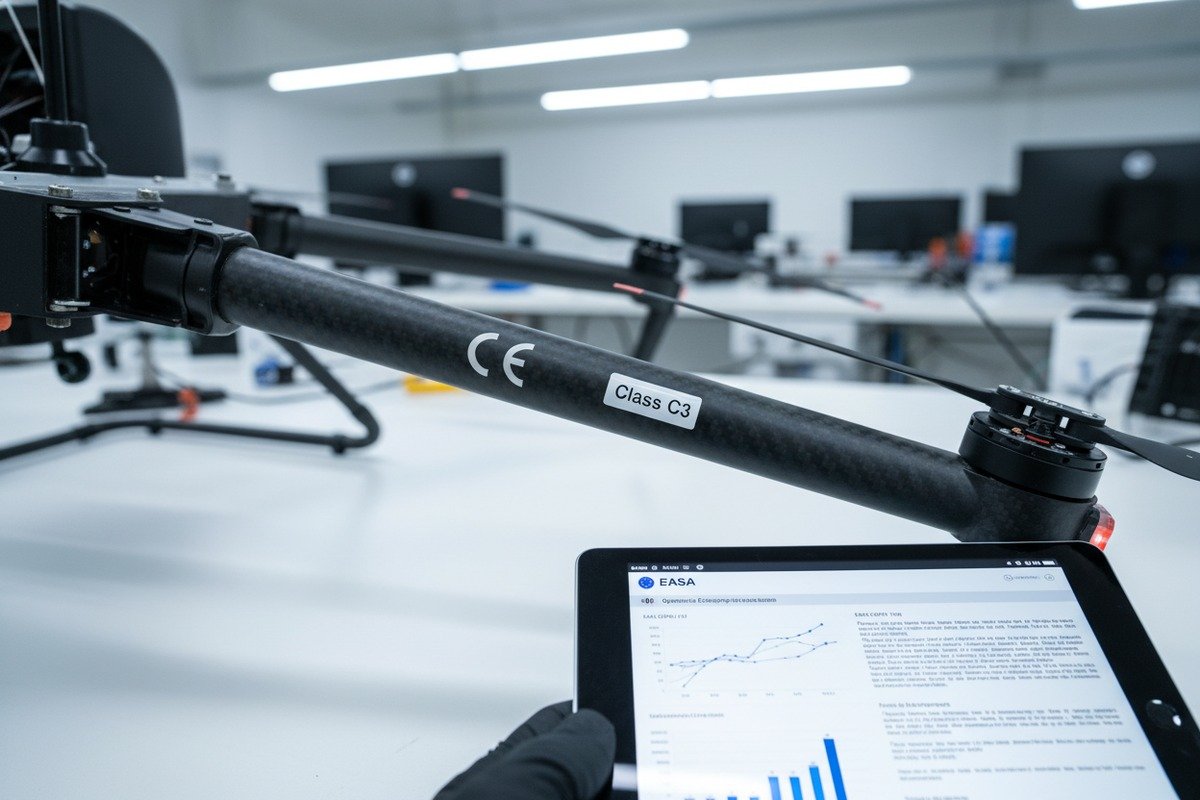
Understanding EASA Drone Categories
Die Agentur der Europäischen Union für Flugsicherheit (EASA) 4 classifies drones into three categories: Open, Specific, and Certified. Agricultural drones typically fall under the Specific category due to their size and operational complexity. This matters because each category has different requirements for pilot licensing, operational manuals, and risk assessments.
When our engineering team designs flight controllers, we build in geofencing and remote identification features. These are mandatory under EU regulations since January 2024. Without them, your drone cannot legally operate in EU airspace.
Key Regulatory Documents to Request
| Dokument | Zweck | Rote Flagge bei Fehlen |
|---|---|---|
| CE Marking Certificate | Confirms product meets EU safety standards | Cannot legally sell in EU |
| Konformitätserklärung | Manufacturer's legal guarantee of compliance | No legal accountability |
| EASA Class Identification Label | Shows drone class (C0-C6) | Operational restrictions apply |
| GDPR 5 Compliance Statement | Data protection for farm analytics | Potential fines up to €20M |
| EUDR Due Diligence Report | Proves deforestation-free supply chain | Import may be blocked by 2025 |
Sustainability Certifications That Matter
The EU's 2040 agri-food roadmap emphasizes low-carbon practices. This means drone suppliers must demonstrate environmental responsibility. Look for certifications related to battery recycling programs, carbon-neutral manufacturing, and sustainable material sourcing.
Our factory in Xi'an has invested in solar-powered assembly lines. We also use recyclable carbon fiber frames. These choices increase production costs by 15%, but they satisfy EU buyer requirements. When the Carbon Border Adjustment Mechanism (CBAM) 6 fully enforces in January 2026, suppliers without low-carbon credentials will face significant tariffs.
Ask potential suppliers about their battery chemistry. Lithium-ion batteries containing conflict minerals raise compliance risks under the Critical Raw Materials Act 7. Transparent sourcing documentation protects both parties.
Can my supplier provide the custom software integration I need for European precision agriculture standards?
Software integration is where many supplier relationships fail. We have seen distributors purchase excellent hardware only to discover the flight planning software cannot communicate with their clients' existing farm management systems. This creates expensive workarounds and frustrated end users.
Evaluate software integration by testing AgData compatibility, API availability for farm management system connections, AI analytics capabilities, and data sovereignty policies. Request demo access to verify real-time processing, predictive modeling features, and compliance with EU digital farming standards launching in 2025-2026.

The AgData Standardization Shift
Europe is pushing hard for unified agricultural data standards. AgData Standardization Shift 8 By 2026, over 60% of large EU farms will use predictive AI systems. These systems require drones that output standardized data formats. Proprietary data silos are becoming unacceptable.
When we develop software for our agricultural drones, interoperability is the priority. Our systems export data in formats compatible with major farm management platforms like John Deere Operations Center, Climate FieldView, and Trimble Ag Software. This flexibility costs more in development but dramatically increases customer satisfaction.
Critical Software Features for EU Precision Agriculture
| Merkmal | EU Trend Alignment | Questions to Ask Supplier |
|---|---|---|
| Multispectral Image Processing | Supports CAP environmental monitoring | What vegetation indices are calculated? |
| Variable Rate Application Maps | Reduces input waste by 20-40% | Can maps integrate with existing sprayers? |
| Carbon Sequestration Tracking | Required for EU carbon farming credits | Does software generate verification reports? |
| Predictive Pest Analytics | Climate-smart agriculture compliance | What is the prediction accuracy rate? |
| Autonomous Flight Planning | Labor shortage solutions | How does geofencing integrate with EU zones? |
Data Sovereignty and Privacy Concerns
EU farmers are increasingly concerned about who owns their field data. Under GDPR, agricultural data collected by drones may constitute personal data if it can identify farm owners or workers. This creates legal obligations for data storage location, access controls, and deletion policies.
Our approach involves on-premise processing options. Farmers can choose to process all drone data locally without cloud uploads. For those preferring cloud analytics, we maintain EU-based servers with full GDPR compliance documentation. This dual approach satisfies both privacy-conscious cooperatives and tech-forward agribusinesses.
Ask suppliers where their servers are located. Chinese-hosted data may face scrutiny from EU regulators. Request written guarantees about data ownership, portability, and deletion timelines.
AI Pragmatism Over Hype
The precision agriculture market is full of AI promises. Not all deliver real value. When evaluating suppliers, distinguish between genuine machine learning capabilities and marketing buzzwords.
Genuine AI features include disease detection models trained on European crop varieties, yield prediction algorithms validated against historical harvest data, and adaptive spray pattern optimization. Ask for accuracy metrics and case studies. If suppliers cannot provide specific performance data, their AI claims may be exaggerated.
How do I evaluate the build quality and durability of agricultural drones for long-term sustainable use?
Agricultural environments destroy poorly built equipment. Dust, moisture, chemical exposure, and temperature extremes test every component. When we stress-test our hexacopter frames, we simulate five years of field conditions in three months. This investment in testing prevents warranty claims and builds distributor trust.
Evaluate build quality by examining frame materials (carbon fiber vs. plastic), motor specifications (KV rating, bearing type), IP ratings for dust/water resistance, battery cycle life, and documented MTBF (Mean Time Between Failures) data. Request sample units for field testing before committing to large orders.

Frame Material Comparison
The frame is your drone's skeleton. Material choice determines weight, strength, and longevity. Agricultural drones face unique stresses including chemical corrosion from fertilizers and pesticides, UV degradation from sun exposure, and vibration fatigue from thousands of flight hours.
| Material | Gewicht | Dauerhaftigkeit | Chemical Resistance | Kosten | Am besten für |
|---|---|---|---|---|---|
| Kohlefaser | Very Light | Ausgezeichnet | Gut | Hoch | Professional operations |
| Fiberglass Composite | Licht | Gut | Ausgezeichnet | Mittel | Chemical spraying focus |
| Aluminum Alloy | Schwer | Ausgezeichnet | Mäßig | Mittel | Budget professional |
| Engineering Plastic | Licht | Schlecht | Variabel | Niedrig | Hobby or light use |
Our SkyRover agricultural drones use matte black carbon fiber frames with protective coatings. This combination provides strength-to-weight ratios that competitors using plastic frames cannot match. The coating resists common agricultural chemicals including glyphosate and chlorpyrifos formulations.
Motor and Propulsion System Quality
Motors fail more often than any other drone component. In agricultural applications, motors endure heavy payloads, frequent start-stop cycles, and environmental contamination. Quality indicators include bearing type (sealed bearings last longer), winding quality (higher copper content improves efficiency), and thermal management design.
Request motor specification sheets showing continuous operating temperature ranges. Agricultural drones in southern Europe regularly encounter ambient temperatures above 35°C. Motors not rated for these conditions will fail prematurely.
Battery Considerations for Sustainable Operations
Batteries represent both the largest ongoing cost and the biggest environmental concern for agricultural drones. EU sustainability trends push toward circular economy principles. This means evaluating battery recyclability, expected cycle life, and supplier take-back programs.
High-quality agricultural drone batteries should deliver 300-500 charge cycles before significant capacity degradation. Ask suppliers for cycle life test data at realistic discharge rates. A battery tested at gentle discharge rates may show impressive numbers that do not reflect actual field performance under heavy spray loads.
Warranty and Spare Parts Availability
Build quality ultimately shows in warranty terms. Suppliers confident in their products offer longer warranties and reasonable claim processes. Our standard warranty covers manufacturing defects for 24 months. We also maintain European parts warehouses to ensure replacement components arrive within one week.
Before ordering, ask about spare parts pricing and availability. Some suppliers offer low initial prices but charge excessive markups for replacement motors, ESCs, and propellers. Calculate total cost of ownership over three to five years, not just purchase price.
What should I look for in a supplier's export experience to ensure seamless delivery to the European market?
Export logistics can make or break a supplier relationship. We have invested years building reliable shipping channels to Europe. When customs paperwork is wrong, your drones sit in warehouses while your customers wait. This damages your reputation and costs money in storage fees.
Evaluate export experience by requesting references from existing European customers, reviewing customs documentation samples, confirming Incoterms familiarity, checking for established freight forwarder relationships, and verifying the supplier can provide all certificates required for EU import clearance including origin documentation and dual-use technology declarations.

Essential Export Documentation
Experienced exporters prepare documentation proactively. Inexperienced ones create documents only when customs officers request them, causing delays. The following documents should be available for every shipment without asking.
| Dokument | Zweck | Common Problems |
|---|---|---|
| Handelsrechnung | Declares value and contents | Undervaluation triggers audits |
| Packliste | Details package contents | Missing serial numbers cause delays |
| Ursprungszeugnis | Confirms manufacturing country | Incorrect format rejected by customs |
| Bill of Lading/Airway Bill | Liefervertrag | Mismatched consignee information |
| Export License (if required) | Dual-use technology clearance | Missing for advanced imaging systems |
| Dokumentation zur Batteriesicherheit | UN38.3 test reports | Required for lithium battery shipments |
Understanding Dual-Use Technology Restrictions
Some agricultural drone components fall under dual-use export controls. High-resolution cameras, advanced GPS systems, and certain flight controllers may require export licenses depending on specifications. Suppliers unfamiliar with these regulations risk shipment seizures.
When we export to Europe, our compliance team reviews every order against the EU Dual-Use Regulation. We provide customers with written confirmations that shipments are properly classified. This documentation protects your import process and demonstrates supplier professionalism.
Incoterms and Risk Management
Incoterms 9 define who bears responsibility for goods at each shipping stage. For drone imports, DDP (Delivered Duty Paid) offers buyers the most protection. The supplier handles all customs clearance and duty payments. DAP (Delivered at Place) leaves customs clearance to the buyer but includes delivery to a specified location.
Our standard terms offer both DDP and DAP options. DDP costs more but eliminates customs complexity for buyers. This matters especially for first-time importers unfamiliar with EU agricultural equipment tariff codes.
Supplier References and Track Record
The best indicator of future performance is past performance. Ask potential suppliers for contact information of European customers willing to provide references. Reputable suppliers happily connect you with satisfied partners.
Questions for references should include delivery time accuracy, documentation completeness, responsiveness to problems, and product condition upon arrival. Also ask about after-sales support. When issues arise months after delivery, does the supplier still respond promptly?
Geopolitical Considerations
Current EU discussions about supply chain diversification affect drone sourcing decisions. Dependence on single-country suppliers creates risk exposure. We address this by maintaining component inventories within Europe and offering extended delivery lead times when customers prefer to avoid rush shipping during uncertain periods.
The Critical Raw Materials Act pushes for supply chain transparency. Ask suppliers about their component sourcing. Can they document where batteries, motors, and electronic components originate? Suppliers with diversified supply chains offer more resilience.
Schlussfolgerung
Vetting agricultural drone suppliers for Europe requires systematic evaluation across four areas: regulatory compliance, software integration, build quality, and export experience. Use the checklists and tables in this guide to score potential suppliers objectively. The right partner delivers not just hardware but long-term support aligned with EU sustainability goals through 2026 and beyond.
Fußnoten
1. Official legal text of the EU Deforestation Regulation. ︎
2. Explains the purpose and requirements of CE marking for products in the EU. ︎
3. Explains the international standard for ingress protection (IP) ratings. ︎
4. Official website for the primary EU aviation safety authority. ︎
5. Official regulation on data protection and privacy in the European Union. ︎
6. Official European Commission page on CBAM, directly replacing the 403 error. ︎
7. Official legal text of the European Critical Raw Materials Act. ︎
8. Official European Commission page detailing the digitalization of the EU agricultural sector, including the Common European Agricultural Data Space (CEADS) and the Data Act, which address data standardization and sharing. ︎
9. Official rules for the interpretation of trade terms in international transactions. ︎

 English
  Spanish
  German
  French
  Dutch
Dutch  Arabic
