
Every week, our export team fields calls from European buyers worried about one thing: will these firefighting drone projectiles clear customs and meet local regulations RoHS certification 1? The fear is real. Non-compliant products get seized at ports, wasting thousands in shipping costs and months of planning.
To verify firefighting drone projectile suitability for Europe, you must confirm CE marking, REACH chemical compliance, RoHS certification, and EASA operational category alignment. Request EU Declarations of Conformity, third-party test reports, and performance data covering accuracy, payload limits, and environmental impact before purchase.
This guide walks you through every verification step dangerous goods shipping certification 2. We cover regulatory standards, performance testing, customization options, and export qualifications. Let’s make your procurement process smooth and compliant.
How do I verify that the firefighting drone projectiles meet the specific CE and REACH standards required for the European market?
Our quality control department handles CE documentation daily, and we've learned that incomplete paperwork causes more shipment delays than any technical issue. Buyers often assume a CE mark alone guarantees compliance. It doesn't. You need the full chain of documentation.
To verify CE and REACH compliance, request the EU Declaration of Conformity, third-party test reports from accredited labs, REACH registration numbers for chemical components, and RoHS compliance certificates. Cross-check these documents against current EU harmonized standards before signing any purchase agreement.

Understanding CE Marking Requirements
CE-Kennzeichnung 3 signals that a product meets EU health, safety, and environmental standards. For firefighting drone projectiles, this involves multiple directives. The Machinery Directive covers mechanical components. The Low Voltage Directive applies to electrical systems. The Electromagnetic Compatibility Directive ensures the projectile's electronics don't interfere with other devices.
When our engineers prepare CE documentation, they compile technical files showing design calculations, risk assessments, and test results. Your supplier should provide these without hesitation. If they can't produce a complete technical file, that's a red flag.
REACH Chemical Compliance Deep Dive
REACH stands for Registration, Evaluation, Authorization, and Restriction of Chemicals. REACH chemical compliance 4 It applies to any chemical substance used in the projectile's construction or payload. Fire-suppressing agents, foam compounds, and even the plastics in the casing fall under REACH.
| Dokumenttyp | Was es beweist | Who Issues It |
|---|---|---|
| EU-Konformitätserklärung | Product meets applicable EU directives | Manufacturer |
| REACH Registration | Chemicals are registered with ECHA | Supplier or chemical producer |
| RoHS-Testbericht | No restricted hazardous substances | Accredited third-party lab |
| CE Technical File | Full compliance documentation | Manufacturer |
| Safety Data Sheet | Chemical hazard information | Chemical supplier |
RoHS Compliance Verification Steps
The Restriction of Hazardous Substances directive limits lead, mercury, cadmium, and other toxic materials. Firefighting projectiles often contain electronic components for tracking or activation. These must pass RoHS testing.
Request test reports from labs accredited under ISO 17025 5. The report should list specific substances tested and their concentrations. Any value exceeding RoHS limits disqualifies the product from EU markets.
Practical Verification Checklist
Before finalizing your order, confirm these items:
- The Declaration of Conformity lists applicable directives by number
- The manufacturer's address matches business registration records
- Test reports date within the past two years
- REACH substances appear on the ECHA database
- The CE mark appears on the product, not just the packaging
Our export specialists can walk you through sample documentation if you're unsure what complete compliance looks like.
What performance tests should I request from my manufacturer to guarantee the projectile's accuracy and extinguishing range?
When we test new projectile designs in our facility, accuracy under real conditions always surprises buyers. Laboratory results look impressive. Field performance tells the truth. Wind, altitude, and drone speed change everything.
Request trajectory stability tests under varied wind speeds, accuracy tests at multiple release altitudes, suppression effectiveness trials against Class A and B fires, impact force measurements, and dispersion pattern analysis. Demand video documentation and third-party verification for all critical performance claims.

Trajectory Stability Testing
A projectile that drifts off-target wastes resources and risks missing the fire entirely. Stability testing measures how the projectile behaves after release. Our testing protocol includes drops from 20, 50, and 100 meters at wind speeds from 0 to 25 km/h.
The aerodynamic design matters enormously. Fins, weight distribution, and release mechanism all affect trajectory. Ask your supplier for video footage showing actual drops, not computer simulations.
Accuracy Standards and Metrics
| Test Parameter | Mindeststandard | Ideal Performance |
|---|---|---|
| Horizontal drift at 50m drop | <3 meters | <1 meter |
| Vertical accuracy | ±2 meters | ±0.5 meters |
| Wind tolerance | Up to 15 km/h | Up to 25 km/h |
| Release speed compatibility | 0-30 km/h | 0-50 km/h |
| Target hit rate (controlled conditions) | 85% | 95%+ |
Fire Suppression Effectiveness
European fire classification follows EN 2 standards 6. Class A covers ordinary combustibles like wood and paper. Class B covers flammable liquids. Your projectile's payload must match the fire types you'll encounter.
We test suppression effectiveness by measuring the area covered per projectile and the time to extinguishment. A 150-liter foam payload should cover approximately 20-30 square meters depending on concentration and fire intensity.
Impact Force and Dispersion Analysis
Too much impact force damages structures. Too little fails to penetrate vegetation canopy in wildfire scenarios. The ideal impact force depends on your mission profile.
Dispersion pattern testing shows how the extinguishing agent spreads after impact. Even coverage prevents re-ignition. Uneven patterns leave hot spots. Request thermal imaging footage from suppression tests showing temperature reduction across the target area.
Environmental Condition Testing
European operations face diverse conditions. Alpine rescues happen in sub-zero temperatures. Mediterranean wildfires occur in extreme heat. Your projectiles must function across this range.
| Umweltfaktor | Test Range | Critical Threshold |
|---|---|---|
| Operating temperature | -20°C to +50°C | Payload must deploy reliably |
| Luftfeuchtigkeit | 20% to 95% | No corrosion or degradation |
| Altitude | Sea level to 3000m | Trajectory adjustment documented |
| Storage temperature | -30°C to +60°C | 24-month shelf life maintained |
Our quality assurance team documents every test condition. We provide complete data packages showing exactly how the projectiles performed and under what circumstances.
Can I collaborate with the supplier to customize the projectile payload capacity for my specific firefighting mission requirements?
Our engineering team loves customization projects because they push us to solve real problems. A Dutch fire department needed smaller payloads for urban high-rise operations. A Greek forestry service wanted larger capacity for remote wildfire response. Both required different solutions.
Yes, reputable manufacturers offer payload customization including capacity adjustments, agent type modifications, release mechanism changes, and integration with specific drone platforms. Discuss your mission requirements early, request engineering consultations, and ensure customizations don't void CE certification or exceed drone payload limits.

Defining Your Mission Requirements
Before customization begins, you need clear specifications. What fire classes will you address? What's your typical deployment altitude? How far must the drone travel to reach targets? What's your maximum acceptable projectile weight?
We start every custom project with a detailed questionnaire. This prevents expensive redesigns later. Vague requirements produce vague results.
Payload Capacity Considerations
Increasing payload capacity isn't as simple as making a bigger container. Larger payloads affect drone stability, flight time, and maneuverability. Your drone's thrust-to-weight ratio determines the practical limit.
| Drone Class | Typical Max Payload | Recommended Projectile Weight | Flight Time Impact |
|---|---|---|---|
| Medium (25kg MTOW) | 8-10 kg | 6-8 kg | -20% to -30% |
| Heavy (50kg MTOW) | 15-20 kg | 12-15 kg | -25% to -35% |
| Industrial (150kg MTOW) | 50-80 kg | 40-60 kg | -30% to -40% |
Extinguishing Agent Customization
The payload agent matters as much as the capacity. Water works for Class A fires but fails on flammable liquids. Foam concentrates require specific mixing ratios. Dry chemical agents need different dispersal mechanisms.
Our chemical engineers verify compatibility between agents and projectile materials. Some foam compounds corrode certain plastics. Others react with metal components. We test every combination before production.
Release Mechanism Modifications
Standard gravity-drop mechanisms work for many applications. Precision targeting may require powered release systems. High-altitude drops might need stabilization fins or parachute deployment.
We've developed three release mechanism platforms that cover most use cases. Custom mechanisms are possible but add development time and cost. Consider whether existing solutions meet your needs before requesting fully custom designs.
Maintaining Certification After Customization
Here's where many buyers make mistakes. Custom modifications can void CE certification if they alter the product beyond its original design parameters. Our engineering documentation tracks every change and its impact on compliance.
We re-certify customized products when changes affect safety-critical components. This adds time to the project but protects you from regulatory problems later. Ask your supplier how customization affects certification status before proceeding.
What export qualifications should my Chinese supplier hold to ensure the safe and legal delivery of drone projectiles to my warehouse?
Our logistics department processes shipments to 40 countries. Every destination has different requirements. Europe demands more documentation than most regions. Missing even one certificate stops your cargo at the border.
Your Chinese supplier should hold a valid export license, dangerous goods shipping certification (if applicable), AEO certification for faster customs clearance, and proper insurance coverage. Verify their experience with EU imports, request references from European clients, and confirm they can provide all required customs documentation.
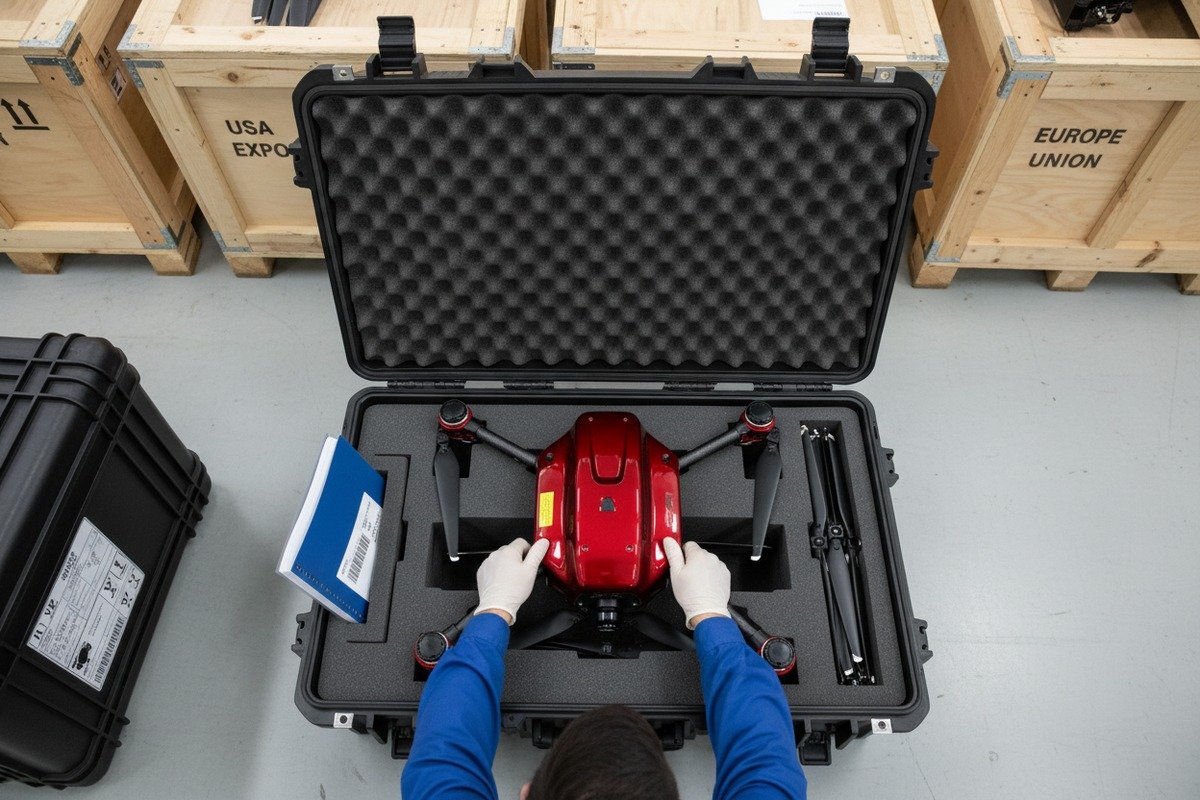
Essential Export Licenses and Certifications
Chinese exporters need several qualifications to ship firefighting equipment legally. The basic export license comes from MOFCOM (Ministry of Commerce). Drone components may require additional dual-use goods clearance depending on specifications.
| Qualification | Issuing Authority | Warum es wichtig ist |
|---|---|---|
| Ausfuhrgenehmigung | MOFCOM | Basic legal authority to export |
| Customs Registration | China Customs | Enables declaration processing |
| AEO Certification 7 | China Customs | Expedited clearance, lower inspection rates |
| Dangerous Goods Certificate | Maritime/Air authority | Required for fire-suppressing agents |
| Product-Specific Export Permit | Various ministries | May apply to advanced drone systems |
Dangerous Goods Shipping Considerations
Fire-suppressing agents often classify as dangerous goods for shipping purposes. Foam concentrates, dry chemicals, and pressurized containers all have specific handling requirements. Your supplier must use certified dangerous goods packaging and properly trained shipping partners.
We maintain IATA dangerous goods certification for air shipments and IMDG certification for sea freight. Our packaging meets UN standards for each material type. This costs more than standard shipping but prevents seizure and delays.
Insurance and Liability Coverage
Adequate insurance protects both parties. Marine cargo insurance covers loss or damage during shipping. Product liability insurance covers claims if the product causes harm after delivery. Professional indemnity insurance covers design and specification errors.
Ask your supplier for insurance certificates naming coverage limits and exclusions. Our policies cover goods from our factory gate to your warehouse door. Gaps in coverage create risk during transfers between carriers.
Customs Documentation Requirements
European customs authorities require extensive documentation for drone imports. Beyond standard commercial invoices and packing lists, you'll need:
- Certificate of Origin (typically Form A for preferential treatment)
- CE-Konformitätserklärung
- Test reports and technical documentation
- EORI number 8 (yours, for EU import)
- Customs tariff classification confirmation
We prepare documentation packages tailored to each EU member state's requirements. German customs differ slightly from French. Italian ports have their own preferences. Experience matters here.
Verifying Supplier Track Record
Don't rely solely on certificates. Ask for contact information from European clients who've received similar shipments. A supplier with genuine EU export experience can provide references confidently.
Our client list includes fire services in Germany, Spain, and Poland. We welcome verification calls. Suppliers who hesitate to provide references may lack the experience they claim.
Schlussfolgerung
Procuring compliant firefighting drone projectiles for Europe requires systematic verification. Confirm CE, REACH, and RoHS documentation. Request comprehensive performance test data. Explore customization options that maintain certification. Choose suppliers with proven EU export qualifications. Your diligence now prevents costly problems later.
Fußnoten
1. Details the RoHS directive, restricting hazardous substances in electronics for environmental protection. ︎
2. Explains IATA’s Dangerous Goods Regulations for safe air transport of hazardous materials. ︎
3. Explains what CE marking is and its importance for EU market access. ︎
4. Provides a comprehensive overview of the REACH regulation and its objectives. ︎
5. Authoritative Wikipedia page providing a comprehensive overview of ISO/IEC 17025. ︎
6. Classifies different types of fires, crucial for selecting appropriate extinguishing agents. ︎
7. Describes the Authorized Economic Operator program for secure and facilitated international trade. ︎
8. Explains the Economic Operator Registration and Identification number for EU customs procedures. ︎

 English
  Spanish
  German
  French
  Dutch
Dutch  Arabic
