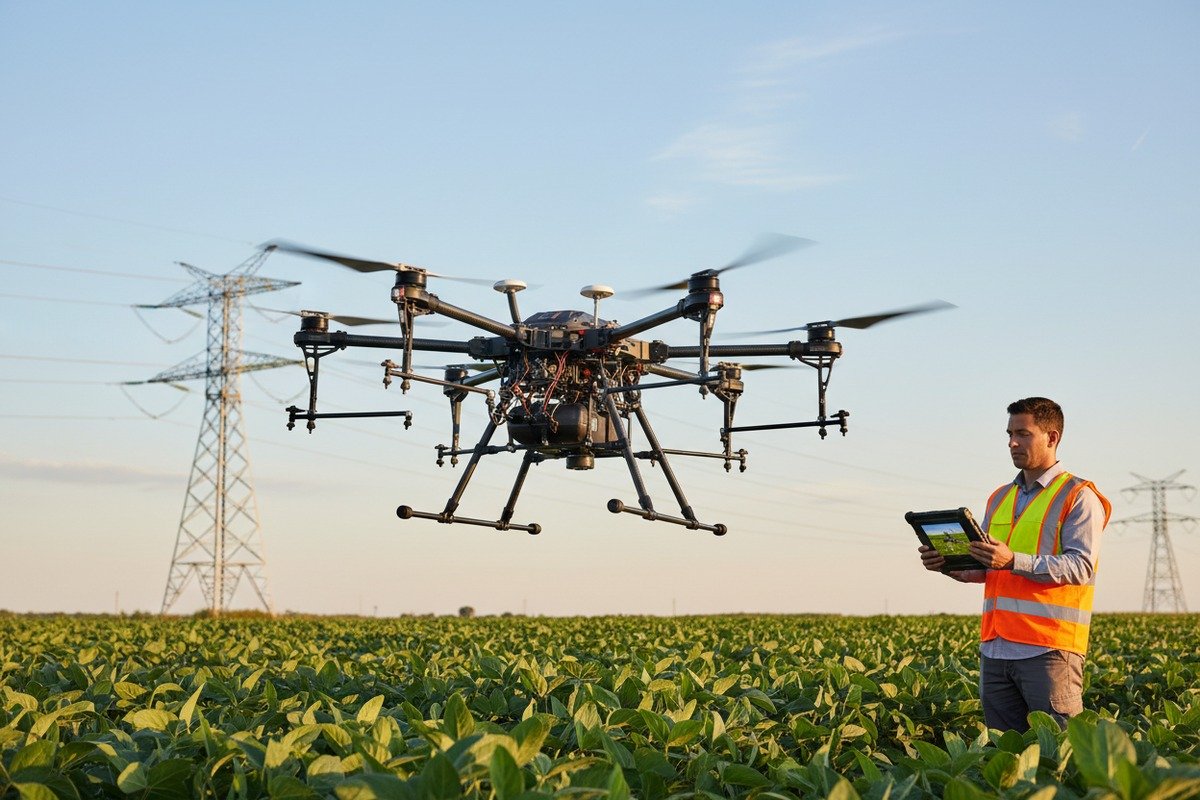
When our production team first started receiving reports of GPS drift and communication dropouts 1 from farmers spraying near transmission towers, we knew this was a critical problem. One client lost an entire spray cycle—and thousands of dollars—because his drone’s compass failed mid-flight near a 500kV line. EMI from high-voltage infrastructure isn’t just an inconvenience; it can ground your entire precision agriculture operation.
To verify EMI resistance of agricultural drones near high-voltage power lines, you must check for compliance certifications like MIL-STD-461 or EN 61000, request lab test reports showing immunity to electromagnetic fields, inspect internal shielding components, and conduct controlled field tests near actual power infrastructure to confirm stable flight performance.
This guide walks you through practical verification steps, from understanding test certificates to evaluating hardware protection and working with your supplier on custom solutions. Let’s start with how to confirm your drone has actually been tested.
How can I confirm that my agricultural drone has undergone rigorous EMI resistance testing?
Our export team deals with this question weekly from distributors in the US and Europe. Buyers want proof, not promises. third-party test reports 2 The challenge is that many manufacturers claim EMI resistance without providing verifiable documentation.
To confirm rigorous EMI testing, request third-party test reports referencing standards like MIL-STD-461, RTCA/DO-160, or EN 61000. Look for immunity test data showing the drone's response to radiated and conducted interference at frequencies matching power line emissions, typically 50-60 Hz fundamentals with harmonics reaching 100 MHz and beyond.

Understanding Key EMI Standards
Not all certifications are equal. When we prepare documentation for our SkyRover agricultural drones, we reference specific standards that matter for power line environments.
| Standard | Focus Area | Relevance to Ag Drones |
|---|---|---|
| MIL-STD-461 | Military-grade EMC | Highest immunity levels; ideal for harsh environments |
| RTCA/DO-160 | Airborne equipment | Covers radiated susceptibility; often required for commercial UAVs |
| EN 61000-4-3 | Radiated immunity | Tests resistance to external RF fields |
| FCC Teil 15 | Emissions compliance | Ensures drone doesn't interfere with other devices |
What to Look for in Test Reports
When reviewing test documentation, check for these specific elements:
- Frequency range tested: Reports should cover at least 10 kHz to 1 GHz. Power lines generate interference across this spectrum.
- Field strength levels: Look for immunity tests at 10 V/m or higher. This simulates conditions near high-voltage infrastructure.
- Test configurations: The drone should be tested in flight-ready mode with all systems active.
- Pass/fail criteria: Clear performance thresholds should be documented.
Fragen an Ihren Lieferanten
Before purchasing, request answers to these questions:
- Can you provide the full EMC test report, not just a summary certificate?
- Which accredited lab 3 performed the testing?
- Were tests conducted with spray systems and payloads attached?
- What field strength levels 4 were used during immunity testing?
In our experience exporting to the US, buyers who ask these questions upfront avoid costly surprises later. A certificate without supporting data often indicates incomplete testing.
Rote Flaggen, auf die man achten sollte
Be cautious if your supplier:
- Only provides self-declaration documents without third-party verification
- Cannot specify which standards were tested against
- Claims "military-grade" protection without MIL-STD documentation
- Refuses to share detailed test parameters
What internal shielding features should I look for to protect my drone from high-voltage interference?
When we calibrate our flight controllers before shipment, the shielding components 5 are among the first things we inspect. These physical barriers are your drone's first line of defense against electromagnetic fields that can corrupt sensor data and disrupt communication links.
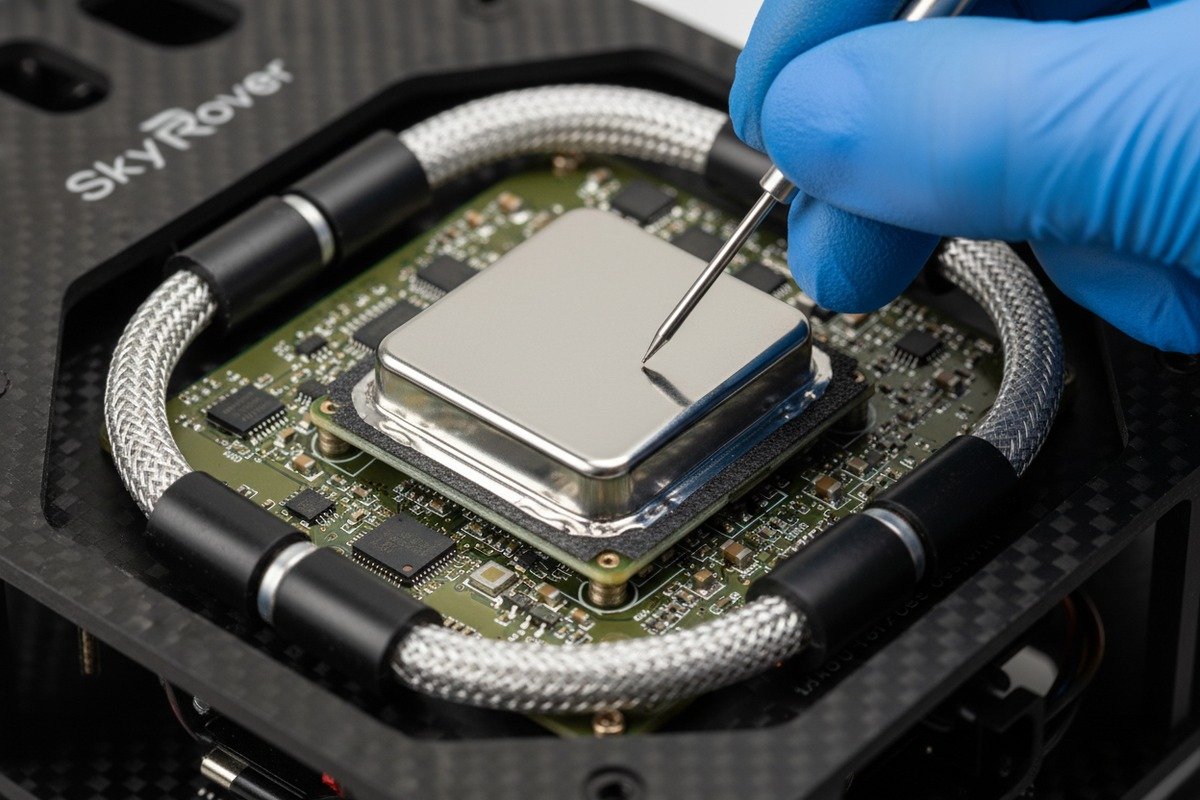
Key internal shielding features include metal enclosures around sensitive electronics, shielded cabling with braided or foil wraps, conductive gaskets sealing enclosure gaps, ferrite beads on power and data lines, and board-level metal cans over critical components like GPS receivers and IMU chips.
Types of Shielding Materials
Different materials offer varying levels of protection. Our engineering team selects materials based on the frequency ranges we need to block.
| Material Type | Frequency Effectiveness | Weight Impact | Typical Application |
|---|---|---|---|
| Aluminum enclosures | Broad spectrum (kHz to GHz) | Mäßig | Flight controller housing |
| Copper foil tape | 100 MHz to 10 GHz | Licht | Internal cable wrapping |
| Conductive elastomers | DC to 115 GHz | Very light | Gaskets and seals |
| Ferrite beads 6 | 10 MHz to 500 MHz | Minimal | Power and USB lines |
| Metallized plastic | 1 MHz to 1 GHz | Licht | External casings |
Critical Components That Need Protection
Not every drone component requires heavy shielding. Focus your inspection on these high-priority systems:
GPS/GNSS Receiver: This is the most EMI-sensitive component. Look for metal cans directly over the GPS module 7 and shielded antenna cables.
Flight Controller IMU: The inertial measurement unit contains accelerometers and gyroscopes. EMI can cause sensor drift. Quality drones place these in shielded enclosures.
Magnetometer: The compass is extremely vulnerable to magnetic fields from power lines. Some designs locate the magnetometer on a mast away from other electronics.
ESC and Motor Wiring: High-current motor lines generate significant EMI. Twisted pair wiring and ferrite chokes reduce this internal interference.
Inspection Checklist
When evaluating a drone's shielding, check these points:
- Are cables routed away from high-current paths?
- Do enclosure seams have conductive gaskets?
- Are there visible ferrite beads on data cables?
- Is the GPS module visibly shielded?
- Are power and signal wires separated?
The Weight vs. Protection Trade-Off
Agricultural drones must balance payload capacity with protection. Heavy shielding reduces flight time and spray volume. Modern solutions address this challenge.
Lightweight RF-absorbing elastomers now provide dual EMI and environmental sealing. Our latest sprayer models use co-extruded gaskets that weigh 40% less than traditional copper mesh while maintaining protection to 115 GHz.
For farmers operating near extreme high-voltage lines (500kV+), the extra protection is worth minor payload reduction. For standard operations, mid-level shielding typically suffices.
How do I evaluate the flight controller's stability when my drone is operating near power grids?
Our R&D engineers spend weeks testing flight controllers in simulated power line environments before approving designs for production. The flight controller is the brain of your drone—if it fails, everything fails. Evaluating its stability requires both laboratory analysis and real-world verification.
Evaluate flight controller stability by reviewing sensor fusion algorithm specifications, testing hover precision near known interference sources, monitoring telemetry for compass and GPS anomalies, checking for automatic failsafe triggers, and analyzing flight logs for unexplained attitude corrections or navigation errors during power grid proximity operations.

Laboratory Testing Methods
Before field testing, controlled laboratory evaluation provides baseline data. Here's what to examine:
Near-Field Scanning: Use magnetic probes to establish the drone's noise floor. This identifies which frequencies cause problems. Spectrum analyzers reveal interference peaks, commonly around 100 MHz from onboard electronics.
Immunity Chamber Testing: Expose the powered drone to calibrated electromagnetic fields. Monitor sensor outputs for drift or errors. The drone should maintain stable readings at field strengths of 10 V/m or higher.
Conducted Interference Tests: Inject noise directly into power lines and data buses. The flight controller should filter this interference without performance degradation.
Field Testing Protocols
Real-world testing reveals issues that laboratory simulations miss. We recommend this structured approach:
| Test Phase | Distance from Lines | Dauer | Key Observations |
|---|---|---|---|
| Baseline | 500+ meters away | 5 minutes hover | Record normal sensor values |
| Approach | 200 meters | 5 minutes hover | Monitor for early anomalies |
| Proximity | 50-100 meters | 10 minutes | Check for GPS drift, compass errors |
| Stress test | Minimum safe distance | 15 Minuten | Full mission simulation |
What to Monitor During Tests
During field testing, watch these specific parameters:
GPS Position Accuracy: Record horizontal and vertical position variance. Values should remain within manufacturer specifications even near power lines.
Compass Heading: Monitor for sudden heading jumps or gradual drift. The magnetometer is most vulnerable to power line magnetic fields.
Attitude Stability: Check roll, pitch, and yaw for unexplained corrections. The flight controller's sensor fusion should maintain stable attitude data.
Communication Link Quality: Note any telemetry dropouts or range reduction. RF interference from power lines can affect control links.
Advanced Sensor Fusion Features
Modern flight controllers use sophisticated algorithms to compensate for interference. Look for these capabilities:
- Multi-sensor redundancy: Systems that cross-check GPS, compass, barometer, and IMU data
- Automatic sensor exclusion: Ability to ignore obviously corrupted sensor inputs
- Adaptive filtering: Real-time adjustment of noise filtering based on detected interference
- Visual positioning backup: Camera-based positioning when GPS is compromised
When we configure flight controllers for customers operating near substations, we often enable enhanced filtering modes and reduce reliance on magnetometer data during critical flight phases.
Interpreting Flight Logs
After test flights, analyze logs for these warning signs:
- Frequent EKF (Extended Kalman Filter) resets
- Compass variance warnings
- GPS position jumps exceeding 2 meters
- Unexpected altitude holds or position corrections
- Motor output fluctuations without pilot input
These indicators suggest EMI is affecting flight stability, even if the mission completed successfully.
Can my supplier provide technical documentation or custom engineering to improve EMI protection for my specific needs?
When clients approach us with unique operational requirements—like daily spraying runs alongside 500kV transmission corridors—we know standard solutions may not suffice. The ability to provide custom engineering 9 separates capable suppliers from simple resellers.
Quality suppliers should provide complete technical documentation including EMC test reports, shielding specifications, and component datasheets. They should also offer custom engineering services such as enhanced shielding packages, modified flight controller firmware, specialized cable routing, and integration of additional filtering components tailored to your specific power line environment.

Documentation You Should Request
Before discussing customization, establish baseline capabilities through documentation review:
| Dokumenttyp | Zweck | Red Flag If Missing |
|---|---|---|
| Full EMC test report | Verify immunity levels tested | Indicates incomplete testing |
| Shielding material specs | Understand protection frequency range | Suggests generic components |
| Flight controller datasheet | Review sensor specifications | Makes troubleshooting impossible |
| Wiring diagrams | Assess cable routing quality | Prevents custom modifications |
| BMS specifications | Evaluate power stability features | Important for EMI filtering |
Custom Engineering Options
Experienced manufacturers can modify designs for enhanced EMI protection. Here's what to discuss with your supplier:
Enhanced Shielding Packages: Additional metal enclosures, upgraded gaskets, or relocated sensitive components away from interference-prone areas.
Firmware Modifications: Adjusted sensor fusion parameters, enhanced filtering algorithms, or modified failsafe behaviors for high-EMI environments.
Hardware Additions: Extra ferrite beads, optoisolators for ground loop prevention, or upgraded shielded cabling throughout the airframe.
Battery Integration: Smart BMS systems with adaptive signal filtering that maintain stable voltage output despite EMI-induced ripples. Semi-solid state batteries now offer 300-400 Wh/kg density with excellent EMI resistance.
Evaluating Supplier Capability
Not all suppliers can deliver custom engineering. Ask these qualifying questions:
- Do you have in-house engineering staff or only sales teams?
- Can you modify firmware, or do you rely on third-party controllers?
- What is your typical turnaround time for custom modifications?
- Can you provide examples of previous custom EMI solutions?
- Will modifications void warranties or certifications?
Our engineering team in Xi'an works directly with clients on custom projects. This includes remote collaboration on specification development and on-site support for complex installations when needed.
Cost-Benefit Analysis
Custom EMI solutions involve trade-offs. Consider this framework when deciding:
When Standard Solutions Suffice:
- Operating 200+ meters from transmission lines
- Power line voltages below 220kV
- Occasional proximity rather than constant exposure
- Basic ferrite beads and standard shielding adequate
When Custom Engineering Is Justified:
- Daily operations within 100 meters of high-voltage lines
- 500kV+ transmission infrastructure in spray zones
- Previous equipment failures due to EMI
- High-value crops where mission failure is costly
- Insurance or regulatory requirements for enhanced protection
Working With Your Supplier
For successful custom projects:
- Document your operational environment: Provide power line voltages, distances, and flight profiles
- Share failure history: Previous incidents help engineers target solutions
- Define success criteria: Specify acceptable GPS accuracy, flight time impact, and cost limits
- Plan for validation: Agree on testing protocols to verify improvements
- Request ongoing support: Custom solutions may need adjustment based on field experience
The investment in custom engineering typically pays off through reduced mission failures, lower equipment replacement costs, and reliable data collection for precision agriculture applications.
Schlussfolgerung
Verifying EMI resistance requires a systematic approach: check certifications, inspect shielding hardware, test flight controller stability, and work with suppliers who can document and customize solutions. Whether you're a distributor importing for resale or a farm operator purchasing direct, these verification steps protect your investment and ensure reliable precision agriculture operations near power infrastructure.
Fußnoten
1. Explains common issues faced by drones near high-voltage lines. ︎
2. Emphasizes the importance of independent verification for EMI resistance. ︎
3. Highlights the need for testing by recognized and impartial facilities. ︎
4. Defines the intensity of electromagnetic fields for immunity testing. ︎
5. Describes physical barriers protecting drone electronics from EMI. ︎
6. Explains how these components suppress high-frequency electronic noise. ︎
7. Identifies a critical drone component highly sensitive to EMI. ︎
8. Describes software methods for combining sensor data for stability. ︎
9. Emphasizes tailored solutions for unique EMI protection requirements. ︎

 English
  Spanish
  German
  French
  Dutch
Dutch  Arabic
