
Watching a client lose a harvest because a replacement motor was stuck in customs keeps our engineering team awake at night. We know that in precision agriculture, downtime equates to immediate financial loss.
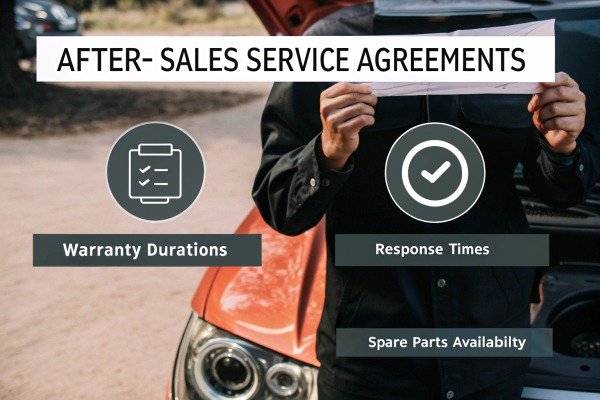
To incorporate strong after-sales commitments, you must explicitly define service scopes including remote diagnostics and firmware updates, mandate a 5 to 10-year spare parts availability window, specify warranty durations by component type, and establish financial penalties or service retention funds for missed support deadlines.
Here is how you can structure these critical clauses to protect your investment and ensure operational continuity.
What clauses should I include to define the scope of after-sales technical support?
When our flight control engineers analyze error logs from thousands of miles away, we realize that clear communication protocols are just as vital as hardware quality. Vague support promises often lead to frustration during critical spraying seasons.
Your agreement should include a Service Level Agreement (SLA) mandating response times within 24 to 48 hours, explicit requirements for remote diagnostic training for your local team, access to perpetual firmware updates, and protocols for data sovereignty regarding flight logs uploaded for troubleshooting.

To ensure your agricultural drones remain operational, the contract must move beyond generic promises of "good service." You need a detailed technical framework that outlines exactly how support is delivered.
Establishing a Service Level Agreement (SLA)
The core of your support clause is the SLA. In the agricultural sector, a 48-hour delay can mean missing a critical window for pesticide application. pesticide application 1 Your contract should categorize issues by severity. "Critical failures" that ground the drone must trigger a faster response than "routine inquiries" about software settings. We recommend defining these tiers clearly to avoid ambiguity.
The agreement must also specify the method of support. Will the supplier provide a dedicated account manager, or will you be routed to a general helpdesk? For commercial importers, we always suggest negotiating for a direct line to engineering support rather than general customer service.
Technical Documentation and Training
Hardware is only as good as the technician maintaining it. We often see contracts that neglect the transfer of knowledge. You must require the supplier to provide comprehensive technical documentation, including circuit diagrams for local repairs and access to diagnostic software. circuit diagrams 2
Furthermore, include a clause for "Train-the-Trainer" sessions. This ensures your local team is certified to handle basic repairs, reducing the need to ship units back to the factory.
Firmware and Software Continuity
Agricultural drones rely heavily on software for flight path planning and spraying precision. A hardware contract is incomplete without software guarantees. You must include a clause that ensures free, perpetual access to firmware updates. Firmware-Updates 3 This is crucial for fixing bugs and ensuring compatibility with evolving regional GPS and mapping standards.
Table 1: Recommended Service Level Agreement (SLA) Tiers
| Schweregrad | Definition | Reaktionszeit | Auflösung Ziel |
|---|---|---|---|
| Critical (Priority 1) | Drone is grounded; unable to perform spraying missions. | < 12 Hours | < 48 Hours (Remote Fix) or Part Dispatch |
| High (Priority 2) | Drone operates with limited functionality (e.g., radar failure). | < 24 Stunden | < 72 Hours |
| Routine (Priority 3) | General inquiries, cosmetic issues, or documentation requests. | < 48 Hours | 5 Business Days |
| Software-Update | Critical bug fixes affecting safety or flight stability. | Immediate Notification | Patch within 7 Days |
How do I ensure the contract guarantees the long-term availability of spare parts?
We constantly adjust our inventory based on raw material availability, but we understand that our partners cannot upgrade their fleets every two years. A drone bought today must be repairable well into the future.
You must include a “Sunset Clause” requiring 24 months’ notice before part production ceases, mandate a 5 to 10-year guaranteed availability period for proprietary components, and negotiate a “Critical Spares Kit” to be delivered with the initial batch to mitigate shipping delays.
The greatest risk in importing hardware from overseas is obsolescence. importing hardware from overseas 4 If a supplier stops making a specific motor mount or flight controller two years after your purchase, your entire fleet could become useless.
The 5-to-10 Year Availability Commitment
Agricultural equipment has a longer lifecycle than consumer electronics. Your contract should explicitly state that the supplier agrees to maintain an inventory of spare parts for a minimum of 5 to 10 years after the product model is discontinued. This aligns the drone's service life with the return on investment (ROI) expected by farmers. return on investment 5
The Sunset Clause and Last-Time-Buy
Eventually, technology moves on. However, you should not be caught off guard. Insert a "Sunset Clause" that legally obligates the manufacturer to provide a formal written notice at least 24 months before ceasing production of any proprietary component.
This clause should also include a "Last-Time-Buy" option, giving you the right to purchase a bulk stock of these parts at a fixed price before the production line closes. This allows you to stockpile enough components to service your existing customers for the remainder of the drone's life.
Critical Spares Kit and Pricing Parity
To avoid downtime caused by international shipping, require a "Critical Spares Kit" with every significant order. This kit should contain high-failure items like ESCs (Electronic Speed Controllers), pumps, and nozzles. Elektronische Drehzahlregler 6
Additionally, protect yourself from price gouging. Include a clause stating that spare parts pricing shall not exceed a certain percentage markup over the original manufacturing cost, or that it must remain consistent with the pricing offered to other distributors.
Table 2: Essential Spare Parts Categorization for Contracts
| Kategorie | Beispiele | Recommended Stocking Strategy | Contract Requirement |
|---|---|---|---|
| Stark beanspruchte Verbrauchsmaterialien | Propellers, Nozzles, Landing Gear Skids | High Volume (Local Stock) | Bulk pricing discounts; guaranteed 2-week lead time. |
| Critical Electronics | ESCs, Radar Modules, Pumps | Medium Volume (Critical Spares Kit) | 5-year availability guarantee; "Hot Swap" capability. |
| Kern Avionik | Flight Controller, GPS Module, Remote Controller | Low Volume (On-demand) | Priority shipping clause; 7-10 year availability. |
| Strukturrahmen | Carbon Fiber Arms, Central Tank Body | Low Volume | Custom order availability; molds retained by supplier. |
What terms should I specify regarding warranty duration and return policies?
Every time we test a battery or motor in our lab, we see distinct lifecycles that a blanket warranty simply cannot cover effectively. A one-size-fits-all policy often leaves the buyer paying for premature failures.
Your agreement must differentiate warranty periods for airframes versus high-wear consumables like batteries, explicitly assign responsibility for international shipping and customs duties on returns, and define “non-conforming goods” to ensure you are not liable for manufacturing defects upon arrival.

A standard "12-month warranty" is often insufficient for complex agricultural drones. The contract needs to break down the warranty by component to reflect reality.
Component-Specific Warranty Periods
The flight controller is unlikely to fail, but motors and pumps work in harsh, wet, and dusty environments. harsh, wet, and dusty environments 7 Your contract should specify different timelines:
- Airframe and Flight Controller: 24 to 36 months.
- Motoren und ESCs: 12 months or a specific number of flight hours.
- Batterien: Typically 6 months or a specific cycle count (e.g., 500 cycles), whichever comes first.
- Consumables (Propellers/Nozzles): Generally excluded unless DOA (Dead on Arrival).
International Shipping and Duties
One of the biggest points of contention is who pays for shipping defective parts back to China. Sending a heavy drone back is cost-prohibitive.
We recommend a "One-Way" or "Local Disposal" clause.
- One-Way: You pay to ship the part to the manufacturer (or a local hub), and the manufacturer pays to ship the replacement to you.
- Local Disposal: For lower-value parts, the contract should allow you to send video evidence of the destruction of the defective part, triggering the shipment of a free replacement without physically returning the broken item. This saves weeks of downtime and shipping costs.
Declaration of Conformity and Regulatory Updates
Warranties should also cover regulatory compliance. If a drone becomes unusable because it fails to meet a new local aviation standard due to a hardware limitation that was not disclosed, this should be treated as a defect. Require the supplier to provide updated "Declarations of Conformity" and technical files necessary for maintaining local civil aviation certifications throughout the warranty period. civil aviation certifications 8
Table 3: Standard Warranty Durations by Component Type
| Komponente | Standard Dauer | Clause Recommendation |
|---|---|---|
| Flugkontrollsystem | 36 Months | Cover software bugs and hardware logic failures. |
| Rahmen & Struktur | 24 Monate | Cover carbon fiber delamination or cracking not caused by crash. |
| Motoren & ESCs | 12 Months / 200 Hours | Include protection against moisture ingress if IP rating is claimed. |
| Batterien | 6 Months / 300 Cycles | Define "End of Life" as capacity dropping below 80%. |
| Smart Remote Controller | 12 Monate | Cover screen failure and transmission module defects. |
How can I include penalties for missed service deadlines in the agreement?
We prioritize clients who hold us accountable because it forces our supply chain to be more resilient and responsive. Without financial consequences, service deadlines can easily slip during our peak production months.
Implement a “Service Retention Fund” where a percentage of the contract value is withheld to guarantee performance, and include clauses for liquidated damages that accrue daily for delayed technical support or spare parts delivery.

Trust is good, but leverage is better. When sourcing from overseas, you need financial mechanisms to ensure your emails are answered and parts are shipped on time.
The Service Retention Fund
This is a powerful tool. Instead of paying 100% upfront or upon delivery, negotiate to hold back 5% to 10% of the total contract value in a "Service Retention Fund" or escrow account. This amount is released after a set period (e.g., 12 months) only if the supplier has met all SLA requirements. If they fail to provide support or parts, you have a fund to draw from to solve the problem yourself (e.g., hiring a local engineer).
Pauschalierter Schadensersatz für Ausfallzeiten
Agricultural windows are narrow. If a drone is down for two weeks, the season might be over. Your contract should include "Liquidated Damages" for delays. Pauschalierter Schadenersatz 9 Pauschalierter Schadenersatz 10 For example, if a critical spare part is not shipped within the agreed 48 hours, a penalty of 0.5% of the delayed part's value (or a fixed dollar amount) accrues for every day of delay, up to a certain cap.
Dispute Resolution and Venue
If penalties fail, you need a legal path. While many Chinese suppliers prefer arbitration in CIETAC (China), you might push for neutral arbitration in places like Hong Kong or Singapore. However, for after-sales service specifically, having a clear penalty structure that deducts from future payments or the retention fund is usually more effective than threatening a lawsuit.
Escalation Matrix
Finally, include an escalation matrix in the penalty clause. If a critical issue isn't resolved within the SLA timeframe, the issue must automatically escalate to the supplier’s Director of Engineering or VP of Sales. This ensures your problems don't get stuck with junior support staff.
Schlussfolgerung
Incorporating detailed after-sales commitments into your sourcing agreement is the only way to safeguard your agricultural drone business against operational risks. By defining clear SLAs, securing long-term spare parts access, and enforcing financial penalties for non-performance, you transform a simple purchase order into a resilient partnership that protects your ROI and your reputation.
Fußnoten
1. Official guidance on pesticide application regulations and safety. ︎
2. Standards for electrical and electronic documentation including circuit diagrams. ︎
3. Authoritative definition from the National Institute of Standards and Technology. ︎
4. General background on the concept of product obsolescence in hardware. ︎
5. Research on ROI for agricultural technology and equipment. ︎
6. Technical documentation for ESCs used in commercial drones. ︎
7. International standard for Ingress Protection (IP) ratings for electronics. ︎
8. Official information on drone certifications and regulatory compliance. ︎
9. Legal definition from Cornell Law School’s Legal Information Institute. ︎
10. Legal definition and application of liquidated damages in contracts. ︎

 English
  Español de México
  Deutsch
  Français
  Русский
  العربية
