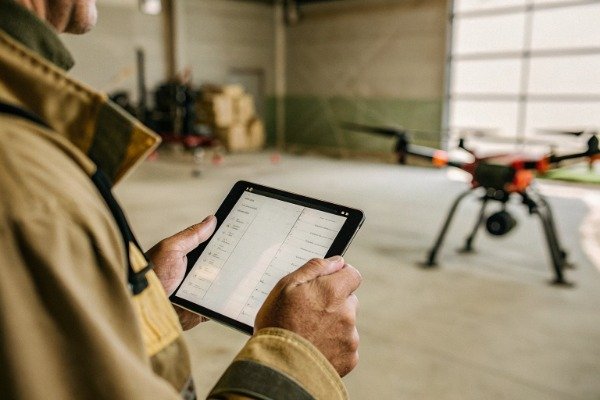
At SkyRover, we see clients struggle when drones fail mid-mission due to overload. Don’t let weight miscalculations compromise your fire suppression efforts; accurate evaluation is critical for safety.
drones fail mid-mission 1
To evaluate payload capacity, calculate the "Effective Payload" by subtracting the drone’s empty weight and batteries from its Maximum Takeoff Weight (MTOW). Ensure this figure exceeds your mission gear weight by a 20% safety buffer to account for environmental factors like heat, wind resistance, and emergency maneuvering needs.
Let’s break down the specific weight requirements and technical trade-offs to ensure you choose the right equipment.
What is the maximum weight my drone needs to carry for fire extinguishing balls?
We often advise clients that underestimating suppressant weight leads to mission failure. Carrying insufficient extinguishing agents renders the flight useless against spreading fires, wasting valuable time and resources.
The required weight depends on the specific fire class and suppression method. Standard fire extinguishing balls weigh between 1.3 kg and 4 kg each. For effective suppression, industrial drones typically need a payload capacity of at least 20 kg to carry multiple units or a dedicated launcher system.
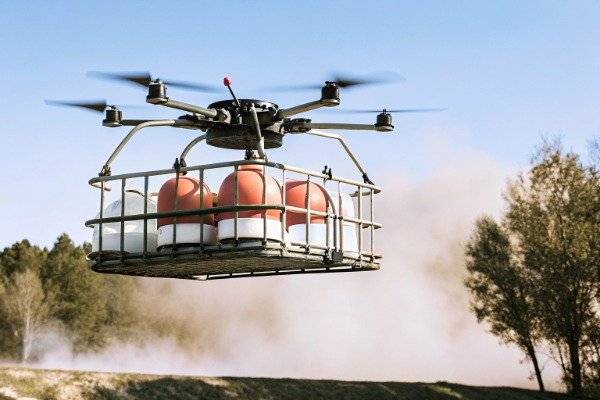
When evaluating the payload for fire extinguishing balls, you must look beyond the weight of the balls themselves. Many procurement managers make the mistake of calculating only the "consumable" weight. However, the delivery mechanism—the rack, drop system, or launcher—adds significant mass that eats into your payload budget.
fire extinguishing balls 2
Calculating the Total System Weight
To determine the true requirement, you need to sum three components: the weight of the extinguishing balls, the weight of the release mechanism, and the weight of the mounting brackets. For example, a standard 1.3 kg fire ball is light, but a mission usually requires dropping 4 to 6 balls to suppress a fire effectively. A rack capable of holding 6 balls might weigh an additional 2 to 3 kg.
If you choose a drone that can barely lift 10 kg, and your total payload (balls + rack) is 9.8 kg, you are flying at the absolute limit. This leaves no room for error. In our testing at SkyRover, we recommend that the total payload should not exceed 80% of the drone’s rated capacity to ensure stability.
Payload Requirements for Different Suppression Agents
Different fire scenarios require different quantities of suppressants. A small spot fire might be handled with two balls, while a larger blaze requires a continuous drop. Below is a breakdown of typical weight requirements we encounter in the industry.
| Suppression Type | Unit Weight | Typical Loadout | Hardware Weight | Total Payload Needed |
|---|---|---|---|---|
| Standard Fire Ball | 1.3 kg | 4-6 units | 2.5 kg (Rack) | ~8 – 10.5 kg |
| Heavy Duty Ball | 4.0 kg | 2-4 units | 3.0 kg (Rack) | ~11 – 19 kg |
| Powder Tank | K.A. | 10 kg Powder | 2.0 kg (Tank) | ~12 kg |
| Liquid Hose | K.A. | Drag force varies | 1.5 kg (Nozzle) | High Thrust Required |
By understanding these numbers, you can avoid purchasing a platform that is underpowered for your specific suppression tactics. Always ask your supplier for the "installed weight" of the release mechanism, not just the drone’s lifting capacity.
How does a heavier payload affect my drone’s flight time and battery life?
Our engineers constantly battle the physics of lift versus duration. Ignoring the drastic drop in flight time when fully loaded puts your expensive equipment at risk of crashing or failing to return.
physics of lift 3
Heavier payloads significantly increase power consumption, reducing flight time by up to 50% compared to unloaded hovering. High discharge rates overheat batteries faster, shortening their overall lifespan. You must calculate endurance based on the "loaded" weight specification, not the maximum hover time listed in marketing brochures.
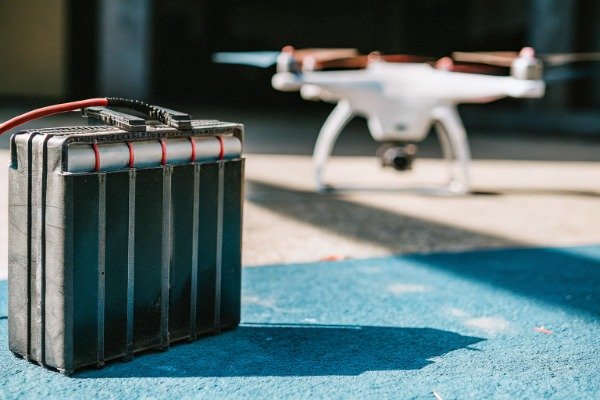
The relationship between payload weight and flight time is not linear; it is often exponential. As you add weight, the motors must spin faster to generate the necessary lift. This draws more current (Amps) from the battery. The higher the current draw, the less efficient the battery becomes due to internal resistance and heat generation.
internal resistance 4
The Physics of Power Consumption
When we test our SkyRover drones, we see a clear distinction between "hover time" and "mission time." Hovering consumes less power than maneuvering. A heavy drone fighting wind gusts while carrying a full load of fire retardant will drain its battery much faster than a drone hovering in calm air.
For example, a drone might be advertised with a "50-minute flight time." This is usually measured with zero payload at sea level. Once you attach a 20 kg payload, that time might drop to 25 minutes. If you factor in a 20% battery safety reserve (you never want to land at 0%), your actual effective mission time might only be 15 to 18 minutes.
Battery Health and C-Rates
Heavy payloads demand a high "C-rate" (discharge rate) from the battery. If a battery is pushed to its maximum discharge limit constantly, it will heat up rapidly. Excessive heat causes the battery voltage to sag, which can trigger premature low-voltage warnings, forcing the drone to land even if capacity remains.
We have compiled data from various flight tests to illustrate how payload impacts endurance.
| Payload Condition | Current Draw (Amps) | Battery Temperature | Flight Time (Minutes) | Efficiency Loss |
|---|---|---|---|---|
| Unloaded (0 kg) | 40 A | 35°C | 55 min | 0% |
| Medium Load (10 kg) | 65 A | 45°C | 38 min | ~30% |
| Full Load (25 kg) | 110 A | 60°C | 22 min | ~60% |
Note: Data is illustrative based on typical heavy-lift industrial drone performance.
When evaluating a supplier, ask for a flight time chart that specifically plots "Payload vs. Time." Do not rely on the single maximum number on the spec sheet.
Can I customize the attachment system for different types of firefighting equipment?
We know standard mounts rarely fit every unique mission profile. Being locked into a proprietary system limits your operational flexibility when facing diverse fire scenarios or using legacy equipment.
Yes, industrial drones often support modular attachment systems using standard interfaces like HDMI, SDK ports, or quick-release mechanical rails. Manufacturers can design custom brackets for specific hoses, dry powder tanks, or sensor arrays, provided the total weight remains within the center of gravity and payload limits.
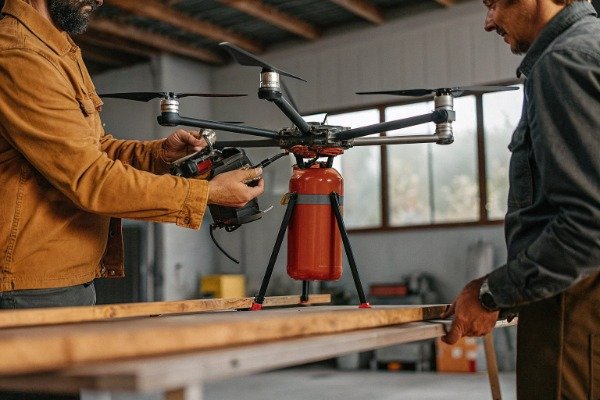
Customization is a key strength of working with an OEM manufacturer like us. Firefighting is dynamic; sometimes you need a thermal camera for reconnaissance, and other times you need a drop mechanism for suppression. A rigid, non-customizable system will eventually become a bottleneck for your operations.
Modular Design Interfaces
Modern industrial drones typically utilize a "payload SDK" (Software Development Kit) or standard hardware rails. This allows third-party equipment to communicate with the flight controller.
- Mechanical Interface: This is the physical connection. We often use quick-release rails that allow you to swap a camera for a searchlight or a drop box in seconds without tools.
- Electrical Interface: This provides power and data. Common standards include CAN Bus, UART, or simple PWM (Pulse Width Modulation) signals.
If you have a specific brand of fire extinguishing ball or a specialized sensor, we can engineer a mounting plate that fits the drone’s center of gravity (CG). Keeping the CG central is vital. If a custom attachment hangs too far forward or backward, the rear or front motors have to work harder to keep the drone level, reducing efficiency and stability.
center of gravity (CG) 5
The Engineering Process for Customization
When a client approaches us with a request to carry a unique device, we follow a specific validation process. We verify the dimensions to ensure the payload doesn’t obstruct the landing gear or the GPS antennas. We also check for electromagnetic interference.
Here is a checklist to determine if a drone system is truly customizable for your needs:
| Merkmal | Beschreibung | Warum es wichtig ist |
|---|---|---|
| Quick-Release Mount | Tool-free swapping mechanism. | Allows rapid role changes in the field (e.g., from scouting to dropping). |
| Open SDK / API | Software access to flight controls. | Enables you to trigger the payload (drop/spray) from the remote controller. |
| Auxiliary Power | 12V or 24V power output ports. | Powers your device directly from the drone battery, saving weight on extra batteries. |
| Adjustable CG | Sliding battery or mount rails. | Ensures the drone stays balanced regardless of the payload shape. |
Always ask your manufacturer if they provide CAD files or engineering support to help you integrate your specific tools.
How do I calculate the trade-off between payload capacity and flight agility?
In our flight tests, we observe that maxed-out drones become sluggish. A slow response in high-wind fire zones can lead to loss of control and dangerous accidents for ground crews.
Calculate the thrust-to-weight ratio; a ratio below 2:1 at full load severely compromises agility. As payload increases, inertia grows, requiring more distance to stop and more power to climb. Prioritize a lighter load if your mission involves navigating complex obstacles or turbulent environments.
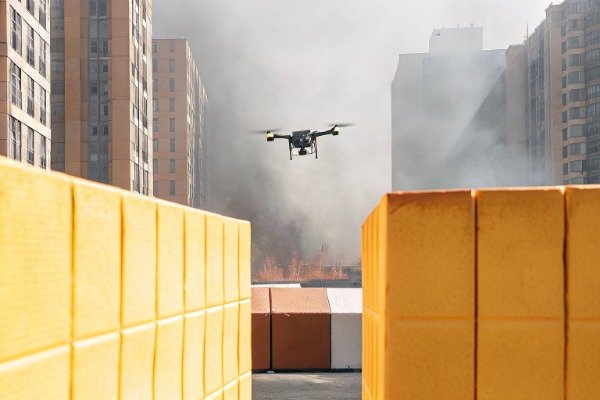
Agility is often overlooked in favor of raw lifting power, but in firefighting, agility is safety. Fire creates its own weather patterns, including strong updrafts and unpredictable turbulence. A drone that is heavy and sluggish cannot react quickly enough to these changes, risking a crash.
thrust-to-weight ratio 6
The Thrust-to-Weight Ratio Rule
The golden rule in our industry is the 2:1 thrust-to-weight ratio. This means the motors should be able to generate double the thrust required to simply lift the drone.
- If your drone + payload weighs 50 kg, the motors should be capable of generating 100 kg of thrust.
- This extra power is not for lifting more weight; it is for maneuvering. It allows the drone to brake hard, climb rapidly over obstacles, and fight against strong winds.
If you load a drone to the point where the ratio drops to 1.5:1, the drone will feel "heavy" on the sticks. It will drift further before stopping and struggle to maintain altitude in a turn.
electromagnetic interference 7
Inertia and Braking Distance
Physics dictates that a heavier object requires more force to stop. We call this the "braking distance." When you release the control stick, a heavy drone will continue to drift forward due to momentum. In an urban environment with high-rise buildings or near trees, this drift can be fatal.
Furthermore, slung loads (payloads hanging from a rope) create a "pendulum effect." If the drone stops suddenly, the load swings forward, potentially destabilizing the aircraft. Advanced flight controllers can compensate for this, but only if the motors have enough spare power (torque) to correct the movement.
payload SDK 8
Trade-off Evaluation Table
To help you decide, compare your mission profile against these agility factors:
| Mission Profile | Recommended Payload Load | Priority |
|---|---|---|
| Open Field / Agriculture | 90-100% of Max Capacity | Efficiency (Max coverage per flight). Agility is less critical. |
| High-Rise Firefighting | 60-70% of Max Capacity | Precision. Needs stability to aim hoses/balls accurately. |
| Search and Rescue | 30-50% of Max Capacity | Speed & Range. Needs to cover ground quickly. |
| High Wind Conditions | < 50% of Max Capacity | Safety. Needs excess power to fight turbulence. |
By calculating these trade-offs, you ensure that the drone is not just capable of lifting the gear, but capable of flying it safely in the conditions you face.
high ‘C-rate’ (discharge rate) 9
Schlussfolgerung
Correctly evaluating payload ensures safety and efficiency. Balance weight, endurance, and agility to select the right SkyRover drone for your firefighting missions.
sum three components 10
Fußnoten
- Provides regulatory context on commercial drone safety and operational risks. ︎
- Background information on the specific fire suppression technology mentioned. ︎
- Educational resource explaining the aerodynamic principles affecting flight duration. ︎
- Technical explanation of how internal resistance reduces battery efficiency under load. ︎
- Scientific definition of Center of Gravity and its critical role in flight stability. ︎
- Explains the propulsion concepts behind the ratio required for flight. ︎
- Explains RF interference issues that can affect drone electronics and safety. ︎
- Example of an industry-standard software development kit for drone payloads. ︎
- Defines C-ratings and their importance for high-performance drone batteries. ︎
- Explains the physics of calculating total aircraft weight and load. ︎

 English
  Spanish
  German
  French
  Dutch
Dutch  Arabic
