
Every week, our customer service team receives calls from buyers who regret their “bargain” drone purchases IP67 weather resistance 1. These units failed mid-spray, leaving crops damaged and money wasted.
To identify low-price traps, evaluate total cost of ownership beyond the initial price. Check for missing certifications, vague specifications, no local service networks, and pressure sales tactics. Quality risks include subpar sensors, weak batteries, lack of regulatory compliance, and unreliable spare parts availability.
This guide walks you through the exact steps to avoid costly mistakes Intellectual property protection agreements 2. We will cover performance indicators, supplier red flags, hidden maintenance costs, and how to evaluate OEM capabilities.
How can I distinguish between a high-performance agricultural drone and a low-quality model that might fail during spraying?
When we calibrate flight controllers on our production line, the difference between quality and junk becomes immediately obvious. Poor drones show inconsistent readings from the first test flight.
High-performance agricultural drones feature robust carbon-fiber frames, flight times exceeding 15 minutes per battery, payload capacities above 20 liters, IP67 weather resistance, and intelligent obstacle avoidance. Low-quality models use cheap plastics, drain batteries in under 10 minutes, and lack precision spraying systems.

Key Hardware Specifications to Check
The frame material tells you a lot about durability. Carbon fiber withstands harsh field conditions. Cheap plastic cracks after a few hard landings. Our engineering team has tested hundreds of units, and frame failure is the number one cause of total drone loss in budget models.
Battery quality determines your actual working time. A claimed 20-minute flight time often drops to 8 minutes under payload. Always ask for real-world test data with full tank weights.
Motor efficiency affects both performance and lifespan. Bürstenlose Motoren 3 from reputable suppliers last 500+ hours. Generic motors burn out in under 100 hours.
Vergleichstabelle der Leistung
| Spezifikation | High-Performance Drone | Low-Quality Drone |
|---|---|---|
| Material des Rahmens | Kohlefaser | Plastic/Aluminum Alloy |
| Flugzeit (mit voller Nutzlast) | 15-25 minutes | 5-10 Minuten |
| Nutzlast Kapazität | 20-40 liters | 10-15 liters |
| Witterungsbeständigkeit | IP67 Bewertung | No Rating |
| Hindernisvermeidung | Radar + Vision | Keine |
| Spray Coverage | 21+ hectares/hour | 5-8 hectares/hour |
| Lebensdauer des Motors | 500+ Stunden | Under 100 hours |
Sensor Quality Matters
Precision spraying requires accurate sensors. Cheap drones use basic GPS with 2-3 meter accuracy. This causes overlap and missed spots. Quality units integrate RTK-Positionierung 4 with centimeter-level precision.
Flow sensors control chemical application rates. Without proper calibration, you waste expensive pesticides or under-treat fields. Our quality control process includes wet tests that verify actual output matches software settings.
Software Integration Red Flags
Watch out for drones with closed software ecosystems. If you cannot update firmware or integrate with farm management platforms, you are buying a dead-end product. Ask suppliers about update frequency and compatibility with tools like Agremo or standard mapping software.
Good software should allow variable rate application based on field maps. Budget drones often claim this feature but deliver uniform spraying only.
What red flags should I look for in a supplier's documentation to ensure my drones won't be seized at customs?
Our export team handles shipments to the United States and Europe every week. We have seen competitors' products held at ports for months due to missing paperwork.
Critical documentation red flags include missing or unverifiable ISO certifications, absent CE/FCC compliance marks, no detailed component origin declarations, incomplete technical files, and vague warranty terms. Legitimate suppliers provide full certification packages, test reports, and customs classification codes upfront.
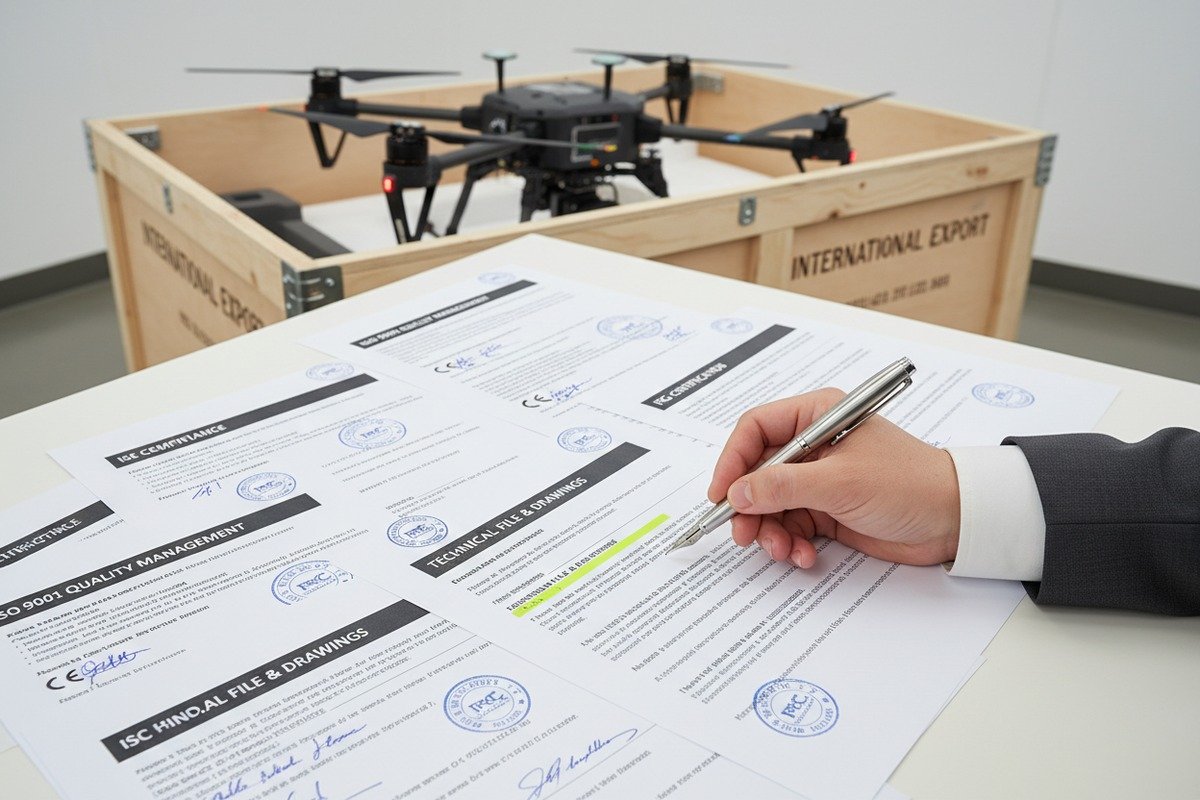
Wesentliche Zertifizierungen zur Überprüfung
ISO 9001-Zertifizierung 5 should specifically cover UAV manufacturing. Some suppliers show general factory certifications that do not apply to drone production. Request the actual certificate and verify the scope statement.
For US imports, FCC compliance is mandatory for radio equipment. For Europe, CE-Kennzeichnung 6 requires full technical documentation. Ask for test reports from accredited laboratories, not just self-declarations.
Checkliste für Dokumentation Tabelle
| Dokumenttyp | Was ist zu prüfen? | Rote Flagge |
|---|---|---|
| ISO-Zertifikat | Scope covers UAV/drone manufacturing | Generic factory certification only |
| CE/FCC Reports | Accredited lab name and test date | Self-declaration without testing |
| Technisches Dossier | Complete component specifications | Vague or missing details |
| Herkunftsland | Clear declaration for all parts | Ambiguous sourcing statements |
| HS-Code-Klassifizierung | Correct tariff code provided | No customs guidance offered |
| Warranty Document | Specific coverage terms and duration | "Standard warranty" with no details |
| Ausfuhrgenehmigung | Valid for drone technology | Missing or expired |
Third-Party Inspection Value
Engaging inspection agencies like SGS or Bureau Veritas before shipment catches problems early. They verify that actual products match documentation. This costs a few hundred dollars but prevents thousands in customs delays or rejected shipments.
Pre-shipment inspection should include functional testing, not just visual checks. Ask inspectors to power on units and verify basic flight capability.
Bedenken hinsichtlich der Datensicherheit
Some importing countries now scrutinize drone data handling. US federal agencies have restricted certain manufacturers over security concerns. Ask suppliers about data storage locations and encryption standards.
If your customers include government contractors, this becomes critical. Documentation should clearly state where flight data goes and who can access it.
Rückverfolgbarkeitsanforderungen
Quality suppliers maintain component traceability. They can tell you where each motor, battery, and sensor came from. This matters for warranty claims and safety investigations.
If a supplier cannot provide component sourcing information, their quality control is likely weak. This also creates liability risks if products cause damage.
Why is a cheap initial purchase price often a trap for high maintenance costs and lack of technical support?
In our experience supporting customers across three continents, the drones that cost least upfront often cost most over two years. We track warranty claims carefully, and the pattern is clear.
Cheap drones become expensive through frequent battery replacements costing $500+ each, proprietary parts with 300% markups, no local repair networks requiring international shipping, absent technical documentation for troubleshooting, and zero software updates leaving units obsolete within months.

True Cost of Ownership Calculation
Initial price represents only 40-60% of two-year ownership costs. Maintenance, parts, training, and downtime make up the rest. Budget drones often flip this ratio, with ongoing costs exceeding purchase price.
Battery replacement is the biggest hidden expense. Quality lithium polymer packs 7 maintain 80% capacity after 300 cycles. Cheap batteries degrade to 50% capacity within 100 cycles, requiring replacement three times as often.
Two-Year Cost Comparison Table
| Kostenkategorie | Quality Drone ($15,000) | Budget Drone ($6,000) |
|---|---|---|
| Erstkauf | $15,000 | $6,000 |
| Battery Replacements (2 years) | $1,500 (1 set) | $4,500 (3 sets) |
| Motor/Propeller Parts | $800 | $2,400 |
| Repair Labor | $500 | $3,000 |
| Downtime Loss (est.) | $1,000 | $8,000 |
| Software-Updates | Eingeschlossen | $0 (none available) |
| Total 2-Year Cost | $18,800 | $23,900 |
Technical Support Availability
When drones malfunction mid-season, response time matters. Our support team maintains a 24-hour response commitment for all markets. Budget suppliers often have no English-speaking support or limit help to email only.
Stellen Sie potenziellen Lieferanten diese Fragen:
- What are your support hours for my time zone?
- Bieten Sie eine Fehlerbehebung per Videoanruf an?
- Can you provide on-site technician visits?
- What training materials come with purchase?
Parts Supply Chain Reality
Proprietary parts lock you into single suppliers. If they raise prices or discontinue models, you have no options. Quality manufacturers use standardized components where possible and maintain parts inventory for five or more years after model discontinuation.
Request a parts price list before purchasing. Compare propeller, nozzle, and pump costs. Some budget drones have parts priced at 5-10 times the cost of equivalent quality drone components.
Software Update Patterns
Firmware updates fix bugs and add features. Budget manufacturers rarely invest in ongoing development. Their software remains frozen at launch quality, which is often poor.
Check the supplier's update history for existing models. If older drones have not received updates in over a year, expect the same treatment for new purchases.
How do I evaluate if a Chinese manufacturer has the engineering expertise to handle my custom OEM drone requirements?
When customers visit our facility, we walk them through our entire development process. This transparency separates serious manufacturers from assembly shops that cannot support customization.
Evaluate OEM capability through R&D team size and qualifications, in-house design software and testing equipment, previous custom project portfolios, prototyping timelines and iteration processes, and intellectual property protection agreements. Request facility tours or video walkthroughs to verify claims.

Bewertung des Ingenieurteams
Ask about team composition. Quality OEM partners have electrical engineers, mechanical engineers, and software developers on staff. A team of 70 people like ours can handle complex customization. Smaller teams may struggle with anything beyond cosmetic changes.
Educational backgrounds matter. Engineers with aerospace or robotics degrees bring relevant expertise. Ask about specific experience with flight controller programming and sensor integration.
Capability Verification Questions
| Fähigkeitsbereich | Zu stellende Frage | Good Answer |
|---|---|---|
| Design Software | What CAD/CAM systems do you use? | SolidWorks, AutoCAD, or similar professional tools |
| Testing Equipment | How do you validate flight performance? | Wind tunnel, vibration testing, environmental chambers |
| Prototyping | What is your typical prototype timeline? | 4-8 weeks for functional prototypes |
| Frühere Projekte | Can you share case studies? | Specific examples with customer permission |
| IP-Schutz | How do you protect our designs? | NDA templates ready, segregated production lines |
Quality Control Process Deep Dive
IQC (Incoming Quality Control) checks raw materials before they enter production. Without this step, defective components contaminate finished products.
IPQC (In-Process Quality Control) catches assembly errors early. Our technicians check each stage against specifications before proceeding.
FQC (Final Quality Control) includes full functional testing. For spraying drones, this means wet tests with actual liquid flow verification. Ask suppliers to describe their FQC checklist in detail.
Prototyping- und Iterationsprozess
Custom projects require multiple prototype cycles. First prototypes identify major design issues. Second versions refine details. Third versions validate production readiness.
Expect four to eight weeks for initial prototypes. If a supplier promises faster delivery, they are likely skipping validation steps. Rushed prototypes cause expensive production problems later.
Kommunikation und Projektmanagement
Language barriers cause project failures. Ensure your supplier contact speaks fluent English and understands technical terminology. Video calls reveal communication quality better than emails.
Ask about project management tools. Professional manufacturers use software to track milestones and share documents. Email-only communication leads to confusion and delays.
Mindestbestellmengen und Flexibilität
OEM economics require volume. Expect minimum orders of 50-100 units for basic customization like branding and color changes. Full custom development may require 500+ unit commitments.
Negotiate pilot runs to test quality before large orders. Ten to twenty units at slightly higher per-unit cost protects both parties.
Ethical Sourcing Considerations
Unusually low prices sometimes indicate problematic labor practices. Ask about factory working conditions and certifications like SA8000. Ethical concerns create reputational risks for importers.
Sustainable manufacturing also affects long-term supplier reliability. Companies cutting corners on worker treatment often cut corners everywhere.
Schlussfolgerung
Sourcing agricultural drones requires looking beyond purchase price. Evaluate total ownership costs, verify documentation thoroughly, assess technical support capabilities, and validate OEM expertise before committing.
Fußnoten
1. Defines a key protection standard for electronic devices. ︎
2. Addresses the importance of safeguarding designs in OEM partnerships. ︎
3. Replaced with an authoritative Wikipedia article explaining brushless DC electric motors. ︎
4. Replaced with an authoritative Wikipedia article explaining real-time kinematic positioning. ︎
5. Details a widely recognized quality management standard. ︎
6. Clarifies a mandatory European conformity mark for products. ︎
7. Replaced with a comprehensive guide to lithium polymer batteries. ︎
8. Explains the comprehensive financial impact beyond initial purchase. ︎

 English
  Español de México
  Deutsch
  Français
  Русский
  العربية
