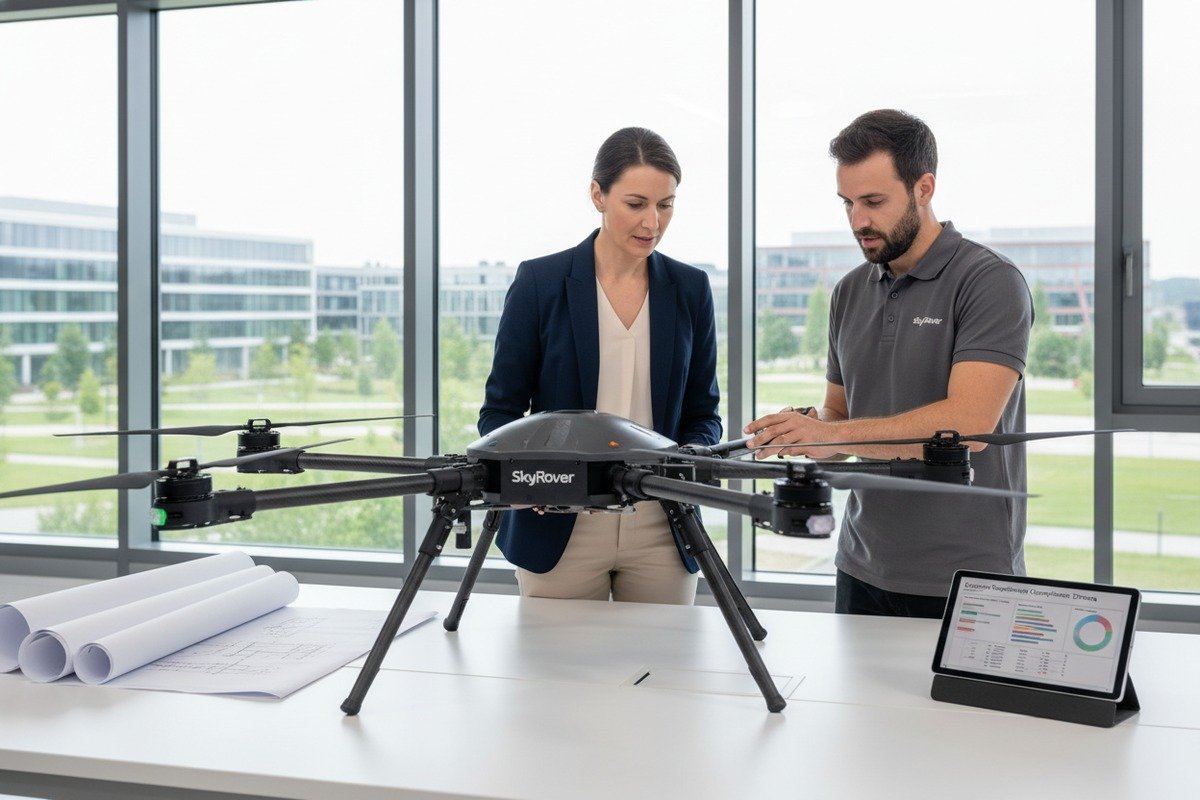
When we began shipping agricultural drones to European distributors three years ago, the regulatory landscape felt like shifting sand EASA Regulations 2019/945 and 2019/947 1. Every quarter brought new questions from our partners—about MTOM limits, Remote ID mandates 2, and national derogations that seemed to contradict each other. The confusion costs time and money.
To evaluate supplier flexibility for European agricultural drone regulatory changes, assess five key areas: their regulatory monitoring systems, hardware modularity for weight and payload adjustments, software update capabilities for Remote ID and geo-fencing, current certification status including C-class labels, and dedicated support for navigating national derogations like Poland’s A3 category allowances.
This guide walks you through practical evaluation methods based on our experience manufacturing drones for the EU market. You will learn exactly what to ask suppliers and what red flags to watch for.
How can I determine if my supplier's software architecture is adaptable to evolving EASA flight requirements?
Our engineering team rewrites firmware more often than we would like to admit. Each EASA update creates ripple effects through flight controllers, ground stations, and mobile apps. Suppliers who cannot keep pace leave their customers grounded.
To determine software adaptability, verify your supplier offers over-the-air (OTA) updates, supports modular firmware architecture, maintains active Remote ID integration, and provides documented API access for geo-fencing and flight altitude enforcement features required under EASA Regulations 2019/945 and 2019/947.

Understanding EASA Software Requirements
The EU drone framework demands specific software capabilities that many legacy systems cannot deliver. Remote ID becomes mandatory for most drone classes between 2026 and 2028. This means your drone must broadcast identification and location data in real-time. Suppliers with rigid software cannot retrofit this feature cost-effectively.
Geo-awareness is another critical requirement. Drones operating in the open and specific categories must recognize restricted airspaces automatically. The software must prevent flights into prohibited zones without manual pilot intervention. We build these systems with updateable geo-zone databases because European authorities change airspace restrictions frequently.
Key Software Evaluation Criteria
| Software Feature | High-Flex Indicator | Low-Flex Red Flag |
|---|---|---|
| Entfernte ID | OTA-enabled, integrated by default | Requires hardware swap |
| Geo-fencing | Cloud-updated zone databases | Static, manual updates only |
| Flight limits | Configurable per-country profiles | Hardcoded 120m limit only |
| VLOS enforcement | Automatic range limiters available | No VLOS support |
| Update frequency | Monthly or faster release cycles | Annual updates or less |
Fragen an Ihren Lieferanten
Start by requesting their software update history for the past 24 months. Flexible suppliers will show multiple releases addressing regulatory changes. Ask specifically about Remote ID implementation timeline. If they cannot provide clear dates and technical specifications, consider this a warning sign.
Request documentation on their geo-awareness system architecture. Open systems allow national aviation authorities to push zone updates directly. Closed systems require the manufacturer to manually integrate each change, creating dangerous delays.
Verify their approach to national derogations. Poland's temporary A3 category allowance for drones under 105kg MTOM requires specific software profiles. France's conditional authorizations need different configurations. Flexible suppliers maintain country-specific presets that operators can activate instantly.
What engineering capabilities should I look for to ensure my drone hardware can be modified for new EU safety standards?
We have redesigned propeller guards three times in two years to meet evolving impact energy requirements. Hardware changes cost far more than software patches. Suppliers without modular engineering approaches trap customers in expensive upgrade cycles.
Look for modular airframe designs supporting payload swaps without structural modifications, propulsion systems rated for multiple MTOM configurations, standardized mounting interfaces for safety equipment, and documented compliance pathways for C0 through C4 class certifications with clear retrofit options for existing fleet units.

The Modularity Imperative
EU drone classes 3 define strict weight and capability boundaries. C3 class drones must stay under 25kg with maximum 3-meter dimensions and 120-meter altitude limits. Agricultural operations often push these boundaries. Suppliers designing for modularity allow operators to reconfigure drones for different regulatory scenarios without purchasing entirely new aircraft.
Our hexacopter platform uses standardized rail mounts for spray tanks, sensors, and broadcast seeders. When Poland introduced the 105kg MTOM allowance under their A3 derogation, operators simply upgraded to larger tanks. No structural modifications were needed. This saved our European partners thousands of euros per unit.
Critical Hardware Specifications
Noise compliance represents an emerging challenge. The EU plans stricter noise limits by 2026. Propulsion systems must accommodate quieter propeller designs without complete motor replacements. We specify oversized motor mounts for this reason—future propeller iterations will fit existing frames.
| Hardware Component | Flexible Design | Rigid Design |
|---|---|---|
| Frame structure | Carbon fiber with modular bays | Welded aluminum, fixed layout |
| Motor mounts | Universal patterns, multiple sizes | Proprietary single-size only |
| Payload interface | Quick-release standardized rails | Permanent integrated tanks |
| Battery compartment | Adjustable for various capacities | Single battery size only |
| Sensor mounting | Multiple hardpoints with power | Single fixed camera position |
Certification Pathway Evaluation
Request your supplier's C-class certification roadmap. Since January 1, 2024, new drones require C-labels for open category operations. Suppliers should provide:
- Current certification status for each model
- Timeline for pending certifications
- Retrofit kits for legacy units
- Documentation packages for specific category applications
Legacy unlabeled drones face increasingly limited operational windows. UK regulations tolerate them only until 2027. EU member states may impose similar restrictions. Suppliers without clear certification pathways risk stranding their customers with unusable equipment.
Structural Adaptability Testing
Ask suppliers about their approach to impact energy compliance. Class C1 drones must transfer less than 80 joules on impact. Class C2 requires low-speed mode capabilities. These requirements influence everything from maximum speeds to structural materials.
Flexible suppliers maintain test facilities and can demonstrate compliance across multiple configurations. They provide engineering support when customers need modified versions for specific national approvals.
Our documentation team works as hard as our engineers. Every shipment to Europe includes country-specific paperwork that would fill a filing cabinet. Suppliers who underestimate documentation requirements create customs nightmares and operational delays.
Evaluate documentation capability by requesting sample EU Declarations of Conformity, technical files meeting EASA format requirements, certificates covering all relevant C-classes, operator manual templates aligned with specific category requirements, and evidence of internal auditing processes demonstrating ongoing compliance monitoring.

Documentation Requirements by Operation Category
European drone operations divide into three categories, each with distinct documentation demands. Open category requires basic registration and C-class labeling. Specific category demands operational authorizations, SORA assessments 5, and detailed operator manuals. Certified category involves full airworthiness certification comparable to manned aircraft.
Agricultural spray drones typically operate in the specific category due to payload hazards and operational complexity. Suppliers must provide documentation supporting authorization applications, not just product specifications.
| Kategorie | Documentation Required | Supplier Responsibility |
|---|---|---|
| Öffnen Sie | C-label certificate, Declaration of Conformity, basic user manual | Full provision |
| Spezifische | SORA support documentation, operational manual templates, risk assessments | Partial support expected |
| Zertifiziert | Full airworthiness documentation, design organization approval | Typically beyond supplier scope |
National Variation Documentation
France and Poland demonstrate how national derogations create documentation complexity. French conditional authorizations for plant protection products require ANSES assessment documentation. Trials lasting up to three years on non-specified crops need specific paperwork.
Poland's A3 category allowance running from May 7, 2025 through January 6, 2026 requires operators to demonstrate compliance with particular limits: VLOS operation, 30m AGL maximum, 30m distance from uncontrolled or residential areas. Suppliers should provide configuration certificates proving their drones meet these parameters.
Evaluating Supplier Documentation Systems
Request samples of existing documentation packages. Quality indicators include:
- Version control showing regular updates
- Multi-language availability for key EU markets
- Digital formats suitable for authority submission
- Clear traceability between documents and specific drone configurations
Ask about their response time for documentation requests. When authorities demand additional information, delays cost money. We maintain dedicated documentation staff who respond within 48 hours to European customer requests.
Certification Status Verification
Verify claimed certifications directly. EASA maintains databases of approved products and organizations. Cross-reference supplier claims against official records. Request copies of test reports from notified bodies. Legitimate suppliers share this information readily.
The UK's post-Brexit divergence adds complexity. UK authorities reject EU certificates entirely. Drones need separate UK certification with UK0 through UK6 markings. Suppliers serving both markets must maintain parallel certification tracks.
When French regulators introduced slope-specific requirements allowing drone spraying on terrain steeper than 20%, our R&D team worked directly with three European partners to validate compliant configurations. This collaboration created market advantage. Passive suppliers watch from the sidelines.
Seek suppliers who maintain dedicated regulatory affairs teams, participate in EASA consultations and industry working groups, offer joint development agreements for market-specific adaptations, provide pilot training programs aligned with European certification requirements, and demonstrate proactive engagement with emerging standards rather than reactive compliance only.

The Value of Proactive Regulatory Engagement
Regulations do not emerge from vacuum. Industry working groups 7, public consultations, and pilot programs shape outcomes. Suppliers participating in these processes gain advance knowledge of coming changes. They influence requirements in ways that benefit their products and customers.
Our regulatory affairs team monitors EASA proceedings, national authority announcements, and industry association communications. When Poland first proposed the A3 category derogation for agricultural drones under 105kg, we knew months before the official announcement. This allowed us to prepare compliant configurations ahead of competitors.
R&D Capability Assessment Framework
| Capability Area | Starker Indikator | Schwacher Indikator |
|---|---|---|
| Regulatory monitoring | Dedicated staff, monthly briefings | No formal tracking process |
| Industry participation | Working group membership, consultation responses | No external engagement |
| Development flexibility | Custom firmware options, configuration services | Standard products only |
| Training support | Certified programs, A1/A3 and A2 preparation | No training offerings |
| Future planning | Published roadmaps, beta programs | No visibility beyond current products |
Collaborative Development Models
Different partnership levels suit different customer needs. Distribution agreements with technical support cover basic requirements. Joint development agreements allow deeper collaboration on market-specific features. Some customers need fully customized solutions developed exclusively for their operations.
We offer tiered partnership programs. Basic partners receive priority technical support and regulatory update briefings. Advanced partners participate in beta testing new features. Strategic partners co-develop unique capabilities protected by exclusivity agreements in their territories.
Training and Certification Support
European pilot requirements have become increasingly stringent. Open category operations require A1/A3 or A2 certificates depending on drone class and operational distance from people. Specific category operations demand additional competency demonstrations.
Suppliers should support customer training programs. This includes:
- Training material development aligned with national authority requirements
- Simulator access for pilot proficiency maintenance
- Examination preparation resources
- Practical assessment coordination
Data Sovereignty Considerations
GDPR 8 and potential future data localization requirements affect agricultural drone operations. Spray records, yield data, and flight logs contain commercially sensitive information. Suppliers must offer data management solutions keeping information within EU jurisdiction when customers require it.
Ask about data storage locations, encryption standards, and data portability options. Cloud-dependent systems with servers outside Europe may create compliance risks for customers bound by strict data protection requirements.
Long-Term Partnership Evaluation
Consider supplier longevity and commitment to the agricultural drone sector. Companies with diversified product lines may deprioritize agricultural applications when market conditions shift. Dedicated agricultural drone manufacturers stake their business on sector success.
Request information about R&D investment levels, product roadmap timelines, and strategic plans for the European market. Suppliers unable or unwilling to share this information may lack the commitment needed for effective long-term partnership.
Schlussfolgerung
Evaluating supplier flexibility for European regulatory changes requires systematic assessment across software adaptability, hardware modularity, documentation quality, and R&D capability. Use the frameworks provided here to score potential suppliers objectively. The investment in evaluation prevents costly surprises when regulations inevitably shift.
Fußnoten
1. Provides the foundational legal framework for drone operations and UAS technical requirements in Europe. ︎
2. Explains the mandatory requirement for drone identification and location broadcasting in Europe. ︎
3. Defines the categories and operational limitations for drones within the European Union. ︎
4. Details the drone classification system and identification labels for safe operation in the EU. ︎
5. Explains the methodology for assessing risks of specific drone operations, developed by EASA. ︎
6. Explains the mandatory document confirming a product’s compliance with EU health, safety, and environmental protection legislation. ︎
7. Highlights the role of collaborative bodies and communities in shaping European aviation and drone regulations. ︎
8. Provides the official legal text of the European Union’s General Data Protection Regulation. ︎

 English
  Spanish
  German
  French
  Dutch
Dutch  Arabic
