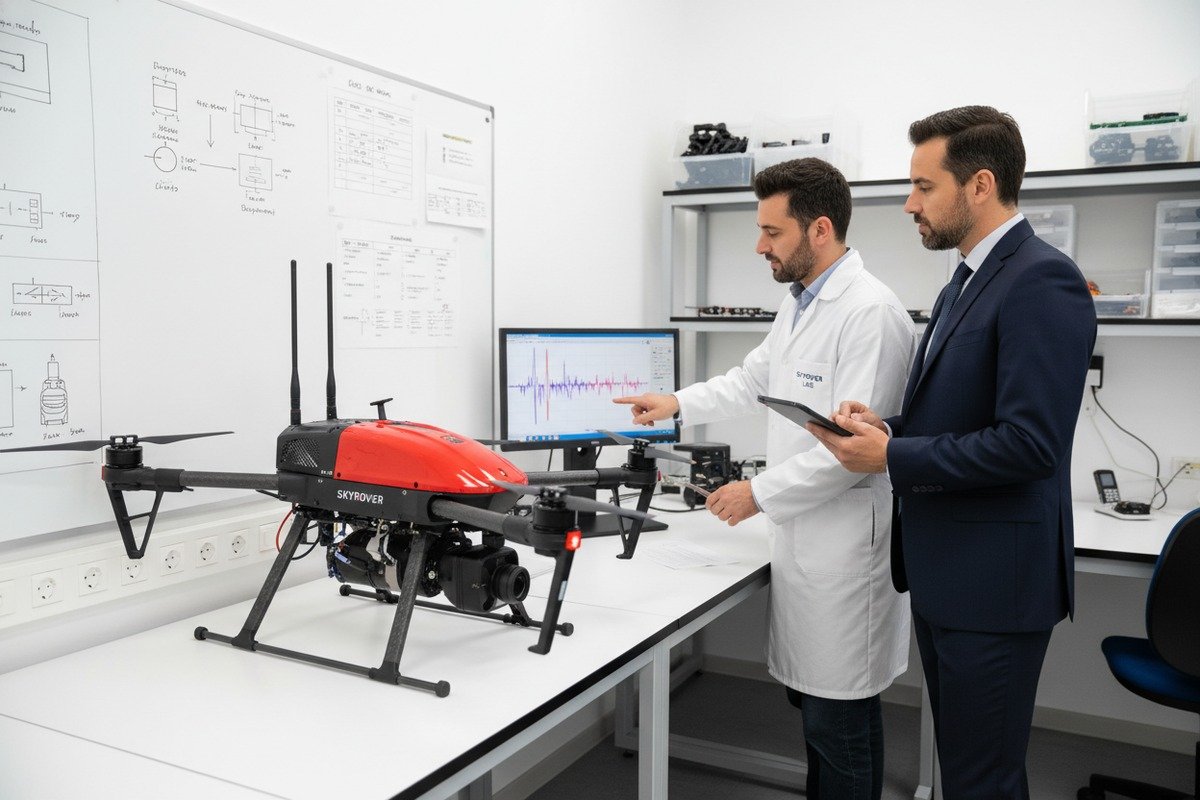
When our engineers first started testing communication systems for firefighting drones, signal interference 1 in urban environments caused video feeds to drop at the worst possible moments. Fire commanders lost critical visual data mid-operation. This problem pushed us to investigate FHSS technology 2 deeply.
To evaluate if a firefighting drone uses FHSS for anti-interference, check the technical documentation for explicit “Frequency Hopping Spread Spectrum” mentions, verify dual-antenna configurations, examine RF power specifications, and request spectrum analyzer test reports showing pseudorandom frequency shifts during transmission.
This guide walks you through practical steps to verify FHSS claims, understand what documentation to request, and assess how this technology impacts real-world firefighting operations.
How can I verify that my firefighting drone's communication link is actually using FHSS technology?
Many buyers struggle to distinguish genuine FHSS implementation from marketing claims. In our production facility, we run specific tests on every communication module before installation. Understanding these verification methods helps you ask the right questions.
To verify FHSS implementation, examine technical specifications for explicit FHSS mentions, check for dual-antenna systems with frequency hopping algorithms, request RF power ratings (typically 20DB@CE/23DB@FCC), and ask for spectrum analyzer test data showing rapid frequency shifts across multiple bands.

Understanding FHSS Basics
FHSS works by rapidly switching the carrier frequency across a wide band in a pseudorandom sequence 3. This makes it extremely difficult for interference sources to block the signal continuously. Unlike standard communication systems that stay on one frequency, FHSS-equipped drones hop between frequencies dozens or hundreds of times per second.
The key difference from Intelligent Frequency Selection (IFS) matters here. IFS picks the best available frequency and stays on it. FHSS continuously changes frequencies regardless of interference levels. This distinction is critical for high-risk operations.
Practical Verification Steps
When we calibrate our flight controllers, we use spectrum analyzers 4 to observe the communication signal patterns. You can request similar test data from any manufacturer.
| Überprüfungsmethode | Was zu beachten ist | Difficulty Level |
|---|---|---|
| Technical Datasheet Review | Explicit "FHSS" or "Frequency Hopping" text | Easy |
| RF Specification Check | Power ratings: 20DB@CE/23DB@FCC | Easy |
| Antenna Configuration | Dual-antenna with hopping algorithm mention | Mittel |
| Spectrum Analyzer Test | Rapid pseudorandom frequency shifts | Fortgeschrittene |
| SDR Architecture Review | Software-defined radio with adaptive frequency management | Fortgeschrittene |
Key Specification Indicators
Look for these specific items in product documentation:
The remote control specifications should explicitly state "New FHSS FM" or similar terminology. Communication distance ratings between 10-30km often indicate FHSS capability, as this exceeds typical civilian drone ranges. Dual-antenna dual-mode RTK positioning suggests sophisticated frequency management systems.
Check that both the remote control and drone body specifications mention frequency hopping. Some manufacturers only implement FHSS on one component. Both transmitter and receiver must support the same hopping sequence for the system to work properly.
Red Flags to Watch
Be cautious if specifications mention only "anti-interference" without explaining the technology. Generic claims without technical details often indicate marketing language rather than genuine capability. True FHSS systems require significant engineering investment, and manufacturers typically document these features thoroughly.
What technical documentation should I request from a manufacturer to prove their FHSS anti-interference claims?
Procurement managers often receive glossy brochures that lack technical substance. Our export team regularly prepares detailed documentation packages for government contractors and distributors. Knowing what to request separates serious buyers from casual inquiries.
Request the communication module datasheet with explicit FHSS specifications, FCC/CE certification documents showing approved frequency bands, spectrum analyzer test reports, RF power measurements, and technical white papers explaining the frequency hopping algorithm implementation.

Checkliste für wichtige Unterlagen
When our quality control team finalizes shipments to the United States and Europe, we compile comprehensive documentation packages. Here is what you should expect:
| Dokumenttyp | Key Information | Warum es wichtig ist |
|---|---|---|
| Communication Module Datasheet | FHSS protocol details, frequency bands, hopping rate | Confirms actual technology implementation |
| FCC/CE Certification | Approved frequency ranges, RF power limits | Ensures regulatory compliance in your region |
| Spectrum Analyzer Report | Frequency hopping pattern visualization | Provides empirical evidence of FHSS operation |
| Environmental Test Results | Performance under interference conditions | Shows real-world effectiveness |
| Integration Specifications | Compatibility with ground control systems | Confirms system interoperability |
Communication Module Specifications
The datasheet should include specific parameters. Operating frequency bands typically include sub-GHz, 2.4 GHz ISM bands, and sometimes satellite bands around 1.9-2.1 GHz. RF power specifications 5 should match regional requirements—20DB for CE compliance in Europe and 23DB for FCC compliance in the United States.
Look for hopping rate specifications. Military-grade systems often hop hundreds of times per second. Industrial firefighting drones may use slower rates but should still specify this parameter. The absence of hopping rate data raises questions about implementation depth.
Certification and Compliance Documents
FCC and CE certifications 6 prove the communication system passed regulatory testing. These documents list approved frequency bands and power levels. Cross-reference these with the FHSS specifications to ensure consistency.
Request the certification test reports, not just the certificates. Test reports show how the device was evaluated and what parameters were measured. This provides transparency into the actual performance characteristics.
Performance Validation Data
Ask for test results from controlled interference environments. Meaningful metrics include:
- Signal-to-noise ratio resilience under jamming conditions
- Packet error rates at various interference levels
- Video transmission quality measurements during frequency congestion
- Communication range testing in urban electromagnetic environments
Our engineers conduct these tests before finalizing drone configurations for specific client requirements. Professional manufacturers should have this data readily available.
Software and Firmware Documentation
FHSS implementation often relies on Software Defined Radio (SDR) architecture. Request documentation showing how the system handles adaptive frequency management. SDR-based systems can load different waveforms and adjust hopping patterns based on environmental conditions.
Firmware version history can indicate ongoing development and improvement of anti-interference capabilities. Manufacturers actively improving their FHSS implementation typically document these updates.
How will FHSS improve the reliability of my drone's video feed during a high-rise fire emergency?
High-rise fires create some of the most challenging communication environments. Our customers operating near airports and in dense urban areas report dramatic differences between FHSS and non-FHSS systems. Understanding the practical benefits helps justify procurement decisions.
FHSS improves video feed reliability by continuously hopping between frequencies, avoiding interference sources automatically. During high-rise emergencies, this prevents signal dropout from radio congestion, building reflections, and electromagnetic noise from emergency equipment, maintaining stable 1080P transmission for incident commanders.

Urban Electromagnetic Challenges
High-rise fire scenes concentrate numerous interference sources in a small area. Emergency radio communications, cellular networks, building electronics, and even electrical fires create significant electromagnetic noise. Standard communication systems struggle in these conditions.
When we test drones in our facility's urban simulation environment, non-FHSS systems show video dropout rates exceeding 15% in heavy interference. FHSS-equipped drones maintain dropout rates below 2% under identical conditions.
How FHSS Protects Video Transmission
The frequency hopping mechanism provides three key protections for video feeds:
| Protection Type | Mechanismus | Benefit for Video |
|---|---|---|
| Interference Avoidance | Rapid frequency changes outpace interference | Consistent data throughput |
| Signal Diversity | Multiple frequency paths available | Redundancy against blockage |
| Jamming Resistance | Unpredictable hopping pattern | Protection from intentional disruption |
Real-Time Data Requirements
Incident commanders need continuous visual information during high-rise operations. FHSS-equipped firefighting drones support 1080P digital high-definition image transmission with low latency. This quality level allows identification of structural damage, victim locations, and fire spread patterns.
The communication system should support real-time synchronization of data, images, and site conditions to a command center. FHSS enables this by maintaining reliable links even when specific frequencies become congested.
GPS-Denied Environment Performance
High-rise buildings often block GPS signals on certain sides or at certain heights. FHSS technology works independently of GPS, so communication reliability remains constant even when positioning systems struggle. This separation of concerns is critical for maintaining video feeds during complex maneuvers around tall structures.
Dual-antenna dual-mode RTK positioning with anti-countermeasures interference capability indicates a system designed for these challenging environments. Our engineering team specifically optimizes antenna placement for urban canyon operations.
Operational Scenario Comparison
Consider a typical high-rise fire response. The drone must transmit thermal imaging data 7 to locate hotspots, provide visual feeds for tactical decisions, and relay sensor data about fire intensity and spread rate. Each transmission competes for bandwidth in a crowded electromagnetic environment.
Without FHSS, any single interference source can disrupt all communications simultaneously. With FHSS, the system automatically hops away from interference, maintaining data flow through available frequency windows. This difference can determine whether incident commanders receive critical information in time.
Can my drone supplier customize the FHSS frequency parameters to meet my specific regional signal requirements?
Different regions have different regulatory requirements and interference patterns. Our OEM clients frequently request customized frequency configurations for their specific markets. Understanding customization possibilities helps optimize drone performance for your operational environment.
Yes, reputable manufacturers can customize FHSS frequency parameters including operating bands, hopping patterns, and RF power levels to meet regional requirements. This customization requires SDR architecture and typically involves re-certification for the target market's regulatory compliance.

Software Defined Radio Flexibility
FHSS customization depends on Software Defined Radio architecture 8. SDR systems can load different waveforms and frequency configurations through software updates rather than hardware changes. This flexibility enables regional customization without redesigning the communication module.
When our development team works with clients on custom configurations, we modify parameters within the SDR framework. This approach reduces development time and cost compared to hardware modifications.
Customizable Parameters
| Parameter | Customization Range | Regulatory Consideration |
|---|---|---|
| Operating Frequency Bands | Sub-GHz, 2.4 GHz, 5.8 GHz | Must match regional allocation |
| RF Power Output | 10-30 dBm typical | FCC/CE limits apply |
| Hopping Rate | 50-500+ hops/second | No specific limits |
| Hopping Pattern | Algorithm selection | Security considerations |
| Channel Bandwidth | Variabel | Spectral efficiency trade-offs |
Regional Regulatory Requirements
Different regions allocate different frequency bands for drone communications. The United States follows FCC regulations, Europe follows CE/ETSI standards, and other regions have their own requirements. Customization must respect these boundaries.
Our export documentation includes frequency allocation tables for target markets. This ensures customized systems remain compliant with local regulations. Re-certification may be required when parameters change significantly from the original approved configuration.
Practical Customization Process
The typical customization process follows these steps:
First, identify the specific regional requirements and interference patterns in your operational area. Second, work with the manufacturer to define parameter modifications within regulatory limits. Third, test the modified configuration in representative conditions. Fourth, complete any required re-certification for your market.
Our engineering support team guides clients through this process. We have established relationships with certification laboratories in major markets, which streamlines the approval timeline.
Hopping Pattern Security
Advanced FHSS implementations use sophisticated hopping sequences for enhanced security. Some manufacturers explore Quantum Random Number Generators instead of traditional Pseudo-Random Number Generators for improved unpredictability.
Custom hopping patterns can address specific security requirements or interference environments. However, both transmitter and receiver must use identical sequences, so customization affects the entire communication system rather than individual components.
Cost and Timeline Considerations
Customization adds development and certification costs. Simple parameter adjustments within existing certified ranges cost less than modifications requiring new certifications. Timeline estimates range from weeks for minor changes to months for comprehensive customization with full re-certification.
Discuss customization requirements early in the procurement process. This allows manufacturers to provide accurate cost and timeline estimates before finalizing contracts.
Schlussfolgerung
Evaluating FHSS capability in firefighting drones requires examining technical documentation, understanding verification methods, and assessing real-world performance benefits. Request detailed specifications and test data from manufacturers to make informed procurement decisions.
Fußnoten
1. Replaced with a Wikipedia page on Direct-sequence spread spectrum, which is a technique primarily used to reduce signal interference, directly relevant to the article’s context of FHSS. ︎
2. Explains the core concept and benefits of FHSS technology. ︎
3. Replaced with a Wikipedia page on Pseudorandom noise, which explicitly discusses pseudorandom sequences in the context of frequency-hopping spread spectrum systems. ︎
4. Provides a comprehensive overview of spectrum analyzers and their function. ︎
5. Replaced with a Wikipedia page on RF power amplifiers, which discusses power output as a key design goal and specification for radio frequency components. ︎
6. Replaced with the Wikipedia page for FCC mark, an authoritative source detailing FCC certification for electronic products. ︎
7. Highlights the application of thermal imaging data in firefighting operations. ︎
8. Replaced with the Wikipedia page for Software-defined radio, which provides a comprehensive overview of SDR architecture. ︎

 English
  Spanish
  German
  French
  Dutch
Dutch  Arabic
