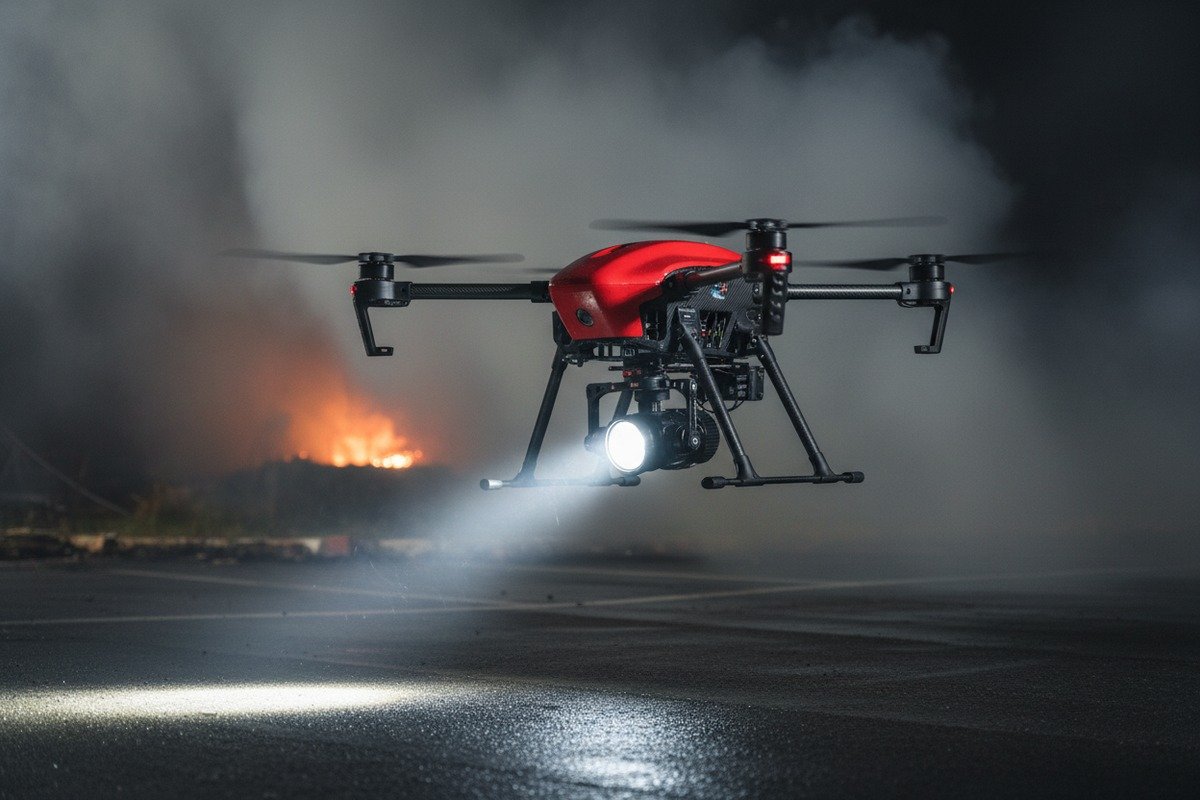
Night rescue operations demand reliable illumination lumens output 1. When our engineering team tests searchlights on the production line, we see firsthand how the wrong brightness level fails rescue crews in critical moments. Smoke, altitude, and battery drain create challenges that many operators underestimate until they face a real emergency.
To evaluate firefighting drone searchlight brightness for night rescue standards, assess lumens output (2,000-5,000+ for firefighting), lux levels at operational altitude (24-35 lux at 100m minimum), beam type matching mission needs, power consumption impact on flight time, and compliance with FAA visibility requirements for night operations.
This guide breaks down each evaluation factor step by step lux levels 2. You will learn how to match specifications to your specific rescue scenarios and avoid common purchasing mistakes.
How do I determine the minimum lumen requirements for my night rescue drone operations?
Our factory receives this question more than any other from fire departments and SAR teams FAA visibility requirements 3. The lumen number on a product sheet means little without context. A 5,000-lumen light that overheats in 10 minutes serves no purpose when your rescue operation lasts an hour IP-Einstufung 4.
Minimum lumen requirements depend on your mission type: urban police operations need 1,500-3,000 lumens, rural search and rescue requires 4,000+ lumens, and firefighting through smoke demands 5,000+ lumens. Building searches work best with 2,000-3,000 lumen combination beams for balanced coverage and penetration.
Understanding Lumens in Real-World Conditions
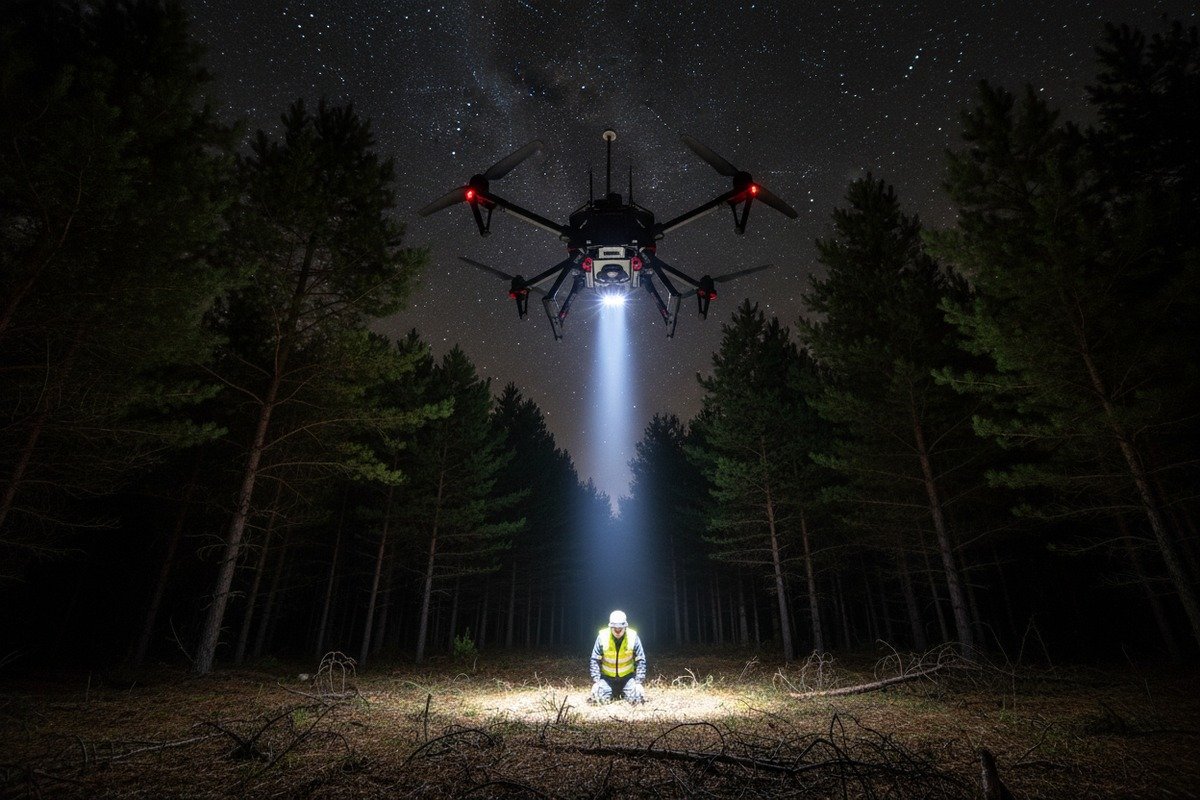
Lumens measure total light output from the source. However, this number does not tell you how that light performs at distance or through smoke. Our testing facility measures lights in clear air and then again through simulated smoke conditions. The difference often surprises procurement teams.
A 5,000-lumen LED loses approximately 40-60% of its effective brightness when penetrating moderate smoke. This means your "5,000-lumen" light performs like a 2,000-lumen unit in actual fire conditions. Planning for this degradation is essential.
Mission-Specific Lumen Guidelines
| Mission Type | Recommended Lumens | Beam Pattern | Key Consideration |
|---|---|---|---|
| Urban Police Patrol | 1,500-3,000 | Spot/Flood Combo | Glare management for populated areas |
| Rural SAR Operations | 4,000+ | Tight Spot (12-15°) | Range over 200m for open terrain |
| Structural Fire | 5,000+ | Adjustable Combo | Smoke penetration capability |
| Wildfire Ember Spotting | 5,000+ | Wide Flood | Large area coverage at altitude |
| Traffic Accident Response | 2,500-4,000 | Flood | Wide scene illumination |
| Building Interior Search | 2,000-3,000 | Combo | Reduced glare for confined spaces |
Balancing Power and Performance
Higher lumens drain batteries faster. Our flight tests show a direct correlation between searchlight power draw and reduced flight time. A 120W searchlight on a Matrice 300 RTK reduces hover time by approximately 15-20%. For missions requiring extended duration, consider lights with adjustable brightness modes.
The DJI Zenmuse S1 offers a practical example. It draws only 17W in high mode while delivering 35 lux at 100m. This efficiency comes from LEP (laser-excited-phosphor) technology 5 rather than traditional LED arrays. Our customers report 25% longer mission times compared to older 100W+ LED systems.
The Smoke Penetration Factor
Not all lumens are created equal. Spectral wavelength 6 affects how light penetrates smoke and haze. Warmer color temperatures (2700K-3000K) penetrate smoke better than cool white (5000K+) lights. When we design searchlight systems for firefighting applications, we specifically tune the color output for atmospheric penetration rather than maximum raw brightness.
What lux levels should I expect at specific altitudes to ensure my searchlight is effective?
When our quality control team calibrates searchlights before shipping, lux at distance is the primary measurement. Lumens tell you what leaves the light. Lux tells you what arrives at your target. This distinction matters more than most operators realize.
For effective night rescue, expect minimum lux levels of 20-35 lux at 100m altitude for victim identification and 10-15 lux at 150m for general scene awareness. Top-tier searchlights like DJI Zenmuse S1 deliver 35 lux at 100m, while the CZI GL60 Plus provides 24 lux at 100m with 1,225m² coverage at 150m height.

How Lux Decreases with Altitude
Light follows the inverse square law 7. When you double the distance from your light source to the target, brightness drops to one-quarter. This physics principle explains why a powerful searchlight at 200m altitude delivers surprisingly dim illumination on the ground.
Our engineering calculations show the following progression for a typical high-output searchlight:
| Altitude | Typical Lux (Spot Center) | Ground Coverage Area | Practical Use Case |
|---|---|---|---|
| 50m | 80-100 lux | 200m² | Detailed victim assessment |
| 100m | 24-35 lux | 600m² | Person identification |
| 150m | 10-15 lux | 1,200m² | General scene scanning |
| 200m | 5-8 lux | 2,000m² | Wide area overview only |
| 300m | 2-4 lux | 4,500m² | Minimal practical use |
Comparing Industry-Leading Searchlights
Our team evaluates competing products to understand market standards. These measurements come from manufacturer specifications and independent testing:
| Modell | Lux at 100m | Maximum Range | Power Draw | Gewicht | Mount Compatibility |
|---|---|---|---|---|---|
| DJI Zenmuse S1 | 35 lux | 500m | 17W (high) | 0.76kg | SkyPort V2.0 |
| CZI GL60 Plus | 24 lux | 400m+ | 120W | 0.75kg | Multiple platforms |
| FoxFury D100 | 18 lux | 300m | 35W | 0.5kg | Universal mount |
| Firehouse ARC V | 12 lux | 250m | 25W | 0.3kg | Strap/clip mount |
Calculating Your Operational Requirements
Different rescue scenarios require different lux thresholds. Our customers in fire departments tell us that identifying a person lying on the ground requires minimum 15-20 lux. Reading clothing details or facial features needs 30+ lux. Spotting movement in debris requires only 8-10 lux.
Work backwards from your typical operational altitude. If your department operates drones primarily at 100-120m height, a searchlight delivering 25+ lux at 100m meets most needs. If you regularly fly at 150m+ for wildfire operations, consider the highest-output options despite their weight penalty.
The Coverage Area Trade-Off
Spot beams concentrate light for maximum lux at distance but illuminate small areas. Flood beams spread light across wide zones but sacrifice intensity. The CZI GL60 Plus demonstrates this balance with 1,225m² coverage at 150m height using its flood mode.
For dynamic rescue operations, adjustable beam systems provide the most flexibility. Our recommended approach: start with flood beam for scene assessment, then switch to spot beam once you identify areas requiring closer inspection.
How can I verify that the searchlight brightness won't degrade during high-temperature firefighting missions?
Our production testing reveals a critical issue many buyers overlook. LEDs generate significant heat. When ambient temperatures rise near active fires, thermal throttling 8 reduces light output dramatically. We have seen cheap searchlights drop to 50% brightness within 15 minutes of continuous operation.
Verify thermal performance by checking the searchlight's IP rating (IP54 minimum, IP67 preferred), operating temperature range (must exceed 50°C ambient), duty cycle specifications (continuous vs. intermittent use), and heat dissipation design. Quality units maintain 90%+ brightness after 30 minutes of continuous operation at elevated temperatures.

Understanding Thermal Throttling
LED efficiency decreases as temperature rises. At 85°C junction temperature, most LEDs operate at only 70-80% of their rated output. During firefighting operations, radiant heat from flames combined with internal heat generation can push LEDs past their optimal operating range within minutes.
Our thermal chamber tests subject searchlights to 60°C ambient temperature while running at maximum output. Quality products from reputable manufacturers maintain 85-90% brightness after 30 minutes. Budget alternatives often drop below 60% in the same timeframe.
Critical Specifications to Verify
When our export documentation team prepares product certifications for US customers, we include detailed thermal specifications. Here is what to request from any supplier:
Operating Temperature Range: Look for -20°C to +50°C minimum. Firefighting applications benefit from units rated to +55°C or higher.
IP-Bewertung: IP54 protects against dust and water splashes. IP67 provides complete dust protection and temporary water immersion capability. For firefighting, IP67 should be your minimum standard.
Duty Cycle: Some lights are rated for intermittent use only (10 minutes on, 5 minutes off). Rescue operations require continuous-rated units.
Heat Sink Design: Active cooling (fans) provides better thermal management than passive designs but adds complexity and potential failure points.
Field Testing Protocol
Before deploying any searchlight in actual emergencies, conduct your own thermal verification:
- Run the light at maximum brightness for 30 continuous minutes
- Measure surface temperature at 10-minute intervals
- Observe any brightness reduction visually
- Record actual lux output at a fixed distance before and after the test
- Allow complete cool-down and repeat to check for permanent degradation
Our quality assurance team performs this test on every batch before shipment. We reject any unit showing more than 15% brightness degradation.
Material and Construction Quality
The housing material affects heat dissipation significantly. Aluminum housings conduct heat away from LEDs better than plastic. Anodized finishes protect against corrosion from firefighting chemicals and salt air in coastal regions.
Check mount construction carefully. Gimbal-mounted searchlights experience vibration stress during flight. Poor-quality pivot points fail after 50-100 hours of operation. Our designs use precision bearings rated for 1,000+ hours of continuous use.
Can I customize the searchlight beam angle and intensity to match my local government's safety standards?
Our OEM department works with government agencies across the United States and Europe on exactly this challenge. Different jurisdictions have different requirements. Some specify maximum intensity to prevent pilot disorientation. Others mandate minimum coverage areas for search operations.
Yes, professional-grade searchlights offer customizable beam angles (typically 12° spot to 60°+ flood) and adjustable intensity levels (often 25%, 50%, 75%, 100% plus strobe modes). Manufacturers like our team can modify firmware settings, beam optics, and mounting configurations to meet specific regulatory requirements through OEM partnerships.
Standard Beam Angle Options
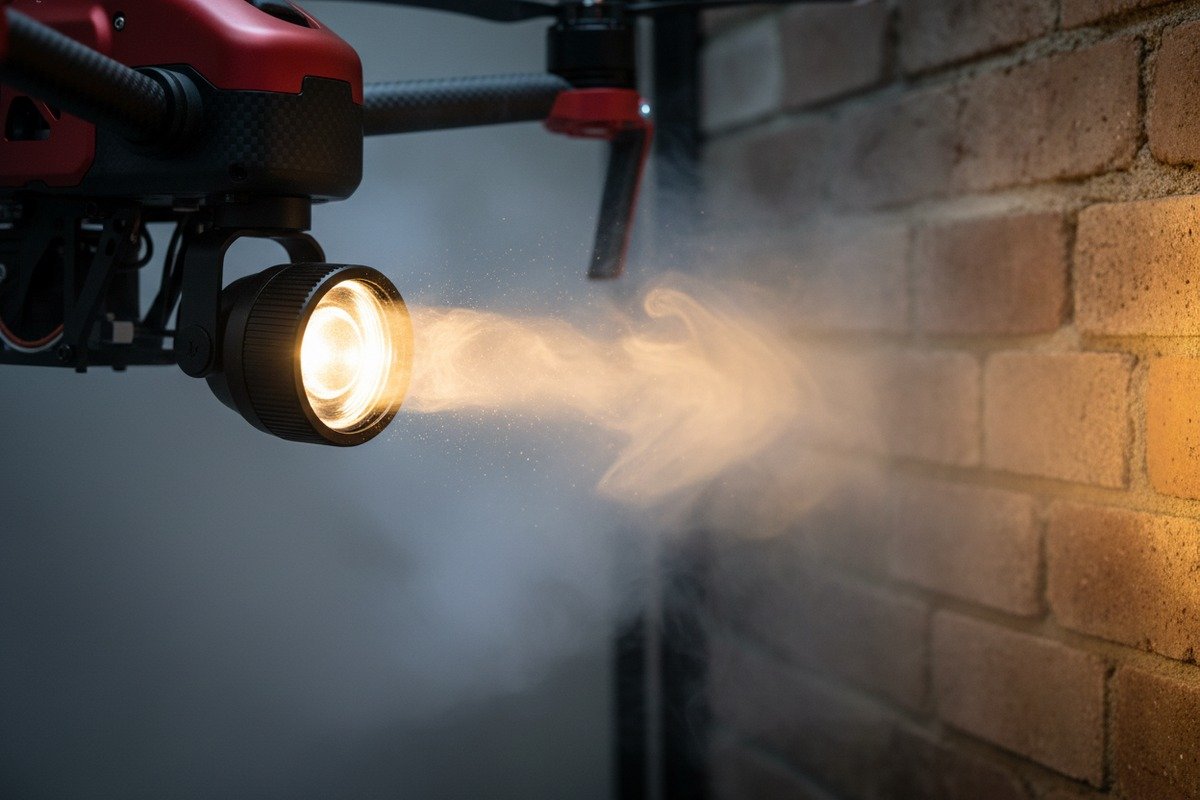
Modern searchlight systems provide adjustable beam patterns through optical design or electronic control:
| Beam Type | Angle Range | Best Application | Coverage at 100m |
|---|---|---|---|
| Tight Spot | 12-15° | Long-range SAR, target identification | 20-25m diameter |
| Medium Spot | 20-30° | Building searches, focused scanning | 35-50m diameter |
| Wide Flood | 45-60° | Area illumination, traffic scenes | 80-100m diameter |
| Adjustable | 15-60° | Multi-mission versatility | Variabel |
FAA Night Flight Requirements
The Federal Aviation Administration requires anti-collision lighting visible from 3 statute miles for night operations. This requirement is separate from searchlight illumination. Many operators integrate both functions.
The Firehouse ARC V exemplifies compliance-focused design: 1,000 lumens with visibility exceeding 4 statute miles, IP67 rating, and 6-hour battery life. This type of strobe satisfies legal requirements while the primary searchlight handles illumination duties.
When we configure drone systems for US customers, we ensure both anti-collision and searchlight systems meet current FAA Part 107 waiver requirements for night operations.
Local Government Specification Matching
Our engineering team has fulfilled custom requirements including:
- Maximum brightness limits for residential area operations
- Specific color temperature requirements for evidence documentation
- Integration with existing incident command systems
- Remote brightness control from ground stations
- Automatic intensity reduction at low altitudes
These modifications require close collaboration between buyer and manufacturer. Our development process typically involves:
- Initial specification review with customer technical team
- Prototype configuration with modified settings
- Field testing at customer facilities
- Documentation for regulatory approval
- Production of customized units
Software-Based Customization
The latest searchlight systems offer firmware-configurable parameters. The DJI Zenmuse S1, for example, provides multiple preset modes (low, high, dual, strobe) controllable through the DJI Pilot interface. More advanced customization requires manufacturer-level access.
Our searchlight control systems allow authorized integrators to:
- Set maximum brightness caps
- Define altitude-based automatic dimming
- Configure preset patterns for specific mission types
- Enable or disable certain features based on jurisdiction
This software approach reduces hardware costs for agencies needing jurisdiction-specific configurations across their fleet.
Schlussfolgerung
Evaluating firefighting drone searchlights requires balancing lumens, lux at altitude, thermal performance, and regulatory compliance. Our team stands ready to help you match specifications to your specific rescue scenarios and customize solutions for your jurisdiction's requirements.
Fußnoten
1. Explains lumens as the measure of light brightness, crucial for lighting evaluation. ︎
2. Defines lux as the unit of illumination, measuring light intensity on a surface. ︎
3. Provides official FAA regulations for night flight visibility minimums. ︎
4. Details the International Protection (IP) rating system for enclosures. ︎
5. Explains how Laser Excited Phosphor (LEP) technology works for illumination. ︎
6. Defines spectral wavelength as it relates to the visible light spectrum. ︎
7. Replaced HTTP 404 link with an authoritative NASA resource explaining the inverse square law of light. ︎
8. Explains the mechanism of thermal throttling in electronic devices like LEDs. ︎

 English
  Spanish
  German
  French
  Dutch
Dutch  Arabic
