
When our engineers first started testing thermal imaging payloads 1 in simulated fire conditions, we discovered that nearly 30% of third-party accessories failed within minutes. This problem costs importers money and puts firefighters at risk.
Ensuring rigorous quality control for firefighting drone accessories requires verifying manufacturer engineering expertise, confirming international certifications like ISO 9001 and AS9100, testing thermal performance under extreme conditions, and demanding complete documentation with technical support commitments before purchase.
The following sections break down each critical quality checkpoint Passive Cooling Systems 2. You will learn exactly what to look for, what questions to ask suppliers, and how to protect your investment.
How can I evaluate the engineering expertise of a manufacturer to ensure my firefighting drone accessories are built to last?
Our production team has spent years refining accessory designs after watching early prototypes fail in real wildfire conditions. The gap between a manufacturer who understands firefighting demands and one who simply assembles parts is enormous.
Evaluate engineering expertise by examining the manufacturer's R&D team qualifications, reviewing their testing facility capabilities, requesting case studies from actual firefighting deployments, and verifying their experience with thermal stress analysis and environmental durability testing protocols.
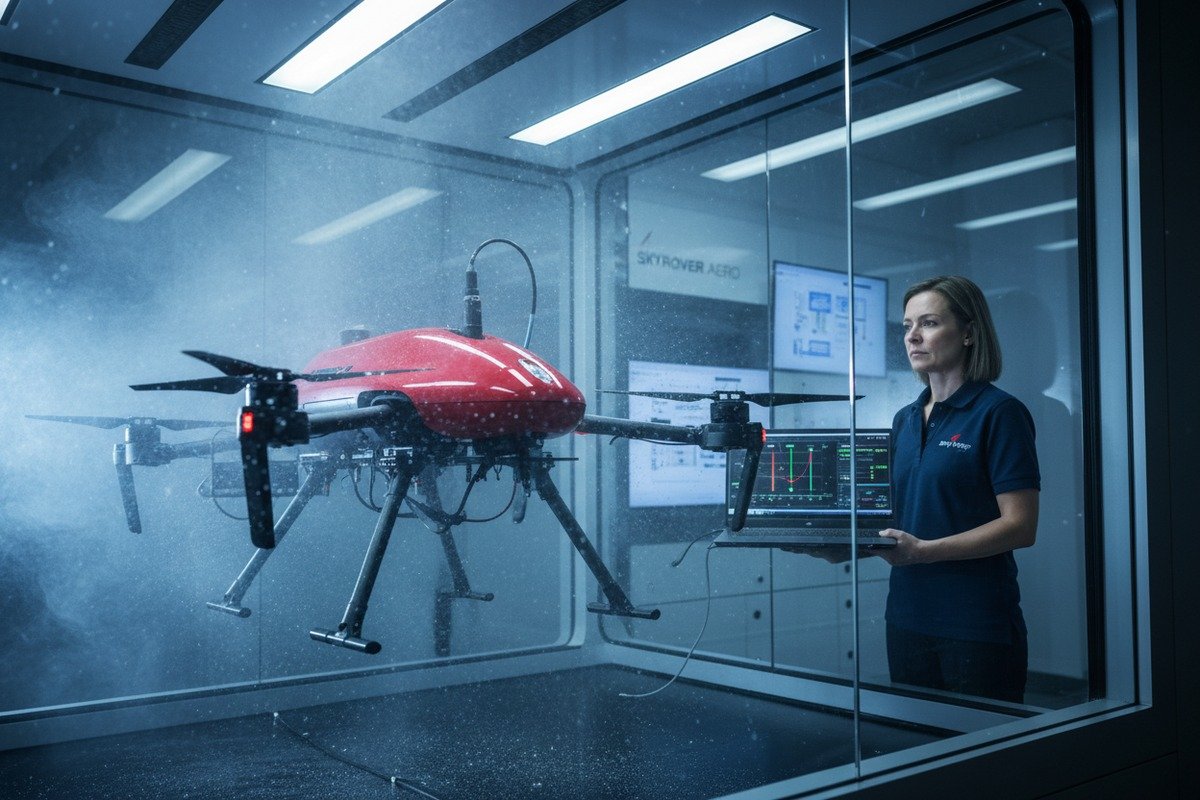
Why Engineering Background Matters
Not all drone manufacturers understand firefighting. Building a consumer camera drone is very different from building accessories that survive 500°F heat exposure. You need to verify that the engineering team includes specialists in materials science 3, thermal management, and ruggedized electronics design.
At our facility in Xi'an, our 70-person team includes engineers who previously worked on aerospace and military-grade systems. This background translates directly into accessory durability. When we design a payload release mechanism, we consider vibration fatigue 4, thermal expansion, and rapid cycling under stress.
Key Questions to Ask Suppliers
| Frage | So sieht eine gute Antwort aus | Reaktion auf rote Flaggen |
|---|---|---|
| What testing equipment do you use? | Environmental chambers, vibration tables, thermal cycling rigs | "We test in the field only" |
| How many engineering staff focus on R&D? | Dedicated R&D team with specific percentages | Vague answers about "everyone contributes" |
| Can you share failure analysis reports? | Detailed root cause documentation | "We don't have failures" |
| What CAD/simulation software do you use? | Industry-standard tools like SolidWorks, ANSYS | No simulation capability |
Verifying Real-World Experience
Request deployment case studies. A manufacturer with genuine expertise can share specific stories about how their accessories performed during actual firefighting missions. For example, we track performance data from our DJI Matrice-compatible thermal payloads used in California wildfire response. This data shows sensor accuracy degradation rates, housing temperature profiles, and battery consumption under load.
Ask about design iteration history. Good engineering teams continuously improve products based on field feedback. If a manufacturer cannot explain what changed between version 1.0 and version 2.0 of an accessory, they may not be learning from operational data.
Testing Facility Requirements
A credible manufacturer operates testing facilities that simulate firefighting conditions. This includes:
- Temperature chambers reaching at least 200°F sustained exposure
- Vibration tables matching rotor frequencies
- Water spray and dust ingress testing equipment
- EMI/EMC testing for communication accessories
When we conduct qualification testing, every accessory undergoes 100% verification before packaging. This means each unit—not just samples—passes functional tests.
What quality certifications should I look for to guarantee my drone components meet international safety standards?
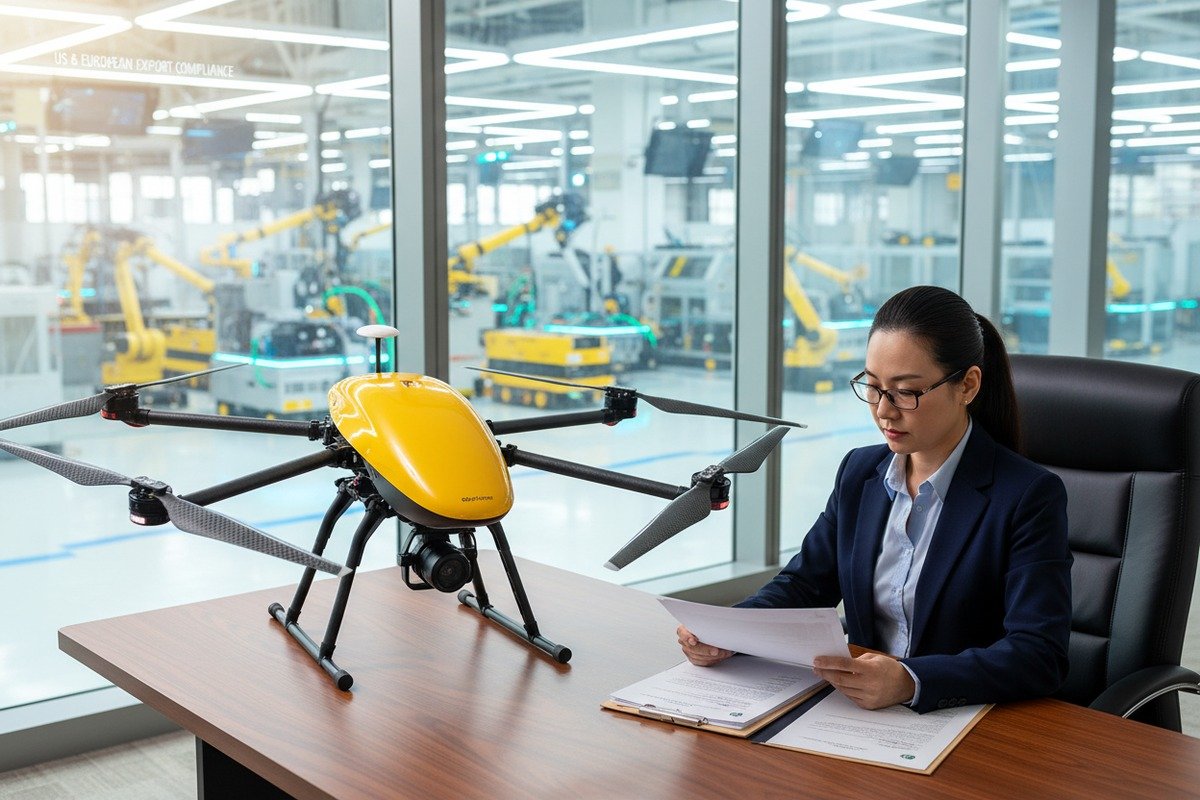
Our export documentation team handles certification questions daily. We understand that importing firefighting equipment into the US or Europe requires specific paperwork that many buyers do not initially realize they need.
Look for ISO 9001 for quality management systems, AS9100 for aerospace-grade manufacturing, CE marking for European compliance, FCC certification for radio equipment, and NDAA compliance documentation for US government procurement eligibility.
Wesentliche Zertifizierungskategorien
Certifications fall into different categories. Some address manufacturing processes. Others address product safety. For firefighting drone accessories, you need both.
| Zertifizierung | Was wird abgedeckt? | Why It Matters for Firefighting |
|---|---|---|
| ISO 9001 | Qualitätsmanagementsystem | Ensures consistent manufacturing processes |
| AS9100 | Aerospace quality standards | Higher reliability requirements than ISO 9001 |
| ISO 21384-3 | UAS manufacturing standards | Drone-specific safety protocols |
| CE-Kennzeichnung | European product safety | Erforderlich für den EU-Marktzugang |
| FCC Part 15/Part 107 | Radio frequency emissions | Legal operation of communication accessories |
| NDAA Compliance | Supply chain transparency | Required for US government sales |
Understanding NDAA Compliance
Die National Defense Authorization Act 5 restricts US government agencies from purchasing equipment with components from certain countries. If your customers include fire departments that receive federal funding, NDAA compliance becomes critical.
We maintain complete component traceability documentation. Every circuit board, sensor, and housing material has origin records. This allows us to provide certificates showing that accessories meet NDAA requirements for government procurement.
Certification Verification Steps
Do not accept certification claims at face value. Request:
- Copies of actual certificates with expiration dates
- Scope statements showing which products are covered
- Audit reports from the certifying body
- Test reports from accredited laboratories
Some manufacturers display ISO logos without current certification. Others hold certification for one product line but not the accessories you need. Always verify scope.
Regional Requirements
Different export markets have different requirements. For US imports, FCC certification matters for any accessory with radio transmission capability. For European imports, CE marking is mandatory. For government contracts, additional security and supply chain requirements apply.
Our team prepares export documentation packages tailored to each destination country. This includes customs classification codes, safety data sheets 6 for battery accessories, and compliance declarations.
How do I ensure the accessories I purchase will maintain stable performance during high-temperature firefighting missions?
When we first deployed thermal imaging payloads near active wildfires, we learned that standard electronics fail quickly. Components rated for 85°C ambient operation cannot survive proximity to fire fronts. This experience shaped our entire approach to thermal engineering.
Ensure stable high-temperature performance by requiring IP45 or higher ingress protection ratings, verifying operating temperature ranges extend to at least 120°F, demanding thermal stress test documentation, and confirming that accessories include active or passive thermal management systems.
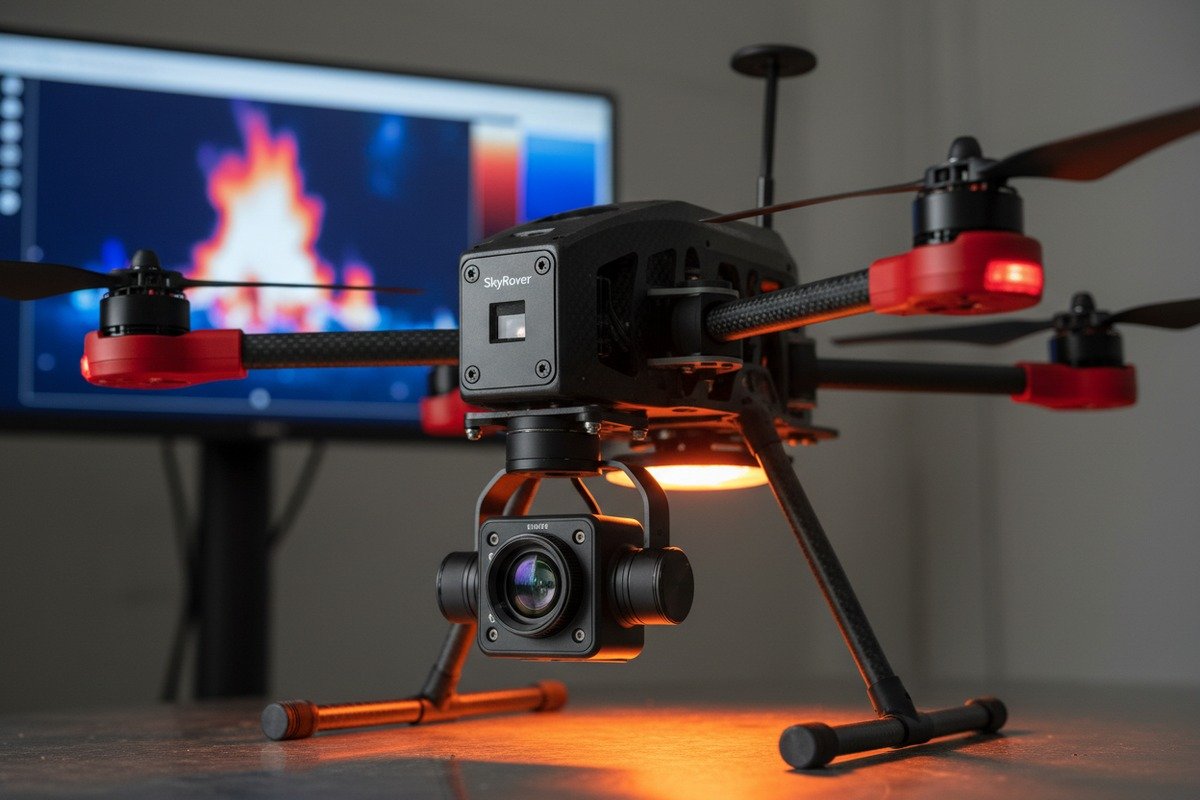
Temperature Rating Fundamentals
Every electronic component has an operating temperature range 7. Consumer-grade parts typically work from -10°C to +50°C. Firefighting accessories need extended ranges. Look for industrial or military-grade components rated to +85°C or higher.
Our thermal imaging payloads use components rated to +105°C. We also add thermal shielding between the sensor and external heat sources. This combination allows sustained operation within 50 meters of active flames.
Critical Thermal Performance Specifications
| Spezifikation | Minimum Akzeptabel | Preferred for Firefighting |
|---|---|---|
| Operating temperature range | -10°C to +50°C | -20°C to +70°C |
| Storage temperature range | -20°C bis +60°C | -40°C to +85°C |
| IP-Einstufung | IP45 | IP54 or IP55 |
| Thermal cycling test | 10 cycles | 100+ cycles |
| Humidity resistance | 80% RH | 95% RH non-condensing |
Thermal Management Technologies
Advanced accessories include thermal management features. These include:
Passive Systems: Heat sinks, thermal pads, thermally conductive housings that dissipate heat without power consumption.
Active Systems: Miniature fans, thermoelectric coolers, or liquid cooling for high-power components like searchlights.
Protective Coatings: Nano-coatings and hydrophobic treatments that prevent moisture ingress while maintaining heat transfer.
When we design payload housings, we use aluminum alloys with high thermal conductivity. This draws heat away from sensitive electronics and radiates it to the air. Carbon fiber frames provide structural strength without adding thermal mass.
Requesting Test Documentation
Ask suppliers for thermal stress test reports. These should show:
- Temperature at which accessories were tested
- Duration of exposure at each temperature
- Performance metrics before and after testing
- Number of thermal cycles completed
A manufacturer who cannot provide this documentation probably has not conducted adequate testing. Our engineering team maintains complete test records for every accessory model, including accelerated aging data that predicts long-term reliability. accelerated aging testing 8
Real-World Validation
Laboratory testing simulates conditions, but field validation confirms performance. Ask manufacturers about actual deployment experience. The DJI Matrice 300 RTK platform, which we support with compatible accessories, has documented wildfire deployment history. Our accessories designed for this platform undergo validation in conditions matching those deployments.
What steps can I take to confirm my supplier provides the necessary documentation and technical support for my imports?
Our export team handles shipments to distributors across the United States and Europe weekly. We have learned that documentation failures cause more import delays than product quality issues. Getting this right protects your timeline and budget.
Confirm documentation and support by requesting sample export document packages before ordering, verifying the supplier has dedicated technical support staff, establishing response time commitments in writing, and confirming availability of spare parts with stated lead times.

Checkliste für wichtige Unterlagen
Before placing an order, request samples of all documentation the supplier will provide. This reveals their export experience and prevents surprises at customs.
| Dokumenttyp | Zweck | Who Requires It |
|---|---|---|
| Handelsrechnung | Declares value and contents | All customs authorities |
| Packliste | Details shipment contents | Freight forwarders, customs |
| Ursprungszeugnis | Proves manufacturing location | Trade agreement compliance |
| Compliance Declaration | Confirms regulatory adherence | FCC, CE, importing agencies |
| Test Reports | Proves product specifications | Quality verification |
| User Manuals | Operating instructions | End users, liability protection |
| MSDS/SDS | Safety data for batteries | Shipping hazardous materials |
Technical Support Evaluation
Technical support capability separates professional suppliers from order-takers. Evaluate support by asking:
-
Response time commitments: What is the guaranteed response time for technical questions? We commit to 24-hour response for urgent issues.
-
Support channels: Email, phone, video conferencing, or on-site visits? Different situations require different channels.
-
Language capability: Can technical staff communicate clearly in English? Miscommunication about technical issues creates safety risks.
-
Documentation quality: Are user manuals clear, complete, and professionally translated?
Spare Parts and Repair Support
Accessories fail eventually. Your supplier relationship extends beyond initial purchase. Verify:
- Spare parts availability and pricing
- Lead times for replacement components
- Repair service options (return-to-manufacturer or field repair kits)
- Warranty terms and claim procedures
We maintain spare parts inventory for all current accessory models. Standard replacement parts ship within 3 business days. This matters when a fire department needs a payload back in service quickly.
OEM and Customization Documentation
If you plan to rebrand accessories with your own company identity, documentation requirements expand. You need:
- Authorization to apply your branding
- Updated compliance documentation reflecting OEM relationship
- Liability allocation agreements
- Custom packaging specifications
Our OEM program includes complete documentation packages. We handle the complexity so our distributors can focus on their customers.
Pre-Order Verification Process
Before committing to a large order, conduct verification:
- Request a sample shipment with full documentation
- Review all documents for accuracy and completeness
- Test the technical support responsiveness with questions
- Verify customs clearance using the provided documents
- Confirm lead times match your project schedule
This verification costs time but prevents expensive problems. A supplier who cannot provide clean documentation for a sample order will not improve at production scale.
Schlussfolgerung
Quality control for firefighting drone accessories demands attention to engineering expertise, certifications, thermal performance, and documentation. Verify each element before committing to a supplier. Your firefighters depend on accessories that work when conditions are worst.
Fußnoten
1. Explains how thermal imaging payloads are used in firefighting drones. ︎
2. Authoritative overview of passive cooling systems, with a more descriptive anchor. ︎
3. Authoritative and comprehensive definition of materials science. ︎
4. Provides a comprehensive definition and explanation of vibration fatigue. ︎
5. Authoritative and comprehensive overview of the National Defense Authorization Act. ︎
6. Authoritative and comprehensive overview of safety data sheets, replacing a broken OSHA link. ︎
7. Explains the concept of operating temperature range for electronic devices. ︎
8. Authoritative overview of accelerated aging testing, with a more descriptive anchor. ︎

 English
  Spanish
  German
  French
  Dutch
Dutch  Arabic
