
Every year, our production line receives drones returned with bearing failures 1 and flight controller damage. The root cause? Poor motor and propeller dynamic balance from the original supplier flight controller damage 2. This hidden defect costs buyers thousands in repairs and mission failures.
To evaluate firefighting drone suppliers, ask about their ISO 21940-11:2016 compliance, target G6.3 balance grade, dynamic balancing test equipment, residual imbalance documentation, motor-propeller combined testing procedures, and re-balancing protocols for field maintenance. Request test reports showing vibration velocity measurements at operational RPMs.
Let me walk you through the exact questions our engineering team uses when qualifying component suppliers G6.3 balance quality grade 3. These questions will help you avoid costly mistakes and ensure your firefighting drones perform reliably in demanding conditions.
What specific dynamic balance grades should I require for my firefighting drone motors?
When we source motors for our heavy-lift firefighting platforms, the balance grade specification is the first item on our checklist. Many buyers overlook this detail and pay the price later with premature component wear and unstable flight characteristics.
You should require G6.3 balance quality grade per ISO 21940-11:2016 for firefighting drone motors. This standard limits vibration velocity to 6.3 mm/s, ensuring smooth operation during high-thrust maneuvers. For premium applications, request G2.5 grade for even lower vibration levels.

Understanding Balance Quality Grades
Balance quality grades 4 measure how much vibration a rotating component produces. The "G" number represents the maximum permissible vibration velocity in millimeters per second. Lower G values mean tighter tolerances and smoother operation.
For firefighting drones, the operating environment is harsh. Motors run at high RPMs while carrying heavy payloads like water tanks or fire suppressant systems. Any imbalance gets amplified under these conditions.
ISO 21940-11:2016 Grade Comparison
| Balance Grade | Vibration Velocity | Typical Application | Suitability for Firefighting |
|---|---|---|---|
| G16 | 16 mm/s | Agricultural equipment | Not recommended |
| G6.3 | 6.3 mm/s | Industrial UAV motors | Minimum acceptable |
| G2.5 | 2.5 mm/s | Precision machinery | Recommended for critical missions |
| G1 | 1 mm/s | High-speed spindles | Premium applications |
Why G6.3 Is the Minimum Standard
Our engineers tested motors at various balance grades under simulated firefighting conditions. Motors rated below G6.3 showed significant bearing wear after just 50 flight hours. The constant vibration loosened fasteners and degraded flight controller sensor accuracy.
At G6.3, motors maintain stable performance through 200+ flight hours before requiring service. This translates directly to lower maintenance costs and higher mission reliability.
Fragen an Ihren Lieferanten
When speaking with potential suppliers, use these specific questions:
- What balance quality grade do your motors achieve?
- Do you test at the actual operating RPM for firefighting applications?
- Can you provide the residual imbalance value in gram-millimeters?
- Is the balance specification listed on your motor datasheet?
If a supplier cannot immediately answer these questions, consider it a red flag. Reputable manufacturers track and document balance quality for every motor batch.
How can I verify that my supplier uses high-standard dynamic balance testing for propellers?
In our quality control department, we reject approximately 15% of propeller shipments from new suppliers due to inadequate balancing. Verification before purchase saves enormous headaches during production.
Verify supplier propeller balancing by requesting test stand specifications, sample test reports with vibration data, video demonstrations of the balancing process, equipment calibration certificates, and traceability records. Reputable suppliers use professional stands like Tyto Robotics Flight Stand 150 with documented procedures.
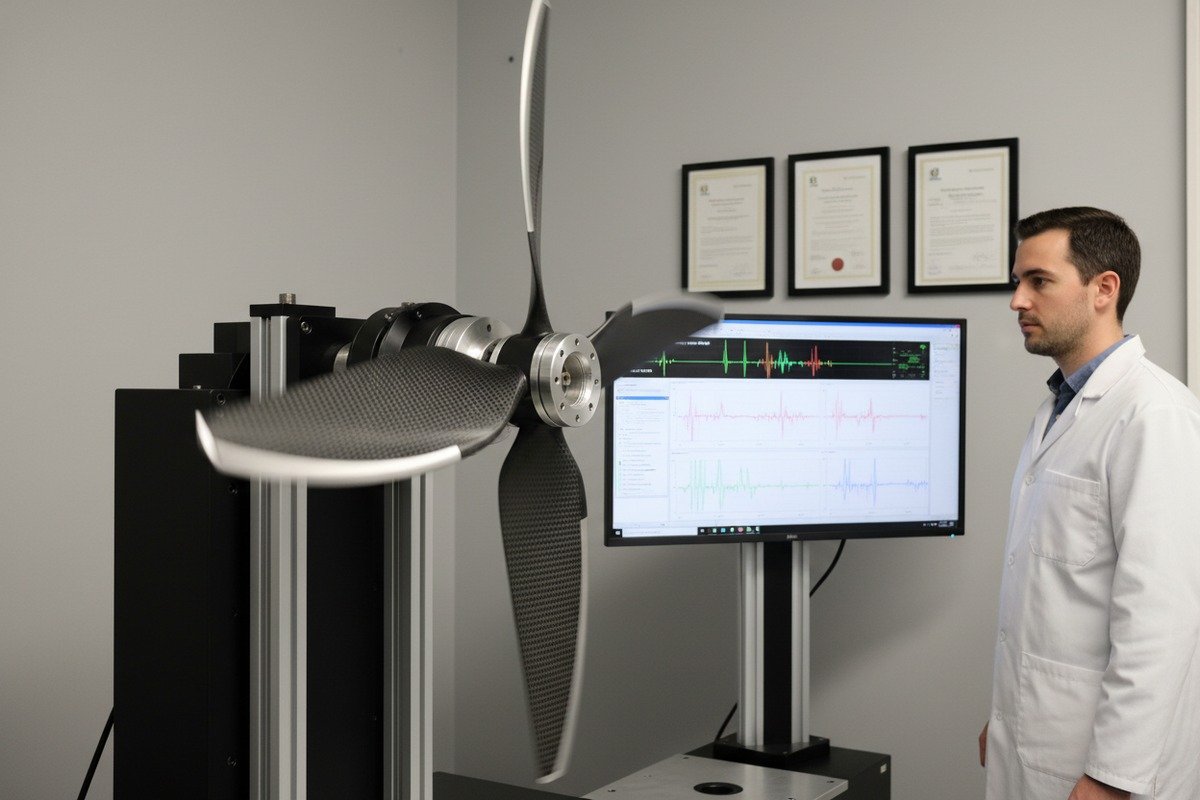
Three Types of Propeller Balancing
Understanding the difference between balancing methods helps you ask better questions.
Static Balancing: The propeller rests on a pivot. Technicians add weights until it sits level. This method detects gross imbalance but misses dynamic issues.
Dynamic Balancing: The propeller spins at operating RPM on a test stand. Sensors measure actual vibration. Technicians adjust until vibration falls below the target threshold.
Aerodynamic Balancing: Each blade's thrust is measured and matched. This ensures uniform lift distribution during rotation.
For firefighting drones, dynamic balancing 6 is essential. Static balancing alone is insufficient for professional applications.
Test Equipment Specifications to Request
| Spezifikation | Minimum Akzeptabel | Premium Standard |
|---|---|---|
| Thrust Range | 10 kgf | 50+ kgf |
| Thrust Resolution | 1 gf | 0.5 gf |
| Thrust Accuracy | ±0.1% | ±0.05% |
| RPM Range | 0-15,000 | 0-30,000 |
| Vibration Measurement | Single-axis | Three-axis |
| Data Logging | Manual | Automatic with timestamps |
Red Flags in Supplier Responses
Watch for these warning signs when evaluating suppliers:
- Claims of "factory balanced" without documentation
- Inability to specify the balance grade achieved
- No test stand photos or specifications available
- Resistance to providing sample test reports
- Static-only balancing claims for industrial propellers
Checkliste für die Überprüfung
Use this checklist when auditing supplier capabilities:
- Request photos of their balancing equipment with brand/model visible
- Ask for calibration certificates with dates
- Request a sample test report from a recent production batch
- Ask about their pass/fail criteria and rejection rate
- Verify they test motor-propeller combinations, not just individual components
Our procurement team always requests a video call to see the balancing process in action. Legitimate suppliers welcome this transparency.
The Cost of Inadequate Verification
One of our distribution partners learned this lesson the hard way. They purchased 200 propeller sets from an unverified supplier to save 20% on costs. Within three months, 40% of their fleet showed flight controller errors from excessive vibration. The repair costs exceeded the initial savings by five times.
Why is motor dynamic balance critical for the long-term durability of my industrial drones?
Our service center data tells a clear story. Drones with properly balanced motors last three times longer than those with marginal balance quality. The physics behind this difference affects every component in your aircraft.
Motor dynamic balance directly impacts bearing lifespan, flight controller accuracy, battery efficiency, and structural integrity. Imbalanced motors create vibration that degrades bearings 60% faster, causes sensor drift in IMUs, wastes 15-20% battery capacity, and loosens airframe fasteners over time.

The Vibration Damage Chain
When a motor has residual imbalance, it creates centrifugal force that oscillates with each rotation. At 5,000 RPM, this means over 80 vibration cycles per second. Every cycle transfers stress to connected components.
Bearings: Motor bearings absorb the most direct impact. Constant vibration causes micro-fractures in bearing races. These eventually lead to increased friction, heat generation, and failure.
Fluglotsen: Modern flight controllers use MEMS accelerometers and gyroscopes 7. These sensors are sensitive to vibration. Excessive motor vibration corrupts sensor data, causing flight instability and the dreaded "toilet bowl" effect in hover.
Batterien: Vibration forces motors to work harder to maintain stable flight. This draws more current and generates more heat. Our testing shows poorly balanced motors reduce flight time by 15-20%.
Component Lifespan Comparison
| Komponente | Balanced Motor (G6.3) | Unbalanced Motor (G16+) | Lifespan Reduction |
|---|---|---|---|
| Motor Bearings | 400+ flight hours | 150 flight hours | 62% |
| Flugregler | 1,000+ flight hours | 600 flight hours | 40% |
| ESC Capacitors | 800+ flight hours | 500 flight hours | 37% |
| Propeller Mounts | 600+ flight hours | 300 flight hours | 50% |
| Airframe Fasteners | Rarely loosen | Monthly retorque needed | Ongoing maintenance |
The Camera "Jello Effect"
For firefighting drones with imaging payloads, motor balance affects data quality. Vibration causes rolling shutter distortion 8 in video footage. This appears as a wobbly, jello-like effect that makes thermal imaging unreliable.
In firefighting operations, clear thermal imaging can mean the difference between locating trapped victims and missing them entirely. No gimbal can fully compensate for excessive motor vibration.
Environmental Factors in Firefighting
Firefighting drones face conditions that amplify balance problems:
- Heat: Motors near fire zones experience temperature swings that expand and contract materials unevenly
- Debris: Smoke particles and ash can deposit on propeller surfaces, changing balance
- Luftfeuchtigkeit: Water droplets from firefighting spray add temporary mass to propeller blades
- Wind: Gusts require rapid thrust changes that stress already-compromised bearings
These factors make starting with excellent balance even more critical. Drones entering firefighting missions need every possible margin of safety.
Calculating the True Cost
Consider the total cost of ownership for a fleet of ten firefighting drones:
With G6.3 balanced motors:
- Annual bearing replacements: 2-3 per fleet
- Flight controller issues: Rare
- Average maintenance hours: 50 per year
With poorly balanced motors:
- Annual bearing replacements: 8-12 per fleet
- Flight controller issues: Monthly calibration needed
- Average maintenance hours: 150 per year
The initial savings from cheaper, poorly balanced motors disappear quickly when maintenance costs triple.
What technical documentation should I request to ensure my OEM drone meets strict vibration standards?
When we prepare OEM shipments for our partners in the United States and Europe, documentation completeness determines whether products clear customs smoothly and satisfy end customers. Proper paperwork protects everyone in the supply chain.
Request motor balance test reports with G-value specifications, propeller balance certificates with residual imbalance measurements, equipment calibration records, ISO 21940-11:2016 compliance statements, batch traceability documents, and re-balancing procedure guidelines. All documents should include dates, technician signatures, and serial number references.

Checkliste für wichtige Unterlagen
Building a complete documentation package requires requesting specific items. Here is what our quality team requires from every component supplier:
Motor Documentation Requirements
| Dokumenttyp | Key Information | Zweck |
|---|---|---|
| Balance Test Report | G-value, test RPM, residual imbalance | Proves balance quality achieved |
| Calibration Certificate | Equipment model, calibration date, next due date | Validates test accuracy |
| Material Certificate | Rotor material, magnet grade, bearing type | Ensures consistent quality |
| Production Batch Record | Date, operator ID, inspection results | Enables traceability |
| Compliance Declaration | Standards referenced, authorized signature | Legal protection |
Propeller Documentation Requirements
Propellers need equally thorough documentation:
- Dynamic Balance Report: Shows vibration velocity at test RPM
- Material Test Certificate: Carbon fiber layup specifications
- Dimensional Inspection Report: Blade pitch, diameter, weight
- Batch Traceability: Links propeller to specific production run
- Storage and Handling Guidelines: Prevents damage before installation
Reading a Balance Test Report
Understanding test reports helps you spot problems. A proper report should include:
- Test Date: Should be recent, within the production window
- Equipment Used: Brand, model, and last calibration date
- Test Conditions: RPM, temperature, mounting configuration
- Before/After Values: Shows improvement from balancing process
- Pass/Fail Determination: Clear statement against specified standard
- Technician Identification: Name or ID for accountability
Sample Acceptance Criteria Table
Use this table when establishing quality requirements with your supplier:
| Parameter | Acceptance Limit | Measurement Method |
|---|---|---|
| Vibration Velocity | ≤6.3 mm/s | Dynamic balance stand |
| Residual Imbalance | Per ISO 21940-11 formula | Calculated from test data |
| Thrust Deviation | ≤2% from nominal | Calibrated thrust stand |
| RPM Stability | ±50 RPM at set point | Optical tachometer |
| Temperature Rise | ≤40°C after 5-minute run | Thermal probe |
Documentation for Re-Balancing Protocols
Firefighting drones require field maintenance. Your documentation package should include:
- Re-balancing interval recommendations
- Procedures after propeller replacement
- Field inspection checklists
- Criteria for returning motors for factory service
- Warranty terms related to balance maintenance
Working with OEM Branding
If you're private-labeling firefighting drones, ensure documentation transfers properly:
- Original test reports should reference part numbers, not brand names
- Your company can add branded cover sheets
- Keep original certificates on file for warranty claims
- Include your contact information for technical support
Our engineering team creates comprehensive documentation packages for every OEM partner. This transparency builds trust and reduces support calls after delivery.
Storing Documentation Properly
Create a digital archive organized by:
- Serial number
- Production date
- Component type
- Supplier name
This organization proves invaluable when troubleshooting problems or processing warranty claims months after purchase.
Schlussfolgerung
Asking the right questions about motor and propeller dynamic balance protects your investment in firefighting drones. Focus on ISO 21940-11 compliance, G6.3 minimum standards, proper test documentation, and clear re-balancing protocols. Your supplier's answers reveal their true quality commitment.
Fußnoten
1. Explains common causes of bearing failure in rotating machinery. ︎
2. Provides troubleshooting for common flight controller issues and potential damage. ︎
3. Defines the G6.3 balance quality grade and its significance. ︎
4. Explains the concept of ISO balance quality grades with examples. ︎
5. Details the ISO standard for balancing tolerances and its impact. ︎
6. Describes the process and benefits of dynamic balancing in industrial applications. ︎
7. Authoritative source providing a clear explanation of MEMS accelerometers and gyroscopes. ︎
8. Defines rolling shutter effect and its visual distortions in video. ︎

 English
  Spanish
  German
  French
  Dutch
Dutch  Arabic
