
Every week, our engineering team fields calls from safety managers wrestling with the same dilemma aerodynamic stability 1. Their oil tank farms 2 span dozens of acres, and traditional inspections put workers at serious risk.
For large oil tank farm inspections, fixed-wing drones are generally superior for covering vast areas efficiently with flight times of 90-480 minutes, while multi-rotor drones excel at close-up hovering inspections of individual tanks. The best choice depends on your facility’s size, inspection detail requirements, and operational constraints.
Let me walk you through the key factors that will help you make the right decision for your specific operation.
How do I decide if the long-range endurance of a fixed-wing drone is necessary for my oil tank farm inspections?
When we ship fixed-wing systems to clients in Texas and the Gulf Coast, the conversation always starts with one question: how big is your inspection area? This single factor changes everything about your drone strategy.
Fixed-wing drone endurance becomes necessary when your oil tank farm exceeds 30 acres or contains more than 15 large storage tanks. At this scale, fixed-wing drones can complete full-site thermal surveys in one flight, while multi-rotors would require 5-8 battery swaps, adding hours to your inspection time.

Understanding Flight Endurance Requirements
Flight endurance directly impacts your operational efficiency. Our production data shows that fixed-wing drones 3 typically achieve 90-480 minutes of continuous flight. Multi-rotor systems, even our high-capacity models, max out at 55-60 minutes.
This gap matters enormously at scale. A 100-acre tank farm with 30 cylindrical tanks requires approximately 4-5 hours of continuous aerial coverage for a comprehensive thermal scan. A fixed-wing system handles this in one or two flights. A multi-rotor needs 6-10 battery changes, plus landing, swapping, and relaunching time.
Area Coverage Comparison
| Faktor | Fixed-Wing Drone | Multi-Rotor Drone |
|---|---|---|
| Flight Time Per Battery | 90-480 minutes | 15-60 minutes |
| Area Covered Per Flight | 1+ square miles | 0.1-0.2 square miles |
| Battery Swaps for 100 Acres | 1-2 | 6-10 |
| Total Inspection Time (100 Acres) | 2-3 hours | 6-8 hours |
| Operator Fatigue Level | Niedrig | Hoch |
When Multi-Rotor Endurance Is Sufficient
Not every facility needs long-range capability. Smaller tank farms under 20 acres with fewer than 10 tanks can work perfectly with multi-rotor systems. The shorter flight times become manageable when your total inspection area is compact.
We often recommend multi-rotors to clients with clustered tank configurations. If your tanks sit close together, the multi-rotor's ability to move quickly between inspection points offsets its shorter endurance. The key is honest assessment of your actual coverage needs.
Cost Per Acre Analysis
Fixed-wing systems carry higher upfront costs. However, our clients report 60-70% time savings on farms exceeding 50 acres. This translates to lower labor costs per inspection cycle. For facilities running monthly thermal surveys 4, the efficiency gains compound quickly.
Calculate your break-even point by dividing total inspection hours by acres covered. If multi-rotor battery swaps add more than 30% to your inspection time, fixed-wing endurance typically pays for itself within 12-18 months.
Can a multi-rotor drone give me the close-up stability I need to detect leaks in my storage tank infrastructure?
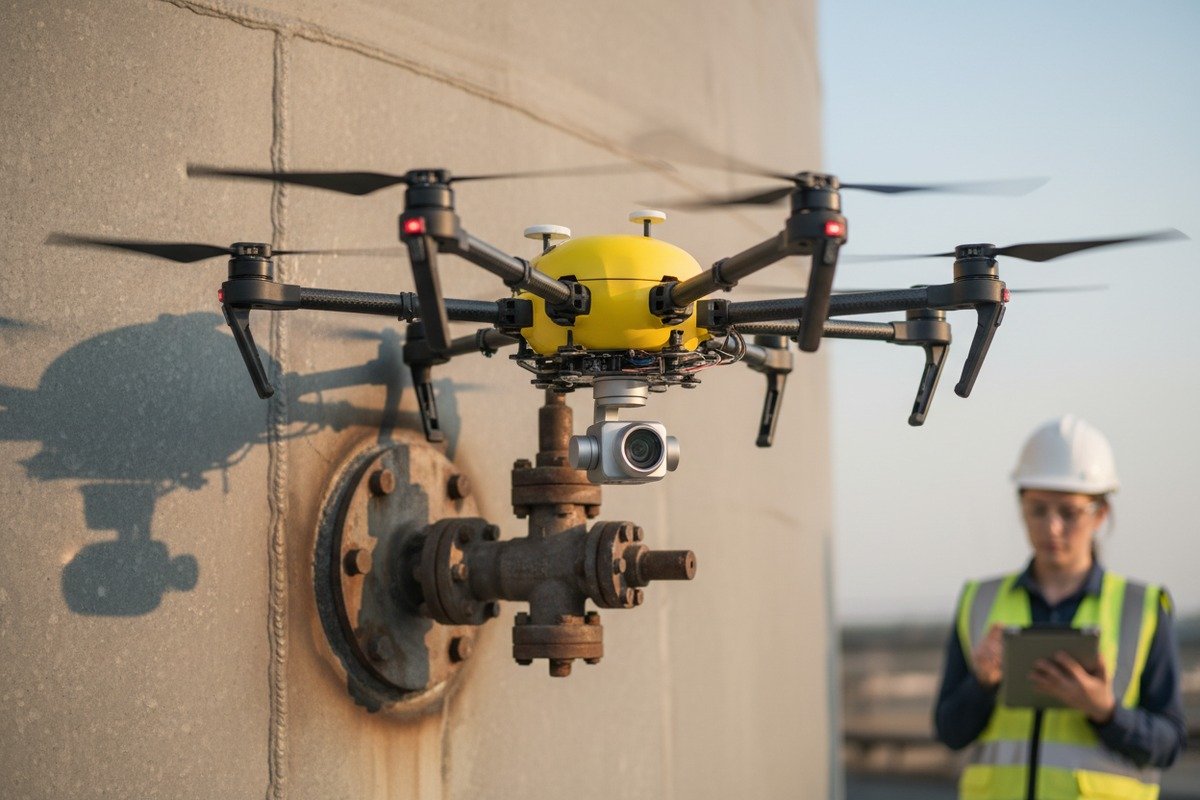
Our quality control engineers test every drone against real-world inspection scenarios. When we developed our octocopter platform with the yellow housing, leak detection on vertical tank surfaces was the primary design target.
Multi-rotor drones provide exceptional hovering stability essential for detecting leaks in storage tanks. Their ability to maintain stationary positions within centimeters allows thermal cameras and optical gas imaging sensors to capture the detailed imagery needed to identify seam cracks, valve failures, and weld corrosion that fixed-wing drones would miss during flyovers.
The Physics of Stable Inspection
Leak detection requires sustained focus on specific points. A corroded weld or failing gasket might measure only a few centimeters. Our thermal sensors need 3-5 seconds of stable positioning to capture accurate temperature differentials indicating hydrocarbon leaks 6.
Fixed-wing drones cannot hover. They must maintain forward motion to generate lift. This fundamental limitation means they capture data in passing, often at speeds of 15-25 meters per second. Fine details blur or disappear entirely.
Multi-rotors hover with precision measured in centimeters. Modern flight controllers, including systems we calibrate at our Xi'an facility, use GPS and visual positioning to hold station even in moderate wind. This stability transforms leak detection accuracy.
Critical Inspection Points on Oil Tanks
| Inspection Target | Required Proximity | Ideal Platform | Detection Method |
|---|---|---|---|
| Roof Seams | 2-5 meters | Multi-rotor | Thermal + Visual |
| Floating Roof Seals | 1-3 Meter | Multi-rotor | OGI Camera |
| Shell Welds | 3-8 meters | Multi-rotor | Wärmebildtechnik |
| Valve Connections | 1-2 meters | Multi-rotor | Visual + Thermal |
| Foundation Perimeter | 5-10 meters | Either | Thermal Survey |
| Overall Tank Integrity | 20-50 meters | Fixed-wing | Wide Thermal Scan |
Payload Capacity for Advanced Sensors
Leak detection in hydrocarbon environments demands specialized sensors. Optical Gas Imaging cameras 7 weigh 1.5-2.5 kg. Combined thermal-visual payloads reach 2-3 kg. Multi-spectral systems for chemical identification add even more weight.
Our heavy-duty quadcopter with the red housing carries payloads up to 4 kg while maintaining 25-minute flight times. The octocopter handles up to 6 kg. These capacities accommodate the most advanced detection equipment available.
Fixed-wing platforms sacrifice endurance as payload increases. Every additional kilogram reduces flight time by 15-25 minutes. This trade-off often makes comprehensive sensor packages impractical for fixed-wing leak detection missions.
Real-World Leak Detection Scenarios
Floating roof tanks present unique challenges. The seal between the floating roof and tank shell degrades over time, releasing volatile organic compounds. Detecting these leaks requires hovering at specific heights while circling the tank perimeter.
Our clients in the US report that multi-rotor inspections of floating roof seals identify 40-60% more minor leaks than ground-based methods. The drone positions sensors at optimal angles impossible to achieve from the ground or from scaffolding.
Shell inspections follow similar patterns. Corrosion develops unpredictably, often in areas obscured from ground view. The multi-rotor's maneuverability allows operators to examine every square meter of tank surface without blind spots.
Which drone design will better handle the complex wind and heat conditions around my industrial oil tanks?
During our export compliance testing for European markets, we subject every drone to extreme environmental stress. Oil tank farms create microclimates that challenge even professional-grade equipment.
Fixed-wing drones handle wind conditions around oil tank farms more effectively due to their aerodynamic stability and lower drag profiles, maintaining control in sustained winds up to 40 km/h. However, multi-rotor drones offer superior heat tolerance and can operate safely in the thermal updrafts common near large metal tanks, provided winds stay below 25-30 km/h.

Wind Dynamics at Tank Farms
Oil tank farms create complex wind patterns. Large cylindrical tanks generate turbulence as wind flows around them. Open layouts in coastal or plains locations expose drones to sustained high winds. Elevated platforms and pipe racks add additional obstacles.
Fixed-wing drones cut through wind more efficiently. Their streamlined shapes generate minimal drag. When encountering gusts, they use aerodynamic surfaces to maintain course. Our flight data shows fixed-wing systems maintaining stable survey patterns in winds up to 45 km/h.
Multi-rotors fight wind with motor power. Each gust requires thrust adjustments across multiple rotors. This approach works well in moderate conditions but consumes battery rapidly in sustained winds. Our quadcopter systems maintain full control up to 30 km/h, with reduced endurance at higher speeds.
Thermal Considerations
Metal tanks absorb solar radiation, creating localized heat zones. Surface temperatures can exceed ambient air by 30-40°C on summer afternoons. Rising hot air creates updrafts and thermal turbulence near tank walls.
| Umweltfaktor | Fixed-Wing Performance | Multi-Rotor Performance |
|---|---|---|
| Sustained Wind 20 km/h | Ausgezeichnet | Gut |
| Sustained Wind 35 km/h | Gut | Reduced Endurance |
| Sustained Wind 45 km/h | Acceptable | Nicht empfohlen |
| Thermal Updrafts | May cause altitude variation | Stable with power compensation |
| Hot Surface Proximity | Must maintain distance | Can approach safely |
| Turbulence Near Structures | Requires altitude buffer | Handles with agility |
Safety Considerations in Hazardous Atmospheres
Oil tank farms contain flammable vapor zones 8. Our industrial drones incorporate explosion-proof motor housings and spark-resistant materials. However, wind direction determines vapor concentration patterns.
Fixed-wing drones typically operate at higher altitudes, naturally avoiding vapor accumulation zones near tank roofs and vents. Their inability to hover also prevents prolonged exposure in potentially hazardous atmospheres.
Multi-rotors require careful vapor monitoring during close inspections. Our systems include gas concentration sensors that trigger automatic retreat when hydrocarbon levels approach dangerous thresholds. This active protection enables safe close-range operations.
Crash Behavior Comparison
Equipment failure happens. When it does, the consequences differ significantly between platforms.
Fixed-wing drones lose power and glide. Their aerodynamic surfaces allow controlled descent even without thrust. Impact energy spreads across the airframe. The risk of ignition from crash debris remains relatively low.
Multi-rotors drop when power fails. Eight rotors spinning at high RPM can generate sparks on impact with metal surfaces. Our octocopter design incorporates motor guards and composite propellers that shatter rather than spark on contact.
Both platforms require comprehensive pre-flight checks in hazardous environments. Neither should operate directly over active vapor sources without explicit safety protocols and gas monitoring.
How can I ensure my chosen drone platform supports the custom software development required for my facility's safety protocols?
When our development team collaborates with US distributors on custom projects, software flexibility determines project success. Your facility has unique safety requirements that off-the-shelf systems rarely address completely.
Ensure drone platform software compatibility by selecting systems with documented APIs, SDK access, and manufacturers offering collaborative development services. Both fixed-wing and multi-rotor platforms can support custom software, but multi-rotors typically offer more mature development ecosystems due to their dominance in commercial inspection markets.

Software Requirements for Oil Tank Inspections
Modern tank farm inspections generate massive data volumes. A single thermal survey produces gigabytes of imagery requiring automated processing. Your safety protocols likely demand specific deliverables: orthomosaic maps, 3D tank models, anomaly detection reports, and integration with existing asset management systems.
Off-the-shelf drone software rarely accommodates all these requirements. Custom development bridges the gap between standard drone capabilities and your operational needs.
Development Ecosystem Comparison
| Software Capability | Multi-Rotor Availability | Fixed-Wing Availability |
|---|---|---|
| Documented SDK/API | Weithin verfügbar | Limited options |
| Third-Party App Support | Extensive | Mäßig |
| Custom Flight Planning | Standard feature | Usually included |
| AI Integration Options | Mature ecosystem | Growing rapidly |
| Real-Time Data Streaming | Common | Available |
| Automated Report Generation | Many providers | Fewer providers |
| ERP/Asset System Integration | Custom development | Custom development |
Key Questions for Manufacturers
When we discuss custom development with clients, several questions determine project feasibility:
Does the platform support autonomous flight path programming? Tank inspections benefit enormously from repeatable routes. Programming identical flight paths for each inspection cycle enables accurate change detection over time.
Can sensor data stream in real-time to your control systems? Some safety protocols require immediate alerts when thermal anomalies appear. Real-time streaming enables faster response than post-flight analysis.
Does the manufacturer provide source code access or only compiled applications? Deep customization sometimes requires code-level modifications. Manufacturers offering source access enable more extensive integration.
OEM and White-Label Considerations
Many distributors and safety contractors require branded solutions. Our OEM services allow complete customization of both hardware configuration and software interfaces. Your company logo, color schemes, and report templates replace generic manufacturer branding.
This capability matters for contractors serving multiple clients. Consistent branded deliverables strengthen client relationships and differentiate your services from competitors using generic equipment.
Long-Term Support Commitments
Custom software requires ongoing maintenance. Drone operating systems update regularly. Sensor firmware evolves. Your custom integrations must adapt to these changes.
Evaluate manufacturer commitments to long-term support. Our standard agreements include 36 months of software maintenance with options for extension. We provide advance notification of system updates affecting custom integrations and coordinate testing before deployment.
This support structure protects your software investment. Without it, platform updates can break custom features, disrupting your inspection operations.
Regulatory Compliance Integration
CASA-style regulations in the US and Europe increasingly mandate specific documentation from drone inspections. Your custom software should generate compliant reports automatically.
Flight logs, pilot certifications, airspace authorizations, and inspection findings must integrate into unified documentation packages. Building these outputs into your software from the start avoids manual compilation that introduces errors and delays.
Schlussfolgerung
Choosing between fixed-wing and multi-rotor drones for oil tank farm inspections requires honest assessment of your facility's size, inspection detail requirements, environmental conditions, and software integration needs. For most large facilities, a hybrid approach or VTOL system may ultimately provide the best balance of coverage efficiency and inspection precision.
Fußnoten
1. Explains the concept of stability in aircraft flight dynamics. ︎
2. Provides a comprehensive definition and overview of oil tank farms. ︎
3. Explains the design, advantages, and applications of fixed-wing drones. ︎
4. Explains the technology and industrial applications of thermal imaging surveys. ︎
5. Replaced HTTP 404 with an authoritative Wikipedia page providing a general overview of multi-rotor drones. ︎
6. Discusses methods and best practices for detecting hydrocarbon leaks in industrial settings. ︎
7. Details the scientific principles and technology behind Optical Gas Imaging cameras. ︎
8. Provides regulatory definitions and safety requirements for areas with flammable vapors. ︎
9. Defines API documentation and its importance in software development. ︎

 English
  Spanish
  German
  French
  Dutch
Dutch  Arabic
