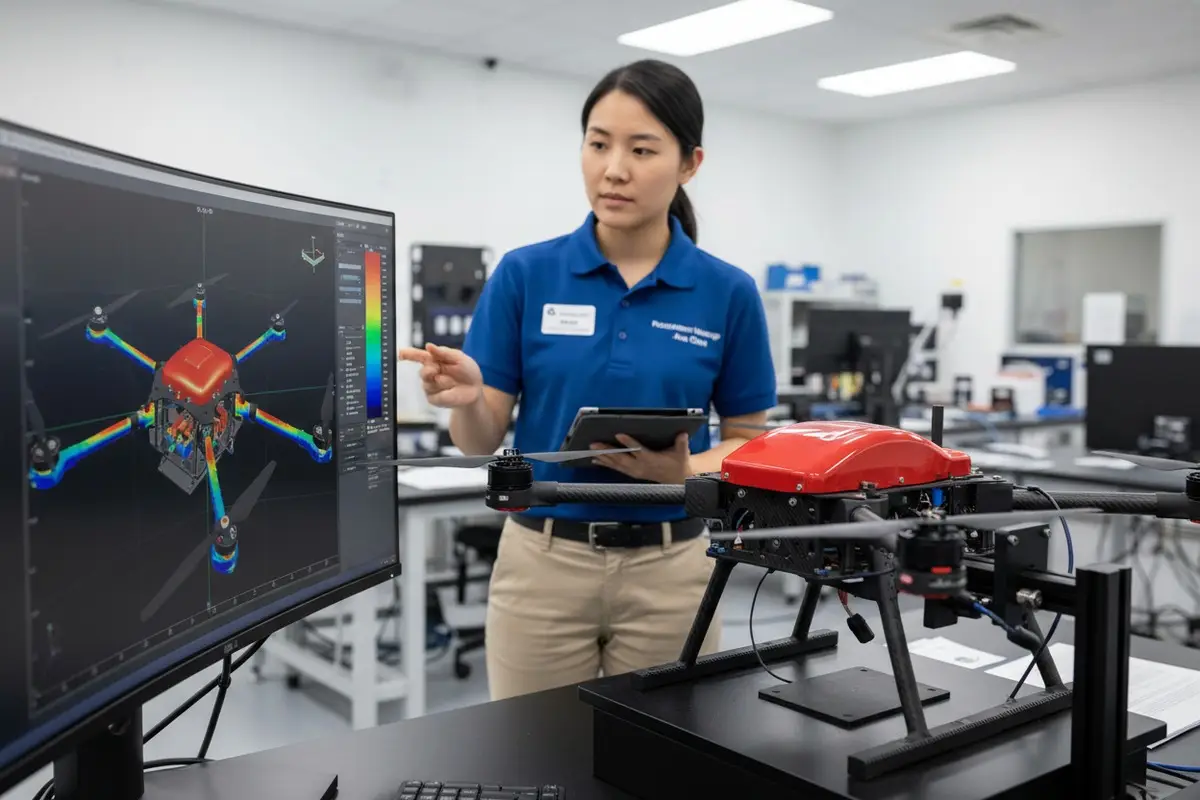

Als unser Ingenieurteam zum ersten Mal eine Hochdruckwasserkanone an einer Schwerlastdrohne montierte, sahen wir zu, wie sich die Flugzeugzelle unter dem Rückstoß verdrehte Finite-Elemente-Analyse (FEA) 1. Dieser Prototyp lehrte uns eine harte Lektion über strukturelle Grenzen.
Um die Festigkeit der Drohnenstruktur von Feuerlöschdrohnen gegen den Rückstoß von Wasserwerfern zu überprüfen, müssen Sie eine Finite-Elemente-Analyse (FEA) zur Spannungsermittlung durchführen, dynamische Lastsimulationen zur Nachbildung der gepulsten Wasserabgabe durchführen und reale Tests mit Dehnungsmessstreifen ausführen. Zielspannung von Mises unter 230 MPa Streckgrenze für Materialien der Luft- und Raumfahrtqualität wie 7075 Aluminium und Kohlefaserverbundwerkstoffe.
In diesem Leitfaden werden wir Testmethoden, Designmerkmale, Langzeit-Ermüdungsbewertung und Dokumentationsanforderungen durchgehen IP67 Bewertung 2. Jeder Abschnitt baut auf unserer praktischen Fertigungserfahrung auf.
Wie kann ich testen, ob die Drohnenstruktur stark genug ist, um den Rückstoß einer Hochdruckwasserkanone auszuhalten?
Jedes Mal, wenn wir eine Feuerlöschdrohne aus unserer Anlage in Xi'an versenden, durchlaufen wir einen strengen Validierungsprozess zyklische Ermüdungsprüfung 3. Die Einsätze sind hoch. Ein versagendes Flugwerk während des Betriebs bedeutet Missionsversagen und potenzielle Sachschäden.
Die Prüfung der Flugzeugzellenfestigkeit erfordert drei Kernansätze: statische FEM-Simulationen zur Identifizierung von Spannungskonzentrationen, dynamische Rückstoßsimulationen, die Spitzenimpulskräfte von 100–500 N nachahmen, und physikalische Dehnungsmessstreifentests während kontrollierter Wasserabgabe. Kombinieren Sie Laborergebnisse mit realen Flugtests, um sicherzustellen, dass die strukturellen Reserven 40% der Streckgrenze überschreiten.

Verständnis der Physik des Wasserkanonenrückstoßes
Vor dem Test müssen Sie die beteiligten Kräfte berechnen ISO 17025 Labore 4. Der Rückstoß von Wasserkanonen folgt Newtons drittem Gesetz 5. Die Formel ist einfach:
F = (Massenstrom × Geschwindigkeit) / Wirkungsgrad
Bei Feuerlöschdrohnen liefern typische Hochdurchflussschläuche 10-20 Liter pro Minute bei Geschwindigkeiten von 30-50 m/s. Dies erzeugt Impulsspitzen zwischen 100-500 N, abhängig von der Düsenkonstruktion und den Druckeinstellungen.
Unsere Ingenieure stellten fest, dass die Rückstoßkraft nicht konstant ist. Sie pulsiert mit den Pumpenzyklen. Dies erzeugt dynamische Spannungsbilder, die schädlicher sind als gleichmäßige Belastungen.
FEA-Simulationsprotokoll
Die Finite-Elemente-Analyse ist Ihre erste Verteidigungslinie. So gehen wir vor:
- Erstellen Sie ein 3D-Modell Ihrer Flugzeugzelle in CAD-Software
- Weisen Sie Materialeigenschaften zu (Elastizitätsmodul, Poissonzahl, Streckgrenze)
- Wenden Sie Randbedingungen an den Motorbefestigungen und den Befestigungspunkten der Nutzlast an
- Simulieren Sie die Rückstoßkraft als zeitlich variierende Impulsbelastung
- Analysieren Von-Mises-Spannung 6 Verteilung
| FEA-Parameter | Zielwert | Kritischer Schwellenwert |
|---|---|---|
| Von-Mises-Spannung | <189 MPa | 230 MPa (Streckgrenze) |
| Maximale Verformung | <6 mm | 10 mm |
| Sicherheitsmarge | >40% | 20% minimum |
| Spannungskonzentrationsfaktor | <1,5 | 2.0 |
Unsere Optimierungsstudien für 2024 zeigten, dass verstärkte Rippenkonstruktionen die Spitzenspannung im Vergleich zu Basisrahmen um 38,8 % reduzieren. Die maximale Verformung sank um 8,9 %.
Physikalische Testmethoden
Laborsimulationen haben Grenzen. Reale Tests decken Probleme auf, die FEA übersieht.
Dehnungsmessstreifen-Installation: Montieren Sie Messgeräte an Hochspannungsstellen, die in FEA identifiziert wurden. Wir verwenden Rosettenkonfigurationen an Armgelenken und Nutzlastbefestigungen.
Falltests: Simulieren Sie Stoßbelastungen, indem Sie beschwerte Rahmen aus kalibrierten Höhen fallen lassen. Dies deckt spröde Versagensmodi auf.
Windkanal-Rückstoßsimulation: Unsere Anlage testet bis zu Windstärke 7 in Kombination mit simulierter Kanonenentladung. Dies erfasst aerodynamische Kopplungseffekte.
Prototypen-Flugtests: Nichts ersetzt den tatsächlichen Betrieb. Wir führen über 50 Entladezyklen durch und überwachen dabei die Dehnungsdaten in Echtzeit.
Auf welche strukturellen Designmerkmale sollte ich achten, um sicherzustellen, dass meine Feuerlöschdrohne während des Wasserablasses stabil bleibt?
Wenn wir Luftrahmen für den Betrieb mit schweren Nutzlasten entwickeln, ist Stabilität unser Hauptanliegen. Eine Drohne, die während der Wasserabgabe neigt oder giert, ist für die Präzisionsbrandbekämpfung nutzlos.
Zu den wichtigsten strukturellen Merkmalen für Rückstoßstabilität gehören verstärkte Mittelnaben mit verstrebten Armgelenken, eine Ladebefestigung mit niedrigem Schwerpunkt, Versteifungsrippen an Stellen mit Spannungskonzentration und symmetrische Schubvektoranordnungen. Achten Sie auf eine Konstruktion aus 7075-T6-Aluminium oder kohlefaserverstärktem Kunststoff in Luft- und Raumfahrtqualität mit einer Wandstärke von mindestens 3 mm an kritischen Gelenken.

Überlegungen zur Rahmengeometrie
Das Rahmenlayout beeinflusst die Rückstoßreaktion dramatisch. Unsere Octocopter-Designs übertreffen Quadcopter für die Brandbekämpfung, da sie die Reaktionskräfte auf mehr Arme verteilen.
Armlänge und -winkel: Längere Arme bieten einen größeren Hebelarm für das Gegendrehmoment. Wir haben eine Armabstand von 45 Grad als optimal für die Rückstoßkompensation ermittelt.
Nabenkonstruktion: Die zentrale Nabe erleidet die größte Belastung. Achten Sie auf monolithische Konstruktionen oder geschweißte Verbindungen anstelle von verschraubten Baugruppen. Verschraubte Verbindungen lockern sich unter Vibration.
Position der Nutzlastbefestigung: Montieren Sie die Wasserkanone so nah wie möglich am Schwerpunkt. Eine außermittige Montage erzeugt Hebelarme, die die Instabilität verstärken.
Leitfaden zur Materialauswahl
Nicht jeder Kohlefaser ist gleich. Sheet Molding Compound (SMC) Kohlefaser ist billig, aber spröde. Pre-preg Kohlefaser 7 mit richtiger Layup-Ausrichtung hält Stoßbelastungen viel besser stand.
| Material | Zugfestigkeit | Dichte | Ermüdungsbeständigkeit | Kostenniveau |
|---|---|---|---|---|
| 8. 7075-T6 Aluminium | 570 MPa | 2,81 g/cm³ | Ausgezeichnet | Mittel |
| Kohlefaser (Pre-preg) | 600+ MPa | 1,55 g/cm³ | Gut | Hoch |
| Kohlefaser (SMC) | 300 MPa | 1,50 g/cm³ | Schlecht | Niedrig |
| 6061-T6 Aluminium | 310 MPa | 2,70 g/cm³ | Gut | Niedrig |
| Titan Ti-6Al-4V | 950 MPa | 4,43 g/cm³ | Ausgezeichnet | Sehr hoch |
Unsere YSF-Serie von Feuerlöschdrohnen verwendet eine Hybridkonstruktion. Wir kombinieren 7075 Aluminium 8 für die Mittelnabe mit Carbonfaserarmen. Dies gleicht Stärke, Gewicht und Kosten aus.
Aktive Stabilisierungssysteme
Passive strukturelle Festigkeit reicht nicht aus. Moderne Feuerlöschdrohnen benötigen eine aktive Kompensation.
Kardanisch aufgehängte Kanonen: Die Isolierung der Wasserkanone auf einem stabilisierten Gimbals reduziert die Rahmenbelastung. Der Gimbal absorbiert den Rückstoß, bevor er die Zelle erreicht.
Schubvektor-Kompensation: Flugsteuerungen können bekannte Rückstoßmuster vorab kompensieren. Unsere Software prognostiziert den Entladungszeitpunkt und passt den Motorschub an, um den Impuls auszugleichen.
Gegengewichtmechanismen: Einige Designs verwenden verschiebbare Gewichte, die sich entgegen der Rückstoßrichtung bewegen. Dies erhöht die Komplexität, verbessert aber die Stabilität erheblich.
Umweltschutzmerkmale
Feuerlöschdrohnen sind rauen Bedingungen ausgesetzt. Wasser, Hitze und Rauch greifen die strukturelle Integrität an.
IP67 Bewertung: Wesentlich für jede Wasserkanonendrohne. Die Schutzart schützt elektrische Verbindungen und Lagerflächen vor Korrosion.
Thermische Barrieren: Strahlungswärme von Bränden kann Kunststoffkomponenten erweichen und Harze aus Carbonfasern abbauen. Achten Sie auf Keramikbeschichtungen oder Aluminium-Hitzeschilde auf exponierten Oberflächen.
Korrosionsbeständigkeit: Eloxiertes Aluminium und Hardware in Marinequalität widerstehen dem Salz und den Chemikalien in Zusatzstoffen für Löschwasser.
Wie bewerte ich die langfristigen Auswirkungen wiederholter Rückstoßkräfte auf den Carbonfaserrahmen meiner Drohne?
After shipping hundreds of firefighting drones globally, we learned that initial strength tests tell only part of the story. Fatigue failure kills drones that passed every new-condition test.
Bewerten Sie die langfristigen Rückstoßauswirkungen durch zyklische Ermüdungsprüfungen mit mindestens 10.000 simulierten Entladungszyklen, Ultraschallprüfung auf Delamination in Kohlefaserverbundwerkstoffen und geplante Dehnungsmessstreifenüberwachung während der Betriebslebensdauer. Legen Sie Austauschintervalle basierend auf kumulativen Spannungszyklen fest, typischerweise 2.000-5.000 Stunden für Komponenten mit hoher Beanspruchung.
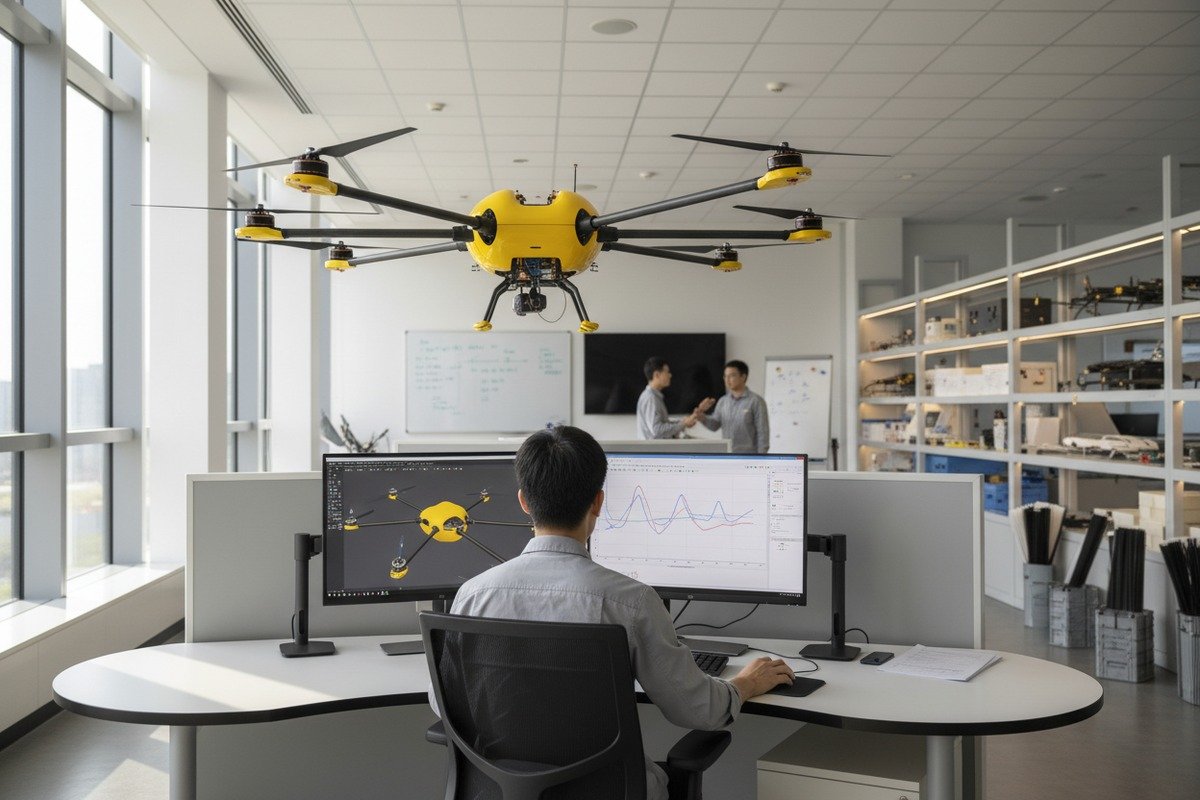
Understanding Fatigue Mechanics
Fatigue failure is sneaky. It happens below yield strength when loads repeat thousands of times. Each cycle creates microscopic cracks. Cracks grow until sudden failure occurs.
Carbon fiber composites fail differently than metals. Metals show gradual crack growth. Carbon fiber delaminates. Layers separate internally, invisible from outside inspection.
Fatigue Testing Protocol
Our quality control department runs standardized fatigue protocols on every airframe design.
Cyclic Loading Setup: Mount the airframe in a test fixture. Apply recoil-magnitude forces through pneumatic actuators at operational frequency (typically 1-5 Hz for water cannons).
Cycle Targets: We test to 10,000 cycles minimum. This represents roughly 5 years of operational use at 50 missions per year with 40 discharges per mission.
Monitoring Points: Track strain at critical locations throughout testing. Plot strain versus cycle count. Look for sudden slope changes indicating crack initiation.
| Inspektionsmethode | Erkennungsfähigkeit | Frequenz | Kosten |
|---|---|---|---|
| Visuelle Inspektion | Oberflächenrisse nur | Jeder Flug | Kostenlos |
| Klopfprüfung | Delamination >10mm | Wöchentlich | Niedrig |
| Ultraschall-C-Scan | Delamination >2mm | Monatlich | Mittel |
| Röntgeninspektion | Innere Hohlräume, Risse | Vierteljährlich | Hoch |
| Dehnungsmessung | Echtzeit-Spannungsänderungen | Kontinuierlich | Mittel |
Delaminationserkennung
Delamination ist die Achillesferse von Kohlefaser. Wassereintritt beschleunigt Delamination. Rückstoßschlag initiiert sie.
Klopfprüfung: Klopfen Sie mit einer Münze auf den Rahmen. Solide Bereiche klingen klar. Delaminierte Bereiche klingen dumpf. Dieser einfache Test erkennt größere Probleme, übersieht aber kleine Defekte.
Ultraschallprüfung: Professionelle NDT-Dienste verwenden C-Scan-Ultraschall. Schallwellen werden an Delaminationsgrenzen reflektiert. Dies deckt interne Schäden vor dem Versagen auf.
Akustische Emissionsüberwachung: Fortschrittliche Systeme verwenden integrierte Sensoren, um während des Betriebs Knackgeräusche zu erkennen. Unsere Exportkunden in Europa fordern diese Funktion zunehmend an.
Festlegung von Servicegrenzwerten
Jeder Rahmen hat eine sichere Betriebsdauer. Überschreitet man diese, besteht die Gefahr eines katastrophalen Ausfalls.
Stundenbasierte Grenzwerte: Erfassen Sie die gesamten Flugstunden. Wir empfehlen eine Inspektion nach 500 Stunden und eine Überlegung zum Austausch nach 2.000 Stunden für hochbelastete Feuerbekämpfungsflüge.
Zyklusbasierte Grenzwerte: Erfassen Sie Wasserentladungszyklen unabhängig voneinander. Hochintensive Missionen mit vielen Entladungen belasten den Rahmen schneller als lange Überwachungsflüge.
Schadensbasierte Bewertung: Jedes Aufprallereignis löst eine sofortige Inspektion aus. Selbst kleinere Kollisionen können versteckte Risse verursachen, die unter nachfolgender Rückstoßbelastung wachsen.
Faktoren der Umweltdegradation
Realweltliche Bedingungen beschleunigen die Ermüdung. Unsere Kunden in heißen, feuchten Klimazonen sehen eine schnellere Degradation als Kunden in trockenen Umgebungen.
UV-Strahlung: Ultraviolette Strahlung baut Epoxidharz in Kohlefaser ab. Lagern Sie Drohnen bei Nichtgebrauch drinnen. Tragen Sie UV-Schutzbeschichtungen auf.
Thermische Zyklen: Wiederholtes Erhitzen und Abkühlen verursacht Matrixrisse. Dies ist besonders schwerwiegend für Feuerbekämpfungsdrohnen, die Feuerstrahlung gefolgt von Abkühlung ausgesetzt sind.
Chemische Einwirkung: Feuerlöschschaum, Salzwasser und Rauchablagerungen greifen Klebeverbindungen an. Eine gründliche Reinigung nach jeder Mission verlängert die Lebensdauer des Rahmens erheblich.
Welche technischen Dokumentationen oder Belastungstestberichte sollte ich von meinem Hersteller anfordern, um die Integrität der Flugzeugzelle nachzuweisen?
Einkaufsmanager kontaktieren oft unser Verkaufsteam und fragen, welche Dokumente sie anfordern sollen. Gute Dokumentation trennt professionelle Hersteller von Hinterhof-Monteuren. Wir bereiten umfassende Pakete für unsere US-amerikanischen und europäischen Händler vor.
Fordern Sie diese wesentlichen Dokumente an: FEA-Spannungsanalysberichte mit von-Mises-Spannungskarten, Zertifikate für dynamische Belastungstests mit Sicherheitsmargen über 40%, Materialrückverfolgbarkeitszertifikate für Legierungen in Luft- und Raumfahrtqualität, Ergebnisse von zyklischen Ermüdungstests für über 10.000 Zyklen und IP67-Wasserdichtigkeitszertifizierung. Verlangen Sie Rohdaten, nicht nur Bestanden/Nicht bestanden-Zusammenfassungen.

Checkliste für wichtige Unterlagen
Nicht alle Testberichte sind gleich. Hier erfahren Sie, worauf Sie achten und was Sie hinterfragen sollten.
FEA-Analyseberichte: Sollten vollständige Spannungskonturdiagramme enthalten, nicht nur Maximalwerte. Fragen Sie nach Beschreibungen der Randbedingungen. Schlechte Randbedingungen liefern irreführende Ergebnisse.
Materialzertifikate: Mill-Zertifikate verfolgen Aluminium bis zu bestimmten Produktionschargen zurück. Kohlefaser sollte Dokumentationen über den Faseranteil und den Layup-Zeitplan enthalten.
Testverfahren: Allgemeine Aussagen wie "gemäß Standards getestet" bedeuten nichts. Fordern Sie spezifische Testverfahren mit Aufzeichnungen über die Kalibrierung der Geräte an.
| Dokumenttyp | Was zu beachten ist | Rote Fahnen |
|---|---|---|
| FEA-Bericht | Spannungskarten, Sicherheitsmargen, Randbedingungen | Nur maximale Spannungs-Werte, keine Visualisierung |
| Materialzertifikat | Materialprüfberichte, Chargennummern, chemische Zusammensetzung | Allgemeine Materialnamen ohne Spezifikationen |
| Dynamischer Testbericht | Zeitverlaufsdaten, Spitzenkräfte, Zyklenzählungen | Nur Bestanden/Nicht bestanden, keine Rohdaten |
| Ermüdungsprüfbericht | S-N-Kurven, Dokumentation des Fehler modus | Weniger als 5.000 Zyklen getestet |
| Umweltprüfbericht | Temperaturbereich, IP-Schutzart-Prüfverfahren | Behauptungen ohne Verifizierung durch Dritte |
Wert der Zertifizierung durch Dritte
Selbsttests des Herstellers haben offensichtliche Interessenkonflikte. Die Zertifizierung durch Dritte erhöht die Glaubwürdigkeit.
ISO 17025 Labore: Tests, die in akkreditierten Labors durchgeführt werden, haben mehr Gewicht. Fragen Sie nach den Akkreditierungsnummern des Labors und verifizieren Sie diese.
FAA/EASA-Dokumentation: Für kommerzielle Feuerlöschbetriebe ist die Dokumentation der behördlichen Konformität unerlässlich. Ausnahmen nach Teil 107 erfordern Nachweise über die Lufttüchtigkeit.
Industriestandards: MIL-STD-810 Umwelttests 9 und ASTM-Materialstandards bieten anerkannte Benchmarks. Der Verweis auf spezifische Standards zeigt professionelle Ingenieurpraxis.
Fragen, die Sie Ihrem Hersteller stellen sollten
Wenn wir Beschaffungsanfragen erhalten, identifizieren diese Fragen sofort ernsthafte Käufer von Gelegenheitskäufern.
Über Tests: "Was war die maximale Belastung, die während des Rückstoßtests aufgezeichnet wurde, und wie groß ist Ihre Sicherheitsmarge zur Streckgrenze?" Ein professioneller Hersteller antwortet sofort mit spezifischen Zahlen.
Über Materialien: "Können Sie das Walzwerkzeugzeugnis für das 7075er Aluminium in dieser Charge bereitstellen?" Seriöse Lieferanten gewährleisten volle Rückverfolgbarkeit.
Über Ausfälle: "Hatten Sie bereits Feldausfälle im Zusammenhang mit der Rückstoßspannung, und welche Konstruktionsänderungen ergaben sich daraus?" Ehrliche Hersteller erkennen Probleme an und demonstrieren kontinuierliche Verbesserung.
Über Support: "Welche Inspektionsintervalle empfehlen Sie, und liefern Sie Ersatzteile für Strukturkomponenten?" Die Fähigkeit zur langfristigen Unterstützung ist ebenso wichtig wie die anfängliche Qualität.
Interpretation der Testergebnisse
Rohdaten erfordern Interpretation. Hier erfahren Sie, wie Sie das, was Sie erhalten, bewerten.
Berechnung der Sicherheitsmarge: (Streckgrenze – Maximale Belastung) / Streckgrenze × 100%. Wir streben mindestens 40% an. Unter 20% ist für Feuerwehreinsätze inakzeptabel.
Verformungsgrenzen: Die maximale Durchbiegung sollte 11% der Spannweite nicht überschreiten. Für einen 500-mm-Arm bedeutet dies weniger als 5 mm Durchbiegung unter Spitzenlast.
Ermüdungsstreuung: Testen Sie mehrere Proben. Wenn die Ergebnisse mehr als 20% variieren, ist die Materialkonsistenz fraglich.
Schlussfolgerung
Die Überprüfung der Festigkeit von Feuerlöschdrohnen-Flugzeugzellen erfordert eine strenge FEA-Analyse, physikalische Tests, Ermüdungsbewertung und eine gründliche Überprüfung der Dokumentation. Unsere Fertigungserfahrung zeigt, dass Abkürzungen in irgendeinem Bereich zu Ausfällen im Feld führen. Investieren Sie jetzt in eine ordnungsgemäße Verifizierung, um spätere kostspielige Probleme zu vermeiden.
Fußnoten
1. Erläutert die Prinzipien und Anwendungen der FEA im Ingenieurwesen. ︎
2. Definiert den IP67-Standard für den Schutz vor Staub und vorübergehender Wasserimmersion. ︎
3. Erläutert den Zweck und die Methoden von zyklischen Ermüdungsprüfungen zur Bestimmung der Lebensdauer von Materialien unter wiederholten Belastungen. ︎
4. Beschreibt den ISO 17025-Standard für Labor kompetenz, Qualitätsmanagement und Akkreditierung. ︎
5. Erläutert Newtons drittes Bewegungsgesetz, das besagt, dass Kräfte in gleichen und entgegengesetzten Paaren auftreten. ︎
6. Neue, funktionierende URL auf derselben Domain wie das Original, die eine detaillierte Erklärung der von Mises-Spannung bietet. ︎
7. Beschreibt vorimprägnierte Kohlefaserverbundwerkstoffe, ihre Eigenschaften und Fertigungsvorteile. ︎
8. Bietet Details zu den Eigenschaften, Merkmalen und gängigen Anwendungen der Aluminiumlegierung 7075. ︎
9. Wikipedia bietet einen umfassenden und maßgeblichen Überblick über MIL-STD-810. ︎
 English
  Español de México
  Deutsch
  Français
  Русский
  العربية
Comments
No comments yet. Be the first to share your thoughts!
Leave a Comment