
When we analyze our export orders, we often see new distributors making a costly mistake: ordering the largest drones available without assessing local farming conditions. This mismatch leads to unsold inventory sitting in warehouses while end-users complain about operational difficulties. operational difficulties 1 We want to help you avoid this capital trap.
To determine the right payload capacity, analyze your target region’s average farm size and crop density. Stock 10L-16L models for small plots and orchards requiring high maneuverability, while prioritizing 30L-50L units for large-scale row crops where maximizing hourly coverage is the primary operational metric.
Here is how to calculate the exact needs of your market.
What are the most popular agricultural drone payload sizes I should stock for my market?
Our sales data indicates a shift in market demand that often catches new importers off guard. Many partners assume that “bigger is better,” but we frequently see heavy-lift units gathering dust while lighter models sell out. You need a balanced inventory strategy to maintain healthy cash flow. inventory strategy 2
The current market volume centers on the 30L to 40L capacity range, offering the best balance between flight duration and tank size. However, you must maintain a stock of 10L units for entry-level service providers and 50L+ heavy-lift drones for specialized industrial agricultural operations.

Understanding the Three Main Payload Tiers
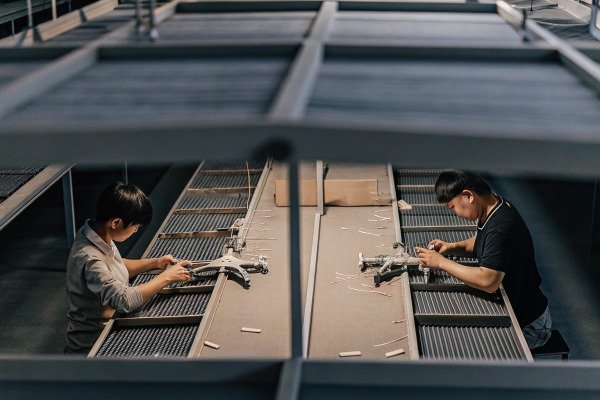
In our manufacturing facility in Xi'an, we categorize agricultural drones into three distinct tiers. manufacturing facility 3 Each tier serves a specific type of customer. Understanding these categories helps you segment your marketing and inventory planning.
The Entry-Level Tier (10L – 16L)
This category is crucial for new importers. These units are lightweight, easy to transport, and require fewer batteries to operate. They are the "bread and butter" for smaller farms or service providers just starting their business. We find these models are particularly popular in regions with fragmented land or terraced fields terraced fields 4. fragmented land 5 They do not require a pickup truck to transport; a standard van or SUV is sufficient.
The Mid-Range Workhorse (30L – 40L)
This is currently the "sweet spot" for the global market. When we design these frames, we optimize them for row crops like corn, soybeans, and wheat corn, soybeans, and wheat 6. A 30L or 40L drone offers enough capacity to cover significant acreage per flight without becoming too heavy for one person to handle during battery swaps. Most of your commercial contractor customers will want this size.
The Heavy-Lift Industrial (50L+)
These massive machines are impressive but niche. They require robust logistical support, including heavy-duty generators and water tanks. We usually advise clients to only stock these if they have customers managing thousands of acres of contiguous land.
Matching Payload to Customer Profiles
To help you visualize who buys what, we have compiled a profile based on our export history.
Table 1: Payload Tier vs. Ideal Customer Profile
| Payload Capacity | Ideal Customer Type | Primary Crop Application | Transport Requirement |
|---|---|---|---|
| 10kg – 16kg | Individual farmers, Vineyard owners | Vineyards, Orchards, Spot Spraying | SUV or small van |
| 30kg – 40kg | Commercial Service Providers (CSP) | Wheat, Corn, Rice, Cotton | Pickup truck or trailer |
| 50kg+ | Large Ag-Cooperatives, Industrial Farms | Forestry, Large-scale seeding, Fertilizer spreading | Dedicated heavy truck |
Inventory Recommendations for New Importers
If you are placing your first container order with us, do not guess. A safe ratio for a general agricultural market is typically 20% small units, 60% mid-range units, and 20% heavy units. This prevents you from tying up capital in expensive, slow-moving heavy inventory while ensuring you have the high-volume mid-range units ready for the spraying season.
How do I match payload capacity to the specific farm sizes and terrain my customers manage?
We have seen excellent drones crash simply because the pilot struggled to maneuver a heavy frame over complex terrain. Your customers will blame the product quality, but the real issue is often a mismatch between the drone’s inertia and the field’s topography. Using the wrong tool for the terrain is dangerous.
Map payload capacity to terrain complexity: heavy 40L+ drones require large, flat, open fields for safe automated operation. Conversely, recommend agile 10L-20L models for hilly, terraced, or irregular terrain where pilots need rapid response times and flight stability.

The Impact of Inertia on Hilly Terrain
When we test our drones near Chengdu, we specifically fly them over uneven hills to observe flight controller behavior. A fully loaded 50L drone has tremendous inertia inertia 7. If it is flying fast and needs to climb a steep hill suddenly, it consumes a massive spike of power. If it needs to stop quickly to avoid an obstacle, it takes longer to decelerate. avoid an obstacle 8
For customers working on flat plains (like the US Midwest), inertia is less of a problem. They fly long, straight lines. However, for customers in mountainous regions or areas with many trees and power lines, a heavy drone is a liability. You must teach your sales team to ask about topography before recommending a model.
Calculating Efficiency Based on Field Size
A larger tank does not always mean faster work if the field is small. A large drone takes time to accelerate and decelerate. On a small 5-acre plot, a large drone spends more time turning around than actually spraying.
We use a simple rule of thumb: The drone should be able to empty its tank in one or two straight flight lines. If the drone has to turn 10 times to empty a tank, it is too big for that field. The turning maneuvers waste battery and reduce the effective spray width.
Terrain and Size Decision Matrix
Use the following table to guide your customers during the consultation process. This positions you as an expert consultant rather than just a box mover.
Table 2: Field Topography and Drone Selection Guide
| Field Characteristic | Recommended Payload | Reason for Recommendation |
|---|---|---|
| Flat, >100 Acres | 40L – 50L+ | Maximizes flight time per battery; fewer refill stops needed. |
| Flat, <20 Acres | 16L – 30L | Reduces setup time; easier for a single operator to manage. |
| Steep Hills / Terraces | 10L – 16L | High agility required; heavy drones drain battery too fast climbing. |
| Obstacle Heavy (Trees) | 16L – 20L | Lower inertia allows for safer obstacle avoidance and braking. |
| Muddy / Soft Soil | 20L – 30L | Heavy drones (50L+) are difficult to carry out if they land in mud. |
The "Redundancy Risk" Factor
Sometimes, we advise importers to sell two smaller drones instead of one giant one. Why? If a customer buys one 50L drone and it crashes or needs maintenance, their entire operation stops. If they buy two 25L drones, they can continue working if one unit goes down. For professional sprayers, this redundancy is worth more than the extra payload capacity.
Does a larger payload capacity always guarantee better efficiency and ROI for the end user?
Customers often calculate ROI on a spreadsheet assuming continuous flight, but they forget the logistics on the ground. We have visited farms where a massive drone sits idle for twenty minutes because the support crew cannot mix chemicals fast enough. This bottleneck destroys the theoretical efficiency gains.
Larger payloads only improve ROI if the ground logistics can match the drone’s consumption rate. Without rapid mixing systems and high-capacity generators, a 50L drone offers lower daily productivity than two 25L drones due to extended downtime.

The Hidden Costs of "Going Big"
When we discuss pricing with our distributors, we are transparent about the total system cost. A 50L drone is not just more expensive to buy; it is more expensive to feed.
Generator Requirements
A 10L drone might charge on a portable 3000W generator. A 50L drone typically requires an 8000W to 12000W generator, or even a specialized charging station. If your customer does not have this power infrastructure, they cannot cycle their batteries fast enough to keep the drone in the air.
Chemical Logistics
A heavy-lift drone sprays liquid very fast—often 8 to 10 liters per minute. This means a 40L tank is empty in 4 to 5 minutes. The ground crew must mix 40 liters of chemicals every 5 minutes. This is physically exhausting and prone to error. If the drone lands and waits 10 minutes for the crew to mix the next batch, the efficiency of the large payload is lost.
Comparing ROI Scenarios
Let's look at the financial reality. A smaller drone has a lower barrier to entry and cheaper operating costs. A larger drone has higher potential revenue but much higher operating costs (OPEX).
Table 3: Operational Cost and Efficiency Comparison
| Feature | Medium Payload (30L) | Large Payload (50L) | Impact on ROI |
|---|---|---|---|
| Battery Cost | Moderate ($800-$1200) | High ($1800-$2500) | Large drones risk higher replacement costs. |
| Charging Cycle | 10-12 minutes | 15-20 minutes | Slower charging delays flight operations. |
| Transport Vehicle | Pickup Truck | Truck + Trailer | Logistics costs eat into profit margins. |
| Crash Risk Cost | Moderate Repair Bill | Very High Repair Bill | One crash can wipe out a season's profit. |
| Soil Compaction | Low impact | Higher impact | Important for sensitive wet fields. |
When is Bigger Actually Better?
Bigger is better only when spreading solid fertilizer or seeds. Granules are heavy and bulky. A 10L tank can only hold a tiny amount of fertilizer, requiring constant refills. For spreading (seeding/fertilizing), we always recommend the largest payload possible (50kg+), because the flow rate for solids is much faster than liquids. The ground logistics are also easier—you just pour bags into the hopper.
How does payload weight impact the flight endurance and battery maintenance I need to consider?
Our engineers fight a constant battle against gravity; adding weight always subtracts time. Clients often demand both “maximum payload” and “long flight time,” but physics makes this impossible. Ignoring this trade-off leads to overheated batteries and frustrated customers.
Heavier payloads drastically reduce flight endurance, often limiting flight times to 10-12 minutes per battery. This high current draw generates excessive heat, accelerating battery degradation and requiring customers to budget for 20% more battery replacements annually.
The Physics of Battery Drain
In our testing labs, we see a direct correlation between weight and battery lifespan. When a drone carries a 50kg payload, the motors must spin at near-maximum RPM to generate lift. This draws a massive amount of current (Amps) from the battery.
The Heat Problem
High current creates heat. When a battery lands after a heavy-lift flight, it is hot—often too hot to charge immediately. The intelligent battery management system (BMS) will prevent charging battery management system (BMS) 9 until the cells cool down. This "cooling time" is dead time. Your customer cannot fly. Smaller payloads stress the battery less, resulting in cooler landing temperatures and faster turnaround times.
Battery Cycle Life Expectations
We generally warrant our batteries for a specific number of cycles. However, consistently flying at Maximum Take-Off Weight (MTOW) will degrade Maximum Take-Off Weight (MTOW) 10 the battery faster than flying at 70% capacity.
- Light Load Operations: A battery might last 800-1000 cycles.
- Heavy Load Operations: The same battery might drop to 80% health after just 400-500 cycles.
You need to educate your customers that buying a larger drone means buying batteries more frequently. This is a recurring revenue stream for you, but an operating cost for them.
Maintenance Considerations for Heavy Lifters
Heavy payloads put immense stress on the entire airframe.
- Motors: The bearings wear out faster on heavy-lift drones.
- Arms: The carbon fiber arms are under higher tension.
- Props: Propellers flex more and need more frequent replacement.
We recommend that importers stock a higher ratio of spare parts (propellers, ESCs, motors) for the heavy-lift models compared to the smaller ones. A 10L drone might need a checkup every 200 hours. A 50L drone running full loads should be inspected every 100 hours to ensure safety.
Strategies for Your Customers
Advise your customers to fly with a "buffer." Just because a drone can carry 40L does not mean it must carry 40L every flight. Flying a 40L drone with 30L of liquid increases flight time, reduces battery heat, and extends the equipment's lifespan. This "under-loading" strategy is a pro-tip that will earn you trust with experienced operators.
Conclusion
Determining the right payload capacity is not about finding the most powerful drone, but finding the most efficient tool for the specific job. By analyzing your customers' terrain, farm size, and logistical capabilities, you can recommend the correct mix of 10L agility and 40L capacity. This consultative approach prevents unsold inventory and builds long-term loyalty with your buyers.
Footnotes
1. FAA regulations govern commercial drone operations, which impact how users handle operational challenges. ↩︎
2. ISO standards provide a framework for quality management and inventory strategy in manufacturing and distribution. ↩︎
3. General background on manufacturing processes and facility categorization for industrial equipment. ↩︎
4. Educational resource explaining the agricultural landscape suited for smaller drones. ↩︎
5. Explains the geographic challenge of fragmented land which necessitates smaller, more maneuverable drones. ↩︎
6. Government data on the major row crops mentioned. ↩︎
7. NASA definition of the physical property affecting drone maneuverability. ↩︎
8. UK Civil Aviation Authority provides safety guidelines for drone obstacle avoidance and flight safety. ↩︎
9. Technical definition of the safety system controlling battery charging. ↩︎
10. Standard aviation industry definition for aircraft weight limits. ↩︎

 English
  Spanish
  German
  French
  Dutch
Dutch  Arabic
