
We often see clients frustrated by middlemen disguising themselves as factories, leading to support nightmares. At our Chengdu facility, we know that finding a genuine source is critical for long-term reliability and safety in high-stakes operations.
To distinguish a manufacturer from a trading company, verify their business license scope for "Production" terms and cross-reference their address with satellite imagery of factory facilities. Additionally, request a live video tour of the assembly line and demand specific R&D documentation like patent filings or proprietary software code.
Let’s cut through the noise and look at the practical steps to ensure you are dealing with the source.
Can I ask for a virtual factory tour to verify production lines?
Many "suppliers" refuse video calls, claiming confidentiality or technical issues. When we invite clients to view our assembly lines remotely, we see their confidence in our production capabilities increase immediately.
Yes, you absolutely can and should ask for a live virtual tour. A genuine manufacturer will readily agree to show you their CNC machines, testing bays, and assembly stations in real-time. If a supplier refuses or only offers pre-recorded videos, they are likely a trading company hiding their lack of facilities.
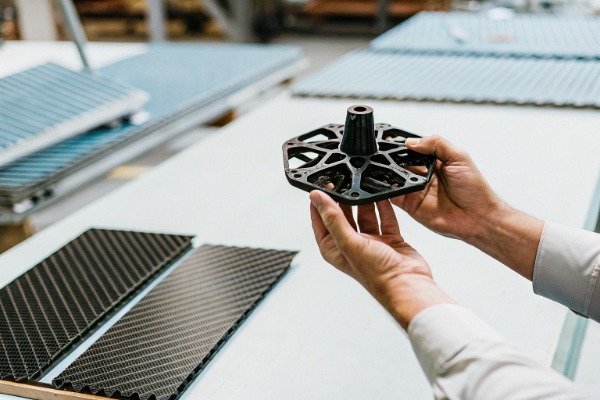
The Importance of "Live" Verification
In the age of digital marketing, a polished website can make a small trading office look like a massive industrial complex. We have seen competitors who operate out of a single room in a Shenzhen skyscraper post stock photos of sprawling factories. This is why a live video call is non-negotiable.
When you request a tour, pay attention to the reaction. A trading company will often stall, claiming that the factory is in a "restricted area" or that they need to schedule permission weeks in advance. In contrast, when we receive these requests, we simply check our production manager’s schedule to ensure the line is active. We are proud of our equipment and staff, so we have no reason to hide them.
What to Look For During the Tour
Once you get them on a video call (using Zoom, WhatsApp, or WeChat), do not let them control the narrative with a scripted walk-through. You need to direct the camera. Ask to see specific areas that prove manufacturing capability rather than just assembly.
Zoom, WhatsApp, or WeChat 1
Key areas to inspect:
- Raw Material Storage: Look for shelves of carbon fiber sheets, unbranded motors, and electronic components. Traders usually only have finished boxes.
- CNC Machining Centers: Real manufacturers cut their own frames and molds. Ask to see the machines in operation.
- Testing Bays: Firefighting drones require rigorous testing. Look for rain test chambers (for IP ratings) and flight test cages.
- Staff Uniforms: Do the workers on the line wear uniforms with the company logo? In trading companies, you might see people in street clothes packing boxes, or no assembly staff at all.
The "Specific Item" Test
To ensure the video isn’t pre-recorded or staged at a partner’s facility, ask the host to do something specific. Ask them to write your name and the current date on a piece of paper and place it on a drone frame currently on the assembly line. Alternatively, ask them to show you the serial number of a specific unit and read it out loud. A trader cannot do this if they are not physically at the factory.
Visual Cues: Factory vs. Trader
Below is a comparison of what you will typically see during a video call with a genuine manufacturer versus a trading company.
| الميزة | Genuine Manufacturer | Trading Company / Middleman |
|---|---|---|
| Background Noise | Industrial sounds (drills, CNC machines, fans). | Office silence, typing, or street noise. |
| Inventory | Raw materials, half-assembled frames, spare parts. | Only finished, sealed boxes ready for shipping. |
| Staff Presence | Engineers, assembly workers, QC inspectors. | Salespeople, admin staff, or an empty room. |
| Response to Requests | "Let me walk over to the testing area." | "We cannot show that due to trade secrets." |
| المعرفة التقنية | Host can explain the assembly step in detail. | Host struggles to explain what the worker is doing. |
By applying critical thinking during these tours, you can eliminate 90% of the middlemen. If they cannot show you where the product is made, they are not the ones making it.
What specific questions about the supply chain reveal a trading company?
Supply chain transparency is often where traders stumble because they lack deep knowledge. In our daily operations managing component sourcing, we know exactly where every motor, sensor, and screw comes from.
Ask for a detailed Bill of Materials (BOM) breakdown and the specific origins of critical components like flight controllers. Trading companies usually cannot provide deep supply chain data or explain sub-component sourcing. Furthermore, asking about specific hardware modifications will reveal if they have direct engineering control or are merely reselling.
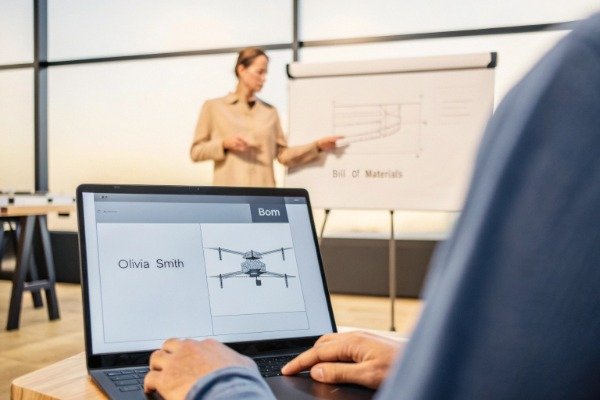
The Bill of Materials (BOM) Audit
A manufacturer builds a drone from the ground up. This means we have a Bill of Materials (BOM) that lists every single component, its cost, its supplier, and its specifications. A trading company, on the other hand, buys a finished product. They view the drone as a single SKU (Stock Keeping Unit), not a collection of 500+ parts.
Stock Keeping Unit 2
To test this, ask the supplier for the brand and model of the Electronic Speed Controllers (ESCs) or the specific sensor modules used in the collision avoidance system. A trader will likely have to "check with the engineering team" (which usually means emailing the real factory). A manufacturer can answer this immediately or pull up the spec sheet on the spot.
Electronic Speed Controllers (ESCs) 3
Analyzing the Business License
In China, every company has a business license that explicitly states their "Business Scope." This is public information, but many international buyers fail to check it. You can ask the supplier to send a scan of their license.
Business Scope 4
- Look for these words: "Manufacturing," "Production," "Processing," "Assembly," "R&D."
- Avoid these words: "Wholesale," "Retailing," "Supply Chain Management," "Technology Promotion" (without production).
If the license only says "Sales of electronic products," they are legally not a factory. While some manufacturers set up separate sales companies for export, the parent company should always have a manufacturing license.
The "Engineer Access" Test
One of the most revealing strategies is to ask to speak directly with a technical engineer regarding a complex integration issue. For example, tell them you need to know the specific voltage drop across the main power distribution board under full load for a firefighting mission.
voltage drop 5
- The Manufacturer’s Reaction: We would connect you with our electrical engineer or the technical lead. They might join the call or provide a detailed technical email with data graphs.
- The Trader’s Reaction: They will act as a gatekeeper. They will say, "Send us the question, and we will get back to you." They cannot let you speak to the engineer because the engineer works for a different company, and they are terrified you will cut them out of the deal.
Component Origin and Quality Control
Firefighting drones carry heavy payloads and operate in dangerous environments. The quality of the supply chain determines the safety of the mission. You need to know if the components are genuine or cheap clones.
Key Supply Chain Questions to Ask
Use the following questions to probe the depth of their supply chain knowledge.
| فئة السؤال | سؤال محدد لطرحه | Manufacturer Response Indicator | Trader Response Indicator |
|---|---|---|---|
| Component Sourcing | "Who manufactures the servo motors for the landing gear?" | Names the specific supplier (e.g., "We use KST or Savox"). | "It is our own brand" or "Top quality brand." |
| Lead Times | "If the flight controller chip is out of stock, what is the delay?" | "We have a 3-week lead time on chips from STMicroelectronics." | "We have stock, don’t worry" (ignoring the component shortage). |
| Quality Control | "Do you test the batteries in-house or trust the supplier?" | "We cycle test every batch on our own equipment." | "The battery factory tests them." |
| التوثيق | "Can I see the CE certificate for the transmission module?" | Provides a cert where the "Applicant" matches their company name. | Provides a cert with a different company name or blurred details. |
By digging into the supply chain, you force the supplier to demonstrate knowledge that only a creator possesses. A reseller sells a box; a manufacturer sells a system they built.
Do manufacturers offer more flexible OEM customization than traders?
Off-the-shelf drones rarely fit every mission perfectly, especially in complex firefighting scenarios. Our R&D team frequently modifies airframes for specific payloads, a level of flexibility that mere resellers simply cannot match.
Manufacturers offer significantly more flexible OEM customization because they own the intellectual property and production tooling. While traders are limited to simple logo placement or packaging changes, a factory can alter airframe structures, integrate custom payloads, and modify flight control software to meet specific operational requirements.
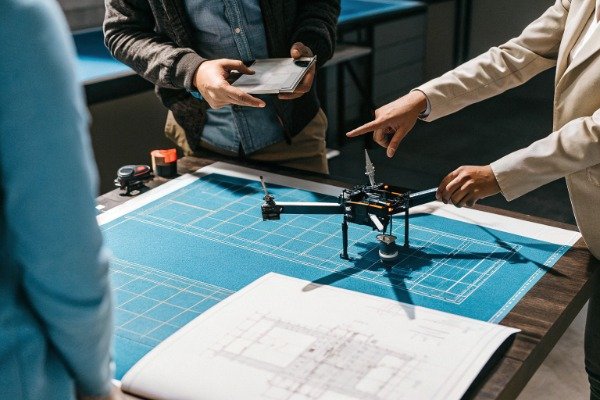
Structural vs. Cosmetic Customization
There is a massive difference between "customization" defined by a trader and "customization" defined by a manufacturer. Traders usually offer White Labeling. This means they will take a standard product, print your logo on the arm, change the startup screen on the controller, and paint the box a different color. This is useful for branding, but it does not improve performance.
As a manufacturer, we offer OEM (Original Equipment Manufacturing) and ODM (Original Design Manufacturing). This involves structural engineering. For example, if a fire department needs a drone to carry a specific type of fire extinguishing bomb that requires a unique release mechanism, we can redesign the bottom plate of the drone, change the center of gravity calculations, and mold a new mount. A trader cannot do this because they do not own the CAD files or the molds.
Software and SDK Integration
In the industrial drone sector, hardware is only half the battle. Many of our clients require deep software integration. They might want the drone to interface with their existing command center software or require a specific communication protocol for data security.
- Manufacturer Capability: We have access to the source code of the flight controller. We can open the SDK (Software Development Kit) to your developers or write custom firmware to limit altitude, change flight modes, or automate specific patrol routes.
- Trader Limitation: Traders are locked out of the firmware. They can only change basic settings available in the user menu (like max height or return-to-home altitude). They cannot alter the core logic of the machine.
The "Prototype" Challenge
To verify if a supplier has true customization power, challenge them with a prototype request. Ask them: "Can you increase the wheelbase by 50mm to accommodate larger propellers for higher altitude flight?"
A manufacturer will calculate the motor efficiency, check the frame rigidity, and give you a quote for the NRE (Non-Recurring Engineering) cost and a timeline for the prototype. A trader will likely say, "The standard model is best, we don’t recommend changing it," because they simply cannot make that change.
Customization Capabilities Comparison
The table below outlines what you can expect from different types of suppliers regarding customization.
| الميزة | Trading Company / Reseller | Direct Manufacturer (OEM/ODM) |
|---|---|---|
| Logo & Branding | Yes (Pad printing, stickers). | Yes (Molded into the chassis). |
| Packaging | Yes (Custom boxes). | Yes (Custom flight cases). |
| Airframe Modification | No. | Yes (Carbon fiber cutting, molding). |
| Payload Integration | Limited to standard ports (HDMI/Ethernet). | Full integration (GPIO, UART, API). |
| البرامج/البرامج الثابتة | No access. | Full SDK access and custom coding. |
| Minimum Order (MOQ) | Low (for standard items). | High for custom dev, Low for standard. |
For firefighting applications, where every second and every gram of payload counts, you need a partner who can tailor the tool to the job. Only a manufacturer with in-house R&D can provide that solution.
How does the warranty policy differ between a factory and a middleman?
A broken drone during fire season is a disaster, and waiting months for a repair is unacceptable. We stock spare parts for years to support our clients, whereas traders often abandon products once models change.
Factory warranties are generally more reliable because they are backed by an inventory of spare parts and in-house technical engineers. Middlemen often have limited repair capabilities and may require shipping the unit back to a third party, causing long delays. Direct manufacturers can often provide remote troubleshooting and immediate part dispatch.
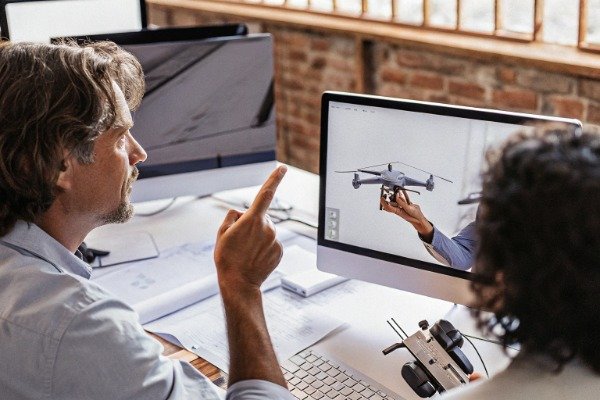
دورة حياة الدعم
When you buy from a trader, you are buying a snapshot in time. If that trader goes out of business or decides to stop carrying that specific brand, your warranty effectively evaporates. We have seen many distributors drop product lines because the profit margins shrank, leaving all their previous customers with zero support.
A manufacturer has a vested interest in the product’s lifecycle. Even if we stop selling a specific model of a firefighting drone, we usually keep the molds and spare parts in our warehouse for 3 to 5 years. We know that government procurement cycles are long, and our customers expect durability.
Remote Technical Support vs. "Forwarding Emails"
The quality of the warranty is defined by the speed of the solution.
- The Trader Loop: You email the trader with a log file showing a motor error. The trader translates your email (often poorly) and sends it to the factory. The factory replies the next day. The trader translates it back to you. This game of "telephone" takes days and often results in miscommunication.
- The Manufacturer Direct Line: When our clients have an issue, they send the flight logs directly to our support team. Our engineers analyze the data, identify if it was a sensor failure or pilot error, and send a solution immediately. We can often solve software issues via TeamViewer or remote desktop sessions.
Spare Parts Availability and Pricing
Traders make money on the markup. This applies to spare parts too. If you need a replacement arm or a new GPS module, a trader will mark up the price significantly. Furthermore, they likely do not stock these parts. They have to order them from the factory, wait for delivery, and then ship them to you.
TeamViewer or remote desktop 6
As a manufacturer, we can ship parts the same day. For our distributors and major clients, we often provide a "service kit" with the initial purchase—a box of common wear-and-tear parts (propellers, landing gear, cables) so that minor repairs can be done on-site without any downtime.
CAD files 7
Warranty Policy Red Flags
When reviewing a contract, look for these red flags that indicate a trader’s weak warranty:
مركز الجاذبية 8
- "Return to Base" Only: If the policy requires you to ship the drone back to China for every minor issue, it is a bad policy. A manufacturer will usually allow you to replace a module yourself if you are technically capable.
- Short Duration: Industrial drones should have at least a 12-month warranty on the airframe. 3-6 months is typical for consumer toys or low-quality trader goods.
- Exclusion of "Wear Items": While propellers are wear items, motors and ESCs should be covered. Traders often try to exclude expensive electronics to protect their margins.
Support Comparison Table
| Support Aspect | Trading Company | الشركة المصنعة |
|---|---|---|
| وقت الاستجابة | 24-72 hours (Middleman delay). | 12-24 hours (Direct access). |
| Troubleshooting | Generic advice ("Did you reboot?"). | Data-driven analysis (Log files). |
| Spare Parts | High markup, long lead time. | Factory cost, immediate dispatch. |
| Repair Location | Must ship to China. | Remote guidance or local partner. |
| Long-term Support | Ends when they stop selling the model. | 3-5 years post-production. |
Your warranty is your insurance policy. Don’t buy a policy from someone who can’t pay out the claim.
Original Design Manufacturing 9
الخاتمة
Sourcing directly from a manufacturer ensures better customization, support, and pricing. Verify facilities via live video, audit the supply chain, and ask tough technical questions to secure a reliable partner for your firefighting missions.
White Labeling 10
الحواشي
- Official website of one of the major communication platforms mentioned for video verification. ︎
- Definition of SKU (Stock Keeping Unit) in the context of inventory management. ︎
- Technical overview of Electronic Speed Controllers, a critical component in drone propulsion. ︎
- US Department of Commerce guide on verifying the business scope of Chinese companies. ︎
- Explanation of voltage drop from Fluke, a leader in electronic test and measurement tools. ︎
- Official website of TeamViewer, the software cited for remote technical support. ︎
- Industry leader Autodesk explaining Computer-Aided Design (CAD) technology used in engineering. ︎
- NASA educational resource explaining the physics of center of gravity in aircraft. ︎
- Definition of ODM (Original Design Manufacturing) and how it differs from OEM. ︎
- Business definition of white labeling, distinguishing it from original manufacturing. ︎

 English
  Spanish
  German
  French
  Dutch
Dutch  Arabic
