
Seeing a shipment detained at customs because of a radio frequency mismatch is a nightmare we work hard to prevent for our partners. We know that navigating the complex web of European regulations for large quadcopters can feel overwhelming when lives and budgets are on the line.
To ensure compliance, verify the drone carries a CE mark with a valid Declaration of Conformity referencing the Radio Equipment Directive 2014/53/EU. Confirm the video transmission operates on harmonized EU bands like 2.4 GHz (max 100mW) or 5.8 GHz (max 25mW) and adheres to specific class identification labels required by EASA.
Let’s break down exactly what you need to check check the Notified Body 1 before signing that purchase order.
What specific CE certifications must my firefighting drone supplier provide for video transmission compliance?
We spend months in the lab fine-tuning our signal processors to pass strict audits, so we understand the frustration of vague paperwork. Without the right documents, your equipment might never clear customs or legally fly.
Your supplier must provide a Declaration of Conformity citing the Radio Equipment Directive (RED) 2014/53/EU. Specifically, look for test reports against ETSI EN 300 328 for 2.4 GHz wideband transmission and ETSI EN 301 893 for 5 GHz RLAN, alongside EMC standards like EN 301 489 to ensure signal immunity.

When sourcing high-value industrial equipment, simply seeing a "CE" sticker on the fuselage is not enough. That sticker is merely a self-declaration that the product meets EU requirements, but for radio equipment, the documentation behind it is what truly matters. In our factory, every batch of transmission modules undergoes rigorous testing to ensure we can back up that mark with data.
The Declaration of Conformity (DoC)
The most critical document you must request is the EU Declaration of Conformity. This is a legal document signed by the manufacturer (or their authorized representative in the EU) declaring compliance. For a firefighting drone's video transmission system, the DoC must explicitly reference the توجيه المعدات اللاسلكية (RED) 2014/53/EU. If the document only references the Machinery Directive or Low Voltage Directive without mentioning RED, the radio components have likely not been certified for transmission compliance.
Essential ETSI Standards
The European Telecommunications Standards Institute (ETSI) sets the harmonized standards that demonstrate compliance European Telecommunications Standards Institute (ETSI) 2 with the RED. When you review the DoC or the technical test reports, you need to look for specific standard numbers. If these numbers are missing or outdated, the equipment may not be legal.
- ETSI EN 300 328: This is the standard for Wideband transmission systems operating in the 2.4 GHz ISM band. It ensures the drone uses techniques like frequency hopping correctly and stays within power limits.
- ETSI EN 301 893: This applies to 5 GHz RLAN equipment. It is crucial for ensuring the drone uses Dynamic Frequency Selection (DFS) to avoid interfering with radars.
- ETSI EN 300 440: This covers Short Range Devices (SRD) in the 1 GHz to 40 GHz range, often relevant for auxiliary telemetry links.
EMC and Immunity
For firefighting drones, Electromagnetic Compatibility (EMC) is arguably as important as the radio frequency Electromagnetic Compatibility (EMC) 3 itself. Fire scenes are chaotic environments often filled with interference from radios, trucks, and pumps. The certification ETSI EN 301 489 covers EMC for radio equipment. It tests if the drone disturbs other electronics and, conversely, if the drone remains stable when blasted with RF noise. We always recommend checking for this specific standard because a drone that loses video feed due to interference from a fire truck's radio is a safety hazard.
Document Verification Checklist
Use the following table to audit the documents your supplier sends you. Missing any of these elements is a significant red flag.
| Document / Certification | Key Standard to Look For | Why It Matters for Firefighting Drones |
|---|---|---|
| Radio Equipment Directive (RED) | 2014/53/EU | Legal basis for selling radio products in the EU. |
| Wideband Transmission | ETSI EN 300 328 | Ensures 2.4 GHz video links don't overpower local Wi-Fi. |
| 5 GHz RLAN | ETSI EN 301 893 | Verifies DFS capability to protect weather/military radar. |
| EMC for Radio | ETSI EN 301 489 | Ensures the drone won't crash due to radio interference on site. |
| Safety Standard | EN 62368-1 | Ensures the electrical safety of the ground station and drone. |
Which frequency bands should I look for to ensure my industrial drones operate legally in EU airspace?
While testing our long-range links, we often have to dial back power settings that are perfectly legal in Asia or the US but forbidden in Europe. Ignoring these limits causes severe interference with critical infrastructure.
For legal operation in the EU, prioritize the 2.4 GHz ISM band (2400-2483.5 MHz) and the 5.8 GHz band (5725-5875 MHz) for Short Range Devices. Ensure 5 GHz systems support Dynamic Frequency Selection (DFS) to avoid radar interference, as bands like 5470-5725 MHz face strict restrictions in certain member states.
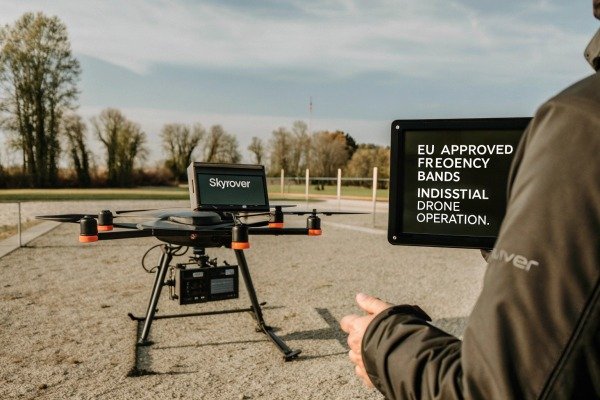
Understanding frequency bands is the difference between a successful mission and a confiscated drone. In our interactions with European clients, we find that the biggest misconception is that "5.8 GHz is 5.8 GHz everywhere." This is false. The specific sub-bands and the power levels allowed in Europe are vastly different from those in the United States or China.
The 2.4 GHz Standard
The 2.4 GHz band (specifically 2400–2483.5 MHz) is the most common lane for drone video transmission because it offers a good balance of range and penetration. In Europe, if the system uses wideband modulation (like most modern digital video links), the maximum Effective Effective Isotropic Radiated Power (EIRP) 4 Isotropic Radiated Power (EIRP) is limited to 100 mW (20 dBm).
This is significantly lower than the nearly 1000 mW often seen in FCC-regulated regions. Firefighting drones need robust connections, so operating at 100 mW requires high-gain antennas and excellent receiver sensitivity. If a supplier promises "5km range in the EU" on 2.4 GHz, ask them to prove it at 100 mW output.
The 5 GHz Maze
The 5 GHz spectrum is less crowded but more regulated.
- 5150–5250 MHz: Generally limited to 200 mW and often restricted to indoor use only, making it unsuitable for outdoor firefighting operations unless specific national exceptions apply.
- 5470–5725 MHz: This band is tricky. While some devices use it, it requires robust Dynamic Frequency Selection (DFS) and Transmit Power Control (TPC) robust Dynamic Frequency Selection (DFS) 5. More importantly, some EU countries have implemented bans or strict limitations here for unmanned aircraft to protect weather radars.
- 5725–5875 MHz: This is the standard "5.8 GHz" band for Short Range Devices (SRD). However, the power limit here is very strict—typically 25 mW (14 dBm) for non-specific SRDs. Some specific video transmission technologies can utilize up to 500mW or 2W in other regions, but flying those in the EU is illegal without a specific license.
Licensed vs. Unlicensed Spectrum
For professional firefighting applications, relying on unlicensed ISM bands (2.4/5.8 GHz) can be risky due to congestion unlicensed ISM bands 6. Some of our advanced clients opt for frequency bands that require a license, or they utilize LTE/5G bonding which leverages cellular networks. If you stick to direct RF links, you must stay within the harmonized license-free bands to avoid interfering with primary users, such as mobile networks or aviation navigation aids.
Comparing EU and FCC Limits
The table below highlights the drastic differences in power limits. If you buy a "Global Version" drone without region-locking, you risk violating these limits.
| Frequency Band | EU Limit (EIRP) | US (FCC) Limit (Reference) | التأثير على عمليات مكافحة الحرائق |
|---|---|---|---|
| 2.4 GHz (ISM) | 100 mW (20 dBm) | ~1000 mW (30 dBm) | Shorter range in EU; requires better antennas. |
| 5.15 – 5.25 GHz | 200 mW (Indoor usually) | ~1000 mW | Not usable for outdoor search and rescue. |
| 5.8 GHz (SRD) | 25 mW (14 dBm) | ~1000 mW | Very short range unless specialized modulation is used. |
| 868 MHz | 25 mW – 500 mW | N/A (915 MHz used in US) | Good for telemetry/control, too slow for HD video. |
How can I verify the authenticity of a manufacturer's Radio Equipment Directive test reports before ordering?
We have seen competitors photoshop test reports, which puts importers at massive risk during audits. It is crucial to look beyond the PDF cover page to ensure the lab data actually matches the hardware you are buying.
Cross-reference the 4-digit ID number next to the CE mark with the European Commission’s NANDO database to confirm the Notified Body’s validity. Request the full test report, not just the certificate, and verify that the model number matches your specific drone configuration and hardware revision.

Verifying authenticity is a step many procurement managers skip, assuming the PDF file attached to an email is legitimate. In our industry, however, "borrowed" or forged certificates are unfortunately common. A fake certificate offers you zero legal protection if your drone causes interference or is audited by telecommunications authorities like OFCOM (UK) or BNetzA (Germany) OFCOM (UK) 7.
Step 1: The NANDO Database Check
The most reliable way to verify a certificate is to check the Notified Body. A legitimate CE certificate for radio equipment usually involves a third-party Notified Body.
- Look at the CE mark on the product or certificate. Is there a 4-digit number next to it? (e.g., CE 1234).
- Go to the European Commission’s NANDO website (New Approach Notified and Designated Organisations).
- Search for that 4-digit number.
- Verify that the organization listed is accredited for the Radio Equipment Directive (RED). If the number belongs to a lab accredited only for medical devices or elevators, the certificate is invalid for a drone.
Step 2: Request the Full Test Report
A "Certificate of Compliance" is just a one-page summary. To be safe, ask us (or any supplier) for the full test report. This document is usually 50 to 100 pages long.
- Check the Photos: The report will contain internal photos of the tested device. Does the circuit board in the photo match the one in the drone you are buying?
- Check the Dates: Standards evolve. If the report cites a version of EN 300 328 that was withdrawn in 2018 version of EN 300 328 8, the product is no longer compliant, even if the report was real at the time.
- Check the Hardware Version: If the report tests "Model X-1.0" but you are buying "Model X-2.0," the certification might not apply if the radio module was changed.
Step 3: Verify the Software/Firmware Version
Modern radio compliance is often defined by firmware. The test report will explicitly state which firmware version was used during testing. If the drone ships with different firmware that unlocks higher power or different frequencies, the physical hardware might be the same, but the system is technically non-compliant. You should ask the supplier to confirm that the shipping firmware maintains the same RF parameters as the tested version.
Why Authentication Matters for Firefighting
In firefighting, liability is a major concern. If a drone interferes with an emergency broadcast and is found to be non-compliant, the agency operating it faces massive legal backlash. Holding a verified, authentic test report from an accredited lab is your primary defense of "due diligence." It proves you took reasonable steps to ensure the equipment was safe and legal.
Can Chinese manufacturers customize transmission power output to meet strict European telecommunications standards?
When we configure flight controllers for our European partners, we often lock specific settings at the factory level to ensure safety. Simply lowering the volume isn’t enough; the hardware must be hard-coded to prevent accidental violations during emergencies.
Yes, reputable manufacturers can customize firmware to lock transmission power to EU limits (e.g., 20 dBm for 2.4 GHz). Ensure the drone features a geo-fenced “EU Mode” that automatically restricts output based on GPS location, preventing operators from manually overriding safety limits during high-stress firefighting operations.

The short answer is yes, but the method of customization matters immensely. In our production line, we don't just change a setting in a user menu; we implement deep-level configurations to ensure compliance is robust and user-proof.
The Problem with "Manual" Compliance
Some low-end suppliers might ship a drone capable of 1000 mW output and tell you, "Just remember to set it to Low Power in the app." This is dangerous. In a high-stress firefighting scenario, an operator might reset the drone or manually crank up the power to punch through smoke interference, unknowingly breaking the law. European regulators often require that the device cannot easily be manipulated by the user to operate outside of compliant parameters.
Geo-Fencing and Auto-Switching
The gold standard for compliance is Location-Based enforcement.
- GPS Detection: When the drone boots up, it checks its GPS coordinates.
- Region Locking: If it detects it is in the EU, the firmware automatically caps the transmission power (EIRP) to 20 dBm (100 mW) for 2.4 GHz.
- User Lock-out: The option to switch to "FCC Mode" or high-power mode is grayed out or removed from the user interface entirely.
This technology protects your organization. It ensures that no matter who is piloting the drone, the machine itself enforces the law.
Customization Options for Procurement
When you are negotiating with a manufacturer like us, you can request specific customization tiers.
| مستوى التخصيص | الوصف | الإيجابيات | السلبيات |
|---|---|---|---|
| Soft-Limit (App) | User selects "EU Mode" in the app settings. | Flexible for global travel. | High risk of user error; non-compliant if easily reversible. |
| Firmware Lock (Hard-Coded) | Factory flashes specific EU firmware that removes high-power options. | Very compliant; user cannot override. | Drone must be re-flashed if sold to non-EU region. |
| Geo-Fencing (Smart) | Drone auto-adjusts limits based on real-time GPS location. | Best user experience; seamless compliance. | Requires advanced software development from supplier. |
LTE/5G Bonding: The Alternative
For clients finding the 100 mW limit too restrictive for long-range video, we often customize the drone to use Cellular Bonding. Instead of relying solely on direct RF الترابط الخلوي 9, the drone transmits video over 4G/5G networks.
- Compliance: This shifts the compliance burden to the cellular modem (which must be CE and GCF certified) and the network provider.
- Power: Since it uses mobile towers, you don't need to worry about the 100 mW limit for the video link itself, only for the command and control link (which is lower bandwidth and works fine at lower power).
الخاتمة
Purchasing firefighting drones for the European market requires more than just checking flight time specs; it demands a rigorous audit of the video transmission system. By verifying valid CE documentation referencing the RED directive, understanding the strict power limits RED directive 10 of EU frequency bands, and ensuring your supplier can lock these settings via firmware, you protect your agency from legal liability and interference risks. Always prioritize transparency—ask for the full test reports, check the NANDO database, and choose a partner willing to customize compliance into the hardware itself.
الحواشي
1. Official EU explanation of Notified Bodies for product compliance. ︎
2. Official website of the standards organization mentioned. ︎
3. Educational resource explaining electromagnetic compatibility principles. ︎
4. Definition of EIRP in the context of radio transmission. ︎
5. Explanation of DFS technology for radar avoidance. ︎
6. Technical overview of ISM band regulations and compliance. ︎
7. Official website of the UK telecommunications regulator. ︎
8. Official standard specification for 2.4 GHz wideband transmission. ︎
9. Technology overview of cellular bonding for data transmission. ︎
10. Official text of the Radio Equipment Directive 2014/53/EU. ︎

 English
  Spanish
  German
  French
  Dutch
Dutch  Arabic
