
Watching a client lose a brand-new sprayer because it plowed into a hillside is a painful experience we strive to prevent at our factory. In our years of exporting to the US and Europe, we have seen that failing to verify terrain following capabilities often leads to poor spray uniformity 1 spray uniformity and costly crashes.
To confirm terrain following, first review the technical datasheet for a Millimeter-wave (mmWave) radar sensor or LiDAR module specifically listed for “Ground Following.” Next, verify that the flight control software includes a “Terrain Mode” for setting height Above Ground Level (AGL), and physically test the drone’s reaction reaction latency 2 to elevation changes during a demo flight.
Let’s examine the specific hardware and software indicators you need to check to ensure your investment is safe.
What specific radar sensors should I look for to guarantee accurate terrain following?
When we source components for our SkyRover series, we reject basic sensors that cannot handle the dust and moisture typical of farm work. Relying on the wrong sensor technology is the number one reason drones fail to maintain altitude over undulating crops.
To ensure accurate terrain following, you must specifically verify the presence of a Millimeter-wave (mmWave) radar system. Look for specifications detailing omnidirectional or spherical radar capabilities, as these sensors provide the necessary depth perception and dust resistance that simple ultrasonic sensors or optical cameras often lack in agricultural environments.

Understanding the difference between sensor types is critical when reading a spec sheet. Many entry-level drones claim to have barometer 3 “altitude hold,” but this is often just a barometer, which is useless for following the contour of a hill. True terrain following requires active sensing. active sensing 4 In our engineering lab, we categorize sensors based on their reliability in harsh agricultural environments.
The gold standard for modern agricultural drones is the Millimeter-wave (mmWave) Radar. Unlike optical cameras, radar does not rely on light. This means your drone can operate at dusk, dawn, or under bright midday sun without getting “blinded.” More importantly, mmWave radar can “see” through the fine mist of pesticides and the dust kicked up by the propellers. If the spec sheet lists “Ultrasonic” or “Barometer only,” the drone is likely designed for flat paddy fields, not complex terrain.
The Importance of Spherical Radar
Recently, the industry has shifted toward Spherical Omnidirectional Radar. Older models used a single downward-facing beam. The problem with a single beam is that if the drone pitches forward to fly fast, the beam points backward, losing track of the ground directly below or ahead. Spherical radar scans 360 degrees, ensuring the drone knows where the ground is even when flying at high tilt angles.
Sensor Comparison for Agriculture
Here is how we evaluate sensor types for our clients:
| Sensor Type | أفضل حالة استخدام | Terrain Following Capability | Drawbacks |
|---|---|---|---|
| mmWave Radar | Hills, dust, spray, night | ممتاز | Higher cost; heavy power consumption. |
| ليدار | Precision mapping | جيد | Can struggle with heavy dust or thick spray mist; expensive. |
| Ultrasonic | Indoor, low altitude | فقير | Limited range (<5m); absorbs into soft canopies; fails in wind. |
| Optical/Vision | Obstacle avoidance | Fair | Fails in low light, direct sun glare, or over uniform green crops. |
| Barometer | High altitude flight | لا يوجد | Measures air pressure, not distance to ground. Drifts significantly. |
When you are evaluating a supplier, ask for the specific frequency of the radar. We generally recommend 24GHz or 77GHz radars. The 77GHz variants offer higher resolution and are better at detecting thinner obstacles like power lines while simultaneously tracking the ground.
How can I test the drone's ability to maintain constant altitude on uneven slopes?
Paper specifications can be misleading, so we always invite our distributors to witness field tests at our Chengdu facility. Seeing the machine react to a physical slope is the only way to trust that the software algorithms are correctly tuned to the hardware.
You can test altitude maintenance by flying the drone manually over a clear, graduated slope while the terrain mode is active. Observe if the aircraft automatically adjusts its throttle to keep a consistent height Above Ground Level (AGL) without any pilot input on the altitude stick.
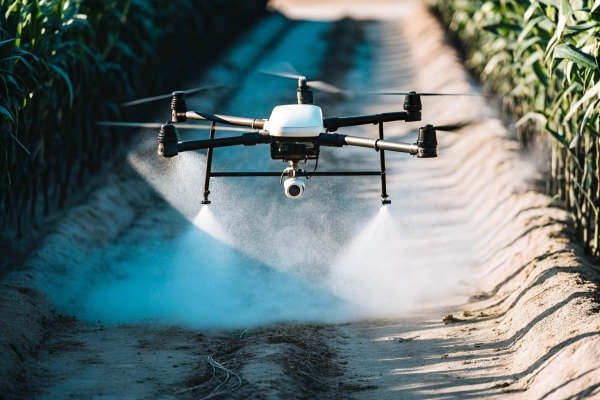
Testing terrain following does not require a complex laboratory setup, but it does require a safe, methodical approach. safe, methodical approach 5 We advise our customers to never perform the first test on a steep vineyard or near valuable obstacles. Start on a gentle incline with a clear line of sight.
The goal of this test is to verify the reaction latency. If the drone reacts too slowly, it will crash into the rising slope. If it reacts too aggressively, the flight will be jerky, resulting in uneven spray application. A well-tuned system should feel “smooth,” as if the drone is sliding up an invisible ramp parallel to the ground.
The "Stair-Step" Test Method
One effective field test is the "Stair-Step" approach. Find a terrain transition, such as a terrace or a sharp embankment (about 1-2 meters high).
- Hover the drone over the lower ground at a set height (e.g., 3 meters).
- Slowly fly forward over the higher ground.
- Watch the telemetry: The drone should physically rise, but the "Height" reading on your screen should remain constantly at "3 meters."
- If the height reading drops to "1 meter" as it passes the ledge, the terrain following is inactive or lagging.
Verifying "Look-Ahead" Capability
Advanced terrain following is predictive, not just reactive. The radar should scan ahead of the drone. To test this, fly towards a slope at a moderate speed (3-4 m/s). The drone should begin to ascend slightly قبل it is critically close to the ground. If it waits until it is directly over the rising slope to throttle up, it lacks predictive "Look-Ahead" capability, which is dangerous at higher flight speeds.
Field Test Checklist
| مرحلة الاختبار | الإجراء | Success Criteria |
|---|---|---|
| التحويم الثابت | Hover over uneven grass/crop. | Drone holds steady AGL; does not drift up/down with wind. |
| Slow Advance | Fly up a 10° slope at 2 m/s. | Smooth ascent; constant distance to canopy maintained. |
| Fast Advance | Fly up a 15° slope at 5 m/s. | Drone anticipates rise; no "dipping" toward the ground. |
| Descent | Fly down the slope. | Drone descends controlled; does not just "drop" or freefall. |
| Yaw Turn | Rotate drone 360° on a slope. | Height remains stable (proves omnidirectional sensing). |
Always keep your finger near the “Pause” or “brake” button during these tests. If the sensor interprets a tall weed as “ground,” it might jump up; if it misses the ground, it will not climb. Safety is paramount. Safety is paramount 6
Where do I find the terrain following configuration in the flight control software?
During our software development collaborations with clients, we find that the user interface is often where user interface 7 confusion arises. A drone might have the hardware, but if the “Terrain Follow” toggle is buried in a sub-menu or disabled by default, the feature is useless.
Locate the specific “Terrain Awareness” or “Ground Radar” tab within the mission planning section of your flight control app. You should verify options to toggle “Terrain Follow” on, adjust the desired height above crops, and confirm the ability to import Digital Elevation Models (DEM) for complex path planning.

The software interface serves as the bridge between the pilot’s intent and the radar’s data. When you inspect a potential new drone, ask the seller to power on the Ground Control Station (GCS) and walk you through the settings. You are looking for two distinct modes of operation: Real-Time Radar Following و Map-Based Terrain Following.
Real-Time Radar Settings
In the main flight settings (often under a radar icon or "Sensing" menu), check for a toggle switch named "Terrain Follow" or "Radar Height Keeping." Once enabled, you should see a value setting for "Target Height."
- التحقق: Change the target height value (e.g., from 2m to 5m). The drone (if flying) should respond immediately.
- Sensitivity: Look for "Sensitivity" or "Response Speed" sliders. These allow you to adjust how aggressively the drone reacts to terrain. High sensitivity is needed for rocky terrain; lower sensitivity is better for smooth, rolling hills to save battery.
Map-Based Terrain (DEM/DSM)
For large-scale operations, real-time radar isn't always enough, especially in mountains where the drone might lose connection. Professional agricultural drones allow you to import a 3D map 8 3D map.
- Check the Import Formats: Does the software support .tif, .dem, or .dsm files?
- Source: Can it download terrain data directly from the internet (like Google Terrain) or do you need to fly a mapping mission first?
- Visual Confirmation: The flight path on the screen should appear "wavy" or 3D, mirroring the ground below, rather than a flat 2D line.
Common Software Terminology Guide
Different manufacturers use different terms. Here is a translation guide based on what we see in the market:
| Term Used | Meaning | ما الذي يجب التحقق منه |
|---|---|---|
| AGL (Above Ground Level) | Height from the sensor to the ground. | Ensure this readout is active and fluctuating slightly on the ground. |
| Terrain Trace | The drone follows the ground contour. | This is the main mode you want for spraying. |
| Ceiling / Floor Limit | Safety limits for altitude. | Ensure "Floor Limit" isn't set higher than your spray height. |
| RTH Altitude (Relative) | Return to Home height behavior. | Critical: Does RTH calculate height from takeoff point or current ground? |
Pay special attention to the RTH (Return to Home) settings. A common disaster occurs when a drone flies up a hill, finishes its job, and initiates RTH. If RTH is calculated based on the “Takeoff Point” (at the bottom of the hill) rather than the current terrain, the drone might fly straight into the side of the hill on its way back. Ensure the software has a “Terrain Aware RTH” option.
Which technical specifications indicate the maximum slope angle the drone can handle?
We often have to explain to procurement managers that physics imposes hard limits on flight performance propulsion system 9. Even with the best radar, if the drone’s propulsion system lacks the thrust to climb a steep gradient while carrying a full liquid tank, the terrain following function will fail.
Examine the technical datasheet for the “Maximum Terrain Follow Slope” or “Max Climbing Angle,” usually stated in degrees. Reliable systems specify a limit between 30 to 45 degrees, which must align with the radar’s vertical detection range to prevent the drone from losing ground lock during steep ascents.

Slope handling is a combination of Sensor Field of View (FOV) و Propulsion Capability. You need to analyze the specification sheet for specific numbers that indicate the drone’s physical limitations. Do not confuse “Max Flight Speed” with “Max Climbing Speed.”
Degrees vs. Percentage
First, ensure you understand the unit of measurement.
- Degrees (°): A 45° slope is extremely steep (100% grade).
- Percentage (%): A 100% grade equals 45°. A 30° slope is roughly a 58% grade.
- Most agricultural drones can handle slopes up to 30° to 45°. Anything claimed above 50° is suspicious for a heavy-lift drone. If the manufacturer lists the slope in percentage but makes it look like degrees (e.g., "Max Slope: 60"), clarify immediately if they mean 60% (approx 31°) or 60° (impossible for most loaded multi-rotors).
The Radar "Blind Spot"
The maximum slope angle is often limited by the radar's FOV 10 radar's FOV. If a drone flies up a 40° slope but the radar only has a 30° forward detection angle, the radar beam will hit the slope too late or not at all (it might be looking horizontally into the hill rather than down at it).
- Requirement: The Radar Vertical FOV should be significantly wider than the Max Slope spec. For example, if the max slope is 30°, a radar FOV of ±45° or more is preferred.
Power and Weight Considerations
Terrain following consumes more energy than flat flight. Climbing requires high motor output.
- Thrust-to-Weight Ratio: For safe hillside operation, the drone needs a ratio of at least 1.8:1 or 2.0:1. If the drone is fully loaded with pesticide, it is heavier and climbs slower.
- Battery Sag: On steep terrain, voltage drops faster. Check if the spec sheet lists "Max Slope at Full Payload." A drone might handle 40° empty but only 20° when carrying 40 liters of liquid.
Deciphering the Specs
| المواصفات | What It Tells You | Red Flag / Warning |
|---|---|---|
| Max Slope (Terrain Mode) | The verified limit for auto-following. | If missing, assume it is only for flat fields (<10°). |
| Radar Detection Range | How far away it sees the ground (e.g., 1-50m). | If min range is >2m, it can't fly low enough for crops. |
| Max Ascent Speed | How fast it can climb vertically. | If <2 m/s, it cannot handle fast forward flight on slopes. |
| FOV (Field of View) | The width/height of the radar beam. | Narrow FOV (<80° horizontal) creates blind spots in turns. |
Finally, always ask about the “Braking Distance” on slopes. A heavy drone flying down a hill has significant momentum. The terrain following system must be able to detect a flattening of the terrain at the bottom of the hill and pull up or slow down in time to avoid hitting the ground as the slope levels out.
الخاتمة
Confirming terrain following capabilities is not just about checking a box on a feature list; it is about verifying the safety and efficiency of your agricultural operations. By inspecting the specific radar hardware (aiming for mmWave), validating the software configuration settings, performing physical field tests for reaction latency, and cross-referencing slope specifications with payload limits, you can ensure the drone will perform reliably. At SkyRover, we believe that an informed buyer is a satisfied partner, ensuring that the technology we build translates into real-world productivity on your farm.
الحواشي
1. International standard defining environmental requirements and performance for agricultural sprayers. ︎
2. FAA resources for commercial drone operators regarding flight safety and system performance. ︎
3. NASA explanation of how barometric altimeters function and their limitations. ︎
4. Wikipedia overview of active sensing technologies like LiDAR. ︎
5. Official safety guidelines and best practices for operating commercial drones. ︎
6. Technical insights into how radar sensors improve safety in industrial and agricultural automation. ︎
7. ISO standard regarding ergonomics of human-system interaction software. ︎
8. Official US government program providing 3D elevation data and mapping. ︎
9. NASA technical overview of propulsion systems and thrust generation. ︎
10. Technical explanation of radar beamwidth and field of view concepts. ︎

 English
  Spanish
  German
  French
  Dutch
Dutch  Arabic
