
Every season, our production floor buzzes with calls from operators stranded mid-field LiPo battery 1. Their generators hum, but their drone batteries sit uncharged. This frustrating mismatch costs hours of productivity and threatens entire spray schedules.
To verify generator compatibility with your drone charging station, check the station’s input specifications for AC voltage range (typically 100-264V), required wattage (3600W-12000W), and frequency (50Hz). Most agricultural drone chargers accept AC input from generators, not direct DC, then convert internally to the 40-62V DC needed for battery packs.
Let me walk you through the exact steps our engineering team uses when helping customers set up reliable field charging systems IP ratings 2. This guide covers technical specs, generator requirements, custom solutions, and durability testing.
How do I check the technical specs to ensure my drone charging station supports DC fast charging from my generator?
When we ship charging stations alongside our agricultural drones, customers often assume any generator will work. This assumption leads to damaged batteries and wasted field time. Understanding the specs prevents costly mistakes.
Check your charging station's label or manual for input voltage (100-264V AC typical), input power rating (minimum 3600W for small units, 9000-12000W for fast chargers), frequency requirement (50Hz), and connector type (240V 50A outlet). Cross-reference these against your generator's output specifications before connecting.

Understanding the AC-to-DC Conversion Process
Here is an important fact many operators miss. Agricultural drone charging stations do not accept direct DC input from generators. Instead, they receive AC power and convert it internally to the DC voltage your batteries need. Our stations, like most in the industry, take 100-264V AC input and transform it to 40-62V DC output for LiPo or LiHV battery packs 3.
This design exists for safety reasons. Direct DC input would require perfect voltage matching. A slight mismatch could overload the battery management system 4 (BMS) or damage cells. The internal AC-DC converter provides a buffer that protects your expensive batteries.
Step-by-Step Specification Verification
Start with the charging station's nameplate. Look for these critical numbers:
| المواصفات | ما الذي تبحث عنه | النطاق النموذجي |
|---|---|---|
| Input Voltage | AC voltage range 5 | 100-264V AC (single-phase) or 175-520V AC (three-phase) |
| Input Power | Wattage rating | 3000W-12000W |
| Input Frequency | Hz requirement | 50Hz or 50/60Hz |
| Output Voltage | DC to batteries | 40-62V DC |
| Output Current | Charging amperage | 50A-194A |
| Connector Type | Outlet requirement | 240V 50A recommended |
Next, check your generator's output panel. Match each specification. If your station requires 9000W and your generator only provides 6000W continuous, charging will fail or take twice as long.
Reading the Fine Print
Our technical support team sees one common error repeatedly. Operators match peak wattage instead of continuous wattage. A generator rated at 9500W peak might only deliver 7500W continuously. Your charging station needs continuous power, not peak bursts.
Also verify the outlet type. Fast charging modes on stations like the DJI C10000 require a 240V 50A outlet. Using a standard 120V outlet forces the charger into slow mode, extending charge times from 10 minutes to over 30 minutes.
What specific generator output parameters should I look for to safely power my agricultural drone fleet?
In our export experience to the US and European markets, generator selection causes more field failures than any other factor. Customers buy generators based on price or brand recognition without checking critical output parameters.
Select a generator providing 20-30% more continuous wattage than your charger requires, stable 50Hz frequency output, a 240V 50A outlet for fast charging, and pure sine wave output from an inverter generator. Avoid dual-fuel generators as they often produce unstable frequency that disrupts charging cycles.

Matching Wattage to Charging Demands
Your generator must handle startup surges and power factor inefficiencies. When we test charging stations in our facility, we always recommend generators rated 20-30% above the charger's maximum input.
For example, the DJI C10000 charger draws 9000W at full load. We recommend a generator with at least 11,000W continuous output. This buffer prevents the generator from bogging down under sustained load.
| Charger Model | Power Rating | Minimum Generator (Continuous) | Recommended Generator |
|---|---|---|---|
| Small Station (T10 class) | 3600W | 4500W | 5500W |
| Mid-Size (C10000 class) | 9000W | 11000W | 12000W |
| Large (C12000 class) | 12000W | 14400W | 15000W |
| Multi-Channel Arrays | 3000W per channel | Sum + 30% | Sum + 40% |
Why Frequency Stability Matters
Charging stations contain sensitive electronics. They expect clean, stable power at exactly 50Hz. When generators struggle under load, their RPM drops. This causes frequency fluctuations that confuse the charger's internal circuitry.
Our field tests revealed that 9500W generators frequently bog down when powering 9000W chargers. The engine strains, frequency drops to 47-48Hz, and the charger either shuts down or extends charge time dramatically. One operator reported 20-minute charges instead of 10 minutes due to this issue.
The Dual-Fuel Generator Problem
Dual-fuel generators (gas and propane) seem convenient for remote operations. However, they often exhibit varying RPM ranges when switching fuels or under heavy load. This creates the frequency instability mentioned above.
Based on feedback from our dealers in agricultural regions, pure gasoline generators provide the most reliable performance. If you must use dual-fuel, test extensively before deploying to the field.
Inverter Generators for Sensitive Electronics
Inverter generator 6s produce pure sine wave output 7. This clean power protects the charging station's AC-DC converter 8 and extends its lifespan. Standard generators produce modified sine wave output that works but causes more stress on electronic components.
For fleets running daily spray operations, the extra cost of an inverter generator pays back through reduced maintenance and longer equipment life.
Can I request a custom DC charging solution from my manufacturer to match my existing field equipment?
At our factory in Xi'an, we receive custom requests weekly. Operators want charging systems that integrate with existing solar setups, specific generator brands, or unique voltage requirements. The answer depends on what you are trying to achieve.
Yes, manufacturers can create custom charging solutions including modified input voltage ranges, specialized connectors, or integrated power management systems. However, direct DC input bypassing AC-DC conversion remains rare due to safety risks and lack of standardization. Contact your manufacturer with detailed specifications of your existing equipment for evaluation.

What Custom Options Actually Exist
When our engineering team evaluates custom requests, we consider three categories:
Input Modifications: We can adjust input voltage ranges, add specific connector types, or integrate voltage stabilizers for inconsistent power sources. These modifications stay within the AC input paradigm while improving compatibility.
Output Customization: Adjusting output voltage or current for specific battery configurations is straightforward. If you run non-standard battery packs, we can calibrate chargers accordingly.
System Integration: Adding telemetry outputs, CAN bus connections, or Bluetooth monitoring capabilities allows integration with fleet management systems.
The Direct DC Input Challenge
True direct DC input—bypassing the internal AC-DC converter—presents significant challenges. The charging station's converter provides critical protections: voltage regulation, current limiting, and overvoltage protection for the BMS.
Without these safeguards, direct DC from a generator or solar array could damage batteries instantly. Voltage spikes, transients, and mismatches become your problem instead of the converter's problem.
| Custom Request Type | Feasibility | Typical Lead Time | مستوى المخاطرة |
|---|---|---|---|
| Input Voltage Range Adjustment | عالية | 2-4 أسابيع | منخفضة |
| Connector Modification | عالية | من أسبوع إلى أسبوعين | منخفضة |
| Telemetry/Monitoring Addition | عالية | من 3 إلى 6 أسابيع | منخفضة |
| Output Voltage/Current Calibration | متوسط | 2-4 أسابيع | متوسط |
| Direct DC Input | منخفضة | من 8 إلى 12 أسبوعاً | عالية |
| Wireless Charging Integration | Experimental | 12+ weeks | عالية |
Hybrid Power System Integration
One increasingly popular custom request involves hybrid systems combining generators with solar panels or battery storage. Our team has developed solutions where solar panels charge a buffer battery bank, which then feeds a standard AC inverter connected to the charging station.
This approach maintains all safety features while reducing fuel consumption. The buffer bank smooths power delivery, and the inverter provides the clean AC the charging station expects.
What Information Your Manufacturer Needs
Before requesting custom solutions, gather these details:
- Your existing power equipment specifications (voltage, wattage, connector types)
- Desired charging time targets
- Operating environment conditions (temperature range, humidity, dust exposure)
- Fleet size and daily charging cycles
- Integration requirements (fleet management software, telemetry needs)
- Budget constraints and timeline
This information helps our engineers evaluate feasibility and provide accurate quotes.
How do I verify the durability of my charging station when it is frequently powered by a portable DC generator?
Our quality control team tests every charging station under simulated field conditions. Dust, humidity, temperature swings, and power fluctuations all stress the equipment. When you power stations from portable generators daily, durability verification becomes essential.
Verify durability by checking IP ratings (IP67 recommended for dusty fields), reviewing cooling system specifications, monitoring charge cycle logs for anomalies, testing under full load with your specific generator, and confirming warranty coverage includes generator-powered operation. Request durability test reports from your manufacturer.
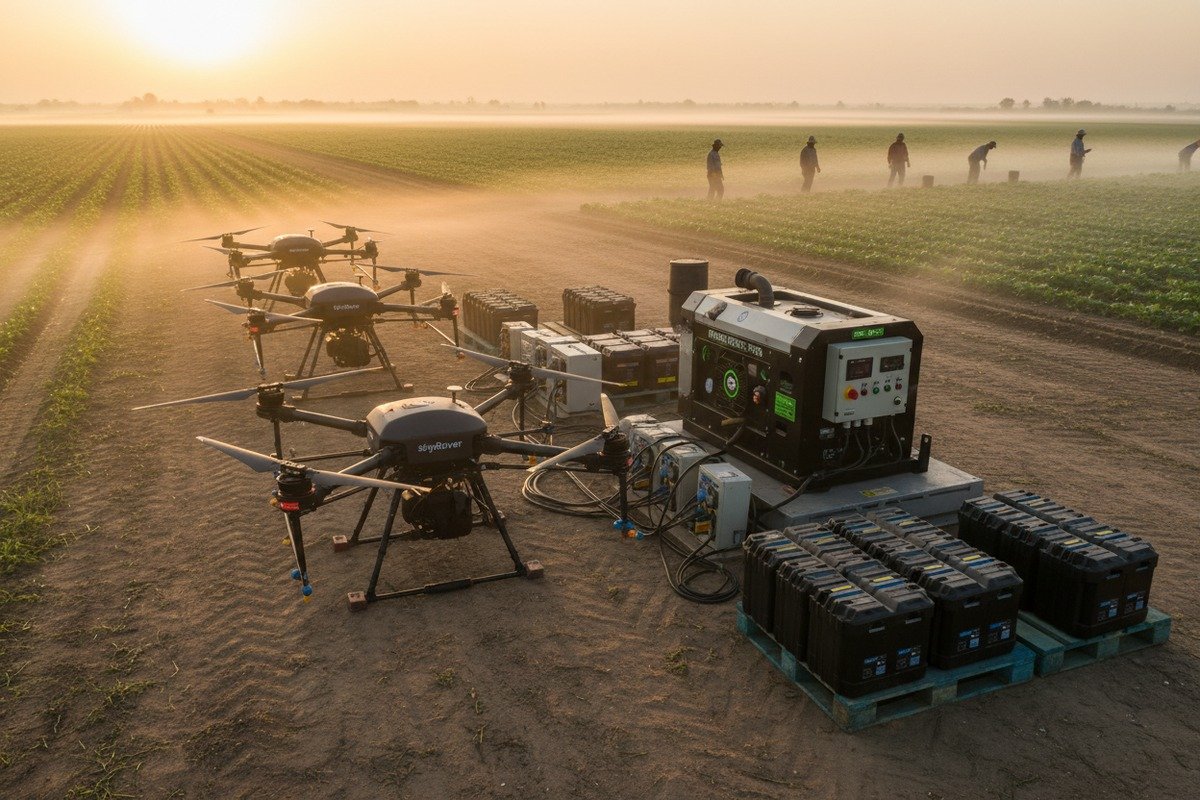
Understanding IP Ratings for Field Use
The Ingress Protection rating tells you how well your charging station resists dust and moisture. Agricultural environments are harsh. Grain dust, pesticide residue, humidity, and occasional rain all threaten electronics.
| تصنيف IP | Dust Protection | Water Protection | Field Suitability |
|---|---|---|---|
| IP54 | Limited dust ingress | Splash resistant | Light duty only |
| IP65 | Dust tight | Low pressure water jets | Moderate field use |
| IP67 | Dust tight | Immersion up to 1 meter | Heavy field use |
| IP68 | Dust tight | Continuous immersion | Industrial/marine |
For agricultural drone operations, we recommend IP67 minimum. This rating ensures dust cannot enter and brief rain exposure will not damage components.
Cooling System Verification
High-power charging generates significant heat. A 9000W charger can push temperatures above safe limits without proper cooling. When generators provide slightly inconsistent power, the AC-DC converter works harder and generates even more heat.
Check your station's cooling specifications:
- Active cooling (fans) versus passive cooling (heat sinks)
- Operating temperature range
- Thermal protection cutoff temperature
- Cooling system power consumption
Run a full charge cycle on a hot day with your generator. Use an infrared thermometer to check housing temperature. If it exceeds the manufacturer's rated maximum, you have a cooling problem.
Monitoring Charge Cycle Logs
Modern charging stations with Bluetooth connectivity log every charge cycle. These logs reveal patterns that indicate stress or degradation:
- Increasing charge times over weeks suggest internal component wear
- Frequent thermal protection triggers indicate cooling issues
- Voltage fluctuations during charging point to generator instability
- Current draw spikes may signal converter problems
Our stations provide this data through a smartphone app. Review logs weekly during heavy use seasons. Catching problems early prevents field failures.
Load Testing Protocol
Before trusting your setup in the field, run controlled tests:
- Connect charging station to generator
- Load with battery packs at 20-30% charge
- Run multiple consecutive fast charge cycles
- Monitor charge times, temperatures, and generator behavior
- Check for error messages or protection triggers
- Document results for warranty purposes
If your generator struggles or the charger behaves erratically during testing, you have found the problem before it strands you mid-field.
Warranty and Support Considerations
Verify that your manufacturer's warranty covers generator-powered operation. Some warranties exclude damage from power fluctuations or non-standard power sources. Get this in writing before deploying.
Also confirm parts availability and repair turnaround time. Our customers receive replacement components within 5-7 days to major markets. Longer wait times mean longer downtime during critical spray windows.
الخاتمة
Verifying generator compatibility with your agricultural drone charging station requires checking technical specifications, matching generator parameters, exploring custom solutions when needed, and testing durability under real field conditions. With proper verification, your fleet stays charged and productive throughout every spray season.
الحواشي
1. Explains the technology, construction, and applications of LiPo batteries. ︎
2. Provides a comprehensive explanation of IP codes, their meaning, and how they classify protection against solids and liquids. ︎
3. Details the characteristics, advantages, and applications of LiHV battery technology. ︎
4. Provides a detailed overview of BMS functions, topologies, and protection mechanisms. ︎
5. Explains the global variations in AC voltage and frequency standards. ︎
6. Explains what an inverter generator is, how it works, and its benefits for sensitive electronics. ︎
7. Explains what a pure sine wave inverter is, its benefits, and how it differs from modified sine wave inverters. ︎
8. Explains the basic principles, components, and applications of AC-DC converters. ︎

 English
  Spanish
  German
  French
  Dutch
Dutch  Arabic
