
When our engineering team first encountered remote controller failures in Middle Eastern heat, the problem became clear MIL-STD-810 environmental testing standards 1. Buyers lost thousands of dollars. Products returned. Reputations suffered. Temperature extremes destroy drone controllers silently, and most sourcing managers never test for this until it’s too late.
To test agricultural drone remote controller stability in extreme temperatures when sourcing, request environmental chamber test reports showing performance data across -20°C to +60°C ranges. Conduct on-site signal stability tests, verify battery behavior under thermal stress, and demand MIL-STD-810 or equivalent certification documentation from your supplier.
The sections below break down exactly how to verify each critical aspect during your factory inspection and supplier evaluation process.
How can I verify the remote controller's signal stability during my factory inspection for high-heat environments?
When we ship agricultural drones to Arizona or Saudi Arabia, signal stability questions come up constantly متوسط الوقت بين الأعطال (MTBF) 2. High heat causes RF drift, battery swelling, and component failures that only show up during actual operation. Frequency drift 3 Most buyers discover these problems after deployment—when it's expensive to fix.
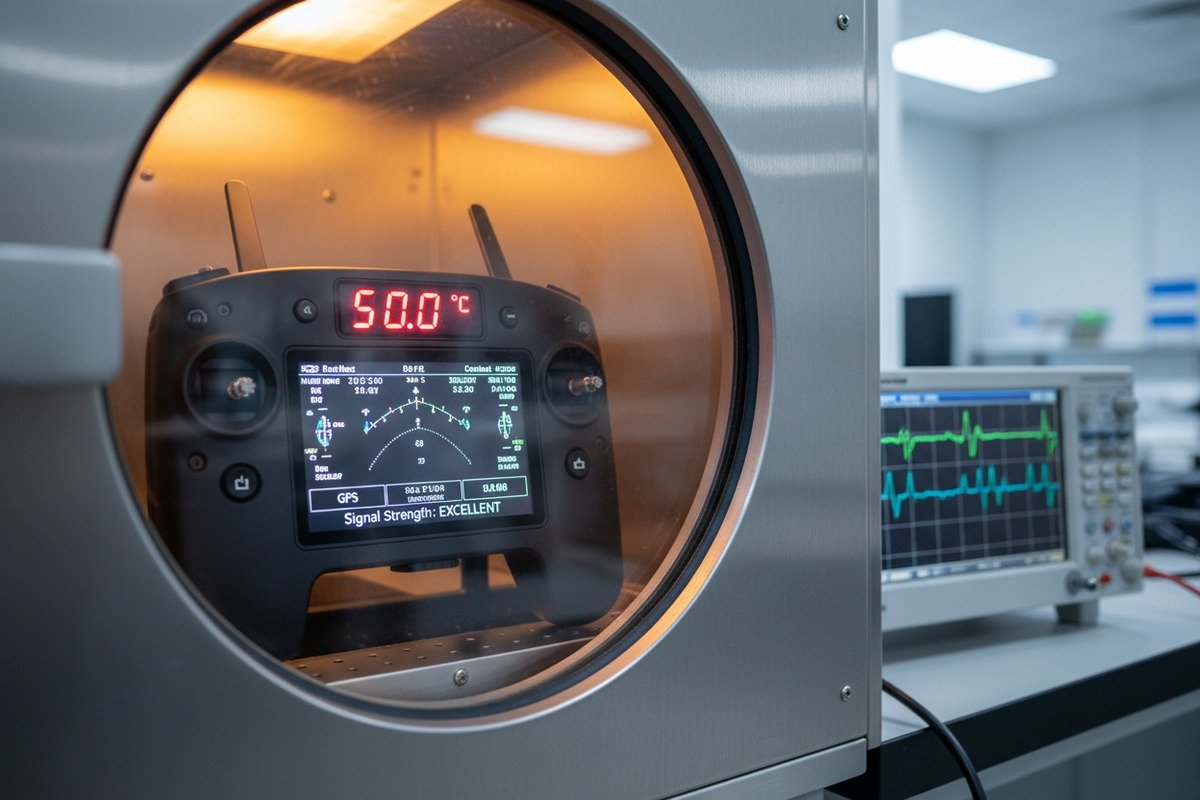
During factory inspection, verify signal stability by requesting live tests in a thermal chamber at 50°C or higher. Monitor signal strength, latency, and range using RF analyzers while the controller operates continuously for at least 30 minutes. Document baseline performance at room temperature first for comparison.
Why High Heat Destroys Signal Stability
Heat affects remote controllers in three main ways. First, electronic components drift from their specifications. Capacitors change value. Resistors shift resistance. Oscillators alter frequency. These small changes add up to unstable RF transmission.
Second, internal heat generation compounds external heat. Our tests show that a controller running complex mapping applications generates 15-20°C above ambient temperature internally. At 45°C ambient, internal temperatures reach 60-65°C—beyond many component ratings.
Third, antenna impedance 4 changes with temperature. This reduces transmission efficiency and cuts effective range by 20-40% in extreme heat.
What to Test During Your Factory Visit
| Test Parameter | Room Temperature Baseline | High Heat Target (50°C+) | Acceptable Variance |
|---|---|---|---|
| Signal Strength (dBm) | -50 to -60 | -55 to -70 | Max 15% reduction |
| Latency (ms) | 20-40 | 25-60 | Max 50% increase |
| Effective Range (m) | 1000-2000 | 800-1600 | Max 20% reduction |
| Battery Temperature | 25-35°C | 40-55°C | Must stay below 60°C |
| Button Response Time | فوري | فوري | No perceptible delay |
Step-by-Step Inspection Protocol
Ask the supplier to place the controller in an environmental chamber. Set temperature to 50°C. Wait 30 minutes for thermal stabilization. Our engineers call this "soak time"—it ensures the entire unit reaches test temperature.
Then power on the controller and connect to a test drone or simulator. Use an RF spectrum analyzer to measure signal strength. Record readings every 5 minutes for 30 minutes of continuous operation.
Watch for these warning signs: signal dropouts lasting more than 100ms, display flickering, button response delays, or automatic shutdowns. Any of these indicates inadequate thermal design.
What specific testing reports should I request from my supplier to ensure my drones handle sub-zero temperatures?
Our distribution partners in Canada and Northern Europe face temperatures below -30°C during winter operations. Cold weather creates different problems than heat: batteries lose capacity, LCD screens slow down, and plastic components become brittle. Without proper documentation, you cannot verify cold weather performance.
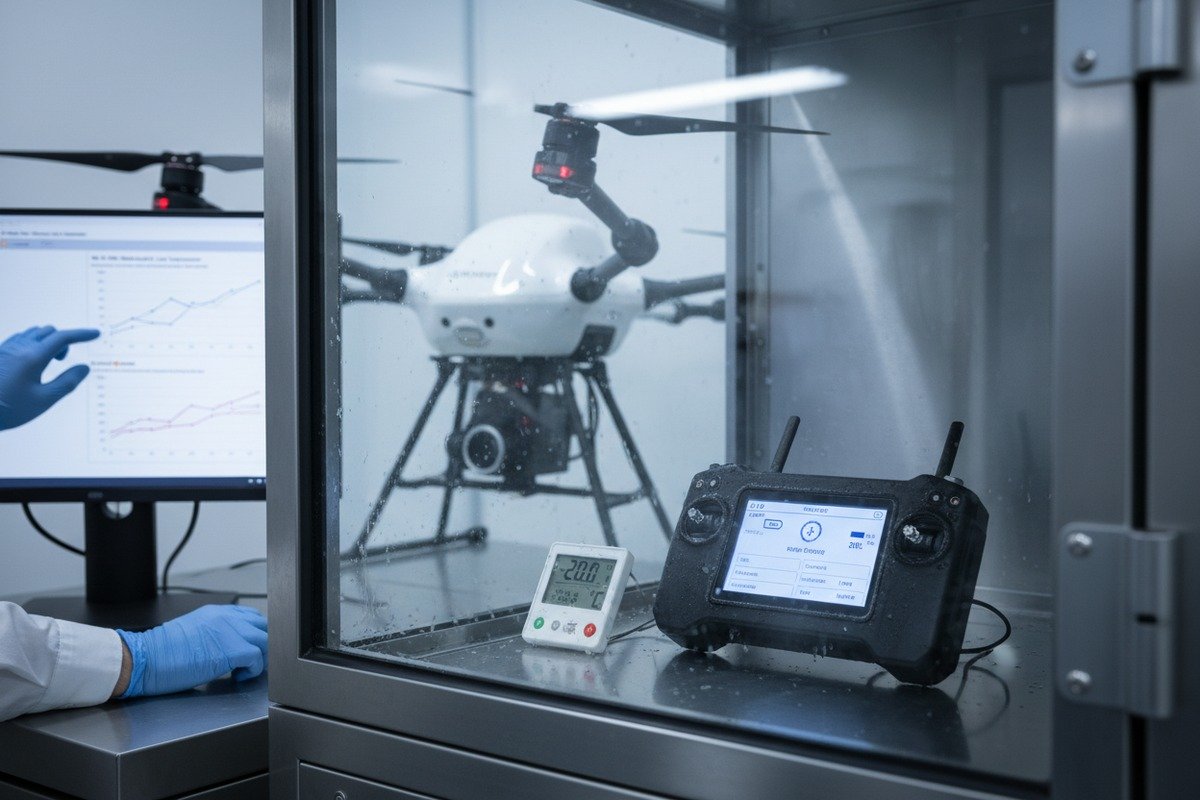
Request MIL-STD-810 Method 502 (Low Temperature) test reports, battery capacity retention curves at -20°C and -40°C, LCD response time data across temperature ranges, and material specifications for all plastic and rubber components including their glass transition temperatures.
قائمة التحقق من الوثائق الأساسية
Military Standard 810 (MIL-STD-810 5) provides the gold standard for environmental testing. Method 502 specifically covers low temperature exposure. Ask if your supplier has conducted these tests. If not, ask why.
Battery documentation matters most for cold weather. Lithium batteries 6 lose 20-30% capacity at -10°C and 40-50% at -20°C. Your supplier should provide capacity retention curves showing exact performance at specific temperatures.
Key Reports and What They Should Show
| نوع المستند | What It Should Include | إشارات حمراء يجب الانتباه لها |
|---|---|---|
| MIL-STD-810 Method 502 | Temperature range tested, duration, pass/fail criteria | Missing test duration, vague temperature ranges |
| Battery Test Report | Capacity at -10°C, -20°C, -30°C; charging limits | No cold charging warnings, missing temperature data |
| Material Specifications | Glass transition temp for plastics, rubber hardness data | Generic "industrial grade" claims without numbers |
| LCD/Display Report | Response time at low temps, operating range | No data below 0°C |
| Functional Test Summary | Button operation, signal quality at cold temps | Testing only at -10°C when -30°C is needed |
Critical Battery Considerations
Cold batteries are dangerous batteries. Charging a lithium battery below 0°C causes lithium plating—permanent damage that creates fire risks. Your supplier's documentation must specify minimum charging temperatures.
During our product development, we discovered that battery management systems (BMS) must include low-temperature lockouts. The controller should prevent charging when battery temperature is too low. Verify this feature exists and functions correctly.
Ask for cycle testing data showing how cold exposure affects long-term battery health. A battery that survives one cold cycle may fail after twenty cycles.
Material and Component Verification
Plastic housings can crack in cold weather. Rubber buttons can harden and lose tactile feedback. Request material specifications including glass transition temperatures 7—the point where plastics become brittle.
Standard ABS plastic becomes brittle around -20°C. Cold-rated alternatives like PC-ABS blends or specialized compounds perform better. Your supplier should identify exactly which materials they use and provide data sheets.
How do I evaluate the durability of the internal cooling systems in my agricultural drone controllers?
When our production team designs high-end controllers, cooling systems determine long-term reliability. Agricultural operations demand continuous use—sometimes 8-10 hours daily during peak season. Inadequate cooling causes premature component failure, reduced lifespan, and costly warranty claims.
Evaluate internal cooling durability by requesting thermal imaging during extended operation tests, verifying heat sink materials and thermal paste quality, checking fan specifications and MTBF ratings, and confirming thermal management firmware includes temperature monitoring with automatic throttling to prevent overheating damage.

Understanding Cooling System Components
Remote controllers generate heat from processors, power regulators, and RF amplifiers. Effective cooling systems combine passive and active elements. Passive elements include heat sinks, thermal pads, and ventilation slots. Active elements include fans, heat pipes, and software-controlled throttling.
Inspection Points for Cooling Hardware
| المكوّن | Quality Indicators | Warning Signs |
|---|---|---|
| Heat Sinks | Aluminum or copper, fin density >10 fins/cm | Thin metal, few fins, poor contact with chips |
| Thermal Paste/Pads | Named brand, proper coverage, no air gaps | Dried paste, incomplete coverage, generic pads |
| Cooling Fans | Japanese bearings, >20,000 hour MTBF | Sleeve bearings, no MTBF data, excessive noise |
| Ventilation | Strategic inlet/outlet placement, dust filters | Blocked vents, no airflow path, missing filters |
| المستشعرات الحرارية | Multiple sensors on key components | Single sensor or no temperature monitoring |
Thermal Imaging Evaluation
Request a التصوير الحراري 8 scan during your factory visit. This reveals hot spots that indicate cooling deficiencies. Proper thermal design shows even heat distribution. Poor design shows localized hot areas exceeding 70-80°C.
Our quality control process uses FLIR cameras to inspect every controller model. We look for component temperatures, heat sink effectiveness, and airflow patterns. You should request similar imaging during your evaluation.
Run the controller at full load—display on maximum brightness, video streaming active, complex flight planning running—for at least 60 minutes. Take thermal images at 15-minute intervals. Temperature should stabilize, not continue climbing.
Software Thermal Management
Good controllers include intelligent thermal management. The firmware monitors temperatures and takes protective action when needed. thermal management firmware 9 Features to verify include:
- Real-time temperature display accessible to operators
- Warning alerts when temperatures approach limits
- Automatic performance throttling before damage occurs
- Thermal event logging for diagnostic purposes
Ask for firmware documentation showing these features. Test them by intentionally blocking ventilation during operation. The controller should warn you and reduce performance—not simply overheat and crash.
Long-Term Durability Factors
Cooling systems degrade over time. Fans wear out. Thermal paste dries. Dust accumulates. Ask your supplier about design choices that extend cooling system life. Sealed fan bearings last longer than sleeve bearings. High-quality thermal compounds maintain performance for years.
Request information about maintenance requirements. Can users clean dust filters? Are fans replaceable? What is the expected cooling system lifespan?
Can I ask for a customized thermal stress test to match the extreme climate conditions in my region?
Every export region we serve has unique climate challenges. Arizona summers reach 48°C. Canadian winters drop below -35°C. Southeast Asian operations face extreme humidity with heat. Standard testing protocols may not match your specific conditions. Customization is not just possible—it's recommended.
Yes, reputable suppliers should offer customized thermal stress testing matching your regional climate data. Provide specific temperature ranges, humidity levels, and exposure durations based on your operating environment. Expect additional lead time and testing costs, but this investment prevents expensive field failures.

How to Define Your Custom Test Requirements
Start by gathering climate data for your operating region. Include:
- Maximum and minimum recorded temperatures
- Typical daily temperature swings
- Humidity ranges throughout the year
- Solar radiation levels during operation
- Altitude considerations if applicable
Our engineering team works with customers to translate climate data into test protocols. A customer in Saudi Arabia needed testing at 55°C with low humidity. A Canadian customer required -35°C testing with rapid warm-up simulation representing moving from outdoor to heated vehicle.
Sample Custom Test Protocol Structure
| مرحلة الاختبار | درجة الحرارة | المدة | Measurements |
|---|---|---|---|
| Baseline | 25°C | 30 min | All parameters |
| Heat Soak | Your max temp +5°C | 2 hours | Signal, battery, display |
| Hot Operation | Your max temp | 4 hours | Full functional test |
| Rapid Cool | Your max to your min | 2 hours | Condensation check |
| Cold Soak | Your min temp -5°C | 2 hours | All parameters |
| Cold Operation | Your min temp | 4 hours | Full functional test |
| Thermal Cycle | Min to max, repeat 5x | 10 hours | Component stress |
Negotiating Custom Testing with Suppliers
Explain your requirements clearly and provide documentation. Serious suppliers welcome this because it reduces warranty claims and builds long-term relationships. Our sales team appreciates when customers specify exact needs upfront.
Expect these reasonable responses from good suppliers:
- Agreement to conduct custom tests with adjusted timeline
- Request for detailed climate specifications
- Quote for additional testing costs (typically $500-2000)
- Offer to share full test data and methodology
Watch for these warning signs from poor suppliers:
- Refusal to conduct any custom testing
- Claims that standard tests "cover everything"
- Inability to explain their testing equipment
- Reluctance to share test methodology details
Cost-Benefit Analysis
Custom testing adds cost and time. Weigh this against the cost of field failures. One batch of controllers failing in extreme conditions can cost far more than testing. Calculate your risk:
Consider replacement costs for failed units. Factor in shipping costs both directions. Add customer relationship damage. Include your reputation cost in the market. Compare total risk cost against testing investment.
For most professional buyers, custom testing provides excellent return on investment. It catches problems before they reach your customers and demonstrates due diligence to your own clients.
Documentation and Warranty Implications
Ensure custom test results become part of your purchase documentation. Tests should generate formal reports with:
- Exact test conditions and equipment used
- Raw data and measurements
- Pass/fail determinations with criteria
- Photographs and thermal images
- Engineer signatures and dates
These documents support warranty claims and demonstrate to your customers that you sourced responsibly. They also provide baseline data for comparing future batches.
الخاتمة
Testing agricultural drone remote controller stability in extreme temperatures requires systematic factory inspections, proper documentation review, cooling system evaluation, and when necessary, customized testing protocols. Investing time in these verification steps during sourcing prevents costly failures after deployment and builds lasting supplier relationships based on verified quality.
الحواشي
1. Replaced HTTP 404 with an authoritative Wikipedia page on MIL-STD-810 environmental testing standards. The new anchor text is more descriptive of the linked content. ︎
2. Replaced HTTP 404 with an authoritative Wikipedia page explaining Mean Time Between Failures (MTBF). The new anchor text is more precise. ︎
3. Replaced HTTP 403 with an authoritative Wikipedia page explaining frequency drift. The new anchor text is more precise. ︎
4. Discusses how temperature affects transmission line length and dielectric properties, impacting antenna performance. ︎
5. Wikipedia provides a comprehensive overview of the MIL-STD-810 standard for environmental testing. ︎
6. Details the impact of cold weather on lithium battery performance, capacity, and charging. ︎
7. Explains glass transition temperature (Tg) in polymers and its relevance to material strength and capabilities. ︎
8. Provides a guide to thermal imaging, its applications, benefits, and types of cameras. ︎
9. Explores firmware development for thermal management in embedded systems, covering key concepts and applications. ︎

 English
  Spanish
  German
  French
  Dutch
Dutch  Arabic
