
When our engineering team first tested طائرات بدون طيار لمكافحة الحرائق 1 in extreme heat conditions, we watched a $15,000 drone fall from the sky mid-mission because of poor battery planning.
To plan your spare battery ratio when sourcing firefighting drones from China, calculate total daily flight hours, divide by single battery flight time, then add 30-50% redundancy. Most operations need 4-6 batteries per drone for standard missions and 8-10 for extended 24-hour firefighting scenarios.
This guide walks you through the exact calculations, charging considerations, import logistics, and maintenance protocols you need to build a reliable battery inventory لوائح اتحاد النقل الجوي الدولي (IATA) 2. Let’s dive into the details that will keep your firefighting fleet in the air when it matters most.
How do I calculate the optimal battery-to-drone ratio for my firefighting operations?
Our production floor sees thousands of battery packs shipped monthly, and the most common mistake buyers make is underestimating their actual spare battery needs for real firefighting conditions.
Calculate your optimal battery-to-drone ratio using this formula: (Total mission hours × 60) ÷ flight time per battery + charging cycles needed, then multiply by 1.3-1.5 for safety redundancy. A typical 8-hour operation with 35-minute batteries requires 5-6 spares per drone minimum.
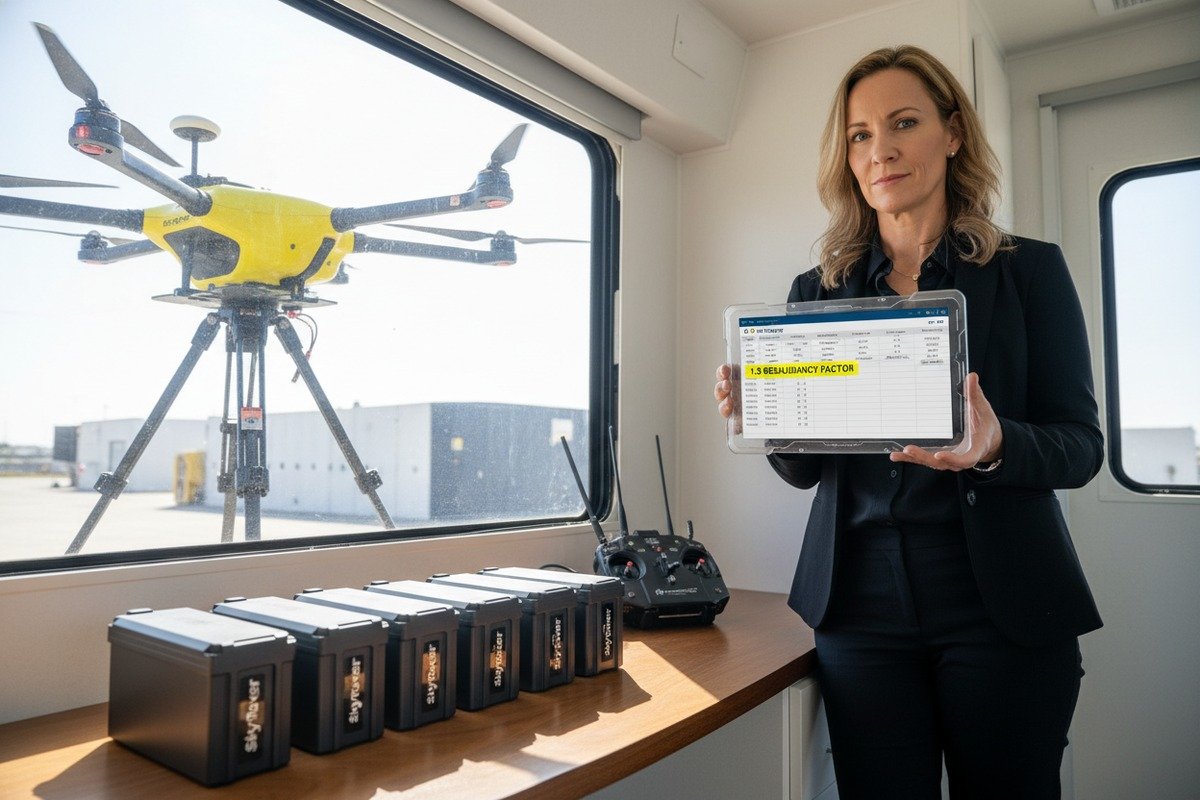
Understanding the Core Variables
The battery-to-drone ratio depends on several interconnected factors. Flight duration per battery varies widely based on payload weight, weather conditions, and proximity to fire heat. Our testing shows that firefighting drones carrying الكاميرات الحرارية 3 and fire suppressant payloads typically achieve 29-40 minutes per charge, compared to 45-55 minutes for surveillance-only configurations.
Mission duration is your starting point. A standard wildfire response might require 8-12 hours of continuous coverage. Extended incidents can demand 24-hour or multi-day operations. Each scenario needs different planning approaches.
Step-by-Step Calculation Method
Here is a practical calculation framework:
| متغير | Example Value | الملاحظات |
|---|---|---|
| Daily operation hours | 10 hours | Total coverage time needed |
| Flight time per battery | 35 minutes | With firefighting payload |
| Recharge time | 45 minutes | Using 2C charging rate |
| Number of drones | 3 | Active fleet size |
| Redundancy factor 4 | 1.4 | 40% safety buffer |
Using these values: (10 × 60) ÷ 35 = 17.1 flight cycles needed per day. With 45-minute recharge times, each battery can complete approximately 8 cycles in 10 hours (accounting for cooling time between charges). So you need at least 3 batteries per drone for continuous operation. Adding the 1.4 redundancy factor: 3 × 1.4 = 4.2, rounded up to 5 batteries per drone.
For a 3-drone fleet, that means 15 batteries minimum. However, our experience supplying fire departments across Europe and North America shows that 6 batteries per drone provides better operational flexibility.
Payload Weight Considerations
Heavier payloads drain batteries faster. A drone carrying a 10kg fire suppressant tank will see 20-30% reduced flight time compared to the same drone with only imaging equipment.
| نوع الحمولة | Typical Weight | Flight Time Impact | Recommended Extra Batteries |
|---|---|---|---|
| Thermal camera only | 0.5-1kg | Baseline | Standard ratio |
| Dual camera system | 1.5-2kg | -10% flight time | +1 per drone |
| Fire suppressant tank | 8-12kg | -25-35% flight time | +2 per drone |
| Combined payload | 10-15kg | -30-40% flight time | +3 per drone |
When we design custom battery packs for heavy-lift firefighting drones, we typically recommend higher capacity cells 5 (28-30Ah) despite their increased weight (up to 13,800g) because the extended flight time outweighs the agility trade-off for firefighting applications.
How will the charging speed of my drones influence the number of spare batteries I should buy?
When we first started offering fast-charging battery systems five years ago, customers were skeptical. Now, charging infrastructure planning has become as important as the drones themselves.
Fast charging at 4C-5C rates (10-15 minutes to 95%) can reduce your spare battery needs by 40-50% compared to standard 1C charging (60+ minutes). However, frequent fast charging shortens battery lifespan by 20-30%, so balance speed against long-term cost and plan for earlier replacement cycles.

Charging Rate Impact Analysis
Charging speed 6 fundamentally changes your operational math. A battery that takes 60 minutes to charge at 1C rate can only complete 6-7 full cycles in an 8-hour operation. The same battery charged at 4C completes the process in 15 minutes, potentially allowing 20+ cycles.
But there are trade-offs. Our quality control data from returned batteries shows that units subjected to regular 4C charging reach 80% capacity (the typical retirement threshold) after 400-500 cycles. Standard 1C-charged batteries from the same production batch typically last 800-1000 cycles.
Charging Infrastructure Planning
Your charging setup directly impacts how many batteries you need on hand at any moment.
| Charging Configuration | Charge Time (30-95%) | Batteries Needed per Drone | الأفضل لـ |
|---|---|---|---|
| Single 1C charger | 50-60 minutes | 6-8 | Budget operations, light use |
| Dual 2C chargers | 25-30 minutes | 4-5 | Standard professional use |
| Multi-port 4C station | 10-15 minutes | 3-4 | High-intensity continuous ops |
| Mobile charging hub with generator | 15-20 minutes | 3-4 | Remote wildfire deployment |
We've shipped complete charging hub solutions to fire departments in California and Australia. These mobile units include 6-port parallel chargers with smart balancing circuits that bring batteries from 30% to 95% in under 12 minutes while maintaining cell balance.
Battery Health vs. Operational Speed
The charging rate debate in the industry remains unresolved. Some operations prioritize speed and accept shorter battery lifespans as a cost of doing business. Others invest in more batteries upfront and use conservative charging to extend replacement cycles.
Our recommendation based on total cost of ownership: use 2C charging as your standard rate. It provides a reasonable 25-30 minute charge time while preserving 70-80% of potential battery lifespan compared to 1C charging. Reserve 4C capability for genuine emergencies.
For a fleet of 5 drones with 5 batteries each (25 total), choosing 4C over 2C charging might let you operate with only 15 batteries instead. But you'll replace those 15 batteries twice in the time the 25-battery fleet needs one replacement cycle. The math often favors more batteries with slower charging.
Smart Charger Features Worth Paying For
When sourcing from Chinese suppliers, look for chargers with these capabilities:
Cell balancing to 4.10V per cell extends lifespan significantly—our testing shows a 40-60% improvement in cycle count. Real-time temperature monitoring prevents charging batteries that are still hot from use. Bluetooth or WiFi connectivity allows remote monitoring of charging status across multiple stations. Storage mode automatically stops charging at 60% for batteries not needed immediately.
What logistics and customs challenges will I face when importing spare drone batteries from China?
Our export team processes battery shipments daily, and we've learned that what seems like simple logistics can become a major headache without proper preparation.
Importing spare drone batteries from China requires UN38.3 certification, proper Class 9 dangerous goods documentation, and compliance with IATA regulations for air freight. Ground shipping is often more reliable than air for large battery quantities. Expect 15-30% higher shipping costs compared to non-hazardous cargo.

Classification and Documentation Requirements
Lithium batteries fall under Class 9 dangerous goods 7 for international transport. This classification triggers a cascade of documentation requirements that many first-time importers underestimate.
Every battery shipment needs UN38.3 test summary documentation proving the cells passed altitude simulation, thermal cycling, vibration, shock, external short circuit, impact, overcharge, and forced discharge tests. Reputable Chinese suppliers like our facility maintain these certifications and can provide documentation on request. Be wary of suppliers who hesitate or cannot produce current UN38.3 reports.
Shipping Method Comparison
| Shipping Method | وقت العبور | عامل التكلفة | Battery Quantity Limits | الأفضل لـ |
|---|---|---|---|---|
| Air freight (cargo) | 5-7 days | 2.5-3x base rate | Limited per package (varies by airline) | Urgent small shipments |
| Ocean freight (FCL) | 25-35 days | 1x base rate | Full container allowed | Large orders, price-sensitive |
| Ocean freight (LCL) | 30-40 days | 1.3x base rate | Pallet quantities | Medium orders |
| Rail freight (China-Europe) | 18-22 days | 1.5x base rate | Good capacity | European buyers |
Air freight restrictions on lithium batteries have tightened significantly. Many airlines refuse lithium shipments entirely, and those that accept them impose strict quantity limits per package. Our experience shows ocean freight is more reliable for orders exceeding 20 battery units.
Customs Entry Considerations
In the United States, drone batteries may require additional documentation beyond standard dangerous goods paperwork. The FCC cares about any integrated electronics in smart battery packs. If your batteries include Bluetooth BMS communication modules, ensure they have FCC compliance documentation.
The EU requires CE marking on battery packs and adherence to the Battery Directive 8 regarding hazardous substance content and recycling provisions. We include all necessary compliance documentation with every shipment to EU countries.
Working with Chinese Suppliers on Export Documentation
Clear communication about your destination country's requirements prevents delays. When we prepare export documentation, we need to know:
Your specific port of entry (requirements vary by customs district). Whether you're using a customs broker or self-clearing. Any special certifications required for government contracts. Your preferred shipping carrier (we have established relationships with DHL, FedEx, and several freight forwarders who specialize in dangerous goods).
Avoiding Common Pitfalls
Some suppliers ship batteries with inadequate packaging to save costs. Proper packaging for lithium batteries includes inner boxes with fire-retardant material, outer cartons meeting UN specifications, and correct labeling on all sides. Improperly packaged shipments get rejected at origin airports or seized at destination customs.
Request photos of your packaged shipment before it leaves the facility. Our standard practice includes sending customers images of labeled boxes and a copy of the completed shipping documents.
How can I ensure my spare battery inventory remains reliable under high-intensity firefighting conditions?
We've tracked battery performance data from firefighting operations across three continents, and the difference between well-maintained and poorly maintained inventories is dramatic—sometimes the difference between mission success and equipment failure.
Maintain reliable battery inventory by storing at 40-60% charge in temperature-controlled environments (15-25°C), implementing weekly capacity checks, rotating stock to equalize wear, and retiring batteries at 20% capacity loss or 200 cycles. Use BMS data logging to identify degrading units before they fail in the field.

Storage Best Practices
How you store batteries between missions significantly impacts their readiness and longevity. Our quality assurance team has documented the following guidelines based on returned battery analysis:
Temperature is critical. Batteries stored above 30°C degrade faster even when not in use. Storing below 10°C can damage cells over time. The ideal range is 15-25°C with moderate humidity.
State of charge matters for storage. Fully charged batteries (4.2V per cell) sitting unused degrade faster than those stored at 3.8V per cell (roughly 50% charge). We recommend charging to full only within 24 hours of planned use.
Maintenance Schedule Framework
| مهمة الصيانة | التردد | الغرض | Action Threshold |
|---|---|---|---|
| Visual inspection | Before each use | Detect physical damage | Any swelling, dents, connector damage |
| Full charge/discharge cycle | شهرياً | Calibrate BMS readings | Capacity below 85% of rated |
| Internal resistance test | ربع سنوي | Detect cell degradation | >20% increase from baseline |
| Capacity verification | ربع سنوي | Track usable capacity | <80% of original rating |
| BMS firmware update | As released | Maintain protection features | Update within 30 days |
Interpreting BMS Data
Modern battery management systems provide extensive data about battery health. Our battery packs include I2C and Bluetooth communication options that report state of charge, state of health, cell voltage balance, temperature history, and cycle count.
State of health (SOH) below 80% indicates retirement time. Cell voltage imbalance exceeding 0.05V after balancing suggests a weak cell that may fail under high-current discharge. Temperature history showing repeated exposure above 60°C correlates with accelerated degradation.
Field Rotation Strategy
In high-intensity operations, rotating which batteries get used prevents premature wear on a subset of your inventory. Label batteries with unique identifiers and log each use cycle. Our customers who implement strict rotation protocols report 25-35% longer average battery life across their fleets.
Consider a "hot standby" approach: keep 30% of your battery inventory fully charged and ready for immediate deployment while the remainder stays at storage charge. Rotate which batteries fill the hot standby role weekly.
Heat Exposure Management
Firefighting brings batteries near extreme temperatures. Radiant heat from active fires can push battery temperatures above safe thresholds even during flight. Our batteries include thermal protection that reduces output above 60°C and shuts down at 65°C to prevent thermal runaway.
After heat-exposed flights, allow batteries to cool to ambient temperature before recharging. Our BMS logs maximum temperature reached during each flight—review this data to identify batteries that experienced thermal stress and prioritize them for inspection.
When to Retire Batteries
The industry standard retirement threshold is 80% of original capacity or visible degradation signs. For firefighting applications where reliability is critical, we recommend more conservative standards:
Retire at 85% capacity for primary response batteries. Move batteries between 80-85% to training or low-priority use. Immediately retire any battery that has experienced thermal runaway protection activation, physical damage, or cell imbalance that persists after multiple balance cycles.
الخاتمة
Planning your spare battery ratio requires balancing calculation formulas against real-world variables like charging infrastructure, import logistics, and maintenance capacity. Start with 5-6 batteries per drone for standard operations, adjust based on your charging capabilities and mission intensity, and invest in proper storage and maintenance protocols to protect your investment.
الحواشي
1. Wikipedia article on drones in wildfire management, an authoritative source. ︎
2. Outlines the International Air Transport Association’s rules for lithium battery shipments. ︎
3. Explains the critical role of thermal cameras in drone-based firefighting. ︎
4. Defines the engineering concept of redundancy for system reliability. ︎
5. Discusses the characteristics and benefits of higher capacity lithium-ion cells. ︎
6. Explores how charging speed affects lithium-ion battery health and performance. ︎
7. Describes the classification of lithium batteries as hazardous materials for transport. ︎
8. Explains the European Union’s legislation concerning batteries and their environmental impact. ︎
9. Explains the mandatory international safety standard for shipping lithium batteries. ︎

 English
  Spanish
  German
  French
  Dutch
Dutch  Arabic
