

When our engineering team first tested hot-swap systems under simulated wildfire conditions 1, we discovered that not all solutions perform equally when it matters most. Many procurement managers 2 have faced the frustration of purchasing drones that claim hot-swap capability, only to find sensors rebooting mid-mission or software crashing during battery changes. This gap between marketing claims and field reality can cost lives during critical firefighting operations.
To evaluate battery hot-swapping for firefighting drones, you must verify continuous power delivery during swaps, test thermal performance under high temperatures, assess mechanical durability of swap mechanisms, and confirm manufacturer support for integration. Focus on swap latency, BMS specifications, cycle life ratings, and field-charging compatibility.
This guide breaks down the exact technical benchmarks 3 and verification methods you need. We will cover sensor continuity testing, thermal reliability standards, hardware longevity concerns, and OEM documentation requirements based on our manufacturing experience and field feedback from fire departments.
How do I verify that a drone's hot-swap system will actually keep my sensors and software running during a battery change?
Our production line tests every hot-swap module through over 500 simulated exchanges before shipment. Yet we still receive questions from procurement teams burned by competitors whose drones dropped thermal imaging feeds 4 during battery changes. The problem is real, and verification requires more than trusting spec sheets.
Verify hot-swap continuity by demanding live demonstrations where you monitor sensor feeds and software status during swaps. Require the manufacturer to show near-zero power interruption using oscilloscope readings. Test with your specific payloads attached, as different sensors have varying power-up sequences that may fail during brief gaps.
Understanding Power Continuity Architecture
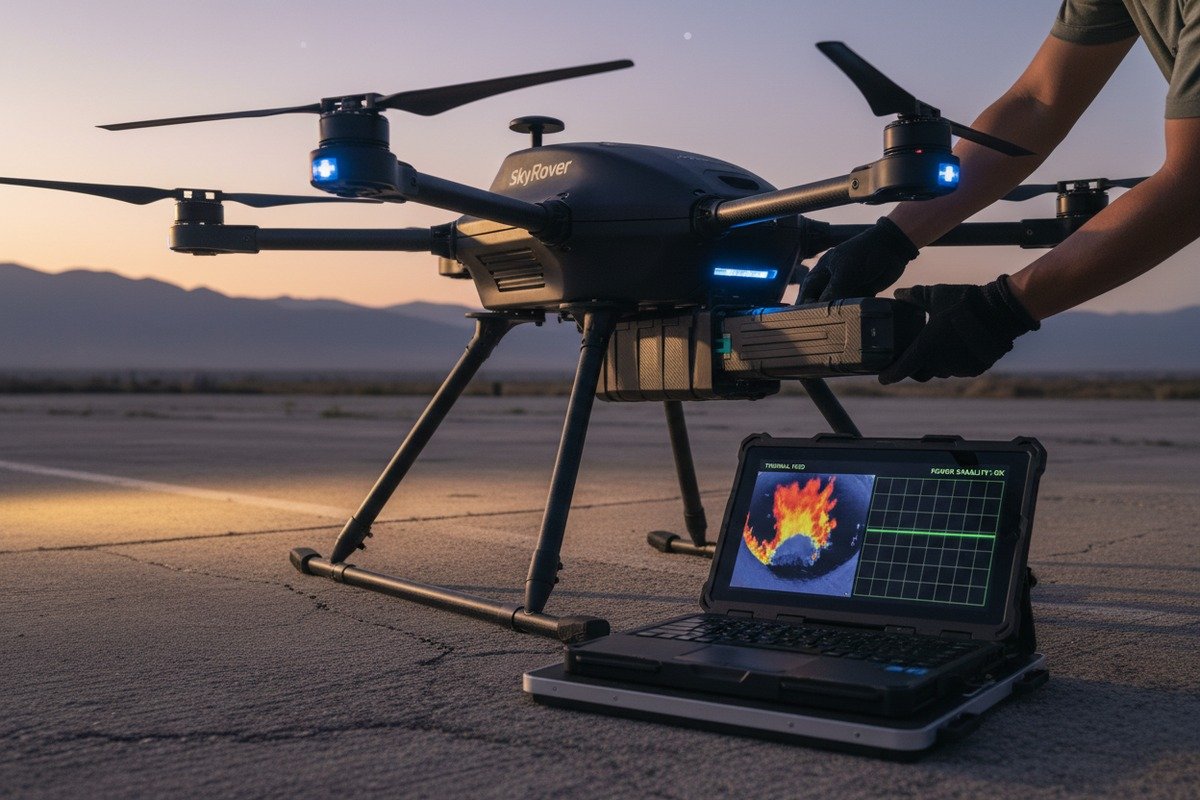
True hot-swap systems use dual-battery configurations where one battery maintains power while the other is replaced. This differs from quick-swap systems that still require a brief shutdown. During our development process, we found that even a 200-millisecond power gap can reset GPS modules and cause thermal cameras to require recalibration.
The key components include:
- Primary power rail that stays active during swaps
- Capacitor banks that buffer momentary transitions
- Intelligent switching circuits that manage handoff timing
Testing Protocol for Procurement Teams
| Test Type | What to Monitor | Pass Criteria | Equipment Needed |
|---|---|---|---|
| Sensor Continuity | Video feed stability | Zero frame drops | Monitor + recording |
| GPS Lock | Position accuracy | No re-acquisition | Ground station software |
| Software State | Application status | No restarts | Diagnostic output |
| Power Rail | Voltage stability | <5% variation | Oscilloscope |
| Data Link | Telemetry stream | Continuous packets | Base station logs |
Request that manufacturers perform these tests with your specific payload configuration. Generic demonstrations using light payloads may hide problems that appear when running high-draw thermal imagers or multi-spectral sensors common in firefighting applications.
Critical Questions for Vendors
Ask vendors to provide oscilloscope captures showing voltage levels during battery transitions. Legitimate hot-swap systems maintain voltage above the minimum threshold for all connected devices throughout the exchange. Any dip below 18V for a typical 22V system indicates potential continuity issues.
Our engineers recommend testing in the following sequence:
- Power on with full sensor suite active
- Begin continuous data recording
- Execute three consecutive battery swaps
- Review recordings for any interruptions
If the vendor hesitates to perform live testing, consider this a red flag. Systems designed properly should demonstrate continuity without concern.
What technical benchmarks should I use to assess the reliability of hot-swapping in high-temperature firefighting scenarios?
When we ship drones to fire departments in Arizona and Southern California, thermal testing becomes non-negotiable. Our quality control team learned that mechanisms working perfectly at 25°C can fail catastrophically when ambient temperatures 5 exceed 45°C. Hot-swap reliability in firefighting demands specific thermal benchmarks.
Assess high-temperature reliability using these benchmarks: BMS thermal cutoff at 65°C minimum, battery chemistry rated for 60°C operation, mechanical tolerances tested at 50°C ambient, and connector ratings exceeding 100°C. Require documentation of thermal chamber testing and field trials in elevated temperature conditions.

Battery Management System Specifications
The BMS serves as the guardian against thermal runaway, which becomes especially dangerous near active fires. Key specifications to verify include:
| BMS Parameter | Minimum Requirement | Ideal Specification | Why It Matters |
|---|---|---|---|
| Continuous Current | 20A | 40-60A | Supports high-power payloads |
| Overcurrent Protection | 80A | 150-180A | Prevents damage during surges |
| Temperature Cutoff | 60°C | 65°C | Allows operation in hot zones |
| Cell Balancing | Passive | Active | Extends cycle life |
| Monitoring Protocol | Basic voltage | I2C/CAN with logging | Enables predictive maintenance |
Battery Chemistry Considerations
Not all lithium batteries 6 perform equally in firefighting environments. Our testing revealed significant differences:
LiFePO4 (Lithium Iron Phosphate)
- Superior thermal stability up to 70°C
- Lower energy density requires larger packs
- Excellent cycle life exceeding 2,000 cycles
- Best choice for extreme heat scenarios
NMC (Nickel Manganese Cobalt)
- Higher energy density for longer flights
- Requires more aggressive thermal management
- Thermal runaway risk increases above 55°C
- Suitable with robust BMS protection
Semi-Solid State (Emerging)
- Improved thermal tolerance
- Higher energy density than LiFePO4
- Limited commercial availability as of 2026
- Premium pricing but promising performance
Mechanical Durability Under Heat
Heat affects more than batteries. The swap mechanism itself must tolerate thermal expansion. We design our locking systems with the following tolerances:
- Connector pins rated for 10,000+ insertions at elevated temperatures
- Housing materials with low thermal expansion coefficients
- Sealing gaskets maintaining IP54 or better across temperature range
- Spring mechanisms tested for consistent tension hot and cold
Request documentation showing the mechanism was tested in thermal chambers, not just at room temperature. Failure to provide this data suggests inadequate testing for firefighting applications.
Field Validation Requirements
Laboratory testing provides baseline confidence, but real-world validation matters more. Ask vendors:
- Has this system been deployed in active wildfire support?
- Can you provide references from fire departments?
- What failures occurred during high-temperature operations?
- How were those failures addressed in current models?
Honest manufacturers share both successes and lessons learned. Evasive answers suggest limited field experience.
How can I confirm that the hot-swap mechanism won't lead to frequent hardware failures or expensive part replacements?
Our service department tracks every warranty claim, and mechanical wear 7 on swap mechanisms ranks among the top concerns from high-frequency users. When a fire department performs 50 swaps daily during fire season, components designed for occasional use fail rapidly. Confirming long-term reliability requires examining cycle ratings, replacement costs, and wear patterns.
Confirm mechanism durability by requiring cycle life documentation exceeding 5,000 swaps, examining replacement part availability and pricing, reviewing warranty terms specific to swap components, and inspecting physical samples for robust construction. Calculate total cost of ownership including anticipated part replacements over three to five years.

Cycle Life and Wear Patterns
Different components wear at different rates. Our engineering data shows typical wear patterns:
| Component | Expected Life (Cycles) | Failure Mode | Replacement Cost Range |
|---|---|---|---|
| Locking Pins | 8,000-12,000 | Wear/deformation | $50-150 |
| Electrical Connectors | 5,000-10,000 | Contact degradation | $100-300 |
| Guide Rails | 15,000+ | Scratching/binding | $75-200 |
| Spring Mechanisms | 10,000-15,000 | Fatigue/weakening | $25-75 |
| Sealing Gaskets | 2,000-4,000 | Compression set | $20-50 |
Note that sealing gaskets require most frequent replacement, especially in smoky environments where particulates accelerate wear.
Total Cost of Ownership Analysis
Smart procurement extends beyond purchase price. We help customers calculate five-year TCO:
Year 1: Purchase price + training + initial spares
Years 2-3: Replacement gaskets, possible connector refresh
Years 4-5: Major mechanism overhaul or replacement
Request from vendors:
- Published replacement part pricing
- Estimated replacement intervals
- Overhaul service availability and cost
- Trade-in programs for worn mechanisms
Some manufacturers offer mechanism refurbishment programs that significantly reduce long-term costs compared to full replacement.
Quality Indicators to Inspect
When examining physical samples, look for:
Connector Quality
- Gold-plated contacts resist corrosion
- Spring-loaded pins maintain consistent pressure
- Adequate contact surface area for current requirements
Mechanical Construction
- CNC-machined guides versus stamped parts
- Adequate material thickness at stress points
- Smooth operation without binding or play
Environmental Protection
- IP54 minimum for smoke resistance
- Sealed bearing surfaces
- Debris channels that direct particles away from contacts
Warranty and Support Considerations
Standard warranties often exclude "wear items," potentially leaving you responsible for significant costs. Negotiate specific coverage:
- Minimum 2-year coverage on swap mechanism
- Defined cycle count before wear exclusions apply
- Expedited replacement part shipping
- On-site repair options for high-volume users
Our experience shows that customers who negotiate these terms upfront save substantially over the equipment lifecycle.
Will my manufacturer offer the technical documentation and OEM support I need to integrate hot-swapping into my operations?
When we work with fire department procurement teams, documentation requests reveal which manufacturers genuinely support operational integration versus those simply selling hardware. Our technical writing team produces integration guides because we understand that a drone sitting unused due to training gaps delivers zero value. Proper OEM support transforms equipment into capability.
Confirm adequate OEM support by requiring complete technical documentation including integration guides, maintenance schedules, and troubleshooting procedures. Verify training availability, spare parts logistics to your region, and responsive technical support channels. Request references from similar organizations who have successfully integrated the system.
Essential Documentation Package
| Document Type | Purpose | Red Flag if Missing |
|---|---|---|
| Integration Manual | Step-by-step deployment guide | Suggests immature product |
| Maintenance Schedule | Preventive care requirements | Leads to unexpected failures |
| Troubleshooting Guide | Field problem resolution | Extended downtime during issues |
| Parts Catalog | Ordering replacements | Difficulty sourcing spares |
| Training Curriculum | Operator certification | Safety and efficiency gaps |
| API Documentation | Software integration | Limited automation potential |
Training Program Evaluation
Effective hot-swap operations require trained personnel. Evaluate training offerings:
Initial Training
- Duration: Minimum 4 hours for hot-swap specific procedures
- Format: Hands-on practice, not just video
- Location: On-site preferred for team training
- Certification: Documented competency verification
Ongoing Support
- Refresher training availability
- New operator onboarding resources
- Advanced troubleshooting courses
- Train-the-trainer programs
Our experience shows that departments investing in comprehensive training experience 60% fewer operational issues than those relying solely on documentation.
Technical Support Structure
Verify support accessibility before purchase:
- Response Time Guarantees: Mission-critical applications need 4-hour response during business hours
- Support Channels: Phone, email, and video call options
- Time Zone Coverage: Ensure support hours align with your operations
- Escalation Path: Access to engineering for complex issues
- Remote Diagnostics: Ability to troubleshoot via telemetry data
Spare Parts Logistics
For US-based fire departments, consider:
- Domestic warehousing for critical spares
- Expedited shipping options
- Emergency stock availability during fire season
- Pre-positioned inventory programs
We maintain regional distribution partnerships specifically to address the urgency firefighting operations demand. Ask potential vendors about their logistics infrastructure in your region.
Integration with Existing Systems
Modern fire departments integrate drones with incident command systems. Verify:
- Data format compatibility with existing software
- API availability for custom integration
- Compatibility with drone-in-a-box autonomous systems
- Fleet management software support
The goal is seamless integration, not a standalone tool requiring separate workflows.
Conclusion
Evaluating battery hot-swapping for firefighting drones requires testing power continuity, verifying thermal performance, assessing mechanical durability, and confirming manufacturer support. Use the benchmarks and verification methods outlined here to make informed procurement decisions that deliver reliable continuous operations.
Footnotes
1. EPA resource on wildfire conditions and environmental impacts. ↩︎
2. Wikipedia overview of procurement managers and their roles in organizations. ↩︎
3. Wikipedia entry for benchmarking, the process of comparing technical standards. ↩︎
4. Wikipedia entry for thermography, the technology behind thermal imaging feeds. ↩︎
5. PubMed study on how high ambient temperatures affect lithium battery performance. ↩︎
6. EPA guidelines on the safe handling and recycling of lithium batteries. ↩︎
7. ScienceDirect article discussing the mechanics and causes of mechanical wear. ↩︎
8. ISO standard for the preparation of technical documentation and instructions. ↩︎



 English
  Español de México
  Deutsch
  Français
  Русский
  العربية
Comments
No comments yet. Be the first to share your thoughts!
Leave a Comment